On this page: jump to a section
- 1. Overview
- 1.1 Scope
- 1.2 Key Assumptions
- 2. As-Is System Landscape
- 2.1 National platforms in current use
- 2.2 State, institution, and industry systems
- 2.3 Observed gaps in the current landscape
- 2.4 Positioning of the PM-SETU LMS
- 3. Business Requirements
- 3.1 LMS access and login journey
- 3.2 Learner / trainee user journey
- 3.3 Trainer / faculty user journey
- 3.4 ITI administrator user journey
- 3.5 SPV / Anchor Industry Partner user journey
- 3.6 Industry partner with existing LMS user journey
- 3.7 Content / knowledge partner user journey
- 3.8 Academic reviewer user journey
- 3.9 Model owner user journey
- 3.10 Integration administrator user journey
- 4. Functional System Requirements
- 4.1 Pillar 1: Course Management
- Functional Capabilities
- Acceptance Criteria
- Validation Rules
- Exception Management
- 4.2 Pillar 2: Content Delivery
- Functional Capabilities
- Acceptance Criteria
- Validation Rules
- Exception Management
- 4.3 Pillar 3: Assessment and Evaluation
- Functional Capabilities - Core Assessment
- Functional Capabilities - AI-Assisted Assessment Support
- Acceptance Criteria
- Validation Rules
- Exception Management
- 4.4 Pillar 4: Personalized and Adaptive Learning
- Functional Capabilities
- Acceptance Criteria
- Validation Rules
- Exception Management
- 4.5 Pillar 5: Learner Progress Tracking
- Functional Capabilities - Progress Tracking
- Functional Capabilities - AI Analytics and Prediction
- Acceptance Criteria
- Validation Rules
- Exception Management
- 4.6 Pillar 6: Certification and Badges
- Functional Capabilities
- Acceptance Criteria
- Validation Rules
- Exception Management
- 4.7 Pillar 7: Digital Identity and Credential Integration
- Functional Capabilities
- Acceptance Criteria
- Validation Rules
- Exception Management
- 4.8 Pillar 8: Student Lifecycle Dashboards and Management
- Functional Capabilities
- Acceptance Criteria
- Validation Rules
- Exception Management
- 4.9 Pillar 9: Interoperability and Integration
- Functional Capabilities
- Acceptance Criteria
- Validation Rules
- Exception Management
- 4.10 Pillar 10: AI Learning Assistance
- 4.10.1 Purpose and Scope
- 4.10.2 Functional Capabilities
- 4.10.3 AI Behavior, Data, and Human Control
- 4.10.5 Market Evidence Considered
- 4.11 Pillar 11: Skills and Career Intelligence
- 4.11.1 Purpose and Scope
- 4.11.2 Functional Capabilities
- 4.11.3 AI Behavior, Data, and Human Control
- 5. Solution Architecture
- 5.1 Data Layer
- 5.2 Platform Layer
- 5.2.1 AI Services
- 5.3 Integration and Interoperability Layer
- 5.4 User Access Layer
- 5.5 Technology Principles
- 6. Non-Functional Requirements
- 6.1 Performance requirements
- 6.2 Security requirements
- 6.3 Availability and disaster recovery requirements
- 6.4 Backup and data retention requirements
- 6.5 Audit logging and monitoring requirements
- 6.6 Accessibility and inclusion requirements
- 6.7 Compliance requirements
- 6.8 Artificial Intelligence Governance
- 6.8.1 AI Output Classification
- 6.8.2 Cross-Cutting Governance Controls
- 6.8.3 Regulatory and Standards References
- 6.8.4 Excluded and Deferred AI Capabilities
- 6.8.5 Basis for the 74-Capability Scope
- 7. Testing Strategy and Deployment Approach
- 7.1 Testing strategy
- 7.2 Acceptance criteria
- 7.3 CI/CD and deployment approach
- 7.4 Product Development Methodology
- 8. Process Designs and Mockups
- 8.1 Learner access, enrollment, and course activation process design
- 8.2 Course and content delivery process design
- 8.3 Assessment and AI-assisted adaptive learning process design
- 8.4 Learner progress, certification, and digital credential process design
- 8.5 Vendor LMS and content partner integration process design
- 8.6 AI Learning Assistance interaction process design
- 8.7 AI predictive indicator and intervention process design
- 8.8 Skills and Career Intelligence process design
- 9 Annexures
- Annexure A: Persona-by-Pillar Access Matrix
- Annexure B: AI Capability Register
- Annexure C: Glossary and Abbreviations
- Annexure D: Regulatory and Standards References
- Annexure E: Project Governance Structure
- Annexure F: Indicative Implementation Timeline
- Annexure G: Risk Register
- Annexure H: Change Management and Capacity Building
- Annexure I: Procurement Approach
- Annexure J: Data Migration Approach
- Annexure K: Support and Helpdesk Model
- Annexure L: Comprehensive Feature Register
- Annexure M: LMS Platform Benchmarking
- Part B1: Government of India Platforms
- Part B2: Open-Source and Enterprise Commercial Platforms
- Part B3: Consumer-Facing and MOOC-Style Commercial Platforms
- Annexure N: Business Case for a Dedicated PM-SETU LMS


Detailed Project Report for Learning Management System
1. OverviewPDF p.4
This Detailed Project Report defines the business, functional, technical, artificial intelligence, and implementation requirements for the PM-SETU Learning Management System (LMS) as the learner-facing and instructional digital layer of the PM-SETU ecosystem. The system is envisaged as the operational platform through which every participating Industrial Training Institute (ITI) delivers an approved course to an identified learner, records what that learner has done, measures attainment, and presents the resulting progress and credential. The platform provides a unified digital environment for course and content governance, blended learning delivery, assessment, adaptive and AI-assisted learner support, progress tracking, skills and career intelligence, certification, and lifecycle hand-off to opportunity services.
The primary purpose of the Learning Management System is to establish a single, reconcilable learner record across the entire learning lifecycle, beginning from enrollment and course activation through content delivery, practical activity, assessment, progression, completion, credentialing, and transition to on-the-job training, apprenticeship, or employment. Given the program's multi-stakeholder delivery structure involving Central and State authorities, State Project/Skill Vehicle (SPV) entities, Anchor Industry Partners (AIPs), ITIs, trainers, awarding bodies, content partners, and industry organizations that already operate their own learning platforms, the system is intended to create one authoritative learner record without requiring every participating organization to adopt an identical underlying system. The platform strengthens instructional governance by enforcing the approved course version, validating every learning event against the learner and batch to which it belongs, preserving the source of each record, and making outstanding requirements explicit rather than inferred.
This version of the Detailed Project Report extends the LMS with a governed set of artificial intelligence (AI) capabilities validated against current global and Indian market practice. Every AI capability in this report is bound to the same governing principle that already anchors the platform's approach to adaptive learning: AI may inform, recommend, draft, and predict, but it does not silently become the authoritative source for a curriculum requirement, assessment result, a completion state, or a credential. This principle is treated as non-negotiable and is applied consistently across every functional pillar, the architecture, and the non- functional requirements set out below.
1.1 ScopePDF p.4
The PM-SETU Learning Management System provides a centralized digital platform to manage the complete learning lifecycle of the scheme across cluster, institution, trainer, and learner levels. The solution supports course and qualification governance, digital and blended content delivery, theoretical and practical assessment, adaptive and AI-assisted learner support, progress and competency tracking, skills and career intelligence, certification and digital credentials, identity and credential integration, and the learner-facing and institution-facing operational dashboards required to run delivery. It enables the digital management of course versions and batches, including national core content, approved industry modules, practical and workshop activity, and on-the-job training components, together with structured workflows for content review, publication, assessment administration, intervention, and completion.
The scope explicitly includes the interoperability required to make the learner journey work across a heterogeneous delivery landscape. The platform admits a vendor or industry partner that already operates a complete learning management system, consuming its records through a governed interface without requiring the same learner activity to be entered twice; it equally admits a partner that contributes learning content alone, without that partner having to operate any learner-lifecycle system. The scope further includes integration with the approved learner identity and enrollment channel, with the designated examination and awarding services for authoritative results and certificates, with credential services such as DigiLocker and the Academic Bank of Credits where applicable, with the National Career Service (NCS) and Skill India Digital Hub (SIDH) for career and opportunity intelligence, and with apprenticeship and employment services for lifecycle hand-off. The platform exposes validated operational events to the Analytics Portal, but national,
State, and cross-system dashboards are delivered through that portal and are outside this Detailed Project Report.
The scope also includes a governed set of artificial intelligence capabilities, organized under a dedicated AI Governance framework, that assists the learner, the trainer, the assessor, and the institution administrator without displacing the authority already assigned in this report to curriculum approval, formal examination, credential issuance, or institutional decision-making. Where an AI capability is not yet sufficiently mature, evidenced, or governable for a Government of India program at the time of this report, it is identified as a future-phase capability rather than specified for initial delivery, and two capabilities identified during market research - emotion or affect recognition, and fully autonomous grading or credentialing agents - are explicitly excluded from scope on governance and legal grounds set out in Section 6.8.
1.2 Key AssumptionsPDF p.5
- ●Learner identity will be resolved against an approved PM-SETU enrollment and identity record before
any learning activity is created, and staff and partner users will be provisioned against approved roles, institutions, and organizations prior to deployment.
- ●Formal examination results, certificate identifiers, and statutory qualification records will remain
authoritative in the designated DGT, NCVT, or other awarding services. The Learning Management System references and presents these records; it does not generate a competing authoritative record, and no AI capability specified in this report alters this position.
- ●External systems, including the identity channel, awarding and examination services, credential
services, vendor learning platforms, the National Career Service, Skill India Digital Hub, and opportunity services, will provide the required interfaces, data-exchange mechanisms, and service availability to enable governed integration.
- ●Where an industry partner operates a connected learning platform, each learning event will retain
one authoritative source and will not be re-entered into a second system solely for reporting purposes. Data ownership for each exchanged object will be agreed before the interface is enabled.
- ●Curriculum, qualification, and assessment approval authority will remain with CSTARI, DGT, NIMI,
NCVET, or the designated authority. The approved course framework will remain stable during implementation, and future revisions will be made through course versioning and configurable rules.
- ●Participating institutions will have the digital infrastructure, connectivity, and trained users required
for adoption. Where connectivity is constrained, delivery will rely on the offline and low-bandwidth capabilities specified in this report rather than on manual parallel records.
- ●Artificial intelligence capabilities will operate on infrastructure procured or empaneled in accordance
with applicable Government of India IT procurement policy, with the underlying AI model provider abstracted behind an internal AI Gateway (Section 5.2.1) (FIXED - was "Section 5.2") so that no capability in this report is dependent on a single named commercial AI provider.
- ●Approved course content will be indexed into a governed knowledge base to support AI grounding
(Section 4.10); the currency and accuracy of that index against the live course version is a program- level operating responsibility, not solely a one-time build activity.
The table below presents the key stakeholders and the role each performs in the PM-SETU learning ecosystem.
| Stakeholder | Role in the Learning Ecosystem |
| Learner / trainee | Principal user of the platform; consumes the approved course, completes learning and assessment activity, and holds the resulting progress, skills, and credential record. |
| Trainer / faculty | Delivers the approved course version, records attendance and practical evidence, administer assessment, records learner intervention, and reviews AI-assisted recommendations and content. |
| ITI / institution administrator | Activates approved course versions, creates batches, assigns trainers and learners, and resolves institution-level data-quality exceptions. |
| SPV / Anchor Industry | Coordinates cluster delivery, industry-supported learning, on-the-job training, |
| Partner | and partner participation within the approved scope. |
| Industry partner operating an LMS | Retains its own learning platform as system of record and exchanges the approved subset of learner activity through a governed interface. |
| Content / knowledge | Contributes approved learning resources with rights and metadata, without |
| partner | operating a learner-lifecycle system. |
| DGT / NCVT and awarding bodies | Own formal examination, result, and certification records and supply confirmed status to the platform. |
| Central Government / PMU | Program governance, configuration authority, and national oversight of learning delivery, including AI governance policy. (FIXED - SPMU moved to the State Governments row below; PMU, per Annexure C, is the Centre-level counterpart to the State Program Management Unit, so it belongs here, SPMU does not.) |
| State Governments / SPMU | State-level oversight of institutions and delivery performance within the State, including the State Program Management Unit's program accountability specified in Annexure E. (FIXED - SPMU added here, and "/ SSC" removed: Sector Skill Councils are industry-led NSDC bodies per Section 2.1, not State Government entities, and are already covered there; retaining "SSC" in this row risked being read as that meaning.) |
| Credential and opportunity services | Digi-Locker, Academic Bank of Credits, National Career Service, apprenticeship, and employment services consuming or supplying learner references. |
| Technology & integration providers | Platform operations, integrations, identity services, AI infrastructure, and interoperability support. |
| Academic reviewer | Validates content submissions against course mapping (Pillar 2) and partner course/content mapping (Pillar 9) before publication or AI-grounding eligibility is granted. |
| Model owner | Named accountable role for AI model/rule version approval and governance across Pillar 3, Pillar 5, Pillar 10, and Pillar 11 (FIXED - was "Pillar 5" only), including suspension of a flawed predictive indicator (Pillar 5) and conduct of the periodic bias/disparity review (Section 6.8.2). Reports to the AI Governance function specified in Annexure E. |
| Integration administrator | Operates and monitors partner connectors, mapping configuration, and exception resolution across Pillar 1, Pillar 2, and Pillar 9 integration points, with additional monitoring-only visibility into Pillar 7 and Pillar 8 per Annexure A (FIXED - Pillar 7 and Pillar 8 added; Annexure A grants View access on both, not previously reflected here). |
| Curriculum administrator | The Centre-level curriculum and applicability-configuration function referenced in Pillar 1's introduction, distinct from the institution-level ITI administrator. Maps to the Centre / State row already defined in Section 5.4 and Annexure A; not a separate access-matrix column. |
SPV / Anchor Industry Partner
Content / knowledge partner
2. As-Is System LandscapePDF p.7
This section records the digital systems that presently support ITI learning delivery, the role each performs, and the gaps that the PM-SETU Learning Management System is required to close. The description is provided as context for the requirements that f ollow. The business requirements, functional system requirements, architecture, and non-functional requirements set out in the remainder of this report are specified against capability, standards, and interfaces, and are deliberately independent of any single existing platform or product.
2.1 National platforms in current usePDF p.7
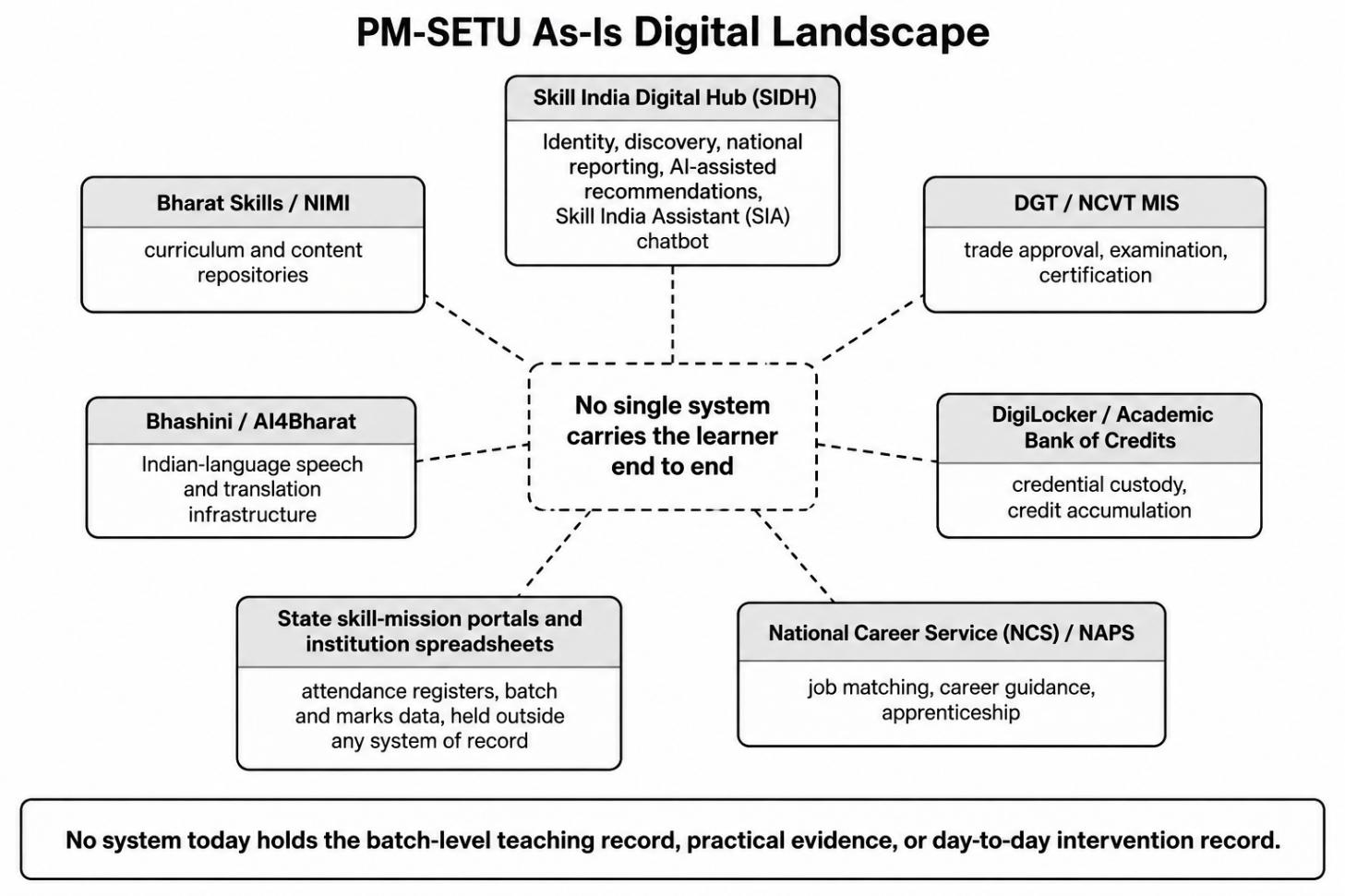
Skill India Digital Hub (SIDH): SIDH operates as the national convergence platform for the skilling ecosystem. It maintains learner identity and profile, supports discovery of courses and schemes, provides a learner-facing digital presence, and consolidates participation data for national reporting. SIDH has also introduced AI-assisted course, career-pathway, and skill-gap recommendations, and a conversational assistant, at the national convergence layer, most notably the Skill India Assistant (SIA), an AI-based chatbot deployed on SIDH in partnership with the National Skill Development Corporation, that answers learner queries and guides course and scheme discovery through a widely used messaging channel. SIA is cited in this report as evidence that AI-assisted learner guidance is already an operating pattern within the Government of India skilling ecosystem, not as a capability this platform needs to replicate. In the PM-SETU context, SIDH, including SIA, is significant primarily as an identity, discovery, reporting, and career- intelligence reference layer: it establishes who the learner is and which scheme the learner is associated with, and it operates at national convergence scale rather than at the batch-level teaching record that PM-SETU delivery requires. It is not an instructional delivery system. It does not maintain the batch-level teaching record, the trainer-recorded practical evidence, the assessment attempt history, the module-level progress state, or the intervention record on which day-to-day ITI delivery depends. Pillar 11 (Section 4.11) is accordingly designed to federate with SIDH and its AI-assisted career and recommendation functions rather than duplicate them, consistent with the positioning set out in Section 2.4.
Bharat Skills and NIMI: These national repositories hold curriculum, trade learning material, instructional media, and question banks. They are authoritative sources of approved content, but they are content repositories rather than learning management systems. A learner's consumption of a resource, the sequence in which it was delivered, and the completion arising from it are not recorded against a batch or a course version.
DGT and NCVT MIS: These systems govern trade and institution approval, examination scheduling, result processing, and certificate issuance. They hold the authoritative formal result and the certificate identifier. They operate at examination cycle granularity and do not carry formative assessment, practical evaluation, or in-course progress.
Digi-Locker and the Academic Bank of Credits: These services provide credential custody and academic credit accumulation. They consume credentials issued by an awarding authority; they do not generate them and are not a source of learning activity.
National Career Service (NCS) and NAPS: The National Career Service provides job-matching, skill-gap analysis against job requirements, and career-guidance functions at a national level, while NAPS and NCS together support the post-training stage of the learner lifecycle. Linkage between a completed learning record and an opportunity outcome is presently established manually, where it is established at all, and no system today connects a learner's in-course competency evidence automatically to a job or apprenticeship recommendation.
Bhashini and AI4Bharat: MeitY's Bhashini platform and the AI4Bharat research initiative provide publicly available Indian-language speech, translation, and text infrastructure covering a large number of scheduled Indian languages. These are government-run language infrastructure services, not learning platforms, and
are referenced in this report as the intended mechanism for multilingual and voice-based AI features (Section 4.10, Section 6.6).
| Platform | What It Is | Why It Is Not a Direct Comparator | Reusable Precedent or Caution |
| DIKSHA (NCERT, Ministry of Education) | National school- education platform, Sunbird-based, 2.25 crore registered users | School education (Class 9-12); its "vocational" content is PSSCIVE career-exposure material for schoolchildren, not NCVET/ITI trade certification | Sunbird RC's W3C-style verifiable credentials are a proven, population- scale government precedent for tamper-evident certificates. Caution: no SCORM/xAPI/cmi5/QTI/LTI support - this platform provides no interoperability precedent |
| SWAYAM Plus (IIT Madras, Ministry of Education) | Employability- focused MOOC aggregator for higher-education and lifelong learners, launched February 2024 | Targets college students and working professionals earning academic credit, not ITI trainees pursuing trade certification | its phased hub-and-partner- onboarding rollout is a real precedent for staged scaling. Caution: no published interoperability documentation; its parent platform SWAYAM has a documented completion rate below 4% since 2017 (Rajya Sabha Standing Committee, February 2025) |
| Bar Council of India / All India Bar Examination Sector Skill Councils (36 bodies under NSDC, e.g., ASDC, HSSC, B&WSSC) AIIMS (multiple campuses) UDISE+ (Unified District Information System for Education Plus) | Statutory professional- certification exam for legal practice Industry-led bodies that author Qualification Packs/NOS and, in some cases, operate their own supplementary e- learning platforms Medical postgraduate/underg raduate training; each campus (Delhi, Bilaspur, Bathinda, Rishikesh) runs its own separate LMS National school- education management information system covering approximately 14.8 lakh schools and 24 crore students; | Not a learning platform at all - a paper-based, OMR- scored, offline exam with no LMS Fundamentally a standards-setting and NCVET-assessment- accreditation layer, not a delivery LMS; even where a platform exists, it offers self-paced content only, with no documented interoperability standards or AI features Medical education domain, not vocational trade certification It is a school-education data-collection and administrative MIS, not a learning management system - it records institutional, teacher, and student data (enrollment, infrastructure, | Caution only: illustrates a regulator deliberately choosing offline delivery over digital convenience to protect assessment integrity - a relevant reference point given this report's own evaluator-confirmation requirements for high-stakes assessment Caution: independent review (January 2026) finds SSCs have "largely limited themselves to standards creation, without owning outcomes." Relevant structurally: several SSCs are themselves NCVET-recognized Awarding Bodies that this platform's federation model, consistent with Section 2.4, is designed to route toward rather than duplicate Caution: illustrates the risk of per- institution fragmentation - no unified system across campuses - which is precisely the failure mode this report's single-system-of-record design is intended to avoid A meaningful share of ITI entrants will already carry a UDISE+ Permanent Education Number from prior school education - a genuine, population-scale precedent for learner-identity resolution at enrollment (Pillar 7), similar in spirit to how this report already treats other |
| Platform | What It Is assigns every enrolled student a unique 11-digit Permanent Education Number (PEN) demographics) but does not deliver instruction, hold course content, or record any learning activity, assessment, or progress | Why It Is Not a Direct Comparator | Reusable Precedent or Caution approved identity channels. Caution: UDISE+ has no learning-delivery, assessment, or interoperability- standard functionality whatsoever to draw any architectural precedent from; its relevance here is identity- linkage only |
2.2 State, institution, and industry systemsPDF p.9
At State level, skill-mission portals maintain admission, attendance, and scheme-reporting data in formats specific to each State. At institution level, the operational teaching record is generally held outside any system of record: attendance registers, spreadsheets for batch and marks data, and messaging groups used to distribute learning material to learners. Biometric or digital attendance capture exists in a few institutions but is rarely linked to the learning record it should inform. A small number of ITIs have procured a learning platform independently; these deployments are isolated and do not exchange records with national systems.
On the industry side, Anchor Industry Partners and original equipment manufacturers frequently operate mature learning platforms of their own, complete with content, assessment, and certification tracks aligned to their equipment and processes; several such platforms internationally have begun to introduce AI-assisted authoring, tutoring, and skills-graph capabilities. These platforms are the authoritative source for the learning they deliver. Separately, publishers and education technology providers supply packaged learning resources without operating any learner-lifecycle system at all. Both categories of partner are essential to PM-SETU delivery, and each requires a different mode of participation.
2.3 Observed gaps in the current landscapePDF p.10
The following observations are drawn from the current-state landscape and determine the capabilities specified in this report.
| Observation | Implication for the PM-SETU LMS |
| No system carries the learner end to end | Identity sits on one platform, curriculum in another, results in a third, and delivery in none. The LMS must hold the operational learner record and reconcile the rest by reference. |
| The teaching record is not digitized at batch level | Attendance, practical evidence, module completion, and intervention must be captured natively, with learner, course version, batch, recorder, and timestamp on every event. |
| Course versioning is not enforced | A live batch must remain bound to the version on which it commenced, so that what a learner was assessed against remains provable after the curriculum is revised. |
| Content is distributed outside any governed channel | Content must carry ownership, rights, validity, language, and accessibility metadata, and must be delivered through the course sequence rather than through ad hoc distribution. |
| Industry platforms are treated as outside the system | The LMS must consume records from a partner-operated platform through a governed interface, so that industry-delivered learning contributes to the national record without duplicate entry. |
| Content-only partners have no route to participate | The LMS must accept standards-based content packages and remote launch, so a partner can contribute learning resources without building a learner-lifecycle platform. |
| Formal results and in-course assessment are conflated | The LMS must distinguish an LMS-controlled result from an externally authoritative result and must map the latter rather than recalculate it. |
| Progress is reported, not tracked | Program reporting is presently assembled retrospectively. The LMS must maintain progress continuously and publish validated events, with the source and freshness of each event retained. |
| Learners on constrained connectivity are excluded | Offline, low-bandwidth, and multilingual delivery must be designed into the platform rather than added as an exception path. |
| Learner support and doubt resolution depend entirely on trainer availability | A dispersed, multilingual ITI learner population has no course- grounded assistance outside classroom hours; a governed, advisory AI learning assistant is required to close this gap without displacing the trainer. |
| Course-level competency data is not connected to employability | Skills and competency evidence recorded during a course have no structured route to a career or job recommendation; a dedicated skills and career intelligence capability, federated to national services, is required. |
| Risk of learner disengagement is identified informally, if at all | Dropout and disengagement are typically noticed only after a learner has already withdrawn. A firm, advisory, explainable predictive capability is required so that institutions can intervene earlier. |
| No baseline measurement exists to demonstrate learner gain attributable to the program (NEW ROW - FIXED) | The LMS must support a baseline assessment recorded at course activation and a matched endline assessment at completion, so that the specific learning gain attributable to the program is measurable and evidence-based, rather than assumed from completion alone. |
2.4 Positioning of the PM-SETU LMSPDF p.10
The Learning Management System is positioned as the operational system of record for learning delivery, and only for learning delivery. It establishes and maintains the learner-to-course relationship, the learning and assessment events that occur against it, and the progress, skills, and credential state that results. It does not
assume authority that properly belongs elsewhere: curriculum and qualification approval remains with the designated authority; formal examination and certification remain with the awarding body; credential custody remains with the credential service; national, State, and fiduciary analytics remain with the Analytics Portal; career and labor-market authority remains with the National Career Service and Skill India Digital Hub; and a partner-operated learning platform remains authoritative for the records it owns.
This positioning extends without modification to every artificial intelligence capability specified in this report. An AI capability may generate a draft, a recommendation, an explanation, or a prediction; it does not become a new source of authority. Section 6.8 sets out the AI Governance framework that enforces this positioning across every functional pillar.
Accordingly, every reference in the remainder of this report is expressed in terms of the function required rather than the platform presently performing it. Where the report refers to the approved identity channel, the designated awarding system, the approved credential service, a connected partner platform, or an AI model provider, the specific system fulfilling that role is confirmed during solution design and may change over the life of the program without altering the requirement.
The approved identity channel, designated awarding system, and approved credential service referenced above shall each be confirmed by name before the start of Phase 1 (Annexure F), so that solution design does not proceed against an undetermined dependency.
The distinction between this platform and Skill India Digital Hub is stated concisely here; the full comparison against Skill India Digital Hub, NIMI/Bharat Skills, and commercial platforms is provided at Annexure M.
| Dimension | PM-SETU LMS (proposed) | SIDH | NIMI/Bharat Skills |
| Role | Batch-level operational delivery, the teaching record itself | National discovery, identity, credentialing, career intelligence | Content and question- bank repository |
| Assessment | Native summative engine, evaluator-confirmed | Routed to external NCVET assessment agencies | Mock tests only, not certification |
| AI learning support | Content-grounded Q&A assistant (RAG) | Recommendation/navig ation chatbot (SIA) | None |
| Interoperability | SCORM/xAPI/cmi5/QTI 3.0/LTI 1.3 native | Not publicly documented | Via Moodle only |
3. Business RequirementsPDF p.11
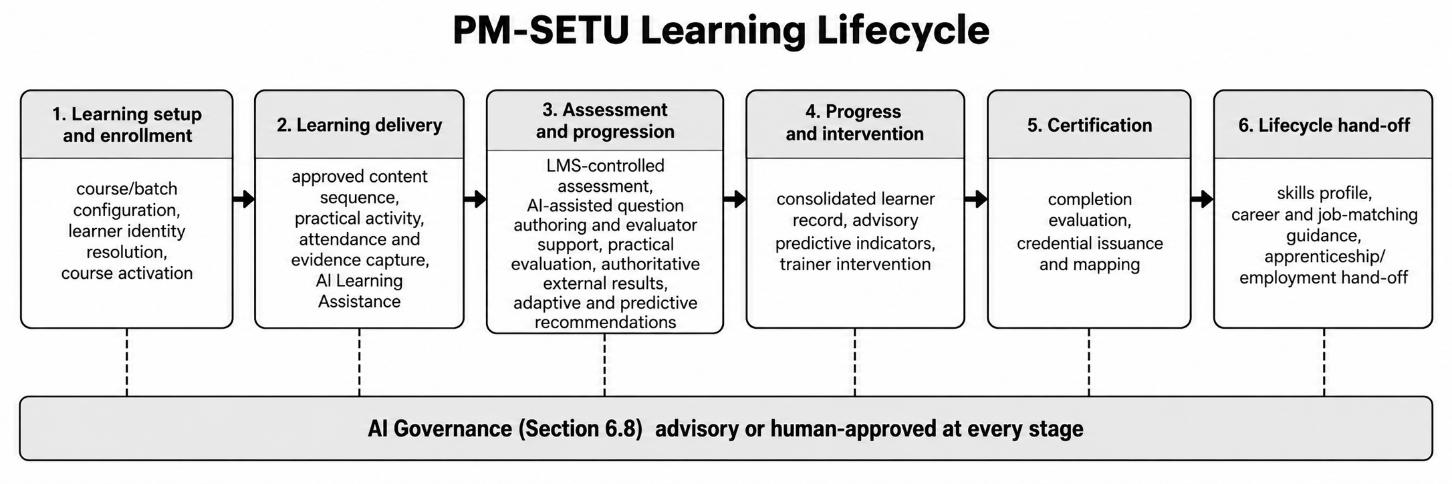
The PM-SETU Learning Management System digitizes and governs the end-to-end learning lifecycle of the program through four core business processes. The lifecycle commences with learning setup and enrollment, covering course and batch configuration, learner identity resolution, and course activation, under which the institution establishes the learner-to-course relationship on which every subsequent transaction depends. Once a batch is active, learning delivery processes govern the presentation of the approved content sequence, the conduct of instructor-led and practical activity, the capture of attendance and practical evidence from whichever source owns it, and AI-assisted learning support grounded in the approved course. Attainment is then subjected to assessment and progression, covering LMS-controlled assessment, AI-assisted question authoring and evaluator support, practical evaluation against approved rubrics, the mapping of authoritative external examination results, and advisory adaptive and predictive recommendations. Finally, certification and lifecycle outcomes convert satisfied completion conditions into recognized credentials and, where the relevant integration is enabled, into a skills-based hand-off to on-the-job training, apprenticeship, or employment.
These processes are inherently complex to administer. They span multiple stakeholders - learners, trainers, institution administrators, SPVs and Anchor Industry Partners, industry organizations operating their own
learning platforms, content partners, awarding bodies, and credential services - each with distinct roles, authority, and information needs. They also involve versioned course structures, batch-bound applicability rules, learning events arriving from several systems at different times, assessment results owned in different places, and credentials that only one party is entitled to issue. Managing this lifecycle through manual or fragmented systems produces the conditions observed in Section 2: an incomplete teaching record, progress that cannot be substantiated, duplicate entry wherever an industry partner is involved, and completion claims that outrun the evidence. A dedicated Learning Management System is therefore required to act as the operational system of record - enforcing the approved course version, validating every event against the learner and batch to which it belongs, maintaining complete audit history, applying artificial intelligence only within a governed, advisory boundary, and providing role-appropriate visibility to all stakeholders.
Functional structure
To address these requirements, the Learning Management System is organized into eleven functional pillars, set out in full in Section 4:
- •Pillar 1 - Course Management: the approved catalogue, composition, and version.
- •Pillar 2 - Content Delivery: presentation of approved learning resources across delivery modes.
- •Pillar 3 - Assessment and Evaluation: theoretical and practical measurement, including AI-assisted
assessment support.
- •Pillar 4 - Personalized and Adaptive Learning: bounded, advisory, AI-enabled recommendation of
the next learning action within the approved course.
- •Pillar 5 - Learner Progress Tracking: the consolidated operational record, including AI analytics and
prediction.
- •Pillar 6 - Certification and Badges: recognition of completion.
- •Pillar 7 - Digital Identity and Credential Integration: linkage to national identity and credential
services.
- •Pillar 8 - Student Lifecycle Dashboards and Management: the learner and institution operational
view.
- •Pillar 9 - Interoperability and Integration: governed admission of vendor platforms and content
partners.
- •Pillar 10 - AI Learning Assistance: conversational and generative assistance grounded in approved
course content, for learners and trainers.
- •Pillar 11 - Skills and Career Intelligence: an evidence-based skills profile and advisory career and
employability guidance, federated to national services.
Two cross-cutting frameworks govern every pillar: the Solution Architecture (Section 5), which specifies the shared platform services - including the AI Services block - that pillars draw upon rather than rebuild; and the AI Governance and Responsible AI framework (Section 6.8), which applies a single, consistent set of human- oversight, explainability, auditability, and safety controls to every AI-enabled capability in this report, generalizing the principle first established for Pillar 4.
Role-based access
Access to each pillar, including its AI-enabled capabilities, is scoped to the stakeholder role and entity defined in the User Access Layer (Section 5.4). No AI capability changes a stakeholder's underlying data-access scope; an AI feature exposed to a trainer, for example, operates only within the learners, batches, and institutions already assigned to that trainer.
3.1 LMS access and login journeyPDF p.13
Every user enters through an approved identity route and is resolved to a role and operating scope before any learning record is displayed or changed. Learners are matched to the approved learner identity and enrollment record; official and partner users are matched to the organization and role provisioned for them. Multi-factor authentication is mandatory for administrative, content-approval, assessment-configuration, and AI-configuration roles, consistent with Section 6.2.
3.2 Learner / trainee user journeyPDF p.14
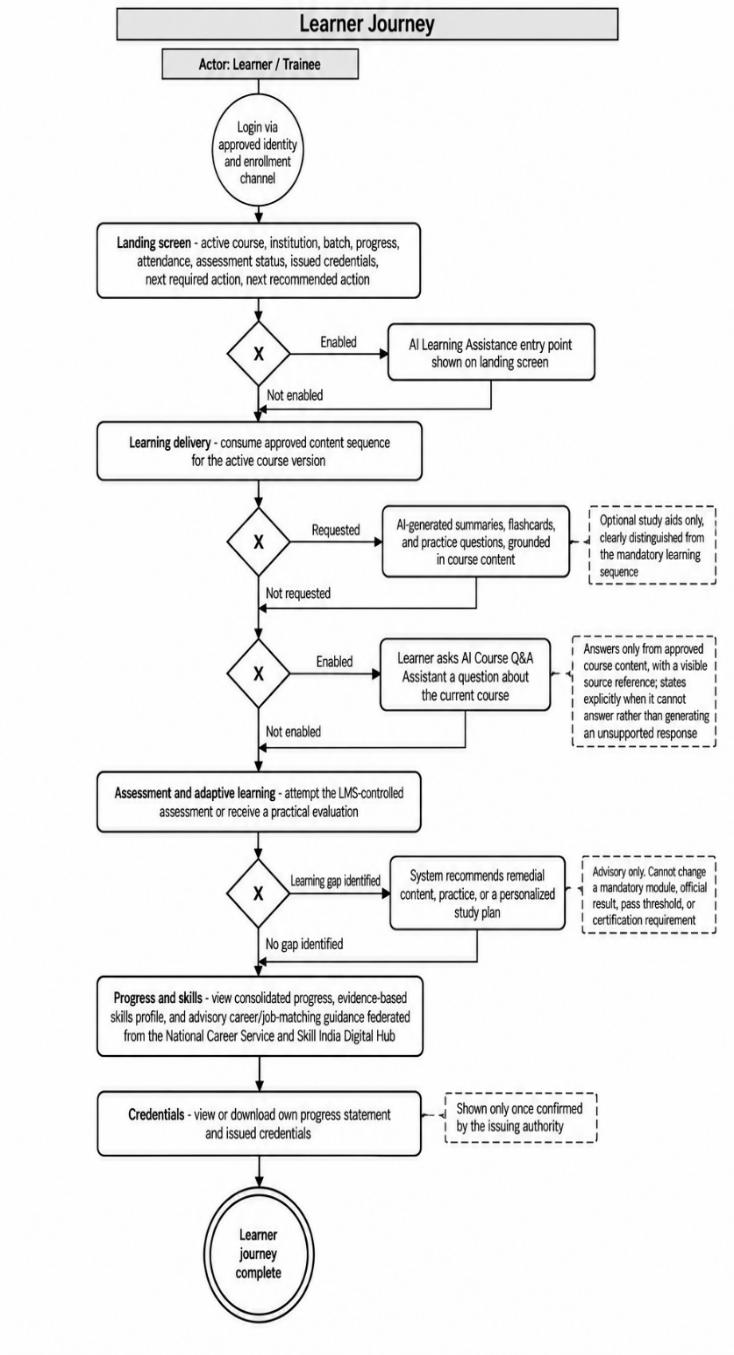
- •Landing screen: The learner home
displays the active course, institution, and batch; current progress, attendance, and assessment status; credentials already issued; the next required and next recommended action; and, where enabled, the AI Learning Assistance entry point. It does not expose administrative configuration or another learner's information.
- •Learning delivery:
The learner consumes the approved content sequence for the active course version and may use AI-generated summaries, flashcards, and practice questions grounded in that content as optional study aids, clearly distinguished from the mandatory sequence (Pillar 10).
- •Doubt resolution and study support:
Where enabled by the institution, the learner may ask the AI Course Q&A Assistant a question about the current course; the assistant answers only from approved course content, with a visible source reference, and states explicitly when it cannot answer rather than generating an unsupported response (Pillar 10).
- •Assessment and adaptive learning:
The learner attempts the LMS- controlled assessment or receives a practical evaluation. Where the result identifies a permitted learning gap, the system may recommend remedial content, practice, or a personalized study plan. The recommendation is advisory and cannot change a mandatory module, official result, pass threshold, or certification requirement (Pillar 4).). Where the course requires it, the learner's journey begins with a baseline assessment at course activation and concludes with a matched endline assessment at completion, with the resulting learning- gain measure presented alongside standard progress.
- •Cohort engagement: Where the institution has enabled it and the learner has opted in, the learner sees
their standing on a batch-scoped engagement ranking based on recorded completion metrics; participation is off by default, has no effect on any mandatory requirement, assessment, or credential, and can be withdrawn by the learner at any time (Pillar 8).
- •Progress and skills: The learner views consolidated progress and, where the course is mapped to
competencies, an evidence-based skills profile and any advisory career or job-matching guidance federated from the National Career Service and Skill India Digital Hub (Pillar 11).
- •Credentials: The learner views or downloads their own progress statement and issued credentials once
confirmed by the issuing authority.
3.3 Trainer / faculty user journeyPDF p.15
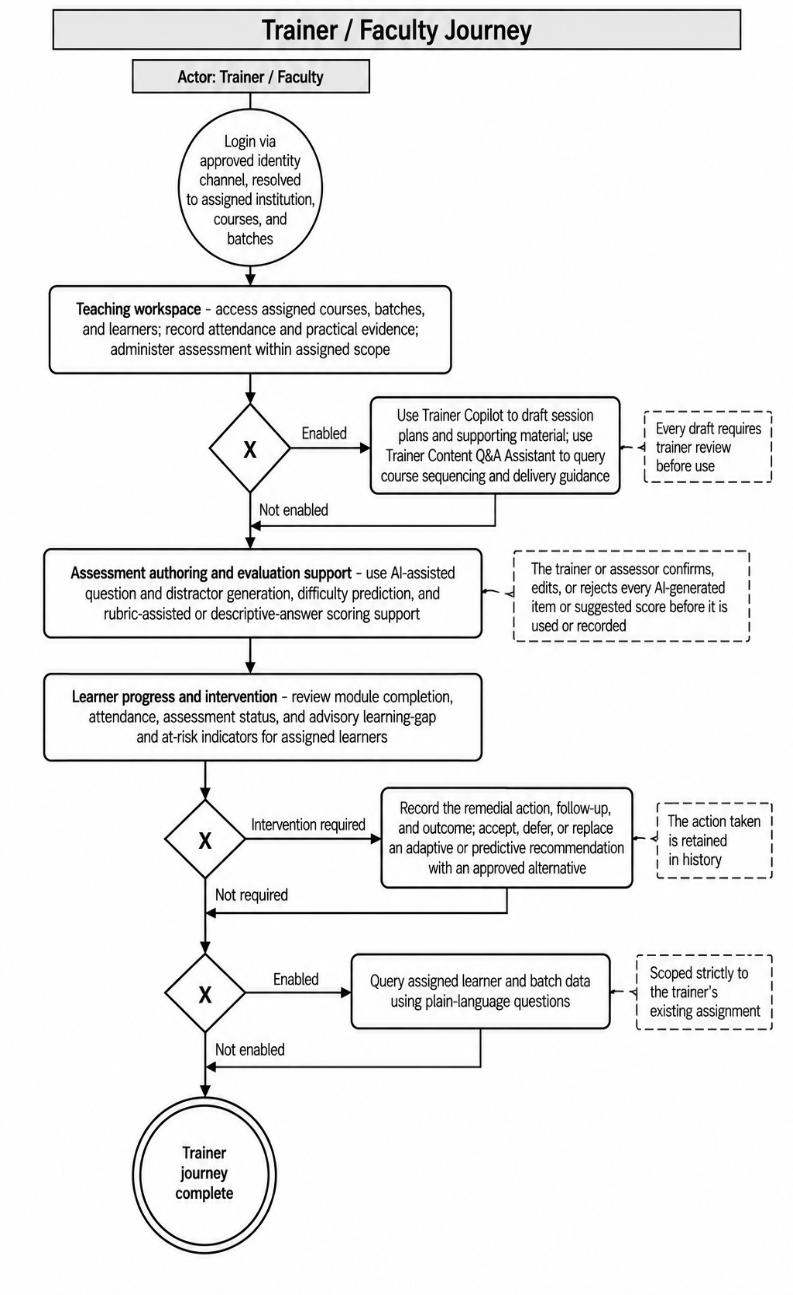
- •Teaching workspace:
The trainer accesses assigned courses, batches, and learners, records attendance and practical evidence, and administers assessment within the assigned scope.
- •AI-assisted preparation:
Where enabled, the trainer may use the Trainer Copilot to draft session plans and supporting material from approved course content, and the Trainer Content Q&A Assistant to query course sequencing and delivery guidance; every draft requires trainer review before use (Pillar 10).
- •Assessment authoring and evaluation
support: The trainer or assessor may use AI-assisted question and distractor generation, difficulty prediction, and rubric-assisted or descriptive-answer scoring support; the trainer or assessor confirms, edits, or rejects every AI- generated item or suggested score before it is used or recorded (Pillar 3).
- •Learner progress and intervention: The
trainer reviews module completion, attendance, assessment status, and advisory learning-gap and at-risk indicators for assigned learners, and records the remedial action, follow-up, and outcome where intervention is required. An adaptive or predictive recommendation may be accepted, deferred, or replaced by an approved alternative, with action retained in history (Pillar 4, Pillar 5). Where a learner's difficulty appears personal or circumstantial rather than academic, the trainer may record a counselling referral in the same intervention history, distinct from an academic remedial action.
- •Natural-language data access: Where enabled, the trainer may query assigned learner and batch data
using plain-language questions, scoped strictly to the trainer's existing assignment (Pillar 10).
3.4 ITI administrator user journeyPDF p.16
- •Course and batch operations: The
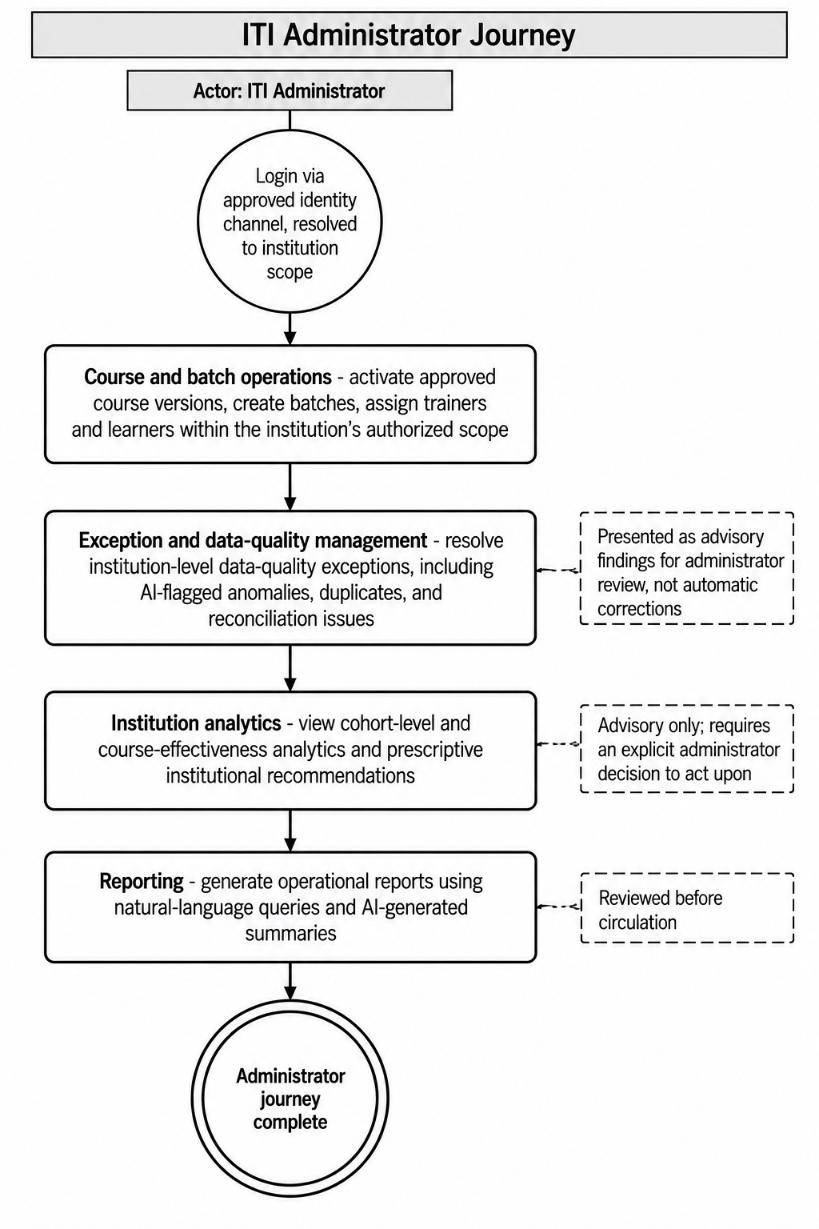
institution administrator activates approved course versions, creates batches, and assigns trainers and learners within the institution's authorized scope.
- •Exception and data-quality management:
The administrator resolves institution-level data-quality exceptions, including AI-flagged anomalies, duplicates, and reconciliation issues, all of which are presented as advisory findings for administrator review, not automatic corrections (Pillar 8, Platform Layer Admin AI service).
- •Institution analytics:
The administrator views cohort-level and course-effectiveness analytics and any prescriptive institutional recommendations, which remain advisory and require an explicit administrator’s decision to act upon (Pillar 5, Pillar 8).
- •Reporting: The administrator may
generate operational reports using natural-language queries and AI- generated summaries, reviewed before circulation (Platform Layer Admin AI service).
3.5 SPV / Anchor Industry Partner user journeyPDF p.17
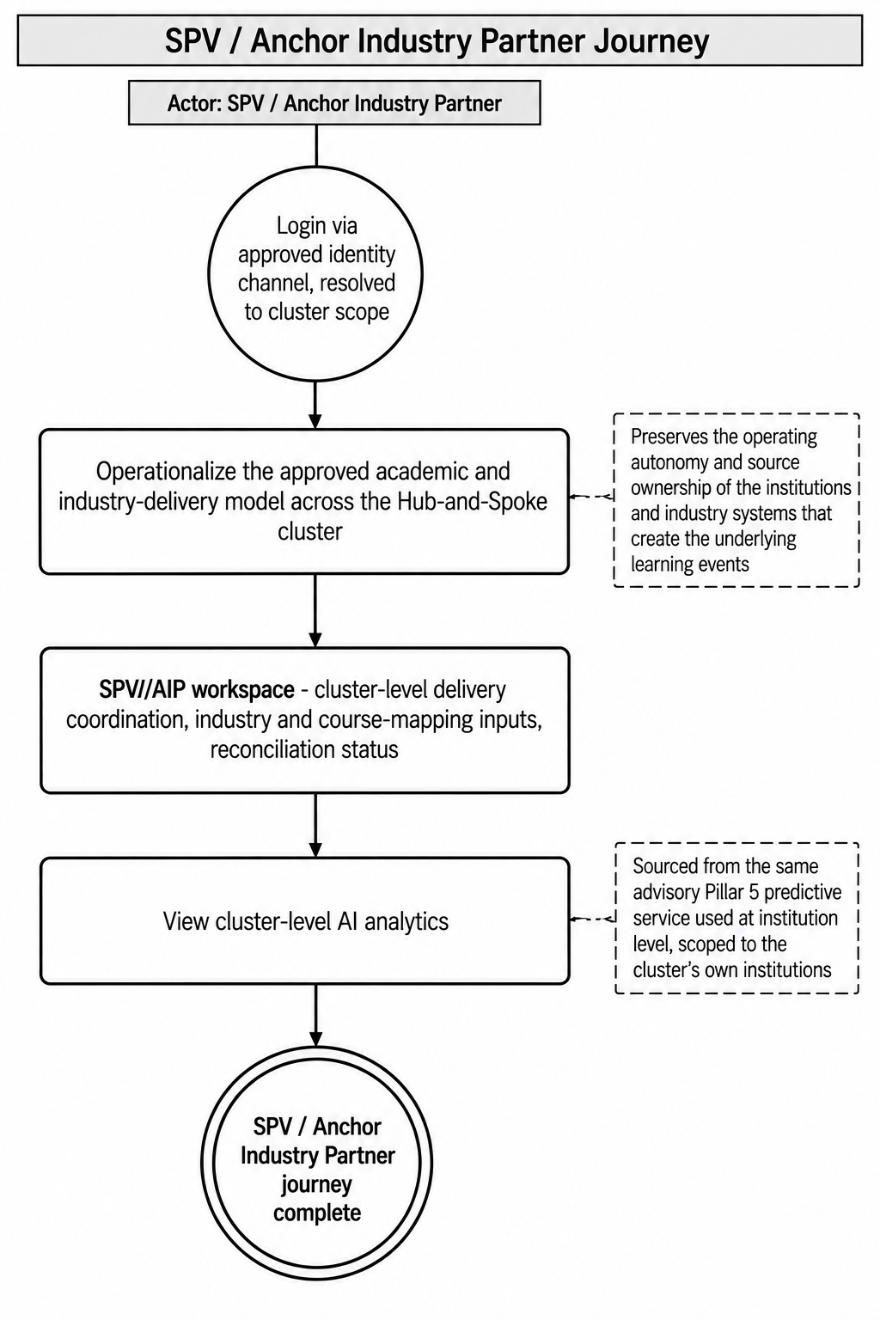
- •Cluster delivery coordination:
The SPV or Anchor Industry Partner uses the system to operationalize the approved academic and industry-delivery model across its Hub-and-Spoke cluster, while preserving the operating autonomy and source ownership of the institutions and industry systems that create the underlying learning events.
- •Industry and course-mapping
inputs: The SPV/AIP workspace presents cluster-level industry and course-mapping inputs for review.
- •Reconciliation status:
The SPV/AIP workspace presents the reconciliation status of learning records across the cluster's institutions.
- •Cluster-level AI analytics: The
SPV/AIP views cluster-level AI analytics, sourced from the same advisory Pillar 5 predictive service used at institution level, scoped to the cluster's own institutions.
3.6 Industry partner with existing LMS user journeyPDF p.18
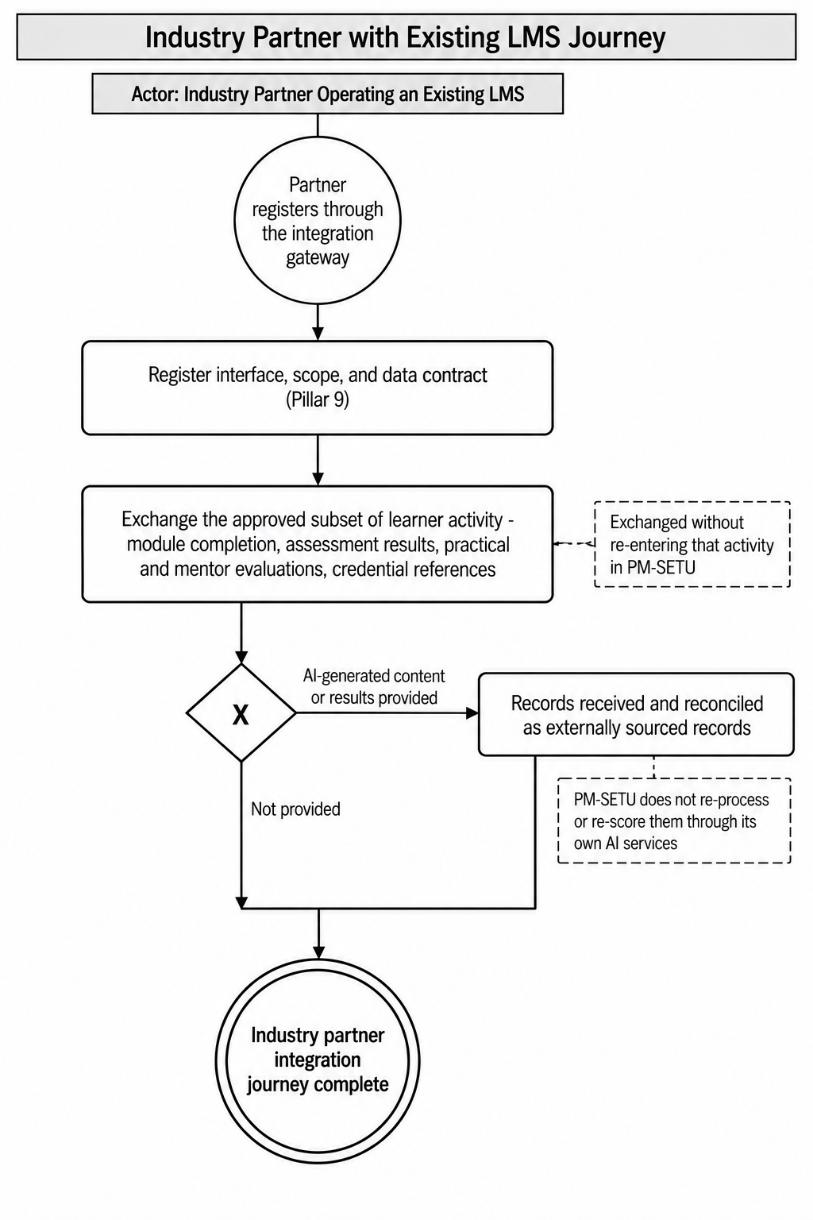
- •Interface registration: An industry
partner that already operates a learning platform registers the interface, scope, and data contract through the integration gateway (Pillar 9).
- •Activity exchange: The partner
exchanges the approved subset of learner activity module completion, assessment results, practical and mentor evaluations, and credential references without re-entering that activity in PM-SETU.
- •AI-sourced record reconciliation:
Where the partner's own platform provides AI-generated learning content or assessment results, those records are received and reconciled as externally sourced records.
- •AI boundary: PM-SETU does not re- process or re-score partner-sourced content or results through its own AI services.
3.7 Content / knowledge partner user journeyPDF p.19
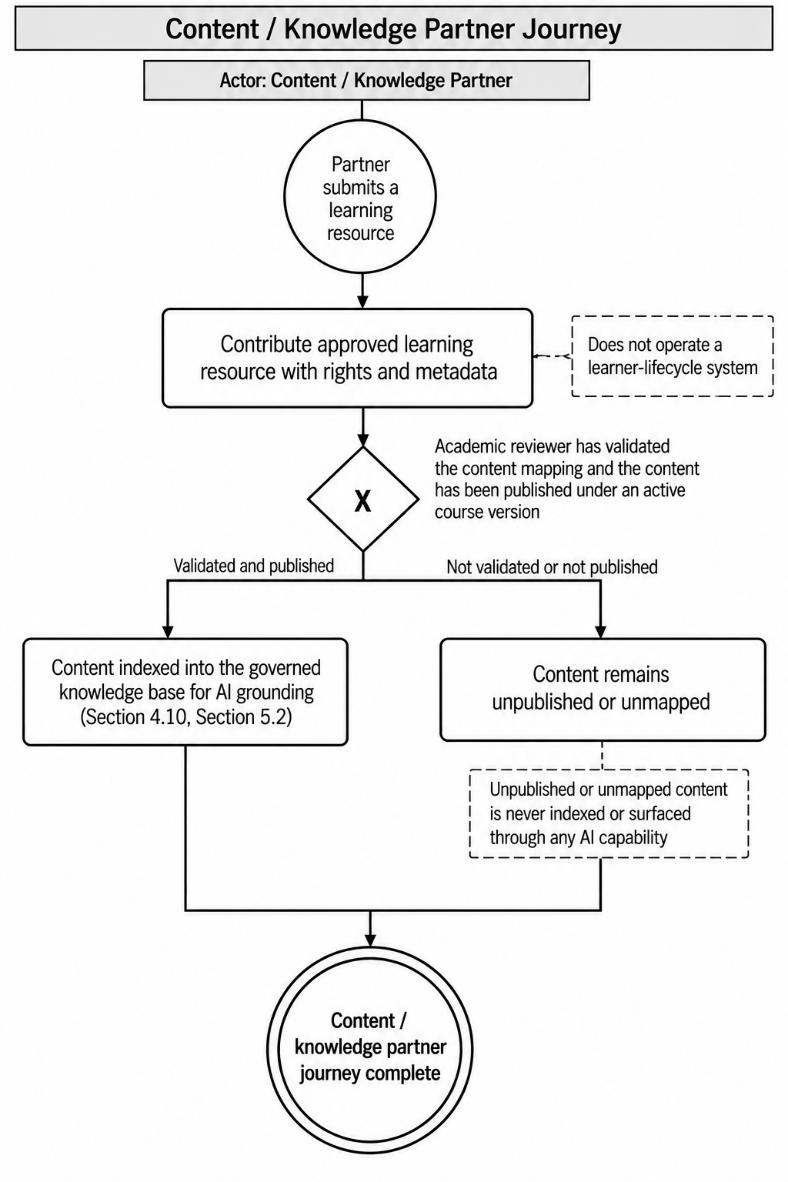
- •Content contribution: A content-only
partner contributes approved learning resources with rights and metadata, without operating a learner-lifecycle system.
- •Academic review: Content submitted by the partner is validated by the academic reviewer against the course mapping.
- •AI grounding eligibility: Only after that
validation, and only once the content has been published under an active course version, does it become eligible for indexing into the governed knowledge base described in Section 4.10 and Section 5.2 for AI grounding purposes.
- •AI boundary:
Unpublished or unmapped content is never indexed or surfaced through any AI capability.
3.8 Academic reviewer user journeyPDF p.20
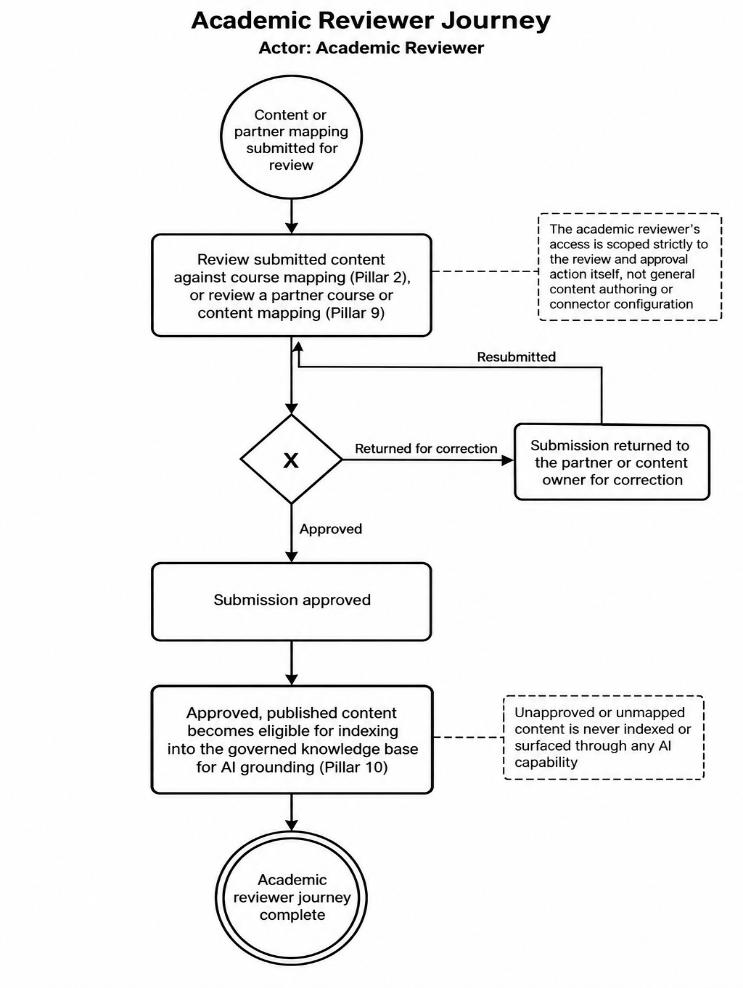
- ●Content and mapping review: The
academic reviewer reviews submitted content against the course mapping (Pillar
- 2)and reviews partner course or content mappings (Pillar 9), approving each submission or returning it for correction.
- ●AI-grounding eligibility gate:
The reviewer's approval is the trigger that makes published content eligible for indexing into the governed knowledge base used for AI grounding (Pillar 10); unapproved or unmapped content is never indexed or surfaced through any AI capability.
- ●Scope of authority: The academic
reviewer's access is scoped strictly to the review and approval action on submitted content and mappings, not general content authoring or connector configuration, consistent with Annexure A.
3.9 Model owner user journeyPDF p.20
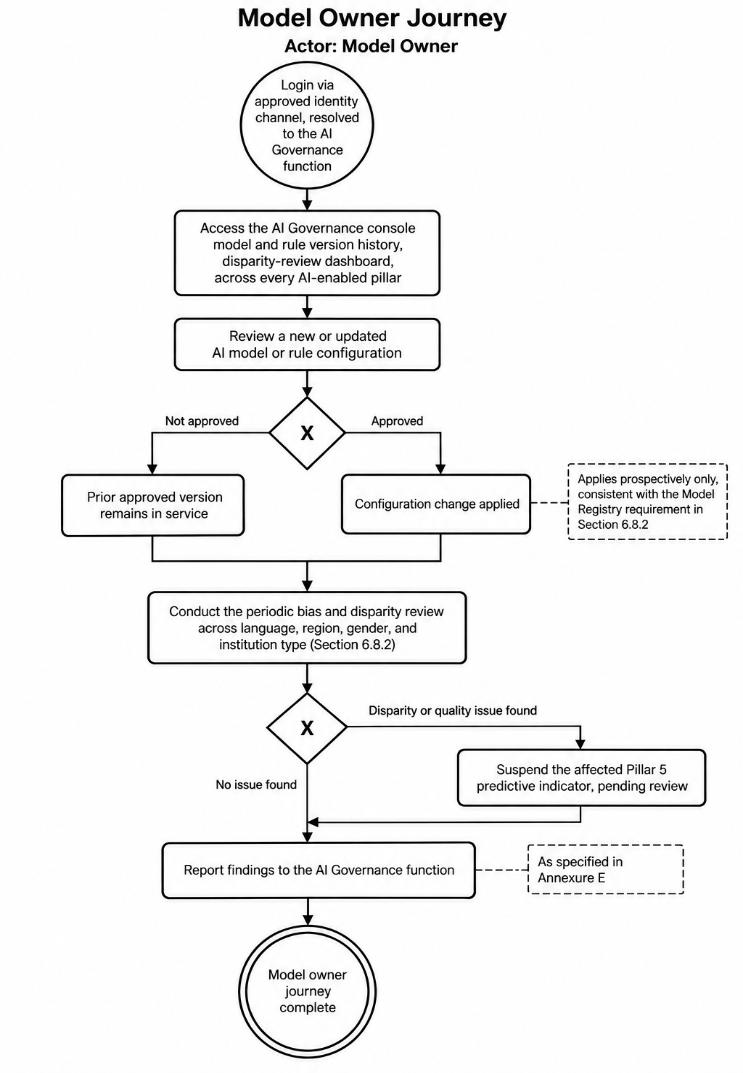
- ●AI Governance console: The model
owner accesses the AI Governance console, including model and rule version history and the disparity-review dashboard, across every AI-enabled pillar.
- ●Model and rule version approval: The
model owner approves a new or updated AI model or rule configuration before it applies prospectively, consistent with the Model Registry requirement in Section 6.8.2.
- ●Predictive-indicator suspension: The
model owner may suspend a Pillar 5 predictive indicator found to exhibit a quality or disparity issue, pending review.
- ●Periodic disparity review: The model
owner conducts the periodic bias and disparity review across language, region, gender, and institution type required under Section 6.8.2, and reports findings to the AI Governance function specified in Annexure
E.
3.10 Integration administrator user journeyPDF p.21
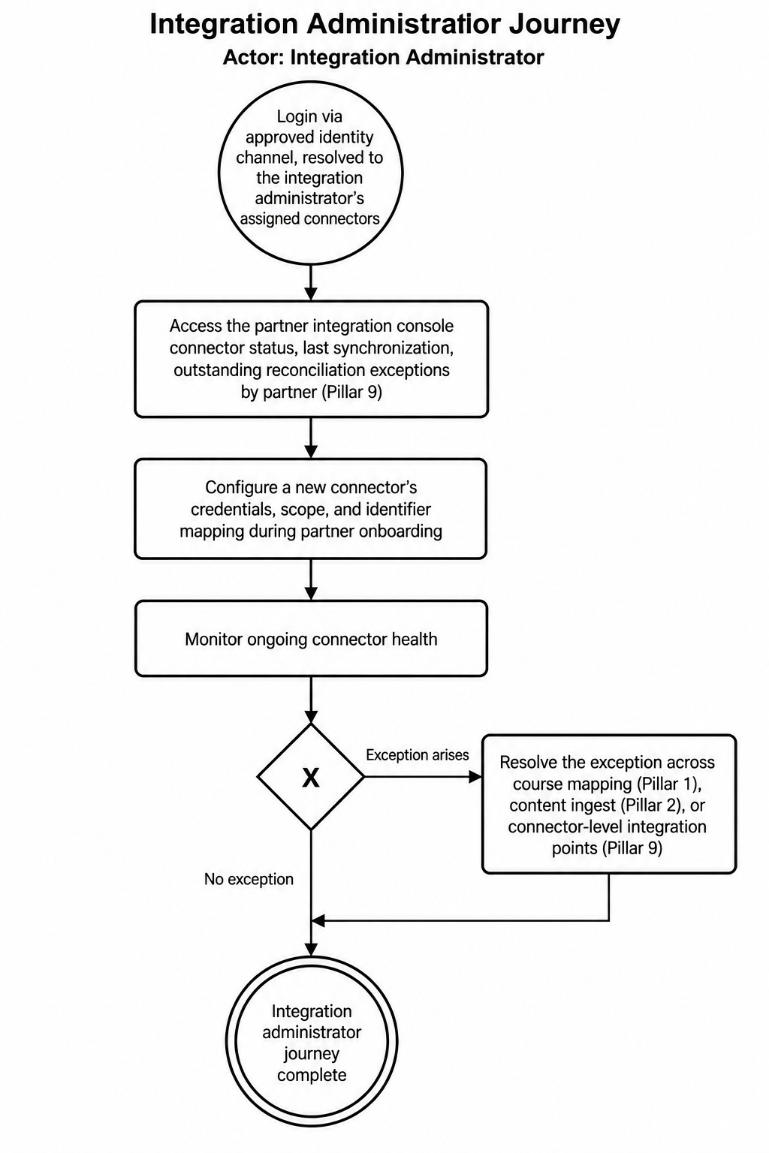
- ●Partner integration console: The
integration administrator accesses the partner integration console showing connector status, last synchronization, and outstanding reconciliation exceptions by partner (Pillar 9).
- ●Connector configuration:
The integration administrator configures a new connector's credentials, scope, and identifier mapping during partner onboarding, and monitors ongoing connector health.
- ●Exception resolution: The integration
administrator resolves mapping and reconciliation exceptions arising across course mapping (Pillar 1), content ingest (Pillar 2), and connector-level integration points (Pillar 9).
4. Functional System RequirementsPDF p.22
This section sets out the functional requirements of the eleven pillars of the PM-SETU Learning Management System. The pillars follow the learner lifecycle: Course Management establishes what is to be learned; Content Delivery presents the approved learning resources; Assessment and Evaluation measures attainment, with AI-assisted authoring and evaluation support; Personalized and Adaptive Learning determines the next recommended action within the approved course; Learner Progress Tracking maintains the running record and advisory predictive indicators; Certification and Badges recognizes completion; Digital Identity and Credential Integration links the learner to authoritative identity and credential services; Student Lifecycle Dashboards and Management presents the resulting journey; Interoperability and Integration admits external learning platforms and content sources under a governed contract; AI Learning Assistance provides grounded conversational and generative support to learners and trainers; and Skills and Career Intelligence extends course-level competency evidence into a durable skills profile and advisory employability guidance.
Each pillar is specified in a consistent form. The description defines the business purpose; Functional Capabilities state what the system shall provide; and the Acceptance Criteria, Validation Rules, and Exception Management sections define the conditions under which the capability is considered fit for use. Where a pillar includes artificial intelligence, its AI Behavior, Human Control, and Governance are stated explicitly and are subject, without exception, to the cross-cutting AI Governance framework in Section 6.8. Requirements are expressed against capability and standard rather than against any product.
4.1 Pillar 1: Course ManagementPDF p.22
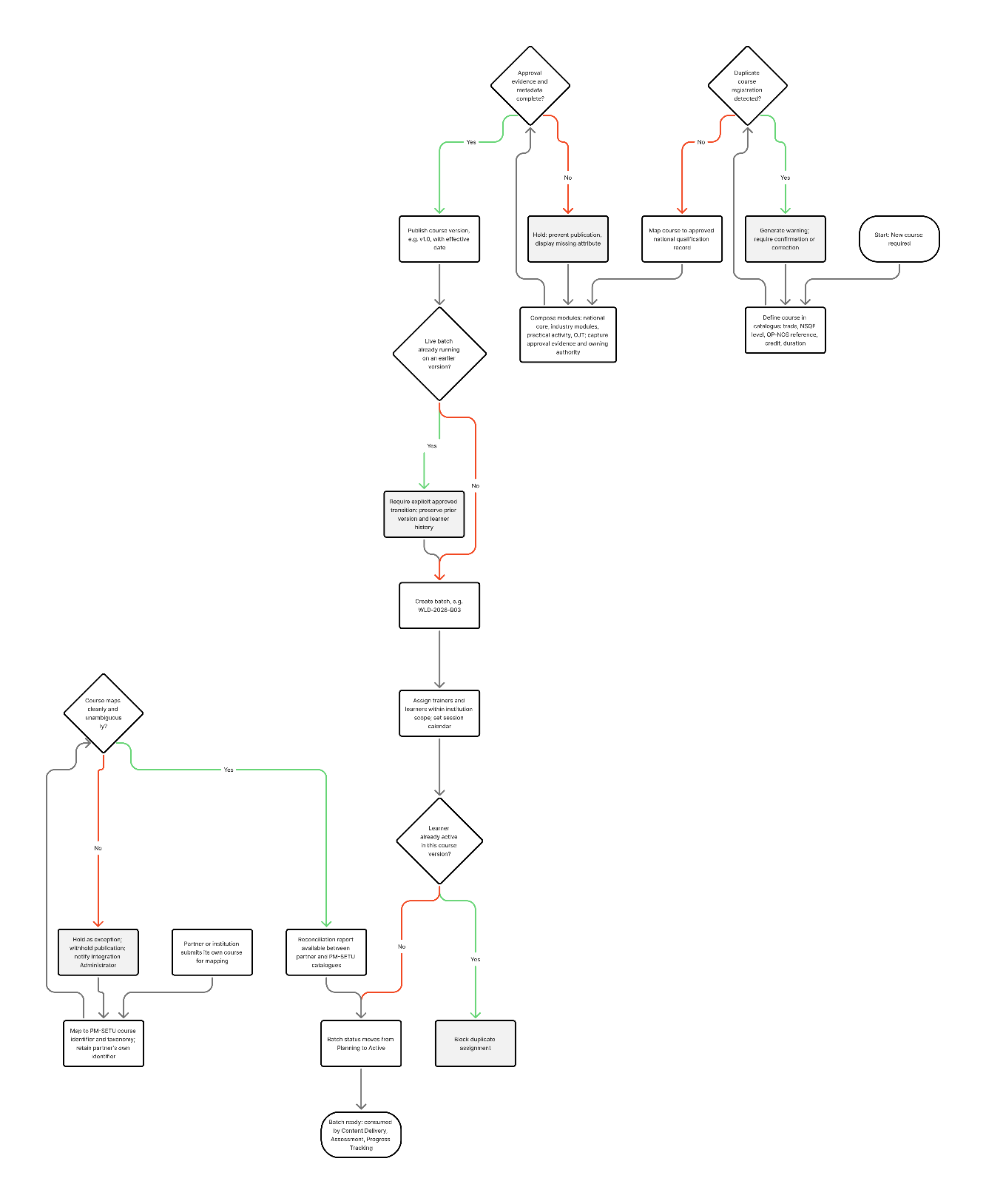
The system shall establish and maintain the approved learning structure presented to a PM-SETU learner. It should maintain the course and qualification catalogue, the version applicable to each batch, the relationship between national core content, approved industry modules, practical activity, on-the-job training, and other approved components, and the metadata required to identify a course consistently across institutions and partner systems.
The component is operated by authorized curriculum and institution administrators and is consumed by learners and trainers through the assigned course. Formal approval by CSTARI, DGT, NIMI, NCVET, or another designated authority is not replaced by the system; the platform records and enforces the approved version and its supporting evidence. The course version and its associated competency map are also the reference structure used by Pillar 4, Pillar 10, and Pillar 11 to bound their AI-enabled capabilities.
Functional CapabilitiesPDF p.23
Catalogue and qualification mapping
- •Maintain a searchable course and qualification catalogue with trade, occupation, NSQF level, QP-NOS
reference, credit, duration, delivery mode, and certification metadata.
- •Map each course to the approved national qualification record maintained by the designated authority.
- •Record the institutions, clusters, and States for which a course is applicable.
- •Support search and filter by trade, level, delivery mode, language, and institution, and expose the
catalogue to the AI-Powered Course Catalogue Search capability specified in Pillar 10.
Course composition and creation
- •Create modular course structures comprising national core, approved industry modules, practical
activities, on-the-job training, and other approved components.
- •Define prerequisites, sequencing rules, and the conditions under which a module unlocks.
- •Associate each course with its content set, assessment plan, completion criteria, competency map, and
applicable credential type.
- •Capture the approval evidence, effective date, and authority for the composition.
Versioning and applicability
- •Maintain version, effective date, status, and batch applicability for every course.
- •Retain a live batch on the course version on which it commenced unless an approved transition is
recorded.
- •Preserve every superseded version and the batches that ran against it.
- •Prevent in-place editing of a published version; a material change creates a new version.
Batch and cohort management
- •Create and manage batches and cohorts by trade, shift, and institution.
- •Assign trainers and learners to a batch within the institution's authorized scope.
- •Capture the session and lesson delivery calendar applicable to the batch.
- •Maintain batch status through planning, active, completed, and closed states.
Partner and institution course mapping
- •Map partner- or institution-owned courses to the PM-SETU course identifier and taxonomy.
- •Preserve the partner's internal identifier alongside the canonical identifier.
- •Hold an unmapped or ambiguous partner course as an exception rather than publishing it.
- •Support reconciliation reporting between partner and PM-SETU course catalogues.
Acceptance CriteriaPDF p.24
- •Every learner and batch is linked to one active course version, and that version remains traceable after
later revisions.
- •Course metadata displayed to the learner agrees with the approved course record and the institution
and batch assignment.
- •A partner course can be reconciled to both the partner identifier and the PM-SETU course identifier.
- •A course version cannot be published while mandatory approval evidence or metadata is incomplete.
- •Batch creation, trainer assignment, and learner assignment are completed digitally within the institution's
authorized scope.
Validation RulesPDF p.24
- •A published course version cannot be edited in place; a material change creates a new version.
- •Mandatory approval evidence, ownership, and effective date are required before publication.
- •A course cannot be assigned to a batch outside its approved applicability or effective period.
- •Formal examination or certification rules held in an external authoritative system are referenced rather
than overwritten.
- •A learner cannot be assigned to more than one active batch of the same course version.
Exception ManagementPDF p.25
| Exception | System Action |
| Approval evidence pending | Hold the version as unavailable for new batch assignment and display the pending requirement to the administrator. |
| Partner course cannot be mapped | Retain the mapping as an exception, withhold publication, and notify the integration administrator. |
| Live batch requires migration to a later version | Require an explicit approved transition and preserve the prior version and its learner history. |
| Mandatory metadata missing | Prevent publication and display the specific missing attribute. |
| Duplicate course registration detected | Generate a duplicate warning and require confirmation or correction before proceeding. |
4.2 Pillar 2: Content DeliveryPDF p.25
The system shall present the approved teaching-learning material associated with the course version and support the blended learning model required for PM-SETU. It shall cover instructor-led and self-learning resources, multimedia, digital learning assets, and practical support material, while retaining source, ownership, version, rights, language, and accessibility information for each resource. Published content is the exclusive source corpus indexed by the knowledge base used for AI grounding in Pillar 3, Pillar 4, and Pillar 10; unpublished or unmapped content is never indexed.
Functional CapabilitiesPDF p.25
Resource presentation and blended delivery
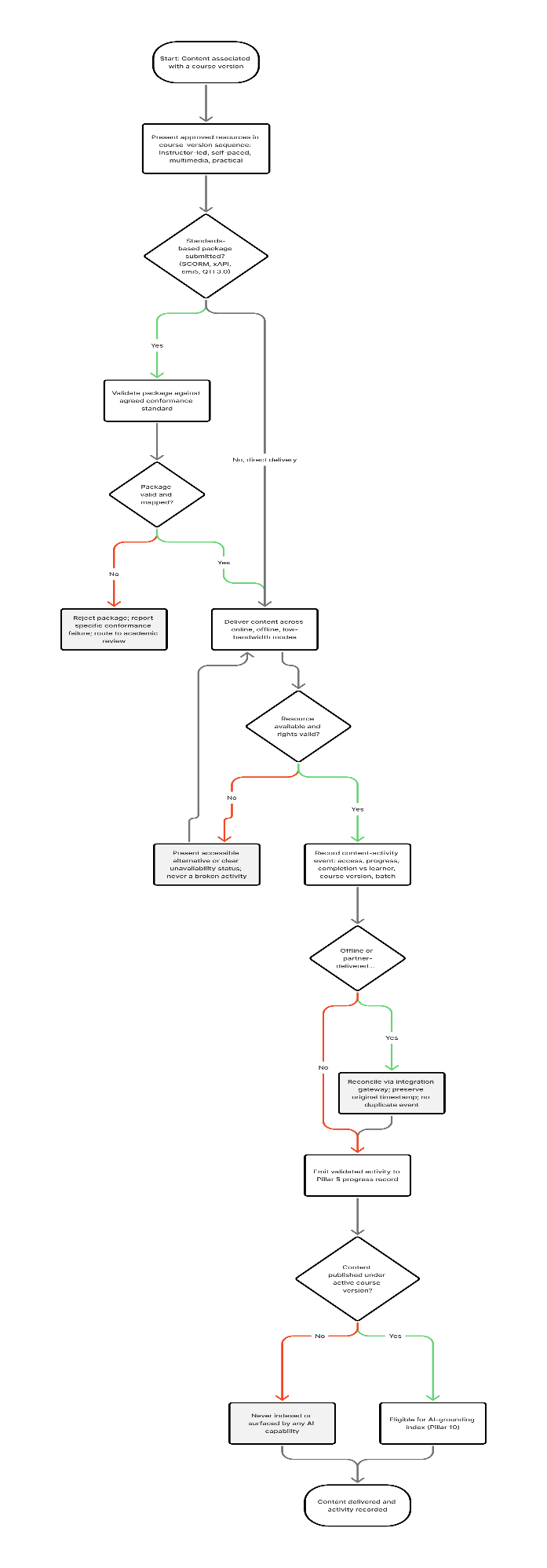
- •Present instructor-led, self-paced, multimedia, and practical support resources in the sequence defined
by the course version.
- •Support online, offline, and low-bandwidth delivery modes, with deferred synchronization of offline
activity.
- •Retain source, ownership, version, rights, language, and accessibility metadata for every resource.
- •Present an accessible alternative in place of, rather than in addition to, an inaccessible resource,
consistent with Section 6.6.
Content ingests and partner content
- •Ingest standards-based content packages (SCORM, xAPI, cmi5, QTI 3.0) and support remote launch of
partner-hosted content under LTI 1.3.
- •Validate a submitted package against the agreed conformance standard before publication.
- •Route an unmapped or rights-incomplete
submission to academic review rather than publishing it.
Activity capture and reliability
- •Record reliable content-activity events - access,
progress, and completion - against the learner, course version, and batch.
- •Reconcile partner-delivered content activity
received through the integration gateway with the PM-SETU learner record.
- •Preserve historical completion evidence when a
resource's rights expire or the resource is withdrawn.
Acceptance CriteriaPDF p.26
- •The content presented to a learner matches the
approved sequence of the active course version.
- •Every content-activity event is attributable to a
learner, course version, batch, and source.
- •A resource whose rights have expired is
withdrawn from new delivery while historical completion remains traceable.
- •Offline activity synchronizes without creating a
duplicate event.
Validation RulesPDF p.26
- •A resource whose validity period has ended
cannot be assigned to a new activity.
- •Deferred offline activity must carry the original
activity timestamp and cannot overwrite a later validated event.
- •Content is not indexed for AI grounding until it is
published under an active course version and validated by academic review.
Exception ManagementPDF p.27
| Exception | System Action |
| Resource unavailable at delivery | Present an alternate approved resource or a clear unavailability status rather than a broken activity. |
| Content rights expired or withdrawn | Withdraw the resource from new delivery while historical completion remains traceable. |
| Partner activity cannot be reconciled Remote launch service unavailable Package fails validation on ingest | Quarantine the event with reason and source reference; do not update learner progress. Record the failed launch, present the fallback resource where configured, and retry under the interface rule. Reject the package, report the specific conformance failure, and retain the submission for correction. |
4.3 Pillar 3: Assessment and EvaluationPDF p.27
The system shall support the measurement of theoretical knowledge and practical skill during the learning period. It shall provide the assessment workflow for formative checks, internal assessments, and practical evaluation, while preserving the authority of the designated examination or awarding system for formal results, and shall provide governed AI assistance for question authoring, adaptive practice, and evaluator support without transferring assessment authority to the AI.
The component is used by learners, trainers, and authorized institution users. Industry mentors may provide evaluation input for on-the-job training or practical activity only where the approved assessment plan assigns that role. The distinction between an LMS-controlled result and an externally authoritative result is enforced throughout: the system computes the former and maps the latter, and no AI capability in this pillar is permitted to compute, override, or recalculate an externally authoritative result.
Functional Capabilities - Core AssessmentPDF p.29
Assessment planning
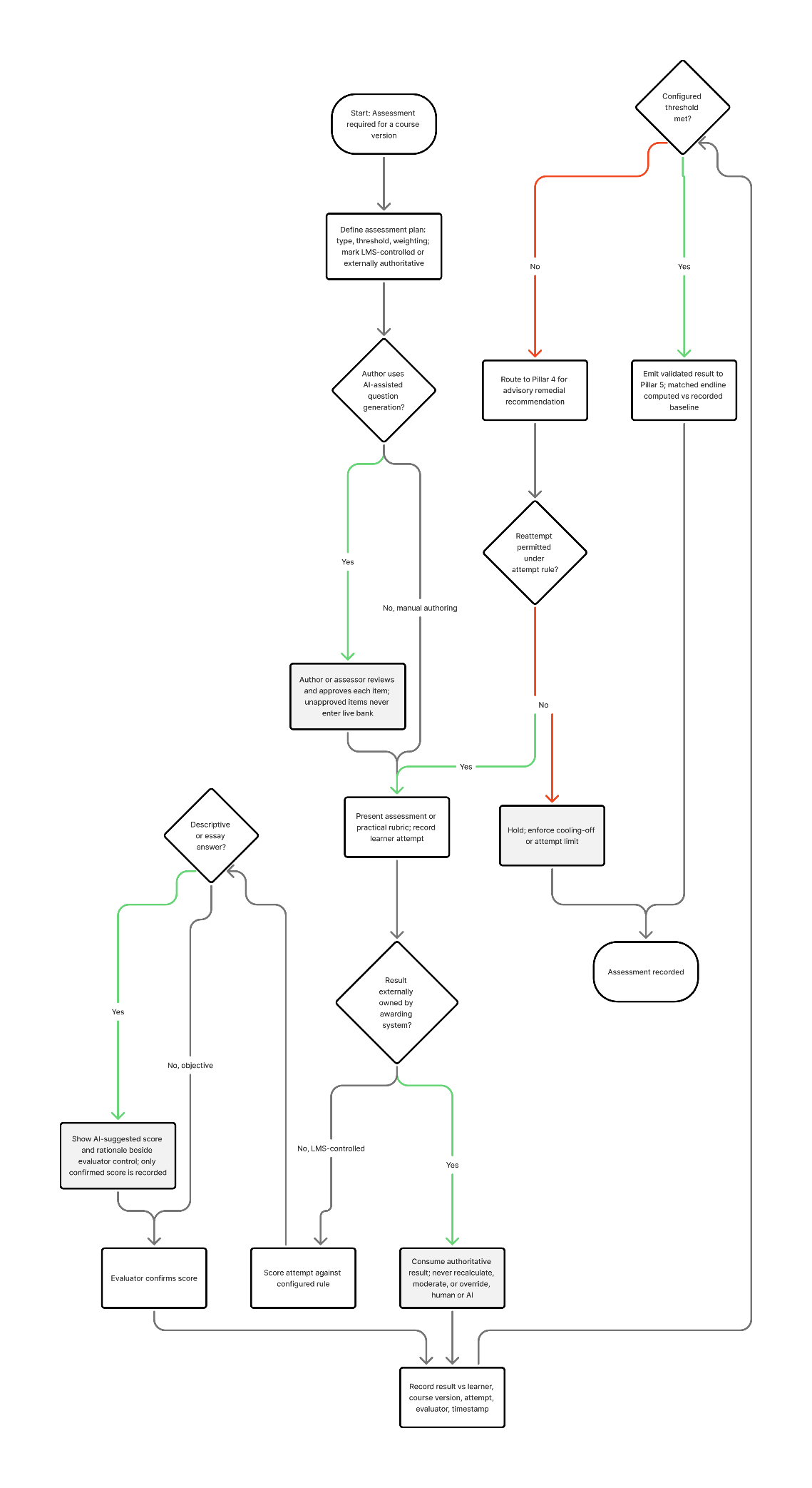
- •Maintain assessment plans against the course version, including assessment type, applicable module
or competency, attempt rule, threshold, and weighting.
- •Record for each assessment whether the result is LMS-controlled or externally authoritative.
- •Define the role permitted to record each practical or mentor evaluation.
- •Schedule assessments within the learner journey and the batch calendar.
- •Support a baseline assessment recorded at course activation and a matched endline assessment
recorded at course completion, both LMS-controlled, using the same question-bank and scoring mechanism as any other assessment type in this pillar.
- •Compute a learning-gain measure as the difference between a learner's endline and baseline result on
matched competencies, presented to the learner, trainer, and institution as a recorded outcome, not an AI-generated estimate.
Assessment content and rubrics
- •Maintain question-bank and assessment-content references with competency, difficulty, and version
metadata.
- •Support multiple assessment formats, including objective, descriptive, practical, and viva components.
- •Maintain practical rubrics with defined criteria and outcome levels for trainer or mentor evaluation.
- •Support import of externally authored assessment content in the agreed interchange format.
Attempt management and scoring
- •Present the assessment to the learner, record the attempt, and preserve the evidence required for
review.
- •Calculate LMS-controlled scores in accordance with the configured rule.
- •Record trainer-evaluated practical outcomes with the evaluating user, rubric version, and timestamp.
- •Apply the configured resume or restart rule where a session is interrupted and record the interruption.
- •Enforce the configured attempt rule, including permitted attempts and any cooling -off period.
Authoritative external results
- •Import formal examination results or status from the authoritative examination or awarding system.
- •Match the imported result to learner, course version, and assessment before accepting it.
- •Present the mapped result without recalculating, moderating, or overriding it, by any component, human
or AI.
- •Expose the received status and its source and freshness to the learner and trainer.
Downstream exposure
- •Expose assessment status to the progress, adaptive-learning, and AI analytics components in read-only
form.
- •Record a re-evaluation or correction as a new controlled event with reason and audit trail.
- •Emit validated assessment events to the learner record and the learning record store.
Functional Capabilities - AI-Assisted Assessment SupportPDF p.29
This capability provides generative and predictive AI assistance to authors, trainers, and assessors across question authoring, adaptive practice, and evaluator support. It does not alter the assessment authority
defined above: every AI-generated or AI-suggested output in this subsection is Advisory or Human-approved, never Authoritative, under the AI output classification defined in Section 6.8.
AI-assisted question and item authoring
- •Generate draft objective, descriptive, and practical questions and plausible distractors aligned to a
defined learning outcome or competency, grounded in the approved course content indexed under Pillar
10.
- •Require author or assessor review and explicit approval before a generated item enters a live question
bank; a generated item is never published without this confirmation.
- •Predict the difficulty level of a bank item or a newly generated item using an item-response model
calibrated on historical response data, presented as an estimate for author review, not a fixed classification.
- •Assemble a test from the approved question bank to match a defined assessment blueprint, subject to
author confirmation before use.
Adaptive assessment (formative use)
- •Where a course administrator explicitly enables it for a formative or practice assessment, adjust question
difficulty in real time based on the learner's responses within that session.
- •Prohibit adaptive difficulty adjustment on any assessment configured as the basis for a certification,
pass/fail, or completion decision, unless the course administrator has explicitly and separately authorized it for that use, in which case the underlying pass rule itself is never altered by the adaptive layer.
AI-assisted evaluator support
- •For descriptive or essay-type answers, generate a suggested score against the defined rubric together
with a stated rationale; display the suggestion alongside, and visually distinct from, the evaluator's own scoring control.
- •Treat the evaluator's confirmed score as the sole recorded result; an AI-suggested score that is not
explicitly confirmed by the evaluator is never recorded as the assessment outcome.
- •Apply defined practical-evaluation rubric to support consistent trainer scoring of practical work,
presented as a scoring aid; the trainer's recorded evaluation remains authoritative.
- •Generate explanatory feedback on assessment performance for learner review, grounded in the specific
items attempted and the applicable rubric or answer key.
- •Analyze recorded response patterns to identify recurring misconceptions and surface assessment-level
analytics against defined learning outcomes for author and institution review.
Assessment-integrity signals
- •Flag a submitted written answer with a likelihood-of-plagiarism signal for evaluator review; the signal
alone does not constitute a finding and does not trigger any automatic penalty.
- •Flag an answer with an indication that it may have been produced by a generative AI tool, presented
strictly as an advisory signal for evaluator review; this indication shall not, by itself, be treated as proof of misconduct, shall never independently trigger a penalty or disciplinary action, and any action taken on the basis of such a flag remains a human evaluator decision, given documented elevated false- positive rates of such detection tools against non-native English writers.
Acceptance CriteriaPDF p.30
- •Every recorded result identifies the learner, course version, assessment, attempt, evaluator or source,
and timestamp.
- •A learner sees the assessment status and feedback permitted by the assessment policy and cannot see
another learner's record.
- •An externally authoritative result is presented without being recalculated by the system or by any AI
capability.
- •Concurrent submission of an attempt does not create a duplicate result.
- •A practical evaluation can be recorded only by the role named in the applicable assessment plan.
- •No AI-generated question enters a live assessment without a recorded author or assessor approval
action.
- •No AI-suggested score becomes the recorded assessment result without an explicit evaluator
confirmation captured in the audit trail.
- •A learner's endline result is only computed against a baseline result recorded for the same learner and
course version; an endline attempted with no matching baseline is flagged rather than silently scored.
Validation RulesPDF p.31
- •Only the role defined in the assessment plan may record a practical evaluation.
- •A completed attempt is immutable; a re-evaluation or correction is recorded as a new controlled event
with reason and audit trail.
- •The system must not record course completion whereas the configured rule requires an authoritative
result that has not been received.
- •An attempt beyond the configured attempt limit shall not be created.
- •An imported result must reference a valid learner, course version, and assessment before it is accepted.
- •Adaptive difficulty adjustment shall not modify the pass threshold or certification requirement of the
assessment it is applied to.
- •AI-generated content that fails an automated quality or grounding check is rejected and is not presented
to an author for approval.
Exception ManagementPDF p.31
| Exception | System Action |
| Assessment session interrupted Imported results cannot be matched | Apply the configured resume or restart rule and record the interruption against the attempt. Quarantine the result for reconciliation and leave the learner record unchanged. |
| Practical evaluation overdue | Show the outstanding evaluation in the learner and trainer view rather than treating the activity as failed. |
| Duplicate result received for the same attempt | Suppress the duplicate, retain it for reconciliation, and alert the integration administrator. |
| Assessment content version withdrawn mid-cycle | Complete in-flight attempts on the delivered version and prevent new attempts on the withdrawn version. |
| AI-suggested score has low confidence | Suppress the suggestion and route the item to full manual evaluation without displaying an AI estimate. |
| AI question-generation service unavailable | Disable the AI authoring aid and allow manual authoring to continue unaffected. |
| Exception | System Action |
| AI-generated item fails grounding or quality check | Reject the item before it reaches author review and log the rejection reason. |
| AI-assisted scoring or authoring model configuration change fails validation | Retain the previous approved model version in service and notify the model owner. |
4.4 Pillar 4: Personalized and Adaptive LearningPDF p.32
The system shall use the learner's recorded progress, assessment performance, completed competencies, and other approved learning signals to recommend the next learning action and to generate a personalized study plan. This capability implements the PM-SETU intent for personalized pathways and intelligent tutoring support, but should not alter the approved curriculum, an official result, or a certification threshold. The learner remains on the approved course; the adaptive layer changes the sequence, pace, or recommendation of supplementary learning within the boundaries configured for that course.
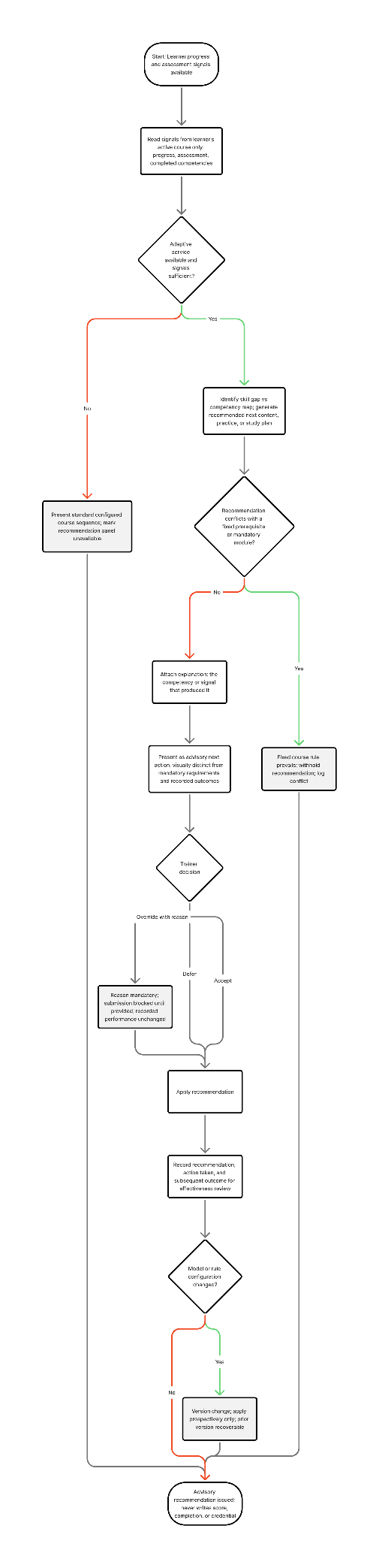
The recommendation is presented to the learner and trainer as an advisory next action. A trainer may accept, defer, or replace the recommendation with an approved alternative, and the action taken is recorded. Every recommendation shall be explainable by reference to the recorded signal that produced it. This pillar is the origin of the AI Governance principles - advisory-only output, explainability, human override, and prospective- only versioning - that Section 6.8 generalizes across every AI capability in this report.
Functional CapabilitiesPDF p.33
Recommendation generation
- •Generate recommended next content, practice, remedial activity,
or revision based on the learner's current course state and configured pedagogic rules.
- •Identify individual skill gaps by reference to the competency map
of the active course version.
- •Recommend both remedial and advanced content according to
demonstrated attainment.
- •Use assessment and progress signals only from records within
the learner's active course.
- •Generate a personalized, time-boxed study or revision plan from
the learner's recorded progress and upcoming assessment schedule, presented as an editable suggestion rather than a fixed obligation.
Difficulty and pace adaptation
- •Adjust the presented difficulty of recommended practice content,
and the suggested pace of a personalized study plan, to the learner's demonstrated ability within the active course.
- •Apply difficulty and pace adaptation only to supplementary and
formative content; never to a mandatory module, assessment threshold, or completion condition.
Boundaries and configuration
- •Permit course administrators to define which modules may be
reordered or supplemented and which are fixed prerequisites.
- •Prevent any recommendation from waiving a mandatory module,
practical activity, assessment, or certification requirement.
- •Prevent the adaptive layer from writing a score, pass or fail
status, completion state, or credential.
- •Version rule and model configuration and apply changes
prospectively only.
Explainability and human control
- •Identify the competency or recorded signal that caused a
recommendation and present a concise reason to the learner and trainer.
- •Distinguish adaptive output visually and structurally from
mandatory requirements and recorded outcomes.
- •Permit a trainer to accept, defer, or override an advisory
recommendation with a reason, without changing the underlying recorded performance.
- •Record recommendation, acceptance, or override and
subsequent outcome so that effectiveness can be evaluated.
Data protection in recommendation
- •Use only the learning signals defined in the approved model configuration for the active course.
- •Do not combine unrelated personal data solely for the purpose of generating a recommendation.
- •Retain the input signal set associated with each recommendation for audit and review.
- •Support periodic review of recommendation quality and of any observed disparity in outcomes across
learner groups.
Acceptance CriteriaPDF p.34
- •Every recommendation is traceable to the active course version and the learner signals used to generate
it.
- •The learner can continue to see the approved learning path even when the recommendation service is
unavailable.
- •Adaptive output is visibly distinguished from formal requirements and recorded outcomes.
- •A trainer override is recorded with reason and does not alter the recorded performance that prompted
the recommendation.
- •Model and rule versions in force at the time of each recommendation are recoverable.
Validation RulesPDF p.34
- •No recommendation may waive a mandatory module, practical activity, assessment, or certification
requirement.
- •A recommendation cannot write a score, pass or fail status, completion state, or credential directly.
- •Model and rule changes are versioned and applied prospectively to recommendations generated after
activation.
- •Where a recommendation conflicts with a fixed prerequisite or trainer restriction, the fixed course rule
prevails.
- •Recommendation output shall not be presented to any stakeholder as an assessment result.
Exception ManagementPDF p.34
| Exception | System Action |
| Adaptive service unavailable | Present the standard configured course sequence and mark the recommendation panel as unavailable. |
| Input data incomplete or stale | Suppress the recommendation or mark it unavailable rather than inferring from missing data. |
| Recommendation conflicts with a fixed prerequisite Model configuration change fails validation Trainer override recorded without reason | Apply the fixed course rule, withhold the recommendation, and log the conflict. Retain the previous approved version in service and notify the model owner. Prevent submission and require the reason before the override is applied. |
4.5 Pillar 5: Learner Progress TrackingPDF p.35
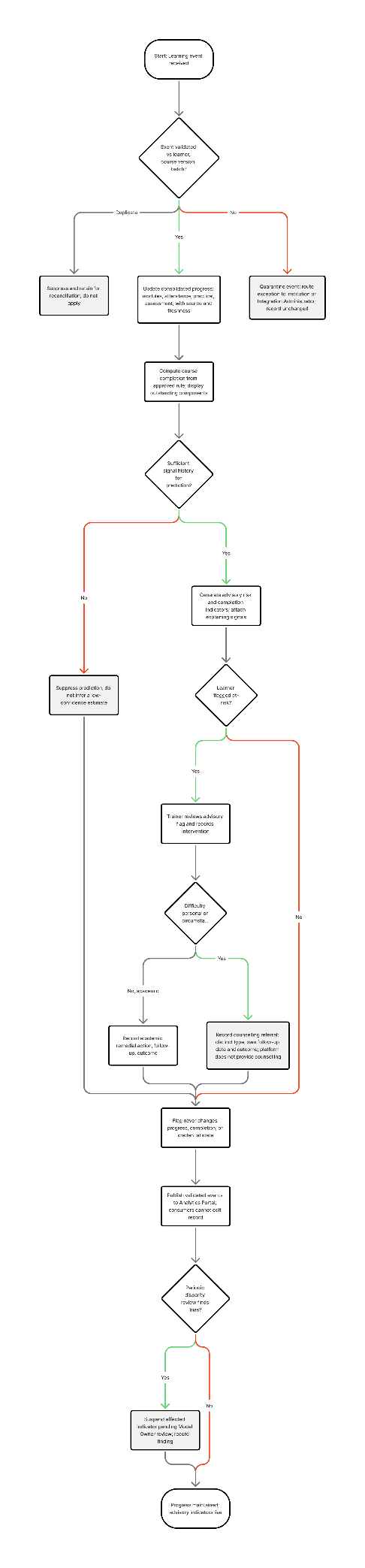
The system shall maintain the operational record of a learner's advancement through the assigned course and support timely intervention by the learner's institution. It shall consolidate module completion, attendance, practical evidence, assessment status, interventions, and completion criteria into a single course-level record while retaining the source of each event, and shall generate firm, advisory, explainable AI predictive indicators to support earlier institutional intervention.
The progress record is the basis for the learner dashboard and for operational hand-off to the Analytics Portal. Program-wide aggregation and threshold analytics are performed in that portal and are not duplicated here.
This pillar consolidates the learner's progress record, but does not itself perform registration, baseline assessment, or career-path discovery - each of these sits at a different, earlier or later stage of the same learner lifecycle this pillar tracks. Registration and enrollment are resolved, and every staff and partner user is provisioned, before any learning activity is created (Pillar 7). Where the course requires it, a baseline assessment is recorded at course activation and a matched endline assessment at course completion (Pillar 3), with the resulting learning-gain measure available alongside the progress this pillar maintains. Advisory career path discovery, job-matching, and labor- market-informed guidance, built from the same recorded evidence this pillar consolidates, are provided in Pillar 11.
Functional Capabilities - Progress TrackingPDF p.35
Progress state maintenance
- •Maintain module and activity status, attendance, practical
evidence, assessment status, and intervention history for each learner and course version.
- •Calculate course completion from the approved completion rule
and display the components still outstanding.
- •Present competency or skill-gap status where the course is
mapped to competencies and the evidence required for attainment is available.
- •Maintain the state separately for each active course where a
learner is enrolled in more than one.
Event validation and lineage
- •Update progress only from events validated against the learner,
course version, batch, and activity.
- •Retain the source identifier, recording user or system, and
freshness timestamp for every event.
- •Suppress and retain duplicate events for reconciliation rather
than applying them.
- •Record a correction as a subsequent event with source and reason, preserving the original evidence.
Intervention
- •Permit authorized trainers and institution users to record an intervention, the action agreed, and the
follow-up date, preserving the history of prior interventions.
- •Support recording a referral to institution-level psychosocial or personal counselling support as a distinct
intervention type, separate from academic remediation, with its own follow-up date and outcome; the platform records the referral and its outcome and does not itself provide counselling.
- •Record dropout or discontinuation with the recorded reason and retain the learner's history.
Publication to monitoring
- •Publish validated learning events and reconciliation status to the Analytics Portal or program monitoring
layer.
- •Expose the source and freshness of each published event.
- •Prevent any analytics or monitoring consumer from editing the progress record.
- •Support scheduled and event-driven publication according to the agreed interface.
Functional Capabilities - AI Analytics and PredictionPDF p.36
This capability replaces the general notion of “predictive or risk indicators, where used” with a firm, specified requirement. Every output in this subsection is Advisory: it informs a trainer or institution decision and never itself changes progress, completion, or credential state.
Predictive indicators
- •Generate an advisory dropout or attrition risk indicator for each learner from validated attendance,
progress, and engagement signals.
- •Generate advisory completion-likelihood, assessment-performance, and engagement-level indicators
from the same validated signal set.
- •Explain each indicator with reference to the specific signals that produced it, in the same manner as the
Pillar 4 recommendation explainability requirement.
- •Suppress a prediction rather than infer one where the learner's signal history is insufficient or stale.
At-risk identification and intervention support
- •Flag learners who require attention based on configured operational conditions, informed by the
predictive indicators above, such as low attendance, stalled progress, or repeated assessment difficulty.
- •Present every predictive or risk indicator as advisory rather than determinative, on every screen where
it appears.
- •Group learners with similar identified gaps to support targeted remedial sessions, as an advisory
grouping only.
Institution and cluster analytics
- •Analyze cohort- and behavior-pattern trends across batches, institutions, or clusters for institution and
SPV review, presented through Pillar 8.
- •Analyze which courses or content are associated with better learner outcomes, for author and
administrator review.
- •Generate prescriptive institutional recommendations from predicted cohort outcomes; such
recommendations are advisory only and are never executed automatically.
Governance of predictive analytics
- •Apply periodic disparity review of prediction outcomes across language, region, gender, and institution
type, consistent with Section 6.8.
- •Retain the input signal set associated with each prediction for audit and review, consistent with the data-
minimization principle already established in Pillar 4.
Acceptance CriteriaPDF p.37
- •The learner and trainer see the same underlying recorded progress for the active course, subject to role-
appropriate detail.
- •Course completion reconciles with the mandatory learning and assessment requirements of the active
course version.
- •Every externally supplied learning event retains its source identifier and timestamp.
- •An outstanding component is visible to the learner as pending, with the specific dependency named.
- •Intervention history is retained in full and is attributable to the recording user.
- •Every predictive indicator is explainable by reference to the signals used and is visually distinguished
from a recorded outcome.
- •No predictive indicator, by itself, changes a learner's progress, completion, or credential state.
Validation RulesPDF p.37
- •Progress is updated only from validated events linked to the learner, course version, and batch.
- •A corrected event does not delete the original audit evidence; the correction is recorded with source and
reason.
- •Analytics and monitoring consumers, including AI prediction services, cannot edit the progress record.
- •Completion shall not be completed while the required authoritative result is absent.
- •An event whose timestamp precedes the batch activation date shall not be applied without review.
- •A prescriptive institutional recommendation shall not trigger an automated action without an explicit
administrator’s decision.
Exception ManagementPDF p.37
| Exception | System Action |
| Event missing or delayed | Show the affected component as pending rather than inferring completion. |
| Duplicate events received Required authoritative result absent Event received for an unknown learner or batch | Suppress the duplicate and retain it for reconciliation. Hold the learner at pending completion and display the missing dependency. Quarantine the event and route the exception to the institution or integration administrator. |
| Attendance conflicts with a recorded practical evaluation Insufficient signal history for a prediction | Flag the inconsistency for institution review and leave both records intact. Suppress the prediction rather than generate a low-confidence estimate. |
| Predictive model shows disparity in a periodic review | Suspend the affected indicator pending review by the model owner and record the finding. |
| Exception | System Action |
| Counselling referral recorded with no outcome by its follow-up date | Surface the overdue referral in the trainer and institution view rather than close it silently |
4.6 Pillar 6: Certification and BadgesPDF p.38
The system shall recognize learner completion and present the status of credentials arising from the learning journey. It shall support completion certificates, digital badges, and stackable micro-credentials where the program permits them, and shall map formal credentials issued by the designated awarding body. The system
shall not create a competing formal certificate where an external awarding system is authoritative, and no AI capability in this report is permitted to issue, alter, or influence a credential decision.
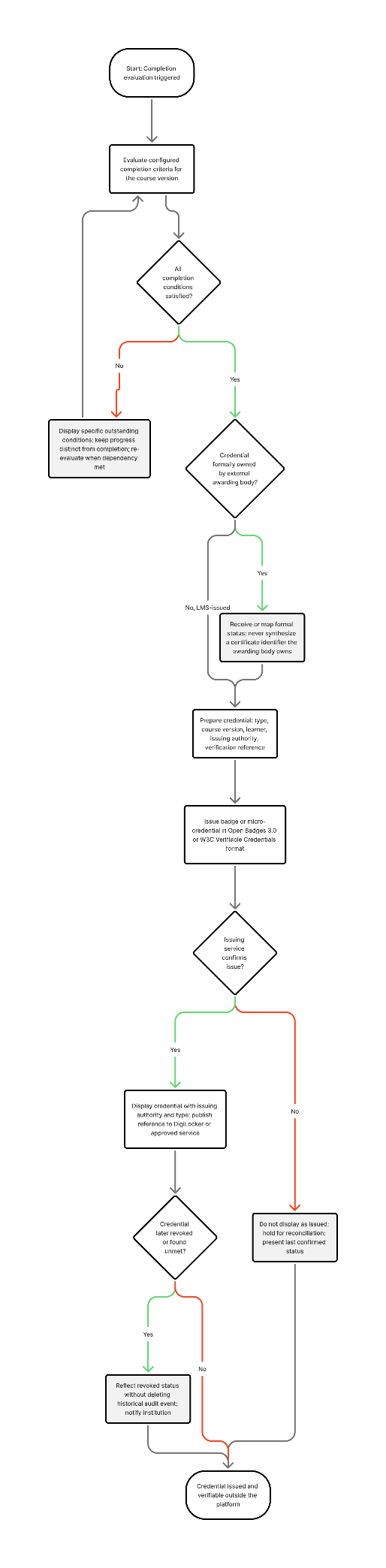
The learner sees credential status in the same workspace as learning progress, with a verifiable reference or link to the authoritative credential service where one is available.
Functional CapabilitiesPDF p.39
Completion evaluation
- •Evaluate the configured completion criteria before creating any
completion certificate or badge.
- •Display the specific conditions outstanding where completion
criteria are not satisfied.
- •Distinguish course progress from course completion in every
learner-facing presentation.
- •Re-evaluate completion automatically when an outstanding
dependency is subsequently satisfied.
Credential issuance and mapping
- •Maintain credential type, course version, learner, issue date,
issuing authority, status, and verification reference.
- •Map issued certificates to the applicable NSQF qualification level
where the credential is so aligned.
- •Support stackable module badges and micro-credentials for
partial completion where approved for the course.
- •Receive or map formal certification status from the designated
awarding system and present it without changing the authoritative record.
Verification and standards
- •Generate a learner-facing verification reference or machine-
readable code where the credential service and program policy permit it.
- •Issue digital badges and micro-credentials in an open, verifiable
format aligned to Open Badges 3.0 or W3C Verifiable Credentials.
- •Expose the issuing authority and credential type on every
credential presented.
- •Support publication of the credential reference to an approved
credential service.
Lifecycle and revocation
- •Reflect a revoked or corrected credential status without deleting
the historical audit event.
- •Publish credential events to the learner progress record and
downstream consumers after successful validation.
- •Retain the completion evidence that supported issuance for the applicable retention period.
- •Prevent presentation of a credential as issued before the issuing service confirms issue.
Acceptance CriteriaPDF p.40
- •A credential is not shown as issued until the issuing or authoritative service confirms issue.
- •Every credential presented to the learner identifies the issuing authority and credential type.
- •A revoked or corrected credential status is reflected without deleting the historical audit event.
- •A badge or micro-credential is verifiable by a party outside the platform.
- •Course progress is never presented as a complete qualification.
Validation RulesPDF p.40
- •Credential issuance requires all completion conditions defined for that credential type.
- •The system must not synthesize a formal certificate identifier where the awarding body owns that
identifier.
- •External credential references are validated for learners and courses or qualification match before
display.
- •A micro-credential shall not be represented as a formal qualification unless the approving authority has
defined it as such.
- •A credential cannot be issued against a course version other than the one the learner completed.
Exception ManagementPDF p.40
| Exception | System Action |
| Credential service unavailable External credential does not match the learner or course reference | Present the last confirmed status and indicate that verification is temporarily unavailable. Hold the credential for reconciliation and do not display it as issued. |
| Credential revoked by the issuing authority | Reflect the revoked status in the learner display and downstream events while retaining audit history. |
| Completion conditions subsequently found unmet | Suspend the credential display, notify the institution, and record the reason. |
| Duplicate credential received for the same learner and course | Suppress the duplicate and raise a reconciliation exception. |
4.7 Pillar 7: Digital Identity and Credential IntegrationPDF p.40
The system shall link the learner record to approved national identity, profile, and credential services so that a learner is not required to maintain a separate identity for each learning function. It shall provide identity resolution, role and entity mapping, consent and data-minimization controls, and governed connectors to the approved identity, credential, and academic credit services.
This component links and authorizes; it does not replicate. Identity source data, credential documents, and external credential ledgers remain in their designated systems, and the platform stores only the identifiers, status, and references required to render the learner journey and prove the source of the information.
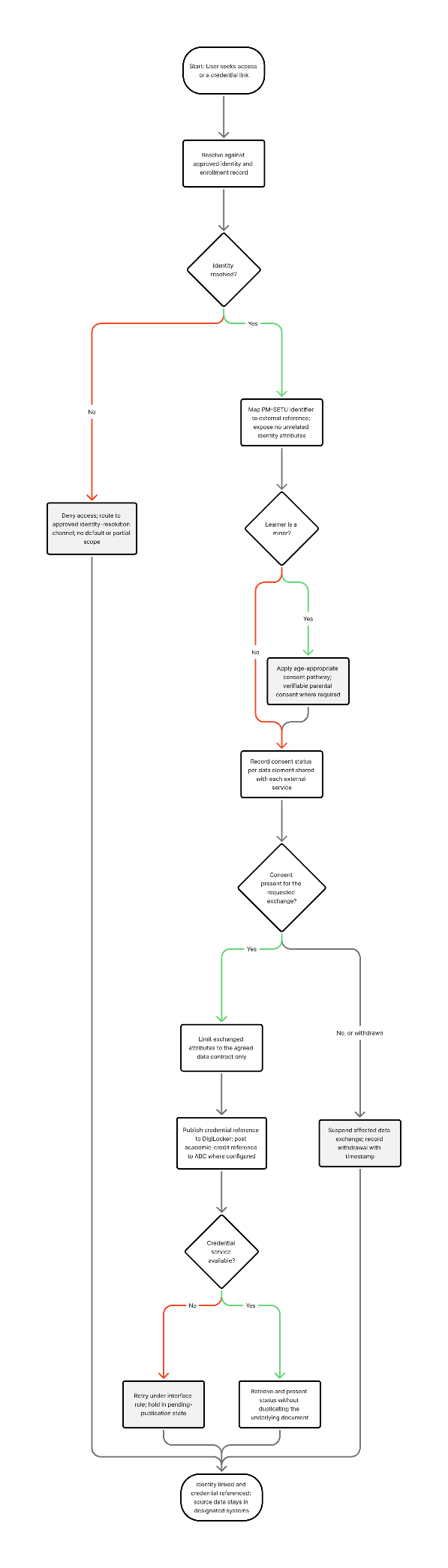
Functional CapabilitiesPDF p.41
Identity resolution and role mapping
- •Resolve every learner to the approved learner identity
and enrollment record before any learning activity is created.
- •Resolve every staff and partner user to a provisioned
role, institution, and organization before granting access.
- •Maintain the mapping between the PM-SETU identifier
and the external identity reference without exposing unrelated identity attributes.
Consent and data minimization
- •Record consent status for the specific data elements
shared with each connected external service.
- •Limit the profile attributes exchanged with any external
service to the agreed data contract.
- •Apply the age-appropriate consent pathway required
under applicable data-protection law where the learner is a minor, including verifiable parental consent where required.
Credential and academic-credit linkage
- •Publish the reference to an issued credential to the
approved credential service, such as DigiLocker, where enabled.
- •Post academic-credit references to the Academic Bank
of Credits where the course and program are so configured.
- •Retrieve and present the status of a credential or credit
posting without duplicating the underlying document.
Acceptance CriteriaPDF p.41
- •A user cannot access any learning record before identity
resolution succeeds.
- •Consent status is recorded for every data element
shared with an external service.
- •A credential or credit reference presented to the learner
matches the confirmed status of the issuing service.
Validation RulesPDF p.41
- •Identity resolution failure prevents access rather than
granting a default or partial scope.
- •Data exchanged with an external service is limited to the
fields defined in the agreed contract.
- •A minor's data is processed only within the consent pathway required by applicable law.
Exception ManagementPDF p.42
| Exception | System Action |
| Identity cannot be resolved Consent withdrawn | Deny access and route the learner or user to the approved identity- resolution channel. Suspend the affected data exchange and record the withdrawal with timestamp. |
| Credential service unavailable at publication | Retry under the agreed interface rule and hold the credential in a pending-publication state. |
4.8 Pillar 8: Student Lifecycle Dashboards and ManagementPDF p.42
The system shall provide the learner-facing and institution-facing consolidation of the learning record. It shall present the learner's active course, next action, progress, assessment status, skills, credentials, and lifecycle milestones from enrollment through on-the-job training or apprenticeship to completion. The same operational record shall be available to the learner's trainer and institution at the level required to support delivery and intervention.
This component is intentionally limited to the learner and institution operational journey. State, national, fiduciary, and cross-system dashboards are delivered through the Analytics Portal and are not recreated here. Administrative AI outputs - natural-language reporting, report summaries, anomaly and duplicate detection, and support-ticket classification - are processed by the shared Admin AI service in the Platform Layer (Section 5.2) and are presented to institution and program administrators through this pillar; the underlying processing does not reside here.

Functional CapabilitiesPDF p.43
Learner workspace
- •Present a learner home showing active course and batch, current
module, next required action, next recommended action, progress, upcoming assessment, skills profile, and credential status.
- •Provide a chronological lifecycle view covering enrollment, course
activation, learning milestones, assessments, interventions, completion, credential status, and opportunity hand-off.
- •Present only those opportunities and support actions relevant to the
learner's approved program context and integration scope.
- •Allow the learner to view or download the learner's own progress
statement and credential references where permitted.
Trainer and institution views
- •Provide the trainer with a batch-level operational view of learner
progress, pending evaluations, and interventions.
- •Provide the institution with a view of active and upcoming courses and
batches, trainer and learner assignment status, delivery and assessment readiness, and unresolved exceptions, including AI- flagged data-quality exceptions.
- •Restrict every view to the assigned institution, courses, batches, and
learners.
- •Support export of institution-scoped operational reports, including AI-
generated report summaries reviewed before circulation, in standard formats.
Attrition and lifecycle indicators
- •Track discontinuation and attrition with the recorded reason and retain
the learner's history.
- •Present lifecycle stage and elapsed duration against the planned batch
calendar.
- •Surface learners whose lifecycle has stalled at a specific stage for
institution follow-up, informed by the Pillar 5 predictive indicators.
- •Distinguish advisory risk and predictive indicators from recorded
outcomes in every presentation.
Data quality and transparency
- •Expose data-quality and missing-dependency status in plain language
rather than displaying an incomplete record as complete.
- •Derive every displayed status from an operational record or an
explicitly stored workflow state; no AI-generated summary is treated as a new source of truth.
- •Show the freshness of externally sourced status on the screen where
it appears.
- •Retain the last confirmed state where a source component is
unavailable and identify the affected element as pending or stale.
Cohort engagement recognition
- •Present an opt-in, batch-scoped ranking of learners by recorded completion metrics such as module
completion and attendance; participation is off by default and never affects any mandatory requirement, assessment, or credential.
- •Scope the ranking to the learner's own batch only; no cross-institution, cross-cluster, or national ranking
is presented anywhere on the platform.
- •Display a learner who is a minor by first name and initial, or by a self-selected pseudonym, never by full
name or any identifying detail beyond what the learner's own batch-mates already see in the classroom; enrollment in this feature for a minor follows the same age-appropriate consent pathway already specified in Pillar 7.
- •This capability computes a ranked display from recorded data only; it performs no inference, prediction,
or behavioral analysis, and is accordingly not subject to the AI Governance classification in Section 6.8 or listed in Annexure B.
Acceptance CriteriaPDF p.44
- •The learner home loads the latest successfully reconciled operational state and identifies any pending
external dependency.
- •The learner sees only the learner's own record; trainer and institution scope is limited to assigned
learners and the institution.
- •Lifecycle status agrees with the underlying progress, assessment, and credential records.
- •A learner enrolled in more than one course can select and view each journey independently.
- •Every displayed metric can be traced to the operational record from which it was derived.
•
Validation RulesPDF p.44
- •No dashboard field may become a separate source of truth; every status is derived from an operational
record or an explicitly stored workflow state.
- •Predictive or adaptive recommendations are visually distinguished from mandatory next actions and
recorded outcomes.
- •Program-wide aggregation is not performed in this component.
- •A view shall not return data outside the authenticated user's entity scope.
- •A stale externally sourced value shall be labeled with the time of its last successful synchronization.
Exception ManagementPDF p.44
| Exception | System Action |
| Source component unavailable | Retain the last confirmed state and identify the affected element as pending or stale. |
| AI-generated report summary requested but service unavailable | Present the underlying operational data without a summary rather than delay the report. |
| Anomaly detection flags a record incorrectly A learner withdraws consent or opts out of cohort ranking | Retain the unchanged record pending administrator review; the flag does not itself alter any record. Remove the learner from the ranking display immediately; retain their underlying progress data unaffected |
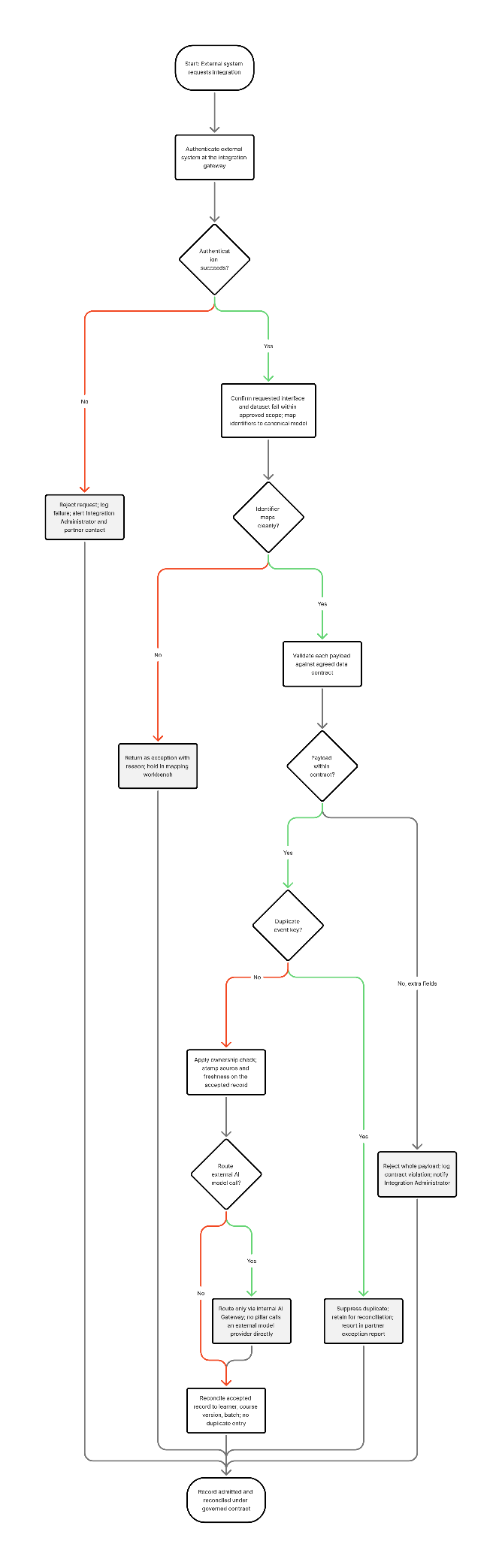
4.9 Pillar 9: Interoperability and IntegrationPDF p.45
This component provides the integration gateway, the canonical identifier model, the learning record store, and the reconciliation controls that make both a connected-platform partner and a content-only partner safe to admit. It also governs integration with the approved identity channel, the designated awarding and examination services, credential services, the National Career Service, Skill India Digital Hub, Bhashini/AI4Bharat language services, and opportunity services. The requirements are expressed against open standards and published interfaces so that any conformant platform, whether open-source, commercial, or partner-built, can be admitted through the same route.
Functional CapabilitiesPDF p.45
Integration gateway
- •Authenticate the external system, confirm that the
requested interface and dataset fall within the approved scope, and map identifiers to the canonical model.
- •Validate each payload against the agreed
contract, apply duplicate and ownership checks, manage retries and quarantine, and stamp source and freshness on every accepted record.
The table below sets out the required integrations, their purpose, and the information exchanged.
| Integration Identity and access management | Purpose Centralized authentication and user management | Data / Information Exchanged Authentication tokens, role and organization assertions, access roles |
| Learner identity and enrollment channel Curriculum and qualification services | Resolution of the learner to an approved identity and enrollment record Alignment of course structures to approved national qualification standards | Learner identity reference, enrollment context, verification status Trade and qualification master, NSQF level, QP-NOS reference, approved curriculum material |
| Examination and awarding services | Consumption of authoritative formal results and certificate status | Examination result, result status, certificate identifier, issue and revocation status |
| Connected partner learning platforms | Exchange of learner activity owned by a partner-operated learning system | Roster and enrollment, module completion, assessment results, practical and mentor evaluations, credential references |
| Content sources and partner repositories | Ingest and remote launch of approved learning resources | Content packages, launch endpoints, item banks, rights, version, language, and accessibility metadata |
| Credential services National Career Service and Skill India Digital Hub | Credential custody and academic credit referencing Career, job-matching, and labor- market intelligence federation for Pillar 11 | Credential references, issue and revocation status, academic credit postings Skills profile reference, job and apprenticeship listings, labor- market demand data, career- pathway data |
| Bhashini / AI4Bharat language services Opportunity and apprenticeship services | Indian-language speech-to-text, text- to-speech, and translation for AI- enabled learner-facing capabilities Lifecycle hand-off from training to on- the-job training, apprenticeship, or employment | Text and speech content for translation or synthesis, supported- language list, confidence indicators Opportunity references, placement and apprenticeship status, outcome return |
| Analytics Portal and program monitoring External AI model provider(s) | Publication of validated learning events for program oversight Underlying generative and predictive model services accessed through the internal AI Gateway | Validated learning, assessment, completion, credential, and predictive-indicator events with source and freshness Prompt and context payloads scoped to approved content; model responses; no learner-identifying data beyond the minimum required for the request |
Integration Purpose Data / Information Exchanged
| Integration | Purpose | Data / Information Exchanged |
| Notification services | Learner, trainer, and administrator communication | Assessment and session reminders, exception notifications, credential status updates |
| Document and object storage | Storage and retrieval of learning resources and submitted evidence | Learning assets, practical evidence, assessment submissions, supporting documents |
Partner onboarding
- •Register a connected-platform partner's interface, scope, and data contract, and configure the
connector, credentials, and identifier mapping.
- •Register a content-only partner's submission together with its rights and metadata and register the
package or launch method.
- •Require academic review and approval of the course and content mapping before activating the
integration or publishing the content.
Acceptance CriteriaPDF p.47
- •A record imported from a connected platform reconciles to the same learner, course version, and batch
without duplicate entry.
- •Conformance of each supported standard - LTI 1.3, SCORM, xAPI, cmi5, QTI 3.0, OneRoster, and Open
Badges - is demonstrated against a reference implementation before a partner connector is accepted.
- •A partner operating its own learning platform and a partner contributing content alone can each be
onboarded end to end in a pre-production environment.
Validation RulesPDF p.47
- •An unmapped or ambiguous partner identifier is held as an exception rather than published.
- •A payload containing fields outside the agreed data contract is rejected, not partially accepted.
- •The external AI model provider integration is abstracted behind the internal AI Gateway; no pillar calls
an external model provider directly.
Exception ManagementPDF p.47
| Exception | System Action |
| Connector authentication fails | Reject the request, log on the failure, and alert the integration administrator and the partner contact. |
| Identifier cannot be mapped | Return the record as an exception with reason and hold it in the mapping workbench. |
| Event fails validation | Quarantine the event with reason and source reference; leave the learner record unchanged. |
| Duplicate event key received | Suppress the duplicate, retain it for reconciliation, and report it in the partner exception report. |
| Partner interface unavailable | Apply the agreed retry rule, mark dependent status as stale, and escalate on breach of the agreed window. |
| Exception | System Action |
| Payload contains fields outside | Reject the payload, log the contract violation, and notify the |
| the data contract | integration administrator. |
4.10 Pillar 10: AI Learning AssistancePDF p.48
The system shall provide conversational and generative assistance to learners and trainers, grounded exclusively in the approved content of the active course version, to reduce dependency on trainer availability for routine doubt resolution and to support study, revision, and content preparation. This pillar did not exist in the prior baseline; it is introduced because no other pillar in this report owns grounded conversational or generative assistance, and because the market evidence reviewed for this program (Section 4.10.5) demonstrates that such assistance is now a mature, evidenced capability in both global and Indian learning platforms.
Every capability in this pillar operates under the Advisory or Human-approved classification defined in Section 6.8. The AI Learning Assistance capability never marks an activity complete, never records an assessment outcome, and never issues or influences a credential.
4.10.1 Purpose and ScopePDF p.48
- •Purpose: to close the gap identified in Section 2.3 between a dispersed, multilingual ITI learner
population and the availability of a trainer, by providing course-grounded assistance that a learner or trainer can consult on demand.
- •Primary users: learners, for course Q&A, explanations, and study aids; trainers, for content Q&A and
session-preparation drafting.
- •Secondary users: institution administrators, who configure whether the capability is enabled for a given
course or batch.
- •Expected outcome: reduced unresolved-doubt turnaround and improved self-directed study support,
without any change to the mandatory course sequence, assessment outcome, or completion condition.
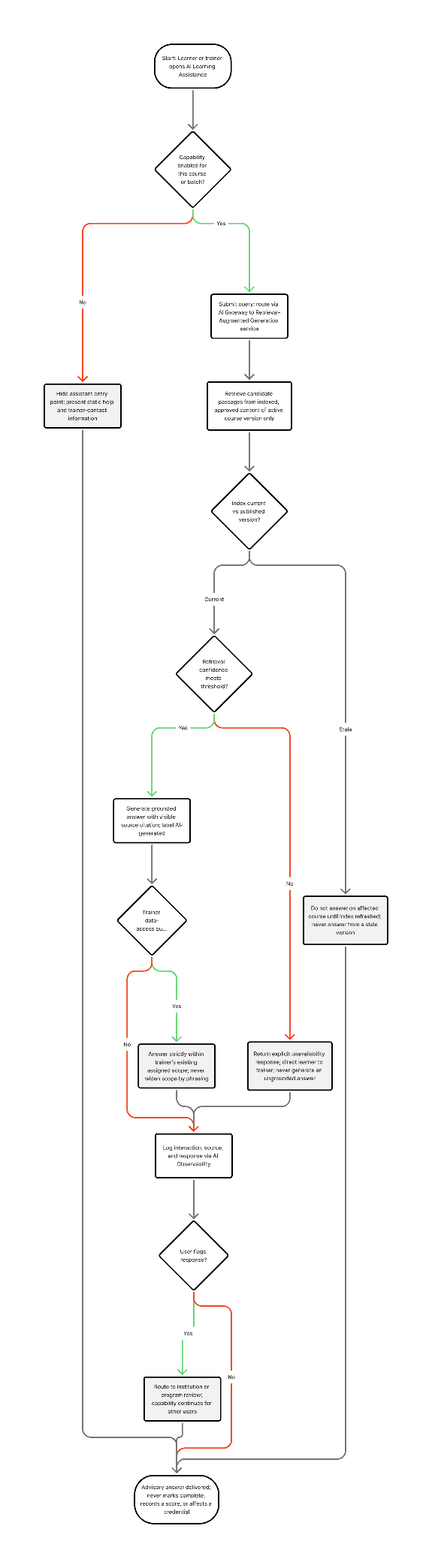
4.10.2 Functional CapabilitiesPDF p.49
AI Course Q&A Assistant and Conversational Tutor
- •Answer a learner's question using content retrieved
exclusively from the approved, published content of the learner's active course version.
- •Present the source passage or a citation to the source
alongside every generated answer.
- •Where no sufficiently relevant approved content is
retrieved, or retrieval confidence falls below the configured threshold, respond with an explicit statement that the assistant cannot answer from approved course content and direct the learner to the trainer, rather than generating an unsupported answer.
- •Support a guided, Socratic-style interaction mode for
tutoring contexts, in which the assistant offers hints, questions, and partial explanations rather than a complete solution, configurable by the institution.
- •Adapt the assistance offered to the learner's current
module and progress state within the active course.
Study and revision support
- •Generate concise summaries of approved course content
for learner revision, on request.
- •Generate flashcards from approved course content to
support spaced-repetition study, on request.
- •Generate a tailored explanation of a specific concept,
matched to the learner's demonstrated level within the course, on request.
- •Generate practice questions matched to a learner's
identified gaps, drawing on the same generation Send configurable engagement prompts, triggered by a defined condition such as elapsed inactivity since last access or an approaching assessment deadline, to encourage consistent study habits.
- •Cap prompt frequency per learner per configured period,
so encouragement does not become intrusive; a learner may disable engagement prompts entirely without affecting access to any mandatory course function.
- •Prompts draw only from the learner's own recorded
progress and course schedule; no prompt is generated from, or contributes to, a behavioral profile of a learner who is a minor, consistent with Section 6.8.
- •capability specified for formative assessment support in
Pillar 3, on request.
Trainer-facing assistance
- •Draft a session plan or supporting training material from approved course content, for trainer review
before use.
- •Answer a trainer's question about course content, sequencing, or delivery guidance, grounded in the
same approved content corpus.
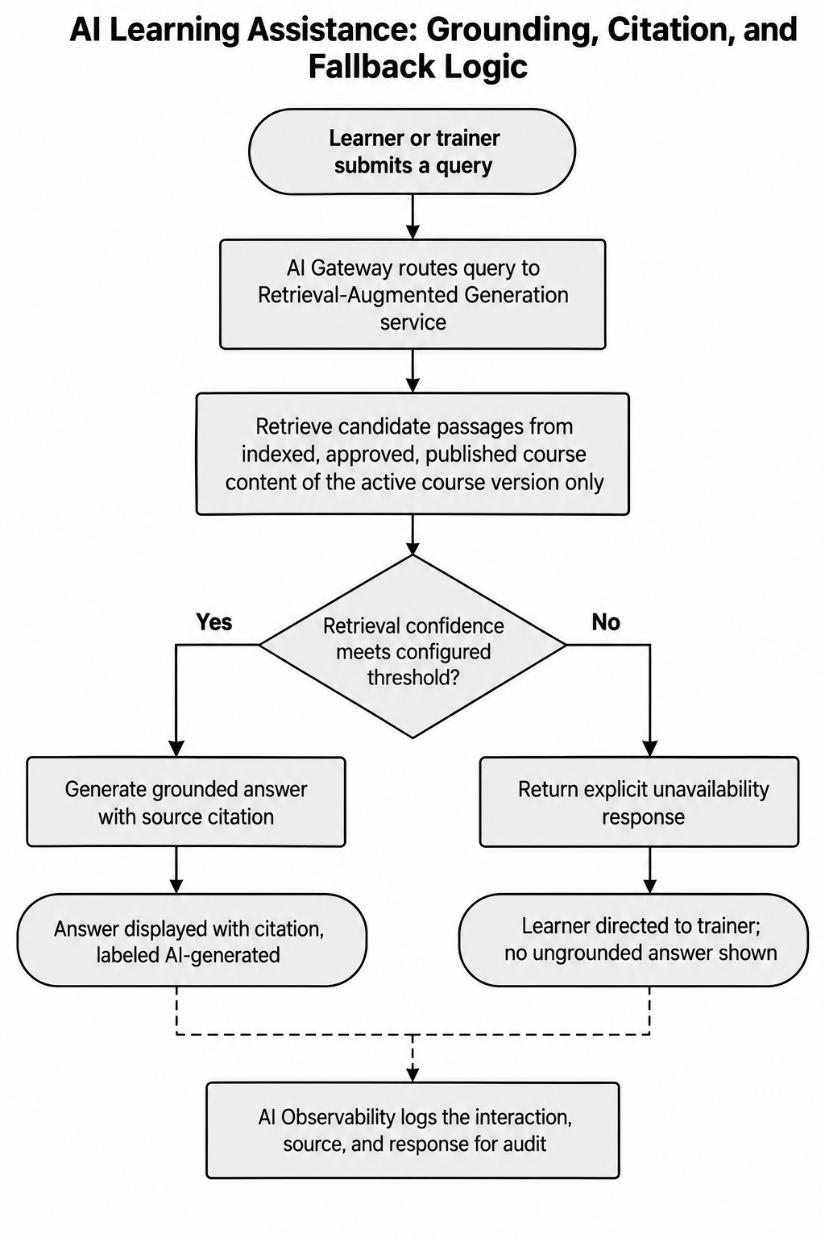
- •Provide role-scoped, natural-language
access to the trainer's own assigned learner and batch data, strictly within the trainer's existing Pillar 5 and Pillar 8 access scope; this capability never exposes data outside that scope regardless of how the query is phrased.
Search and discovery
- •Provide natural-language search across
the approved course and qualification catalogue maintained in Pillar 1.
- •Provide conversational, in-course search
(Ask My Course”) that answers from the specific course's approved content, as a distinct corpus from the catalogue-wide search above.
On-demand generation
- •Generate a quiz or exercise from
approved course content on learner or trainer request, for formative, self-check use.
- •Route a request to convert an on-demand
quiz into a graded, LMS-controlled assessment through the AI-Assisted Assessment Support authoring workflow specified in Pillar 3, which requires author or assessor approval before any such item is used for a graded outcome.
4.10.3 AI Behavior, Data, and Human ControlPDF p.50
| Dimension | Specification |
| AI Behavior | Retrieval-augmented generation grounded in the indexed, approved, published content of the active course version; generative for summaries, flashcards, explanations, practice items, and drafts; conversational for Q&A and search. |
| Inputs | Learner or trainer query; the learner's current module and progress context; the indexed approved-content corpus for the active course; for trainer data- access queries, the trainer's existing assigned scope. |
| Outputs | A grounded, cited answer or an explicit unavailability response; a generated summary, flashcard set, explanation, practice item, or draft, labeled as AI- generated wherever displayed. |
| Dimension | Specification |
| Human Control | The institution can disable the capability per course or batch; the learner or trainer can flag an unhelpful, incorrect, or inappropriate response for review; a trainer-drafted item or plan requires trainer review before use; no output from this pillar is applied to a learner's record without a separate, explicit action in the pillar that owns that record (Pillar 3, Pillar 4, Pillar 5). |
| Output Classification Data Used | Advisory for all conversational, search, and study-aid outputs; Human- approved for any content drafted for reuse as instructional or assessment material. Approved, published course content only; the learner's own progress and module context; no combination with unrelated personal data. |
| Integration Dependencies | RAG / Knowledge Base and Vector Search, AI Gateway, Model Registry, Guardrails, and Multilingual/Speech Service in the Platform Layer (Section 5.2); Course Management (Pillar 1) and Content Delivery (Pillar 2) as the source of the indexed corpus. |
Acceptance CriteriaPDF p.51
- •Every displayed AI-generated answer is traceable to a cited source passage within the approved content
of the active course version.
- •The assistant issues an explicit unavailability response, rather than an ungrounded answer, when no
sufficiently relevant approved content is retrieved.
- •The institution can disable the AI Learning Assistance capability at course or batch level, and the
standard learner and trainer experience is unaffected when it is disabled.
- •A trainer-facing natural-language data query never returns data outside the trainer's existing assigned
scope.
- •All AI-generated content is visibly labeled as AI-generated wherever it is displayed to a learner or trainer.
Validation RulesPDF p.51
- •Content is retrieved and cited only from published content of the active course version; unpublished or
superseded content is never surfaced.
- •A response below the configured retrieval-confidence threshold is suppressed and replaced with the
unavailability response.
- •No AI Learning Assistance output can mark a module or activity complete, record an assessment
outcome, or affect a credential.
- •A quiz or exercise generated under this pillar is treated as formative unless and until it is separately
approved through the Pillar 3 AI-assisted authoring workflow.
Exception ManagementPDF p.51
| Exception | System Action |
| AI Learning Assistance service unavailable | Hide the assistant entry point and present static help and trainer- contact information in its place. |
| Retrieval confidence below threshold | Suppress the generated answer and present the explicit unavailability response. |
| Exception Course content indexed corpus out of date relative to the published version | System Action Prevent the assistant from answering on the affected course until the index is refreshed, rather than answering from a stale version. |
| Learner or trainer flags a response as incorrect or inappropriate | Record the flag with the response and route it to institution or program review; the capability continues to operate for other users. |
| Bhashini / multilingual service unavailable for a requested language Engagement prompt frequency cap reached AI Learning Assistance model or rule configuration change fails validation | Fall back to the default supported language and indicate that the requested language is temporarily unavailable. Suppress further prompts for the remainder of the configured period rather than continue sending them Retain the previous approved version in service and notify the model owner. |
Exception System Action
4.10.5 Market Evidence ConsideredPDF p.52
The introduction of this pillar is supported by evidence gathered during program research rather than by assumption. Khan Academy's Khanmigo assistant, built on a large language model and grounded in Khan Academy's own content library, uses a guided Socratic interaction design and reported substantial adoption growth across partner school districts between the 2023-24 and 2024 - 25 school years, per Khan Academy's own published account. In the Indian market, Physics Wallah's AI Guru assistant, built on a large language model with retrieval grounded in curated content, is reported by the provider to have reached a large user base within two months of launch, with a self -reported academic-query satisfaction rate; this figure is a provider claim and is presented in this report as such, not as an independently verified statistic. Skill India Digital Hub has itself introduced an AI-based conversational assistant and course/career recommendation capability at the national convergence layer, evidencing that AI-assisted learner guidance is an accepted pattern within the Government of India skilling ecosystem. These sources establish that retrieval-grounded conversational assistance is a proven, not experimental, capability class; they do not establish a specific performance guarantee for PM-SETU, which should be validated during solution design and testing (Section 7).
4.11 Pillar 11: Skills and Career IntelligencePDF p.52
The system shall maintain an evidence-based learner skills profile, anchored to National Council for Vocational Education and Training (NCVET) and National Skills Qualification Framework (NSQF) competencies, and shall provide advisory career-path, job-matching, and labor-market-informed guidance by reference to that profile and to external labor-market and opportunity data federated from the National Career Service and Skill India Digital Hub. This pillar did not exist in the prior baseline; it is introduced because course-level competency mapping in Course Management (Pillar 1) had no route to a durable, cross-course skills record or to employability guidance, despite this being central to PM-SETU's skilling-to-employment mandate.
This pillar extends, rather than duplicates, national infrastructure. Where the National Career Service or Skill India Digital Hub already performs a function - job matching, labor-market data, or career guidance at national scale - this pillar integrates with that service rather than rebuilding it, consuming and presenting federated data through the learner's PM-SETU record.
4.11.1 Purpose and ScopePDF p.52
- •Purpose: to convert recorded, in-course competency evidence into a

durable skills record that can inform a learner's next course, career path, or job match, closing the gap identified in Section 2.3 between skilling and employability.
- •Primary users: learners, for skills-profile and career guidance; institutions
and SPVs, for cluster-level skills visibility.
- •Secondary users: employers and AIPs consuming skills and job-
readiness data through the federated NCS/SIDH interface, subject to the learner's consent.
- •Expected outcome: an advisory, evidence-traceable skills and career
record that supports, but never determines, a learner's eligibility for any program component, opportunity, or credential.
4.11.2 Functional CapabilitiesPDF p.53
Skills profiling and mastery estimation
- •Build a structured skills profile for each learner from recorded competency
evidence - assessment outcomes, practical evaluations, and completed competencies - anchored to NCVET/NSQF competency definitions.
- •Estimate the learner's level of mastery for a given skill or competency from
the same recorded evidence, presented as an estimate for learner and trainer review, not a certified rating.
- •Maintain a skills and competency graph mapping skills to competencies,
courses, and qualifications, anchored to NCVET/NSQF taxonomy rather than a generic commercial taxonomy.
- •Build the profile exclusively from recorded evidence; do not infer a skill or
mastery level from unrelated personal data.
Career and employability guidance
- •Identify gaps between a learner's skills profile and a target job role’s
requirement, sourced from federated National Career Service data.
- •Recommend advisory career paths based on the learner's skills profile,
recorded interests, and learning outcomes.
- •Match completed courses and skills to relevant job and apprenticeship
opportunities, federated from the National Career Service and Skill India Digital Hub.
- •Generate an advisory job-readiness score for a defined target job role from
the learner's skills profile; this score shall never gate eligibility for any course, assessment, certification, or program component.
- •Recommend upskilling options informed by current labor-market demand
data sourced from the federate integration.
- •Provide a conversational career assistant that answers learner questions
about career and job options, grounded in the learner's own skills profile and the federated labor-market data, under the same grounding and unavailability-fallback requirements specified in Pillar 10.
Recognition-of-prior-learning support (future phase)
- •As a future-phase capability, analyze evidence submitted in support of a recognition-of-prior-learning
claim to assist, not replace, the human assessor responsible for the RPL decision under the existing SIDH RPL process.
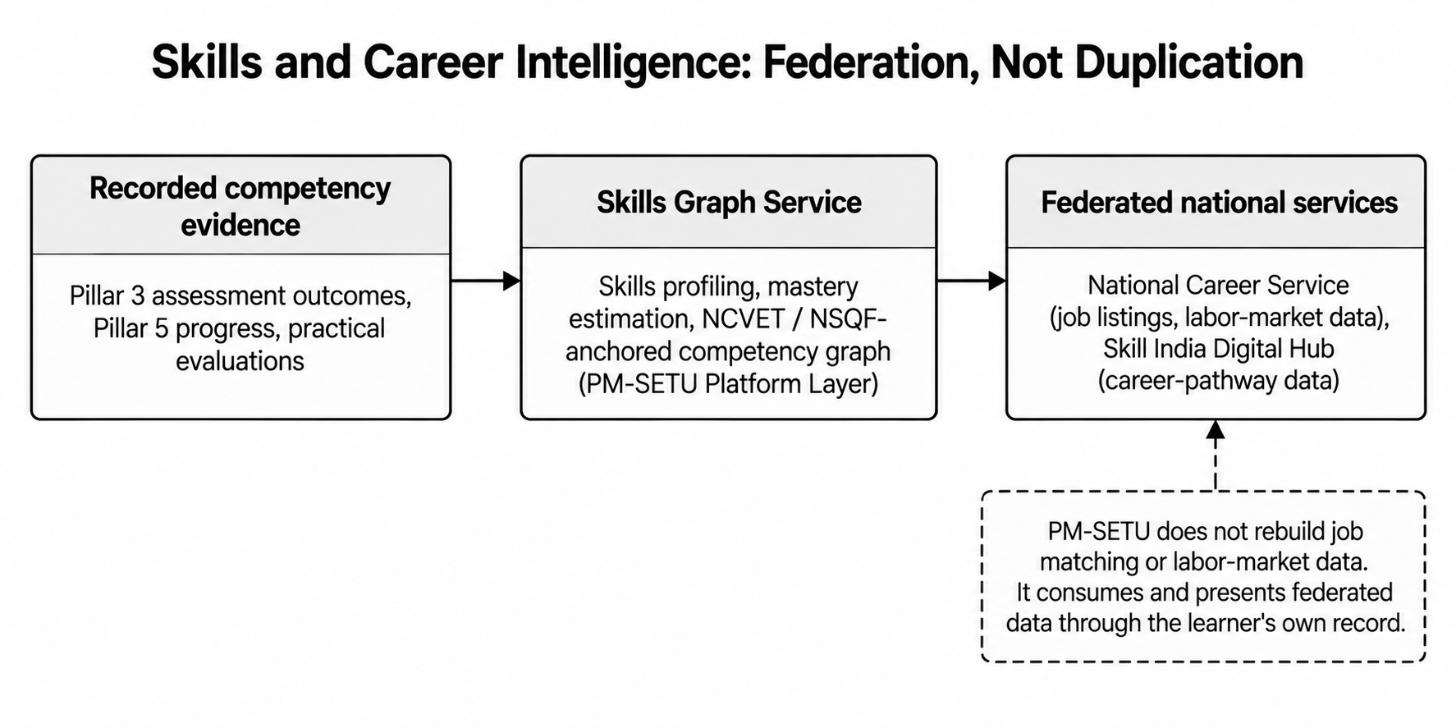
4.11.3 AI Behavior, Data, and Human ControlPDF p.54
| Dimension | Specification |
| AI Behavior Inputs | Inference of skill and mastery level from recorded evidence; recommendation generation for career paths and job matches; conversational assistance for career guidance, grounded in the learner's own profile and federated data. Recorded competency evidence from Pillar 3 and Pillar 5; course completion from Pillar 1; where integrated, job listings and labor-market data from the National Career Service and Skill India Digital Hub. |
| Outputs Human Control | Skills profile and competency-graph position; career-path suggestions; job matches; job-readiness score; labor-market-informed recommendations; conversational guidance - all labeled as advisory and traceable to the underlying evidence. The learner can view the specific evidence underlying any career or job recommendation and can raise a query for institution or trainer review; no recommendation is acted upon automatically. |
| Output Classification Data Used | Advisory in every instance; this pillar never reaches Human-approved or Authoritative status because it does not generate content that is subsequently used as instructional or assessment material. Recorded competency evidence only; federated external labor-market and opportunity data under an explicit data contract; no behavioral or unrelated personal data. |
| Integration Dependencies | Skills Graph Service and Predictive-Analytics Service in the Platform Layer (Section 5.2); Pillar 3 and Pillar 5 as evidence sources; National Career Service, Skill India Digital Hub, and e-Shram interfaces in Pillar 9. |
Acceptance CriteriaPDF p.55
- •Every skill or mastery estimate is traceable to specific recorded competency evidence.
- •Every career path or job-matching recommendation is traceable to the skills profile and, where
applicable, the federated labor-market data used to generate it.
- •A job-readiness score does not affect eligibility for any course, assessment, certification, or program
component in any pillar of this report.
- •Where the National Career Service or Skill India Digital Hub interface is unavailable, the learner's skills
profile remains visible using the last confirmed federated data, labeled as stale.
Validation RulesPDF p.55
- •The skills profile is built exclusively from recorded competency evidence within PM-SETU; it does not
combine unrelated personal data.
- •Career, job-matching, and labor-market recommendations are sourced from an explicit federated data
contract with the National Career Service or Skill India Digital Hub, never fabricated or estimated in the absence of that data.
- •A job-readiness score is presented with its underlying evidence and is never presented as a certified or
authoritative employability determination.
Exception ManagementPDF p.55
| Exception | System Action |
| National Career Service / Skill India Digital Hub interface unavailable | Show the last confirmed federated data with a staleness indicator; do not fabricate current data. |
| Insufficient competency evidence for a skill estimate | Suppress the estimate for that skill rather than infer one, and display the specific evidence still required. |
| Federated job or labor-market data conflicts with a prior version Skills or career-intelligence model configuration change fails validation | Reconcile to the most recently confirmed source and log the conflict for review. Retain the previous approved version in service and notify the model owner. |
5. Solution ArchitecturePDF p.56
The PM-SETU Learning Management System shall act as a unified digital learning platform maintaining one operational learner record across a heterogeneous delivery landscape. The architecture shall enable delivery of the approved course version to an identified learner, immediate capture of learning and assessment events, governed exchange with external learning platforms and content sources, governed use of artificial intelligence within a bounded advisory scope, and role-scoped presentation of the resulting record. The architecture is organized into three layers, connected by an integration boundary, together with a cross-cutting set of AI services that every pillar draws upon rather than rebuilds:
- ●Data Layer - the sources from which learner, course, learning, assessment, skills, and credential
information originate, and the operational store that retains it, including AI interaction and provenance records.
- ●Platform Layer - the eleven functional pillars specified in Section 4, together with the cross-cutting
services, including the AI Services block, that operate across them.
- ●User Access Layer - role-scoped workspaces for learners, trainers, institutions, clusters, and
partners.
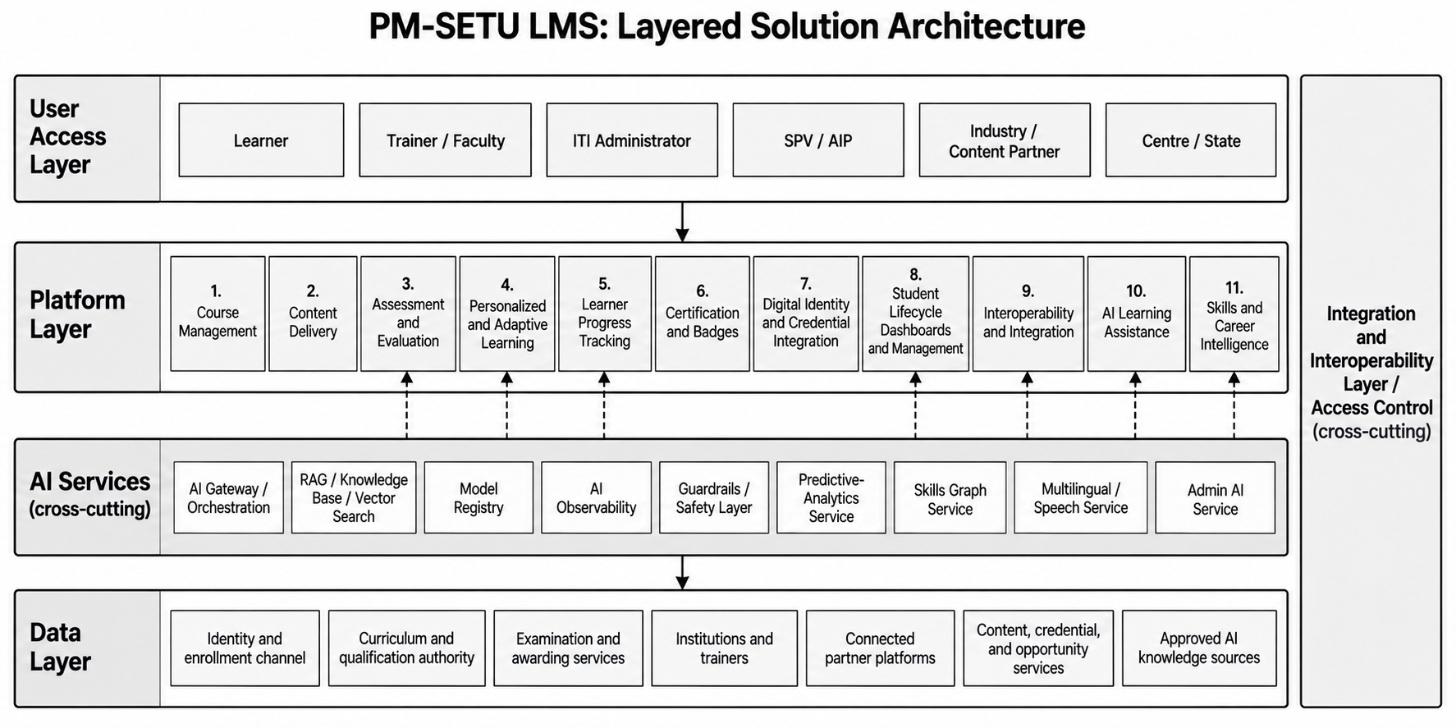
5.1 Data LayerPDF p.56
The Data Layer serves as the foundation of the learning platform. It shall collect, validate, reconcile, and standardize data from multiple internal and external sources, and shall retain the operational records required for the learning journey. This layer is critical because PM-SETU learning events originate in several places at once: natively in the platform, in institution systems, in partner-operated learning platforms, in national services that own identity, results, and credentials, and, for AI-enabled capabilities, in a governed, indexed corpus of the platform's own approved content.
Sources of inflow. Data reaches the platform from seven principal source categories (FIXED - was "six"; the table below has always had seven rows). The approved identity and enrollment channel supplies learner identity, profile, and enrollment context. The designated curriculum authority supplies authoritative trade and qualification references, and the designated examination and awarding service separately supplies formal examination, certification, and result references. Institutions and trainers enter the operational learning records generated during delivery. Industry partners either enter assigned operational records in the platform
or exchange them from a connected learning system. Content, credential, and opportunity services supply approved content metadata, credential references, labor-market data, and apprenticeship or employment hand-off information where integration has been enabled. A seventh category (FIXED - was "A sixth category"), approved AI knowledge sources, comprises the vectorized, indexed corpus of the platform's own published, approved course content, maintained separately from the raw content repository because it requires its own currency and versioning discipline distinct from the live course version.
| Source | Information Supplied | Owner of Record |
| Approved identity and enrollment channel | Learner identity reference, profile attributes within the agreed contract, scheme enrollment context | Identity and enrollment service |
| Curriculum and | Trade, occupation, NSQF level, QP-NOS reference, | CSTARI / DGT / NIMI / |
| qualification authority | approved curriculum and question-bank material | NCVET as designated |
| Examination and awarding services | Formal examination results, certificate status, and certificate identifier | DGT / NCVT or designated awarding body |
| Institutions and trainers | Batch creation and assignment, attendance, practical evidence, LMS-controlled assessment, intervention records | PM-SETU LMS |
| Connected partner learning platforms | Partner-delivered module completion, assessment, practical and mentor-evaluation events | Partner platform |
| Content and knowledge partners; credential and opportunity services | Learning resources with rights and metadata; credential custody references; academic credit references; apprenticeship and employment outcomes; National Career Service and Skill India Digital Hub skills/job/labor-market data | Content partner; respective external service |
| Approved AI knowledge sources | Vectorized, indexed corpus of published, approved course content, maintained separately from the raw content repository, used exclusively for AI grounding | PM-SETU LMS (derived from Pillar 1/Pillar 2 published content) |
Curriculum and qualification authority
CSTARI / DGT / NIMI / NCVET as designated
What is stored: The operational store holds the learner-to-course and batch relationship, course, content, and assessment version references, learning activity, progress, attendance, practical evidence, interventions, adaptive-learning state, skills and competency-graph state, predictive-indicator history, credential status, AI interaction and generated-content provenance records, and the source identifiers required to reconcile external records. It preserves audit history for controlled corrections and version changes. Authoritative identity source data, formal examination and certification records, and external credential documents remain in their designated systems; the platform stores only the identifiers, status, and references needed to render the learner journey and prove the source of the information.
Real-time behavior and refresh: Learner interactions generated directly in the platform - module completion, assessment attempt, trainer-recorded practical evidence, or an AI Learning Assistance interaction - shall update the operational learner record immediately after validation. Connected partner and national systems may use event-driven or scheduled synchronization according to the agreed interface. Every externally derived status shall carry the time or version of the last successful synchronization. Where a source is
unavailable, the platform shall retain the last confirmed state and identify the affected record as pending or stale rather than inferring a new outcome.
5.2 Platform LayerPDF p.58
The Platform Layer is the core application layer in which business rules, workflows, validations, learning delivery, assessment, adaptive and AI-assisted support, dashboards, and audit controls operate. Its functional components are the eleven pillars specified in Section 4. Three capabilities operate across all components: access control, which scopes every service call to the authenticated user and entity; the integration gateway, which manages external identifiers, data contracts, validation, retries, and source lineage; and the AI Services block, which provides the shared AI infrastructure every AI-enabled pillar consumes rather than rebuilds.
| Component | Function within the Platform Layer |
| Course Management | Maintains the approved course and qualification catalogue, composition, version, applicability, and batch assignment |
| Content Delivery | Presents approved digital and blended learning resources, ingests packages, launches partner-hosted resources, and records reliable content activity |
| Assessment and Evaluation | Administers LMS-controlled assessment and practical evaluation workflows, maps authoritative formal results, and provides AI-assisted authoring and evaluator support |
| Personalized and Adaptive Learning | Recommends permitted remedial or next learning actions and personalized study plans from validated learner progress signals, within configured boundaries |
| Learner Progress Tracking | Maintains module, attendance, practical, assessment, intervention, and completion state with full source lineage, and generates advisory predictive indicators |
| Certification and Badges | Evaluates completion and presents LMS-issued or externally authoritative credential status with verification references |
| Digital Identity and Credential Integration | Links learner and staff identity to approved identity and credential services and maintains external identifier mappings |
| Student Lifecycle Dashboards and Management | Presents the learner and institution operational view, including AI- generated reporting and analytics summaries, from enrollment through learning, credential, and opportunity hand-off |
| Interoperability and Integration | Govern connector registration, canonical mapping, standards-based exchange, reconciliation, and publication |
| AI Learning Assistance | Provides retrieval-grounded conversational and generative assistance to learners and trainers within the approved course content boundary |
| Component | Function within the Platform Layer |
| Skills and Career Intelligence | Maintains the evidence-based skills profile and provides advisory career, job-matching, and labor-market-informed guidance federated from national services |
| Cross-cutting services | Access control at every service call, event bus and learning record store, audit trail, notification, multilingual and accessibility services, observability, and model operations |
5.2.1 AI ServicesPDF p.59
The AI Services block provides the shared infrastructure that every AI-enabled pillar consumes. It is specified once, here, rather than rebuilt within each pillar, so that governance, versioning, and monitoring are applied consistently.
| Service | Function | Consuming Pillars | Status |
| AI Gateway / Orchestration | Single control and audit point for every call to an AI model, internal or external; enforces role-based AI permissions and routes requests to the appropriate model | Pillar 3, 4, 5, 9, 10, 11; Admin AI (Pillar 8) (FIXED - added Pillar 9) | Required Now |
| RAG / Knowledge Base / Vector Search | Indexes published, approved course content for retrieval-grounded generation and search | Pillar 3, 10 | Required Now |
| Model Registry | Versions every AI model and rule configuration in use; enforces prospective- only application of changes and supports rollback | All AI-enabled pillars | Required Now |
| AI Observability | Logs AI usage, prompts, outputs, and human confirmations/overrides; monitors model drift and quality | All AI-enabled pillars | Required Now |
| Guardrails / Safety Layer | Validates AI output before display; enforces the unavailability fallback where grounding or confidence is insufficient | Pillar 3, 10 | Required Now |
| Predictive-Analytics | Hosts the predictive models underlying | Pillar 5, Pillar 8 | Required |
| Service | Pillar 5's advisory indicators | (presentation) | Now |
| Skills Graph Service | Maintains the NCVET/NSQF-anchored skills and competency graph | Pillar 11 | Required Now |
| Multilingual / Speech Service | Provides Indian-language translation, text- to-speech, and speech-to-text via the Bhashini/AI4Bharat integration | Pillar 10, accessibility requirements in Section 6.6 | Required Now |
Predictive-Analytics Service
| Service Function C onsuming Pillars Status |
| Admin AI Service Provides natural-language reporting, report summarization, anomaly and duplicate detection, and support-ticket classification for institution and program administrators Pillar 8 (presentation), Pillar 9 exception management Required Now |
| Agent Would govern any future autonomous, multi-step AI agent, with mandatory human-approval gating Future roadmap only (Section 6.8.4) Optional / Later |
| Orchestration / |
| Approval |
| Framework |
Service Function Consuming Pillars Status
Agent Orchestration / Approval Framework
No pillar calls an external AI model provider directly; every call is routed through the AI Gateway, which abstracts the underlying model provider so that no functional requirement in this report is dependent on a single named commercial AI provider, consistent with the procurement-neutrality principle applied throughout this report.
5.3 Integration and Interoperability LayerPDF p.60
The integration boundary is specified as an architectural layer rather than a set of point interfaces, because the program's delivery model depends on admitting systems that PM-SETU does not control. The gateway shall authenticate the external system, confirm that the requested interface and dataset fall within the approved scope, map identifiers to the canonical model, validate each payload against the agreed contract, apply duplicate and ownership checks, manage retries and quarantine, and stamp source and freshness on every accepted record. The required integrations, their purpose, and the information exchanged are set out in Section 4.9.
5.4 User Access LayerPDF p.60
The User Access Layer shall resolve the authenticated user to a role and entity and then constrain both navigation and data. A learner is scoped to the learner's own record. A trainer or institution administrator is scoped to the assigned institution, courses, batches, and learners. An SPV or Anchor Industry Partner is scoped to its cluster. An industry or content partner is scoped only to the course, content, on-the-job training, or integration records assigned to that partner. Centre and State users may hold governance and configuration access where formally provisioned, but program-wide monitoring is consumed through the Analytics Portal rather than through a duplicate dashboard in this platform. Access to every AI-enabled capability is scoped by the same role and entity boundaries defined here; no AI capability in this report expands a user's underlying data-access scope.
| Stakeholder | Workspace and Access | Data Scope |
| Learner / trainee | Learner home, courses, content, AI learning assistance, assessments, progress, skills, credentials, opportunities | The learner's own active and historical record |
| Trainer / faculty | Teaching workspace, assigned courses and batches, AI-assisted authoring and | Assigned institution, courses, batches, and learners |
| Stakeholder copilot, assessments, evaluations, and interventions | Workspace and Access interventions | Data Scope |
| ITI administrator | Institution workspace, course activation, batch and assignment management, exception handling, AI-assisted reporting | The institution and the records belonging to it |
| SPV / Anchor Industry Partner | Cluster workspace, industry and course- mapping inputs, delivery coordination, reconciliation | Assigned cluster and its institutions and partner relationships |
| Industry partner (connected LMS) | Partner integration console, connector health, mapping, and exception management | The partner's own connector, mappings, and exchanged records |
| Content / knowledge | Content submission, metadata, mapping, | Partner-owned resources and |
| partner | review status, and usage return | approved mappings |
| Awarding body and credential services | Interface access only; no interactive workspace | Records exchanged under the agreed data contract |
| Centre / State | Approved governance, configuration, or support access where formally provisioned | Role and entity scoped; program analytics remain in the Analytics Portal |
| Academic reviewer | Content and mapping review queue, approve/reject decision, AI-grounding eligibility gate | Submitted content and mappings awaiting review; not the full course- authoring workspace |
| Model owner | AI Governance console, model/rule version history, disparity review dashboard | AI interaction logs, predictive- indicator outputs, and model version records across all pillars; not learner personal records beyond what a review requires |
| Integration administrator | Partner integration console, connector configuration, exception queue | Connector, mapping, and exchange-log records for the connectors under their administration |
Stakeholder Workspace and Access Data Scope
Content / knowledge partner
Partner-owned resources and approved mappings
5.5 Technology PrinciplesPDF p.61
The platform should be built to current architectural practice so that it can absorb growth in learners, institutions, and integrations, and so that new delivery partners and AI capabilities can be admitted without redesign. The following principles govern solution design; they describe required properties rather than a prescribed product or vendor stack.
| Principle Requirement |
| API-first and contract- driven Every platform capability, including every AI capability, shall be exposed as a documented OpenAPI 3.1 service. User interfaces shall consume the same interfaces available to partners, so that no capability exists only inside a screen. |
| Modular, independently deployable services Functional components shall be separable services with defined interfaces, |
| allowing a component to be scaled, replaced, or upgraded without |
| redeployment of the whole platform. |
| Event-driven learning record Learning activity shall be published as events to a durable event bus and learning record store, so that progress, analytics, adaptive and AI-assisted support, and partner reconciliation consume the same validated stream. |
| Cloud-native and horizontally scalable The solution shall be containerized and orchestrated, shall scale horizontally |
| under assessment and enrollment peaks, and shall be hosted on MeitY- |
| empaneled cloud or National Informatics Centre infrastructure with all data |
| resident in India. |
| Standards-based interoperability Interoperability shall be achieved through published learning-technology standards rather than bespoke per-partner interfaces, as specified in Pillar 9. |
| Offline-first learner experience The learner interface shall function as a progressive web application |
| supporting content download, offline activity capture, and deferred |
| synchronization without duplicate event creation. |
| AI provider abstraction and procurement neutrality Every AI capability should be accessed through the internal AI Gateway rather than directly against a named model provider, so that the underlying model or vendor can be replaced through configuration rather than redesign. |
| Responsible artificial intelligence Every AI-enabled capability shall be versioned, explainable, human- |
| overridable, subject to periodic review including bias and disparity monitoring, |
| and governed by the AI Governance framework in Section 6.8, with model |
| operations, monitoring, and rollback controls in place. |
| Multilingual and accessible by design Language and accessibility shall be properties of content and interface metadata rather than parallel builds, supporting regional languages and assistive technology throughout, including in AI-enabled capabilities. |
| Observability and traceability Distributed tracing, structured logging, and service-level monitoring shall |
| allow a single learner event, including an AI interaction, to be followed across |
| services and integrations. |
| Secure software supply chain Static and dynamic security testing, dependency scanning, and infrastructure- as-code review shall be integrated into the delivery pipeline. |
| Data portability and exit The program shall be able to export the complete learner record, course |
| structures, content metadata, and AI interaction/audit logs in open formats, |
| so that platform change does not require data reconstruction. |
6. Non-Functional RequirementsPDF p.63
The PM-SETU Learning Management System will be used directly by learners, trainers, institutions, and connected partners, at scale and frequently under constrained connectivity. Its non-functional requirements therefore address responsive learner interaction, reliable capture of learning state, security of personal and academic records, availability during training and assessment periods, accessibility across device and connectivity conditions, complete auditability of changes to course, assessment, progress, and credential state, and - introduced in this version - a dedicated governance framework for every artificial intelligence capability in this report.
6.1 Performance requirementsPDF p.63
The platform shall provide a responsive and reliable experience across all stakeholder groups and shall support concurrent access without degradation. The table below sets out the minimum performance parameters under normal and peak operating conditions.
| Performance Parameter | Minimum Requirement |
| Learner page and module load | Core learner pages and module navigation shall respond within 3 seconds for at least 90% of requests under normal load and within 5 seconds under peak load, excluding external media transfer beyond platform control. |
| Learning event commit | A validated internal learning event shall update the learner operational state within 2 seconds for at least 95% of requests. |
| Assessment interaction | Question navigation and answer save shall respond within 2 seconds under the agreed assessment load. Final submission shall return confirmation without creating a duplicate attempt. |
| API and integration response | Synchronous platform interfaces shall respond within 500 milliseconds at the 95th percentile. External source latency, including AI model provider latency, shall be isolated from the learner interface through asynchronous processing where a synchronous response is not required for immediate action. |
| Concurrent usage | The platform should support a minimum of 25,000 concurrent learner sessions, scalable to 60,000 during peak periods such as scheduled assessment windows and enrollment cycles, with no more than 20% response-time degradation. |
| Assessment concurrency | The platform shall support at least 10,000 learners in simultaneous assessment sessions with attempt state preserved through connectivity interruption. |
| Transaction throughput | The platform shall sustain a minimum of 500 learning events per second, scalable to 1,500 events per second during peak processing periods. |
| Partner synchronization | Events received from a connected learning platform shall be validated and reflected in the learner record within 15 minutes of receipt, with end-of-day reconciliation completed by 08:00 hours on T+1. |
| Performance Parameter | Minimum Requirement |
| AI Learning Assistance response | A retrieval-grounded conversational response shall be returned within a target interactive response time appropriate to a synchronous chat interaction; generative study-aid content (summaries, flashcards, quiz generation) may be processed asynchronously. Specific numeric targets shall be confirmed during solution design against the selected AI infrastructure. |
| AI predictive and analytics processing | Predictive indicators (Pillar 5) and skills/career intelligence (Pillar 11) shall be computed on a scheduled batch basis at a minimum daily frequency, with on-demand re-computation available for a newly validated significant event; these are advisory, non-time-critical computations and are not required to be real time. |
| Content delivery | The platform shall support low-bandwidth content variants and resumable delivery were permitted by content rights and technical format, and shall remain usable at the minimum supported connectivity profile. |
| Notifications | System-generated notifications shall be dispatched within 5 minutes of the triggering event. |
| Report generation | Standard operational reports, including AI-generated report summaries, shall be generated within 10 seconds, and consolidated institution or cluster reports within 60 seconds. Large scheduled reports shall execute asynchronously and complete within 15 minutes without impacting online transaction processing. |
| Bulk data processing | Bulk uploads of up to 10,000 records shall be validated and processed within 5 minutes. |
| System availability | The platform shall provide a minimum of 99.5% monthly availability, excluding pre-notified planned maintenance scheduled outside business hours, and 99.9% during declared assessment windows. AI Services (Section 5.2.1) are excluded from this availability commitment where degraded gracefully per the exception-management provisions in each pillar, since these services are advisory and their unavailability does not prevent core learning, assessment, or credentialing functions. |
| Scalability headroom | Architecture shall support at least 30% year-on-year growth in learners, institutions, transaction volumes, content, integrations, and AI service usage over a 5-year horizon through horizontal scaling, without architectural redesign. |
| Data currency | Every externally sourced status displayed to a user, including a federated skills/career data element, shall expose the time or version of the last successful synchronization. |
| Performance Parameter | Minimum Requirement |
| Recovery objectives | Critical learning functions shall meet a recovery time objective of 4 hours and a recovery point objective of 15 minutes, as further detailed under availability and disaster recovery requirements. |
6.2 Security requirementsPDF p.65
The platform shall implement a comprehensive security framework to protect learner personal data, academic records, assessment content, AI interaction data, and partner integration data. Authentication shall be integrated with the approved government identity and access management or single sign-on mechanism. Role-based access control shall be enforced across all components, including every AI capability, so that users access only the information and functionality relevant to their designated responsibilities, and the platform shall maintain strict segregation between learners, institutions, clusters, and partners. The table below describes the security standards and frameworks required for the platform.
| Security Framework / Standard | Application to the Platform |
| ISO/IEC 27001:2022 CERT-In Directions and Guidelines (2022) IT Act, 2000 and DPDP Act, 2023 (Legal Requirement) | The platform and its hosting operations shall implement an Information Security Management System certified to ISO/IEC 27001:2022, with the Statement of Applicability covering all learner data processing environments, including AI Services. Cyber security incidents, including AI-related incidents, shall be reported to CERT-In within 6 hours of detection; security and system logs shall be retained for a minimum of 180 days within India; system clocks shall be synchronized with NIC or NPL network time servers. The platform shall comply with the Information Technology Act, 2000, including reasonable security practices, and with the Digital Personal Data Protection Act, 2023, and the Digital Personal Data Protection Rules 2025, covering lawful processing, purpose limitation, data minimization, learner rights, and breach notification obligations. Care shall apply where a learner is a minor, including the prohibition on behavioral monitoring, tracking, and profiling of children set out in the Digital Personal Data Protection Rules 2025, and the requirement for verifiable parental consent where applicable. |
| MeitY empaneled cloud / GI Cloud (MeghRaj) | The solution, including AI Services, shall be hosted on a MeitY- empaneled cloud service provider or National Informatics Centre infrastructure, with all data including backups and disaster recovery copies residing within Indian territory. |
| Security audit and certification | A CERT-In empaneled agency shall conduct Vulnerability Assessment and Penetration Testing prior to go-live, after every major release including AI-related releases, and at least half-yearly thereafter. Security audit clearance shall be obtained before production deployment. |
| OWASP ASVS / Top 10 and secure SDLC | Application development shall follow secure coding practices aligned to OWASP ASVS Level 2 and OWASP Top 10 mitigation, with static and dynamic security testing integrated into the delivery pipeline. |
| Security Framework / Standard | Application to the Platform |
| Encryption standards | Data in transit shall be protected using TLS 1.2 or higher, with TLS 1.3 preferred. Data at rest, including databases, learning assets, evidence, AI interaction logs, and backups, shall be encrypted using AES-256, with keys managed through a dedicated key management service and defined rotation policies. |
| Identity, access, and authentication Learner data isolation Assessment and content integrity Partner integration security | Authentication shall integrate with the approved government single sign-on or identity provider. Multi-factor authentication shall be mandatory for administrative, content-approval, assessment- configuration, and AI-configuration roles. Role-based access with segregation of duties shall be enforced and supported by quarterly access reviews. A learner shall retrieve only the learner's own records. Trainer and institution access shall be limited to assigned learners and institutional scope, enforced at the service layer rather than at screen rendering, including for every AI capability. Assessment content shall be protected at rest and in transit, released only within the scheduled window, and access logged. Attempts, evaluations, corrections, AI-assisted scoring suggestions, and completion decisions shall be attributable and protected from unauthorized change. Each partner interface, including the external AI model provider interface, shall use approved authentication, scoped credentials, payload validation, rate limiting, and complete integration logging, with credentials rotated on the agreed schedule. |
| AI Gateway security | Every call to an AI model, internal or external, shall be authenticated, scoped by role-based AI permission, and logged; the AI Gateway shall be included within the scope of the platform's penetration testing and vulnerability-assessment cycle. |
| Security monitoring (SIEM / SOC) GIGW 3.0 and e-Governance standards Reference architecture alignment | Security events, including AI Gateway events, shall be aggregated into a security information and event management platform with round-the-clock monitoring, defined incident response runbooks, and tamper-evident log storage. Interfaces, including AI-enabled interfaces, shall conform to the Guidelines for Indian Government Websites 3.0, including accessibility and quality requirements applicable to government digital platforms. Security architecture shall be benchmarked against the NIST Cybersecurity Framework 2.0 as the governing reference model for security controls and maturity assessment. |
6.3 Availability and disaster recovery requirementsPDF p.66
The platform should be designed for high availability during normal training operations and scheduled assessment periods. A disaster recovery environment shall be maintained at a geographically separate
location to ensure continuity of critical learning operations in the event of infrastructure failure, cyber incident, natural disaster, or another disruptive event. The disaster recovery environment shall maintain synchronized copies of application data, configuration, master data, learning assets, assessment records, AI interaction and audit logs, and audit history.
Recovery procedures shall be documented, periodically tested, and governed through defined operational protocols. Recovery priorities shall place learner access, assessment-state integrity, progress data, and identity resolution ahead of non-critical administrative and AI-assisted views. Learning records committed before a service failure shall not be lost or silently duplicated on recovery. External content, credential, or AI Services integrations may be temporarily unavailable without preventing access to unaffected functionality; where an external source is unavailable, the platform shall continue to serve the last confirmed status with an indication of staleness while preventing actions that require fresh confirmation from completing incorrectly.
6.4 Backup and data retention requirementsPDF p.67
The platform shall implement automated backup mechanisms covering application databases, learning assets, assessment content and submissions, practical evidence, credential records, AI interaction and generated-content logs, master data, configuration settings, and system logs. Backups shall be performed at scheduled intervals and stored securely in accordance with government data protection guidelines. The solution shall maintain multiple backup copies to support operational recovery, disaster recovery, and regulatory compliance. Backup files shall be encrypted and protected against unauthorized access or alteration, and periodic restoration testing shall be conducted to validate recoverability and data integrity.
The platform shall preserve historical learning, assessment, progress, skills, credential, AI interaction, and workflow information for the duration prescribed under applicable government record retention policies and program governance requirements, and for the period required to substantiate any credential issued. Archived data shall remain searchable and auditable throughout the retention period. Personal data, including AI interaction data, shall be retained only for as long as the stated purpose requires, in accordance with the Digital Personal Data Protection Act, 2023, and shall follow the same retention regime as other learning records rather than a separate policy.
6.5 Audit logging and monitoring requirementsPDF p.67
Given the academic significance of the records held, comprehensive audit logging shall be a mandatory platform capability. The system shall capture authentication events, course and content version publication, learner enrollment and assignment, attendance and practical evidence entry, assessment attempts and evaluations, progress corrections, adaptive and predictive recommendations and trainer overrides, credential status changes, partner synchronization, denied access attempts, configuration changes, administrative actions, and - introduced in this version - every AI generation event, every AI-suggested score and its human confirmation, every AI-flagged plagiarism or AI-content signal and its review outcome, every predictive- indicator generation, and every career or skills recommendation.
All logs shall include user or source identification, timestamp, action performed, affected learner, course, or object, previous value, updated value, model or rule version in force at the time (where an AI capability is involved), and the origin of the transaction where applicable. Audit logs should be tamper-resistant and accessible only to authorized administrators and auditors. The platform shall support centralized log monitoring, exception detection, activity tracing, and forensic investigation. Log retention periods shall align with program audit requirements and statutory governance obligations.
6.6 Accessibility and inclusion requirementsPDF p.67
Because the platform is used directly by learners rather than only by administrators, accessibility is a functional requirement rather than a compliance formality. Learner-facing interfaces, including every AI-
enabled interface, shall conform to WCAG 2.1 Level AA and to the Guidelines for Indian Government Websites 3.0. Interfaces shall support keyboard navigation, screen-reader compatibility, sufficient color contrast, resizable text, and predictable navigation.
The platform shall support regional languages for both interface and content, including transcripts, captions, and subtitling where the underlying resource permits, delivered through the Multilingual/Speech Service (Section 5.2.1) integrated with Bhashini and AI4Bharat. It shall be usable on the low-cost mobile devices commonly available to learners, and shall operate under intermittent connectivity through download, offline activity capture, and deferred synchronization. Where a learner requires an accessible alternative to a resource, the platform shall present the alternative in place of, rather than in addition to, an inaccessible one. The AI Learning Assistance capability (Pillar 10) shall support text-based interaction in the platform's supported regional languages, with voice interaction supported where the Multilingual/Speech Service confirms adequate accuracy for the requested language.
Where a learner requires an assessment accommodation on account of disability, including extended time, an alternate format, or a sign-language or scribe accommodation for a practical or viva component, the platform shall support recording and applying that accommodation to the learner's assessment configuration without altering the assessment's content or pass criteria for other learners.
6.7 Compliance requirementsPDF p.68
The platform shall adhere to the governance principles and operational controls defined under the PM-SETU program and shall support compliance with Government of India digital governance standards, approved cybersecurity guidelines, data protection requirements, applicable education and skilling regulations, and the artificial intelligence governance requirements set out in Section 6.8. The platform shall maintain the source and authority of course, result, credential, and skills/career records so that a platform workflow, human or AI- assisted, does not supersede statutory academic or certification governance.
The platform shall maintain immutable audit trails for all academic decisions and learning transactions, including every AI-assisted decision support interaction, to support internal audit, external audit, and independent verification. All workflows related to course publication, content approval, assessment, AI- assisted authoring and scoring support, progress correction, completion, and credential issuance shall be digitally recorded and retained to ensure accountability and transparency across the PM-SETU ecosystem. Where a multilateral development partner has fiduciary or reporting requirements bearing on learning outcomes, the platform shall provide evidence-based reporting sufficient to satisfy them.
A Data Protection Impact Assessment shall be conducted prior to large-scale processing of learner personal data under this platform, with particular attention to processing involving minors, consistent with the Digital Personal Data Protection Act 2023, and the Digital Personal Data Protection Rules, 2025. The assessment shall be completed and reviewed before production go-live and revisited whenever a material change to AI processing, data collection, or a new integration is introduced.
Consistent with the Digital Personal Data Protection Act, 2023, an adult learner shall be able to request access to, correction of, and erasure of their own personal data held by the platform, and to register a grievance, through a defined process distinct from the program-level data portability and exit provisions described in Section 5.5 Nomination of a legal heir or representative for a learner's data, where applicable under the Act, shall follow the same process.
6.8 Artificial Intelligence GovernancePDF p.68
This section generalizes the governance principle first established for Personalized and Adaptive Learning (Pillar 4) - advisory-only output, explainability, human override, and prospective-only versioning - into a single
framework applicable to every artificial intelligence capability specified in this report: Pillar 3 (AI-Assisted Assessment Support), Pillar 4, Pillar 5 (AI Analytics and Prediction), Pillar 10 (AI Learning Assistance), Pillar 11 (Skills and Career Intelligence), and the Admin AI Service (Pillar 8 presentation). No principle already established for Pillar 4 is weakened by this section; every requirement below either restates an existing Pillar 4 principle at broader scope or introduces a control the absence of which would leave an AI-enabled pillar ungoverned.
6.8.1 AI Output ClassificationPDF p.69
Every output produced by an AI capability in this report shall be classified into one of four tiers, and the applicable tier shall be evident to the user from the interface presentation:
- •Advisory - informs a decision but has no direct effect on any record; the default classification for
recommendations, predictions, search results, and conversational output.
- •Human-approved - becomes usable only after an explicit human confirmation action is recorded (for
example, an AI-generated question entering a live question bank, or an AI-suggested score being confirmed by an evaluator).
- •System-enforced - an automated action taken without a per-instance human decision; no AI capability
in this report is currently specified at this tier for any function affecting curriculum, assessment outcome, completion, or credential.
- •Authoritative - reserved exclusively for results and credentials sourced from a designated external
authority (the awarding body, the credential service); no AI capability in this report generates or occupies this tier.
6.8.2 Cross-Cutting Governance ControlsPDF p.69
| Control | Requirement | Basis |
| Human oversight | Every AI output affecting curriculum, assessment, completion, or credentials remains Advisory or Human- approved; a human retains the final decision in every instance. | Proposed requirement, extending existing DPR principle |
| Explainability | Every recommendation, prediction, or generated answer is accompanied by a stated reason: the signal, competency, or source passage that produced it. | Proposed requirement, extending existing DPR principle |
| AI / model versioning Audit logging | Every model and rule configuration is versioned in the Model Registry; changes apply prospectively only; the version in force for any historical output is recoverable. Every AI generation, prediction, human confirmation, and override is logged centrally, per Section 6.5. | Proposed requirement, extending existing DPR principle Proposed requirement, extending existing DPR principle |
| Provenance | AI-generated content is visibly labeled as AI-generated wherever displayed. | New requirement (industry best practice, e.g., Moodle AI-content tagging) |
| Control | Requirement | Basis |
| AI permissions Data minimization Privacy (minors) | Role-based permissions determine which role may trigger which AI capability, scoped to the same entity boundaries as the platform's existing role-based access control. Each AI capability uses only the input signal set defined in its approved configuration; unrelated personal data is not combined solely to generate an AI output. No AI capability performs behavioral tracking, monitoring, or profiling of a learner who is a minor; the age-appropriate consent pathway defined in Pillar 7 applies wherever an AI capability processes a minor's data. | New requirement Proposed requirement, extending existing DPR principle Legal requirement (Digital Personal Data Protection Act, 2023; Digital Personal Data Protection Rules, 2025, Rule 10) |
| Bias / fairness monitoring | Prediction, assessment-assist, and skills-inference outputs are subject to periodic disparity review across language, region, gender, and institution type. | Proposed requirement, extending existing DPR principle |
| Hallucination controls Model monitoring and rollback | Every generative capability is grounded in retrieval from approved content (RAG); where grounding confidence is insufficient, the capability returns an explicit unavailability response rather than an ungrounded answer. Every AI model is subject to ongoing quality and drift monitoring, with a defined rollback procedure to the prior approved version. | New requirement, informed by published research on retrieval- augmented generation reliability Proposed requirement, extending existing DPR principle |
| Incident management | AI-related incidents (an unsafe output, a governance- control failure, a suspected bias finding) follow the same incident-response procedure as a security incident, per Section 6.2. | New requirement |
| Human override Failure handling | Every trainer, assessor, or administrator override of an AI output is recorded with a mandatory reason; submission is blocked until a reason is provided. Every AI capability degrades gracefully on failure: the underlying pillar continues to function using its non-AI pathway, and the AI-specific panel is marked unavailable rather than blocking the user. | Proposed requirement, extending existing DPR principle Proposed requirement, extending existing DPR principle |
6.8.3 Regulatory and Standards ReferencesPDF p.70
The following legal requirements, government guidance, standards, and industry practices inform the AI Governance framework. Distinctions between binding legal requirements and non-binding guidance or benchmarks are maintained throughout this report and are not to be conflated.
- •Legal requirements: the Digital Personal Data Protection Act, 2023, and the Digital Personal Data
Protection Rules, 2025, govern lawful processing, purpose limitation, data minimization, and, under Rule 10, verifiable parental consent and the prohibition on tracking, behavioral monitoring, and profiling of children.
- •Legal requirement: the Information Technology Act, 2000, and CERT-In directions govern reasonable
security practices and incident reporting, applicable to AI Services as to any other platform component.
- •Government guidance: the NITI Aayog Responsible AI principles (safety and reliability, equality,
inclusivity and non-discrimination, privacy and security, transparency, accountability, and the protection and reinforcement of positive human values) inform the design of every AI capability in this report.
- •Standard (benchmark, not mandated for this program): ISO/IEC 42001, the international standard
for AI management systems, is referenced as an aspirational maturity benchmark for the platform's AI governance operations, and as a target certification for later program phases rather than an initial go- live requirement.
- •Standard (benchmark, not binding in India): the European Union's Artificial Intelligence Act
classification of educational and assessment AI as high-risk is used in this report as an international rigor benchmark when specifying controls for AI-Assisted Assessment Support (Pillar 3) and AI Analytics and Prediction (Pillar 5); it is not binding law for this program and is not cited as such.
- •Industry best practice: grounding generative output in retrieval from an approved content corpus
(RAG) and requiring evaluator confirmation before an AI-suggested score is recorded, reflect practice observed across the LMS and EdTech platforms reviewed for this program and are adopted here as proposed requirements.
- •Standard (benchmark, not mandated for this program): the United States NIST AI Risk Management
Framework 1.0 is referenced as an additional international benchmark for structuring AI risk identification, measurement, and management practices across the platform's AI Services.
- •Government guidance (international): UNESCO's Guidance for Generative AI in Education and
Research informs the report's approach to grounding, transparency, and human oversight specifically for generative AI capabilities used in a learning context.
6.8.4 Excluded and Deferred AI CapabilitiesPDF p.71
Two capabilities identified during market research are explicitly excluded from this program, documented here rather than silently omitted, so that the exclusion is understood as a deliberate governance decision rather than an oversight.
| Capability | Status | Rationale |
| Emotion or affect recognition (inferring a learner's emotional state from facial, voice, or physiological signals) | Excluded | Inconsistent with the data-minimization and non- profiling principles applied throughout this framework, particularly where the learner population includes minors; the scientific reliability of such inference is contested; the capability is treated in this report as inappropriate for a Government of India learner population regardless of its use in other markets. |
| Fully autonomous grading or | Excluded | Directly contrary to the core governance principle applied throughout this report: an AI output affecting an assessment result, completion state, or credential is Advisory or Human-approved, |
| credentialing agent (an AI system | ||
| that finalizes a score, pass/fail | ||
| status, or credential without human | ||
| confirmation) |
| Capability | Status | Rationale |
| never Authoritative or System-enforced, without | ||
| exception. |
A further set of capabilities - AI-assisted remote proctoring, oral or speech-based assessment scoring, recognition-of-prior-learning evidence analysis, natural-language platform navigation, and autonomous multi- step AI agents for learner support, content authoring, administration, or system reconciliation - are identified as future-phase capabilities. These are not specified for initial delivery because the available evidence at the time of this report does not yet establish sufficient maturity, governability, or legal clarity (in the case of proctoring and speech-based scoring) for a Government of India program, or because the underlying agentic technology class is still an early, actively evolving market segment as of 2026. Where a future-phase capability is pursued in a later program phase, it shall be brought within the same AI Governance framework specified in this section before it is enabled for any learner, trainer, or administrator.
Where this report or an accompanying reference document identifies a specific count of artificial intelligence capabilities considered for the program, that count is 74 distinct capabilities, evaluated and classified as Core (34), Enhanced (30), Future-phase (8), or Excluded (2), as set out in Annexure B. This is the sole authoritative count for this program; any earlier working count referenced during requirements development is superseded by this figure.
6.8.5 Basis for the 74-Capability ScopePDF p.72
Market and research inputs prepared during requirements development surveyed a broader universe of 110 candidate AI capabilities across seventeen categories before this report's 74-capability scope was fixed. The reduction from 110 to 74 is explained here, at category level, so that a reviewer comparing this report against the earlier research inventory can distinguish a considered scoping decision from an omission. No capability in the broader inventory was silently dropped: each was either retained individually within the pillar structure of this report, folded into a non-functional or governance requirement that applies more strongly than a discretionary feature would, or explicitly deferred to a future phase for the reason stated.
| Category in the Broader Research | Disposition in this Report |
| Inventory | |
| AI Content and Authoring (whole- course, module, or lesson generation) | Not specified for initial delivery. Curriculum and course composition is a governed human function under Pillar 1 and the positioning set out in Section 2.4; an AI capability that drafts entire courses or modules would blur the line between platform and curriculum authority that this report's governance principle is designed to hold. Narrower, already-governed authoring aids were retained individually: AI Question and Distractor Generation in Pillar 3, and AI-Generated Content Summaries and Flashcards in Pillar 10. |
| AI Accessibility (captioning, alt-text, reading-level adaptation, accessibility validation) | Not dropped. Elevated from a discretionary feature category to |
| a mandatory non-functional requirement in Section 6.6, binding | |
| on every learner-facing pillar, because WCAG 2.1 AA and | |
| GIGW 3.0 conformance are baseline obligations for a | |
| Government of India platform rather than an optional | |
| enhancement. This is a stronger commitment than listing | |
| accessibility as one selectable AI feature among others. |
| Category in the Broader Research Inventory | Disposition in this Report |
| AI Multilingual and Translation (regional-language delivery, voice interaction) | Not dropped. Delivered as the Multilingual/Speech Service specified in Section 5.2.1 and bound to Section 6.6, integrated with Bhashini and AI4Bharat, and referenced as a mandatory dependency of Pillar 10 rather than listed as its own optional category. |
| AI Multimedia (AI-generated video, avatar instructors, dubbing, role-play simulation) | Deferred. The underlying research rated this category Beta maturity, with open questions of authenticity, learner trust, and demonstrated learning-outcome benefit. It is not specified for initial delivery and is not included in the Core or Enhanced classification in Annexure B. |
| AI Governance and Safety (usage logging, provenance tagging, role- based AI permissions, model monitoring) Generative AI: RAG-Based Content Grounding | Not dropped. Every control identified in this category was retained in full, but was deliberately restructured from a standalone, separately selectable feature category into the mandatory, cross-cutting AI Governance framework in Section 6.8, binding on all 74 capabilities in Annexure B. Treating governance as infrastructure every capability must pass through, rather than as one feature choice among many, is a stronger design than the alternative. Retained in full as a Supporting/Dependency Requirement, not as a standalone user-facing capability. It is specified as the RAG/Knowledge Base/Vector Search service in Section 5.2.1, underpinning Pillar 3 and Pillar 10, consistent with the principle that shared infrastructure a feature depends on is specified once in the architecture rather than double-counted as a separate capability. |
| Generative AI: Multi-Role LMS Copilot | Not carried forward as an additional, undifferentiated capability. Judged redundant with the role-specific copilots already specified individually in this report: the Trainer Copilot (Pillar 10) and the Administrative Copilot (Platform Layer, Section 5.2). A single undifferentiated copilot would not respect the role- scoped access boundaries central to Section 5.4. |
7. Testing Strategy and Deployment ApproachPDF p.74
The PM-SETU Learning Management System shall adopt a structured testing and deployment framework to ensure that all learning, assessment, progress, credential, AI, integration, and reporting functionality operates as intended prior to production rollout. Testing is directed at three things in particular: the integrity of the learner journey, the separation of authority between the platform and the systems connected to it, and the correct, bounded operation of every AI capability against the governance framework in Section 6.8. The solution shall be considered ready for production only when the same learner, course version, assessment, and credential state can be reconciled across the screens, operational records, and external integrations that contribute to it, when each role can see and act only within its permitted scope, and when every AI capability demonstrably operates within its governed, advisory or human-approved boundary.
7.1 Testing strategyPDF p.74
The testing lifecycle shall include Unit Testing, System Integration Testing, User Acceptance Testing, Performance Testing, Security Testing, Accessibility Testing, AI Governance Testing, and Production Validation Testing.
- •Functional and journey testing. End-to-end scenarios shall cover learner activation, course and batch
assignment, digital and blended learning delivery, practical evidence capture, assessment, AI-assisted question authoring and scoring support, adaptive and predictive recommendation, AI Learning Assistance interactions, skills and career intelligence output, progress, completion, credential display, and opportunity hand-off. Negative cases shall confirm that missing prerequisites, incomplete assessment evidence, or an absent authoritative result prevent premature completion.
- •Integration and reconciliation testing. Identity connected partner platform, examination result,
credential, National Career Service/Skill India Digital Hub, Bhashini/AI4Bharat, and opportunity interfaces shall be tested for identifier mapping, duplicate handling, retries, stale data, correction, and source lineage. A record imported from a connected platform shall reconcile to the same learner, course version, and batch without duplicate entry. Conformance of each supported standard - LTI 1.3, SCORM, xAPI, cmi5, QTI 3.0, OneRoster, and Open Badges - shall be demonstrated against reference implementation before a partner connector is accepted.
- •Access-control and privacy testing. Learner, trainer, institution, SPV, industry partner, content
partner, and privileged administrator roles, including role-based AI permissions, shall be tested against permitted data scopes. Tests shall include direct service invocation and address manipulation attempts, not only screen navigation, and shall confirm that denied access is logged.
- •Assessment integrity testing. Attempt creation, autosave, submission, scoring, practical evaluation,
correction, and reattempt rules shall be validated under normal and interrupted sessions. Concurrent submission shall not create a duplicate result, an externally authoritative result shall not be recalculated, and no AI-suggested score shall become the recorded result without a captured evaluator confirmation.
- •AI governance testing. For every AI capability: confirm the output classification (Advisory / Human-
approved) matches the specification in Section 6.8.1; confirm every output is explainable and traceable to its source signal or content passage; confirm human override is available, requires a reason, and is logged; confirm model-version recoverability and prospective-only application of a configuration change; and confirm graceful degradation on AI service failure. This category comprises five named, separately tracked test types, each with its own pass criteria recorded in the test plan:
- –Grounding-rate testing: for every generative capability in Pillar 3 and Pillar 10, sample a defined
set of responses and confirm each is traceable to a cited source passage in the approved, published content of the active course version; the grounding-rate threshold is set during solution design per Section 7.2.
- –Hallucination-audit testing: independently review a sampled set of AI-generated answers,
summaries, questions, and career or job-matching recommendations against their cited source or evidence, and confirm that the unavailability fallback, rather than an ungrounded answer, is returned whenever retrieval confidence is below the configured threshold.
- –Bias and disparity-audit testing: for every predictive indicator (Pillar 5), AI-assisted assessment
support output (Pillar 3), and skills or career recommendation (Pillar 11), test outcome distribution across language, region, gender, and institution type, and confirm that a periodic disparity review is scheduled and its findings are recorded, consistent with Section 6.8.2.
- –Human-override-logging testing: for every AI capability at the Human-approved output tier,
confirm that an override or rejection cannot be submitted without a recorded reason, and that the override, its reason, the original AI output, and the human decision are all captured in the audit log defined in Section 6.5.
- –Assessment-integrity-flag testing: for plagiarism detection and AI-generated-answer detection
(Pillar 3), confirm that a flag alone never triggers a penalty, grade change, or disciplinary workflow step without a recorded evaluator decision, given the documented elevated false-positive rate of AI- content detection against non-native English writers noted in Section 4.3.
- •Accessibility and device testing. Learner journeys, including AI Learning Assistance and multilingual
interactions, shall be tested on the supported mobile and desktop profiles, with keyboard navigation and screen-reader paths, and under low-bandwidth and offline scenarios covering content fallback, resume, and deferred synchronization.
- •Performance, security, and resilience testing. Load, peak assessment concurrency, AI Gateway
load, integration-failure, backup and restore, and failover scenarios shall be executed against the minimum requirements at Section 6. Vulnerability Assessment and Penetration Testing, including of the AI Gateway, shall be completed by a CERT-In empaneled agency before production go-live.
User Acceptance Testing shall be conducted with nominated representatives from the SPMU, State authorities, SPVs, institutions, trainers, learners, and integration partners, validating actual business scenarios including course activation, content delivery, assessment administration, AI-assisted authoring and study support, progress verification, credential presentation, and partner reconciliation. Successful completion of User Acceptance Testing shall constitute formal business sign-off for production deployment.
7.2 Acceptance criteriaPDF p.75
Production deployment approval shall be granted only after successful completion of all planned testing activities and satisfaction of the following criteria.
- •All critical learner journeys pass end to end, with course version, progress, assessment, and credential
state reconciling to the underlying operational records.
- •Role and entity access tests pass for every stakeholder role, including prevention and logging of
unauthorized learner-data access and unauthorized AI-capability access.
- •Connected partner and national-system interfaces, including the National Career Service, Skill India
Digital Hub, and Bhashini/AI4Bharat, pass identifier mapping, retry, duplicate, correction, and stale-data scenarios, and standards conformance is demonstrated for each interface in scope.
- •A partner operating its own learning platform and a partner contributing content alone have each been
onboarded end to end in a pre-production environment.
- •No critical or high-severity defect remains open in learner identity, assessment integrity, progress
calculation, credential status, data isolation, or AI governance controls.
- •Every AI capability specified for initial delivery demonstrates its specified output classification,
explainability, human-override, and graceful-degradation behavior under test.
- •Grounding-rate testing, hallucination-audit testing, bias and disparity-audit testing, human-override-
logging testing, and assessment-integrity-flag testing, as defined in Section 7.1, have each been executed and their results recorded in the test plan; no AI capability specified for initial delivery is exempted from this set.
- •Performance, accessibility, and security requirements at Section 6 are met under the agreed test load
and supported device profiles.
- •All application security findings categorized as critical or high risk, including any AI Gateway findings,
are closed and retested.
- •User Acceptance Testing sign-off is obtained from nominated learners, trainers, institutions, and
integration representatives.
- •Specific numeric acceptance thresholds for AI grounding rate, hallucination rate, prediction-disparity
tolerance, and AI response-time targets not already fixed in Section 6.1 are to be defined during solution design, prior to User Acceptance Testing, and recorded in the test plan.
7.3 CI/CD and deployment approachPDF p.76
The solution shall adopt a continuous integration and continuous delivery approach to support controlled, repeatable, and auditable software releases. Source code repositories, automated build pipelines, quality checks, automated test suites, security scanning, and deployment workflows shall be integrated into a centralized DevSecOps framework. Any change to an AI model or rule configuration shall pass through the same pipeline gates as an application code change, consistent with the Model Registry's prospective-only versioning requirement (Section 6.8.2).
The deployment lifecycle shall follow a phased environment promotion model comprising Development, Testing, User Acceptance Testing, Pre-Production, and Production environments, together with a partner sandbox in which an integration partner can certify a connector before production activation. All releases shall pass through automated code validation, build verification, security scanning, and testing gates before promotion. Course and content master data, learner identity mappings, the AI knowledge-based index, and integration configuration required for the initial rollout shall be validated before production activation, and interfaces to external systems, including AI model providers, shall be enabled by environment and by partner so that a failed integration does not block independent testing.
Production rollout shall be phased according to the agreed PM-SETU implementation plan, beginning with the initial Hub-and-Spoke clusters and expanding after reconciliation, user support, and performance are proven. AI capabilities within the Core and Enhanced classification (Annexure B) shall be enabled progressively per pillar, following the same phased rollout discipline as the underlying pillar, rather than being enabled platform-wide on day one. Each release shall support controlled rollback of application code, configuration, and AI model/rule versions without rolling back valid learner transactions already committed. Post-deployment validation shall confirm login, course access, content delivery, learning -event capture, assessment state, AI capability availability and governance behavior, external synchronization, and audit logging before the release is declared live. This approach will ensure minimal deployment risk, faster release cycles, improved software quality, and complete traceability of changes throughout the lifecycle of the platform.
7.4 Product Development MethodologyPDF p.76
This platform shall be developed using an iterative, sprint-based methodology, with each pillar's Base-tier capabilities delivered and validated before Middle-tier work begins on that same pillar, consistent with the tiered rollout structure in the Comprehensive Feature Register and the advancement gating in Annexure F. A product roadmap shall be maintained and reviewed by the SPMU (Annexure E) at a cadence of [client to
confirm], with each review assessing tier-advancement readiness against the completion and reliability thresholds specified in Annexure F, rather than against elapsed time alone.
Production rollout shall be phased according to the agreed PM-SETU implementation plan, beginning with the initial Hub-and-Spoke clusters and expanding after reconciliation, user support, and performance are proven. AI capabilities within the Core and Enhanced classification (Annexure B) shall be enabled progressively per pillar, following the same phased rollout discipline as the underlying pillar, rather than being enabled platform-wide on day one. Each release shall support controlled rollback of application code, configuration, and AI model/rule versions without rolling back valid learner transactions already committed. Post-deployment validation shall confirm login, course access, content delivery, learning -event capture, assessment state, AI capability availability and governance behavior, external synchronization, and audit logging before the release is declared live. This approach will ensure minimal deployment risk, faster release cycles, improved software quality, and complete traceability of changes throughout the lifecycle of the platform.
8. Process Designs and MockupsPDF p.77
This section presents the core processes executed by the PM-SETU Learning Management System, focused on the operational hand-offs that the platform must control identity and enrollment, course and content delivery, assessment and adaptive/AI-assisted learning, progress and credentials, partner integration, AI learning assistance, predictive intervention, and skills and career intelligence. The user journeys are described at Section 3 and are not repeated here. Each subsection below presents a BPMN 2.0 process design followed immediately by its corresponding wireframe mockup, so that the process and the resulting screen are read together; the consolidated interface requirements that apply across all of them are set out in Section 8.9. The written process description, the architecture in Section 5, and the functional requirements in Section 4 describe the same system as the diagrams; no diagram introduces a capability not already specified in those sections.
8.1 Learner access, enrollment, and course activation process designPDF p.77
- 1.The learner is resolved against the approved identity and enrollment channel (Pillar 7); the platform does
not create a new identity.
- 2.The institution activates the approved course version and creates or assigns the learner to a batch (Pillar
1).
- 3.The learner's home workspace is provisioned, showing the active course, batch, and institution (Pillar
8).
- 4.Where the AI Learning Assistance capability is enabled for the course, the assistant entry point is
provisioned as part of the same workspace, with its availability state (enabled/disabled) drawn from course configuration.
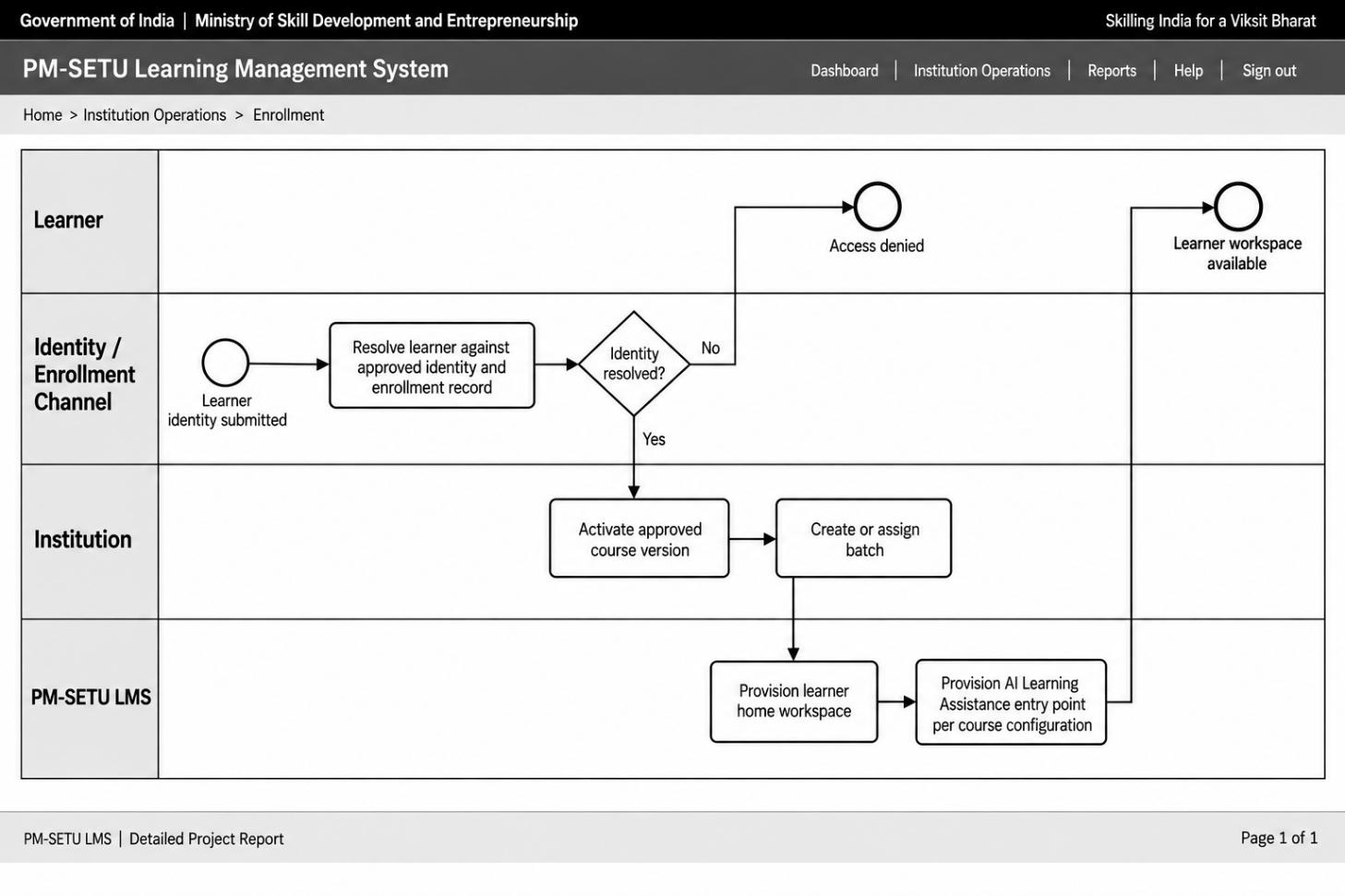
The mockup below shows the resulting learner home workspace referenced in the process design above, including the next required action, the advisory recommendation card, and the AI Learning Assistance entry point.
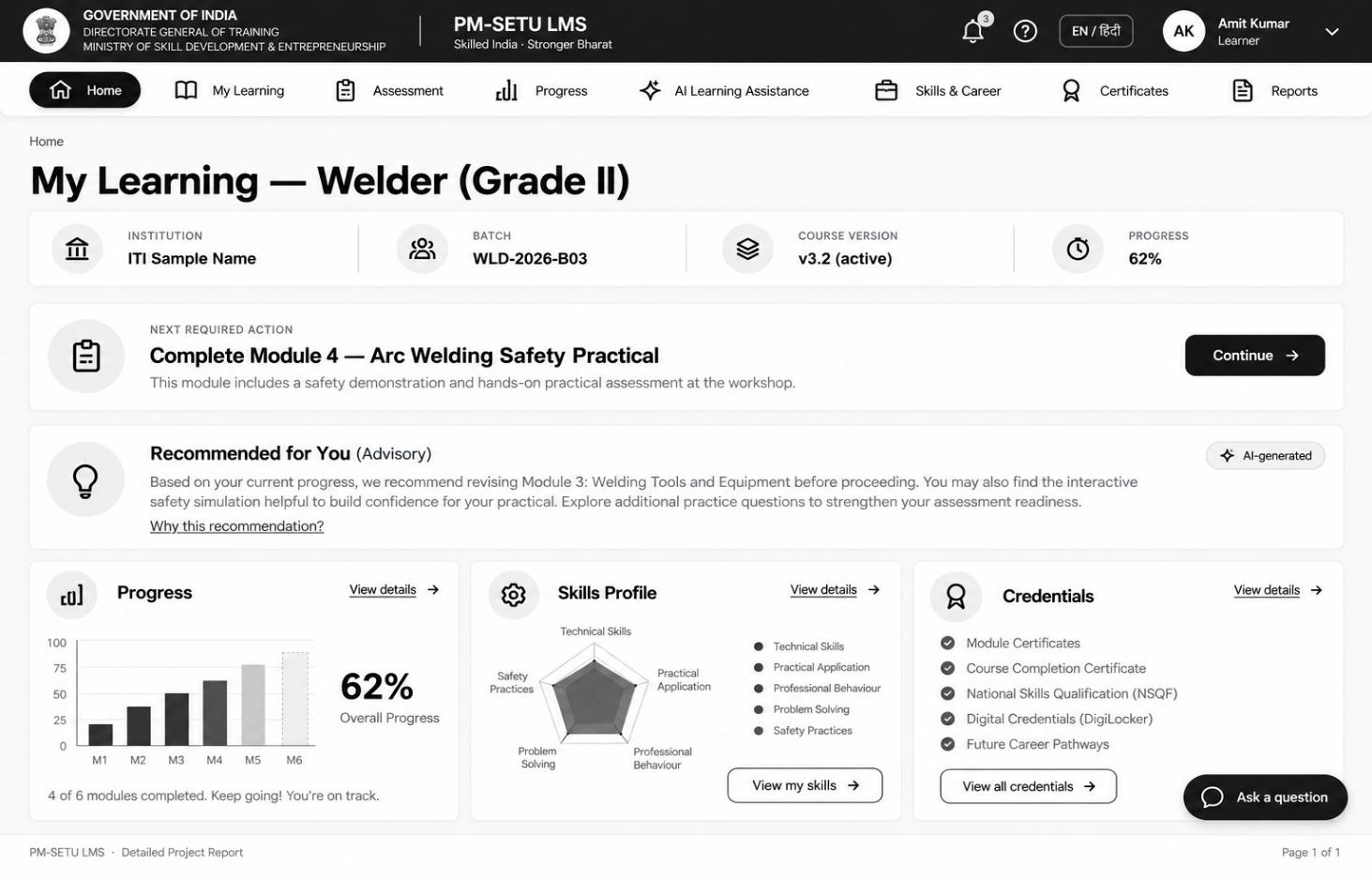
8.2 Course and content delivery process designPDF p.79
- 5.The trainer or the platform presents the approved content sequence for the active course version (Pillar
2).
- 6.The learner consumes instructor-led, self-paced, or practical content; activity is captured against learner,
course version, and batch.
- 7.Where the learner requests it, the AI Course Q&A Assistant answers from the approved content of the
active course, citing its source, or returns an explicit unavailability response (Pillar 10); this interaction is logged but does not itself update module-completion state.
- 8.Module completion is recorded once the configured completion condition for that module is satisfied,
updating the Pillar 5 progress record.
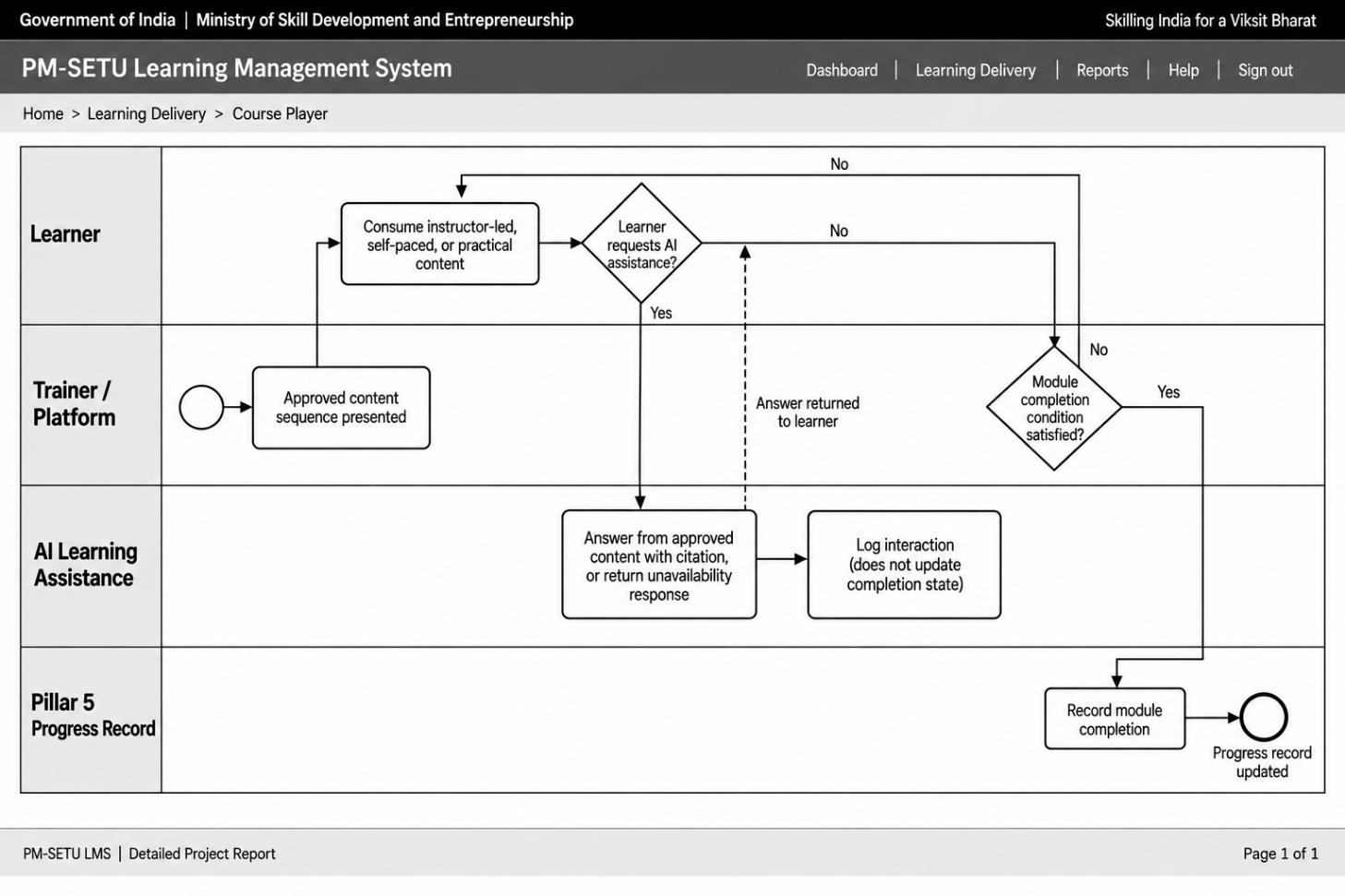
The mockup below shows the resulting course content player referenced in the process design above, including the progress module strip, the completion control, and the advisory study-aid panel grounded in the same course content.
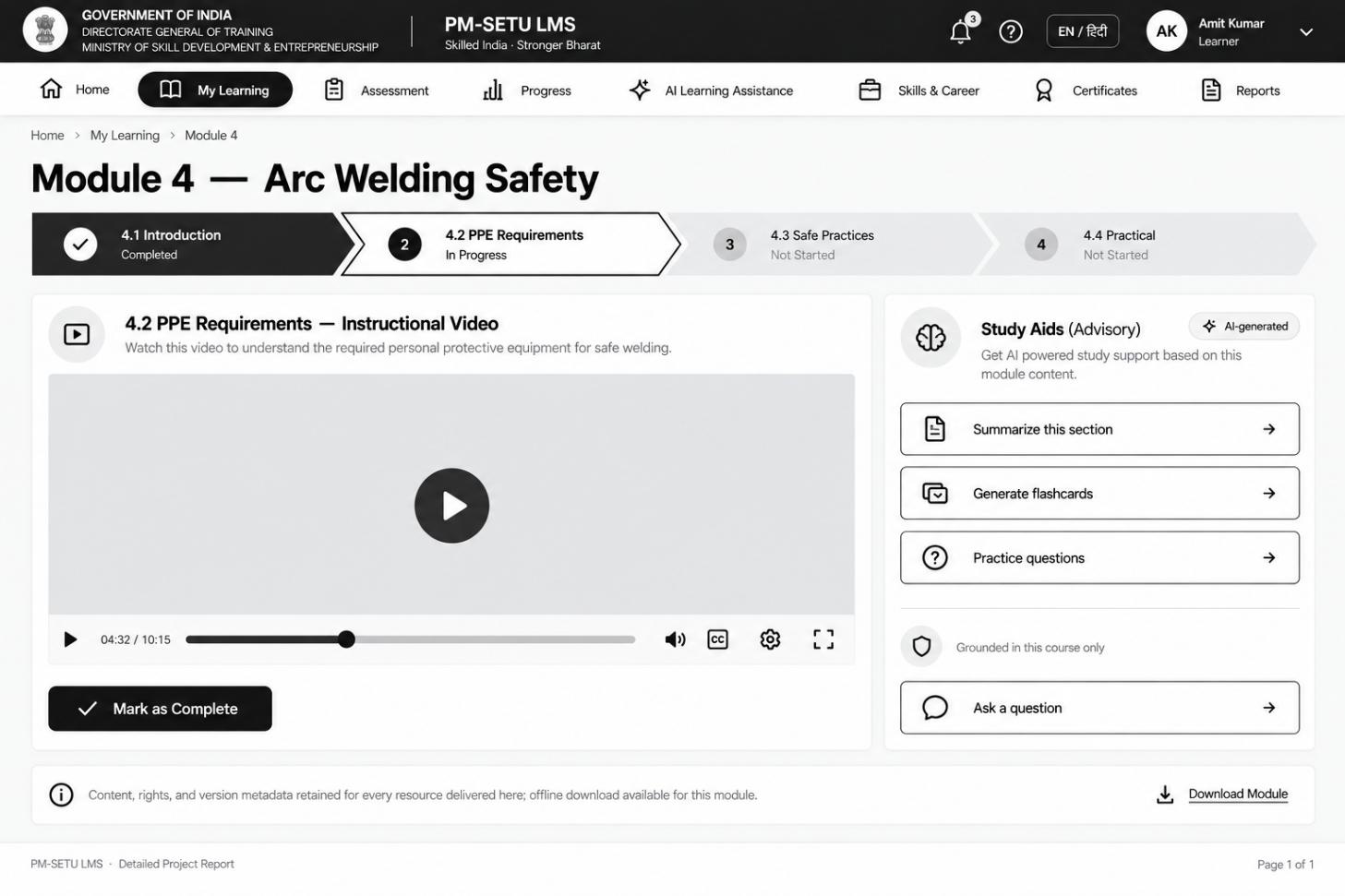
8.3 Assessment and AI-assisted adaptive learning process designPDF p.80
This process links assessment with the next permitted learning action and is extended in this version to show where AI-assisted authoring and evaluator support enter the flow, without altering the existing separation between the recorded academic outcome and the advisory recommendation.
Where the course is configured to require it, a baseline assessment is presented and recorded at course activation, before the first module is delivered; the same assessment instrument, or a matched equivalent, is presented again as the endline assessment once completion criteria are otherwise satisfied.
- 9.Where enabled, an author or assessor drafts a question or test using AI-assisted generation; the item is
reviewed and approved before entering the live question bank (Pillar 3).
- 10.The platform presents the assessment or practical rubric defined for the learner's course version and records the learner attempt or the authorized practical evaluation.
- 11.Where the assessment is formally owned by an external examination system, the platform consumes the result received from that source rather than recalculating it; otherwise, it scores the attempt against the configured rule.
- 12.For a descriptive answer, an AI-suggested score and rationale may be displayed alongside the evaluator's own scoring control; the evaluator's confirmed score, and only that score, becomes the recorded result.
- 13.If the configured threshold is met, the result updates the learner progress record (Pillar 5).
- 14.If it is not met, the platform may recommend remedial content, practice, or a personalized study plan (Pillar 4) and create an intervention item for the trainer, who may accept, defer, or replace the recommendation.
- 15.After the learner completes the remedial activity, reassessment proceeds under the configured attempt rule.
The AI-assisted output at every step above is advisory or human-approved and is visually and structurally separate from the recorded academic outcome and the practical evaluation panel; the reattempt eligibility table is governed by the configured attempt rule rather than by completion of the recommended remedial activity, preserving the process logic of the prior baseline.
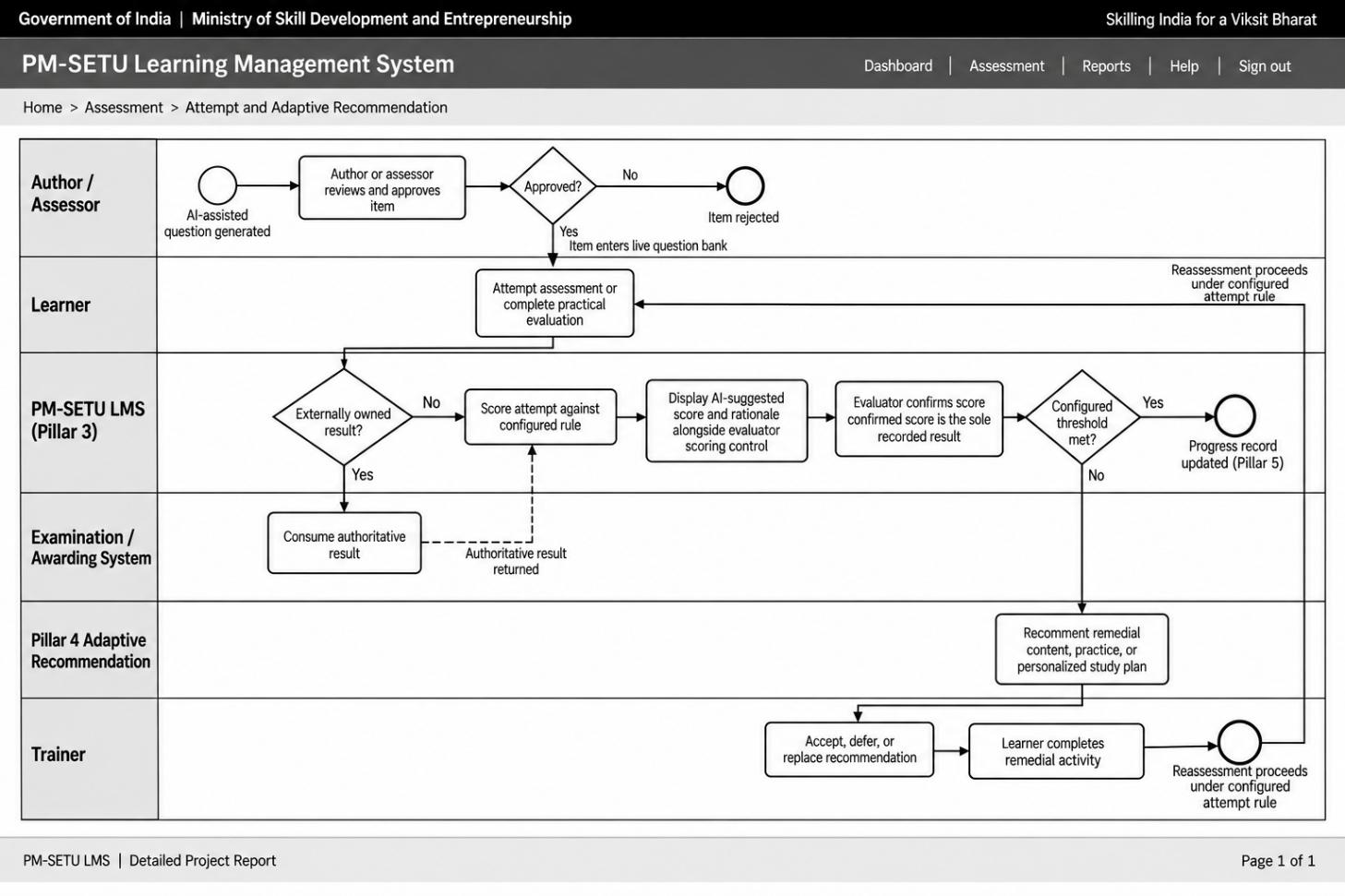
The mockup below shows the resulting assessment screen referenced in the process design above, with the advisory recommendation panel presented separately from the mandatory question and the recorded result.
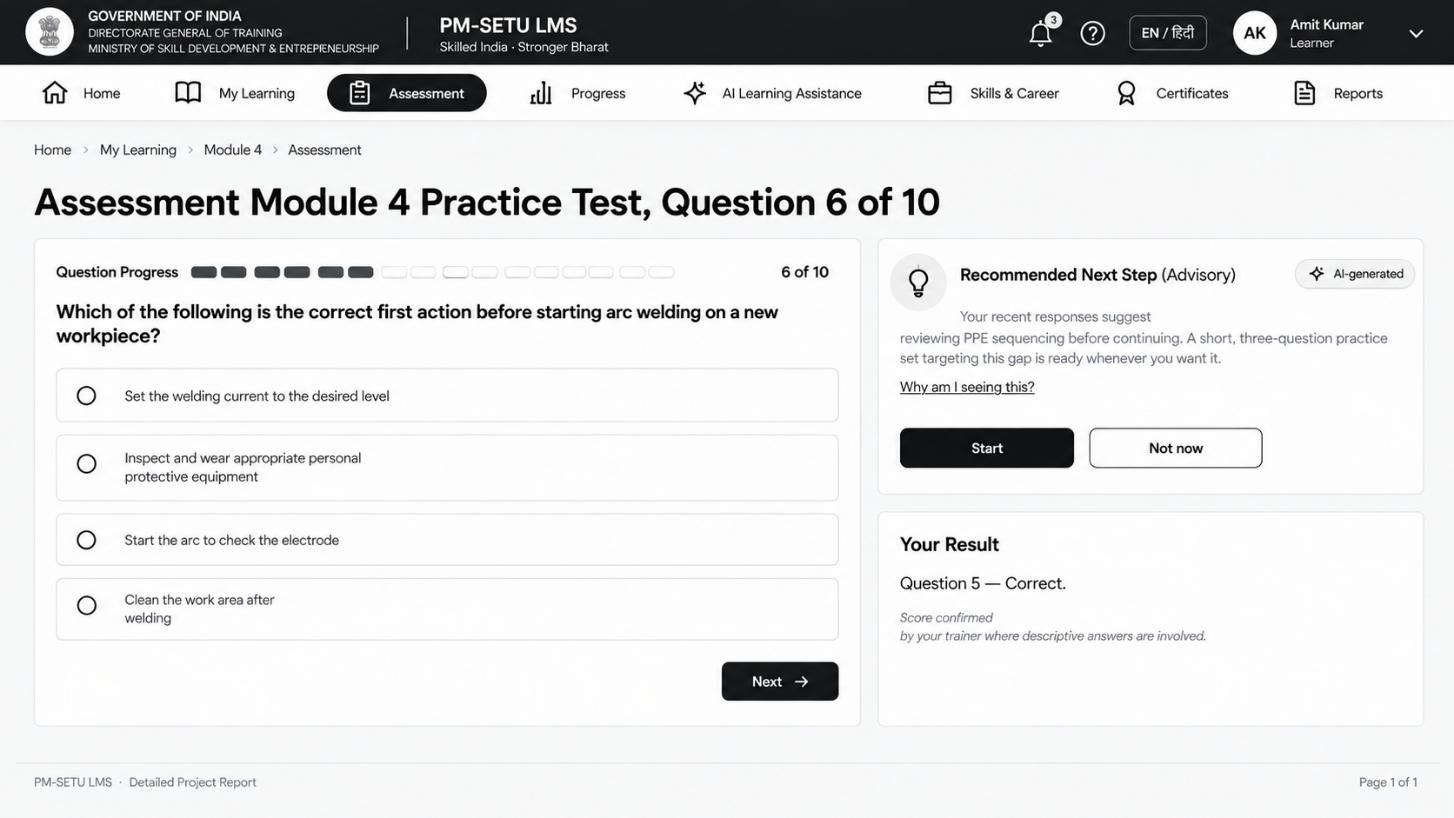
8.4 Learner progress, certification, and digital credential process designPDF p.82
- 16.Validated learning, attendance, practical, and assessment events update the consolidated Pillar 5 progress record.
- 17.The Pillar 5 AI Analytics and Prediction capability computes advisory risk and completion indicators on the configured schedule, explainable by reference to the signals used.
- 18.Where an indicator flags a learner, the trainer reviews the flag and, at the trainer's discretion, records an intervention (Pillar 5); the flag itself never changes progress state.
- 19.Once completion criteria are satisfied, the platform evaluates certificate/badge eligibility and issues or maps the credential once the issuing authority confirms issue (Pillar 6).
- 20.The learner's skills profile is updated from the same recorded evidence, and any career or job- matching guidance is refreshed (Pillar 11).
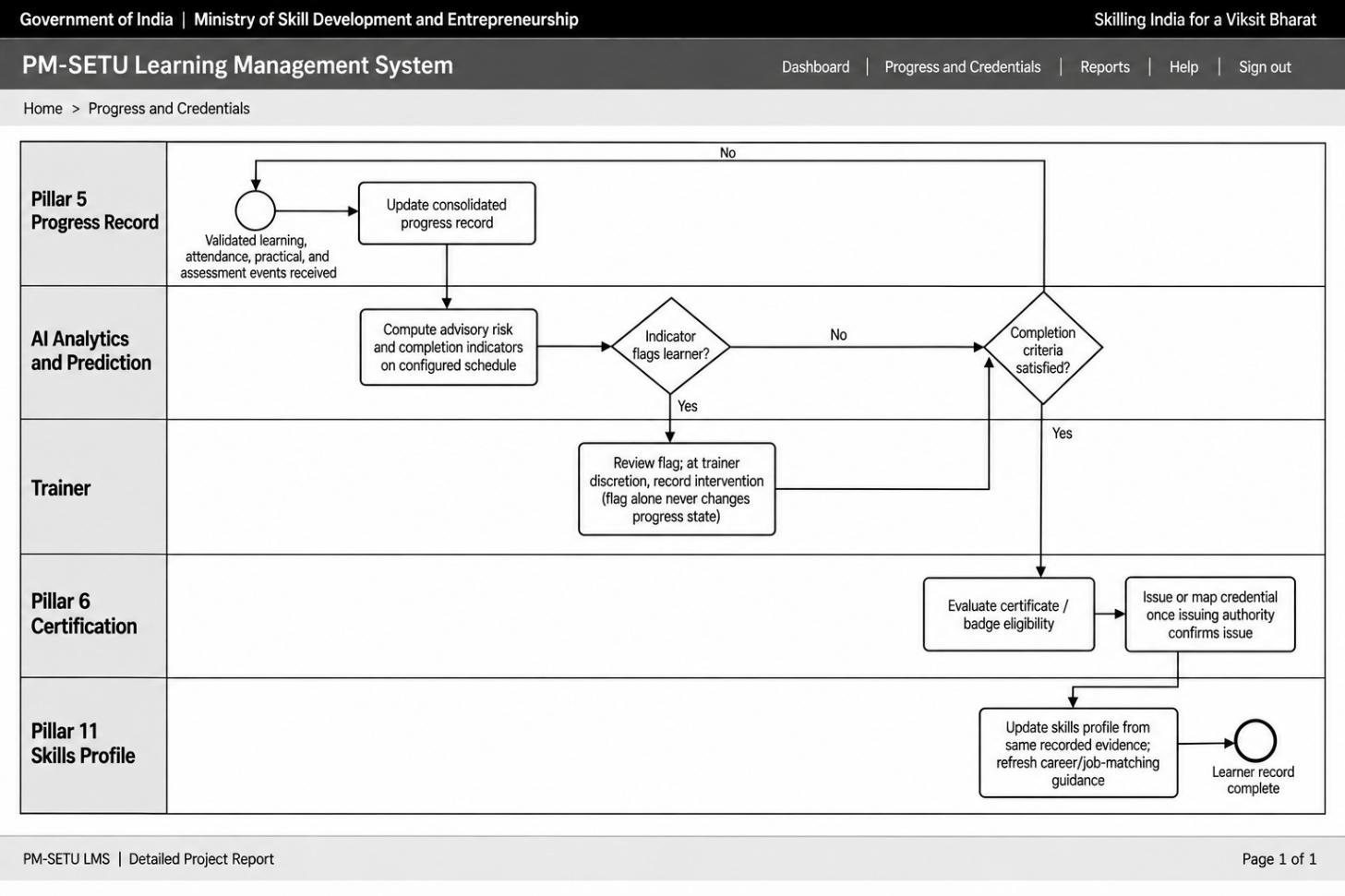
The mockup below shows the resulting consolidated view referenced in the process design above, presenting progress, issued and pending credentials, and the advisory skills profile in one workspace.
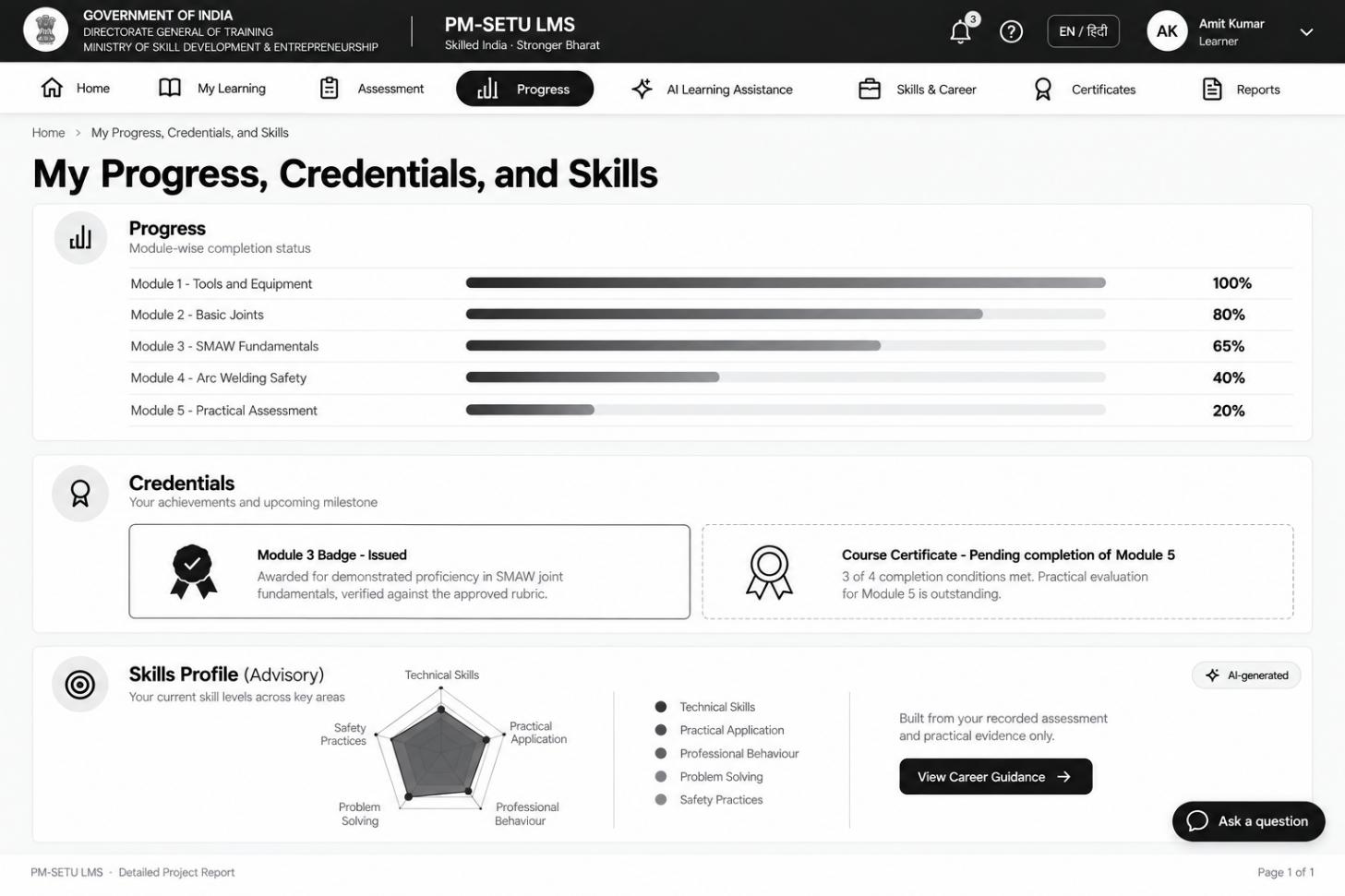
8.5 Vendor LMS and content partner integration process designPDF p.83
This process covers the two principal forms of external contribution to the platform. The integration gateway first determines whether the partner operates its own learning management system. A connected-platform partner registers the interface, scope, and data contract, and the gateway configures the connector, credentials, and identifier mapping. A content-only partner submits the resource together with its rights and metadata, and the gateway registers the package or launch method. Both paths then converge on reconciliation to the PM-SETU canonical model: learner, course, version, batch, and competency identifiers are mapped while the partner's own identifiers are preserved. The academic reviewer validates the course and content mapping and, if it is not acceptable, returns it for correction without activating the integration or publishing the content. Once approved, and only once approved, published content becomes eligible for indexing into the AI knowledge base described in Section 4.10 and Section 5.1. The platform then activates the connector or publishes the content version and begins exchanging the completion, assessment, credential, or other approved events defined in the contract, with reconciliation and duplicate checks applied on every exchange.
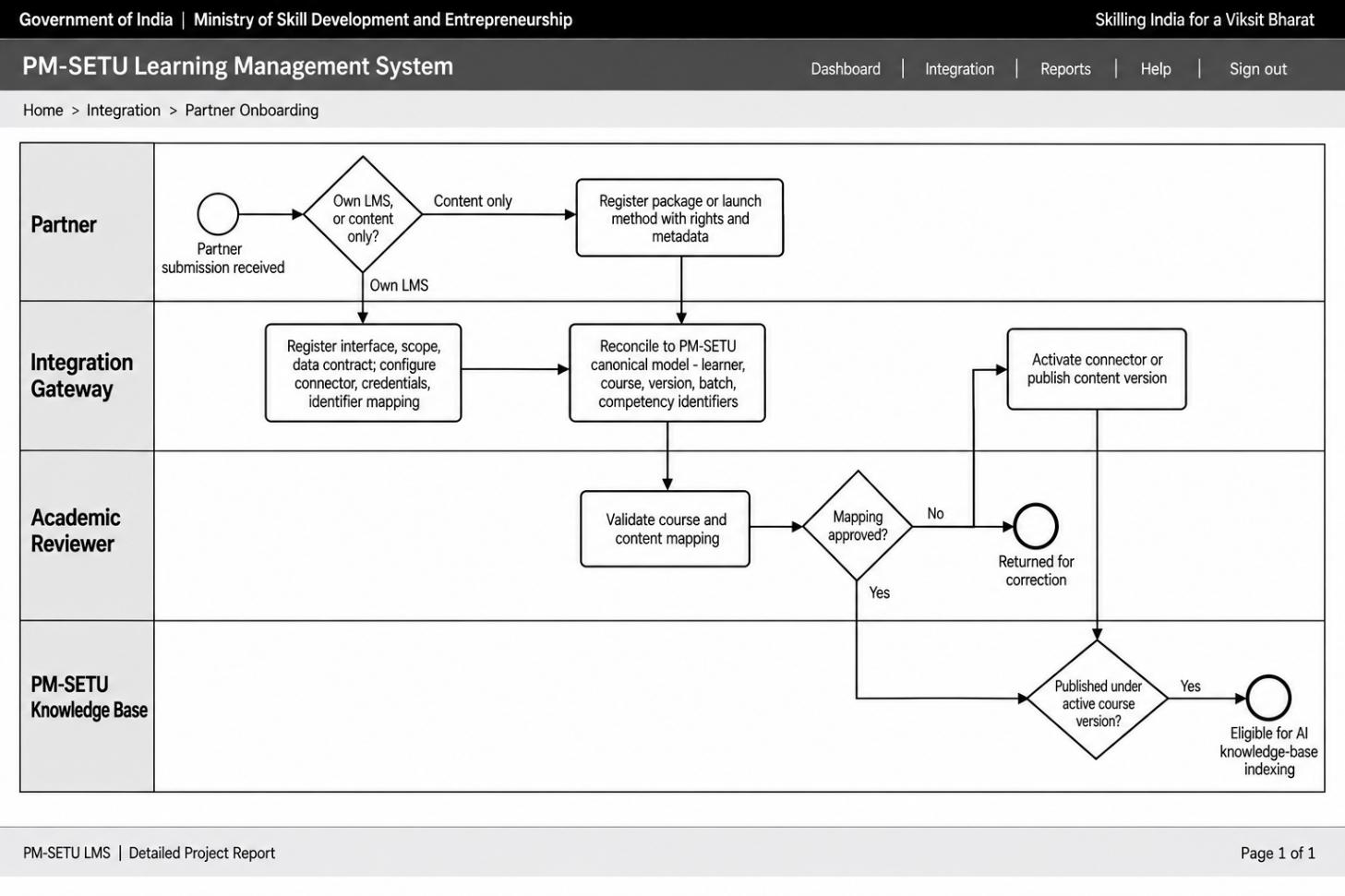
The mockup below shows the resulting integration console referenced in the process design above, listing connector status, last synchronization, and outstanding reconciliation exceptions by partner.
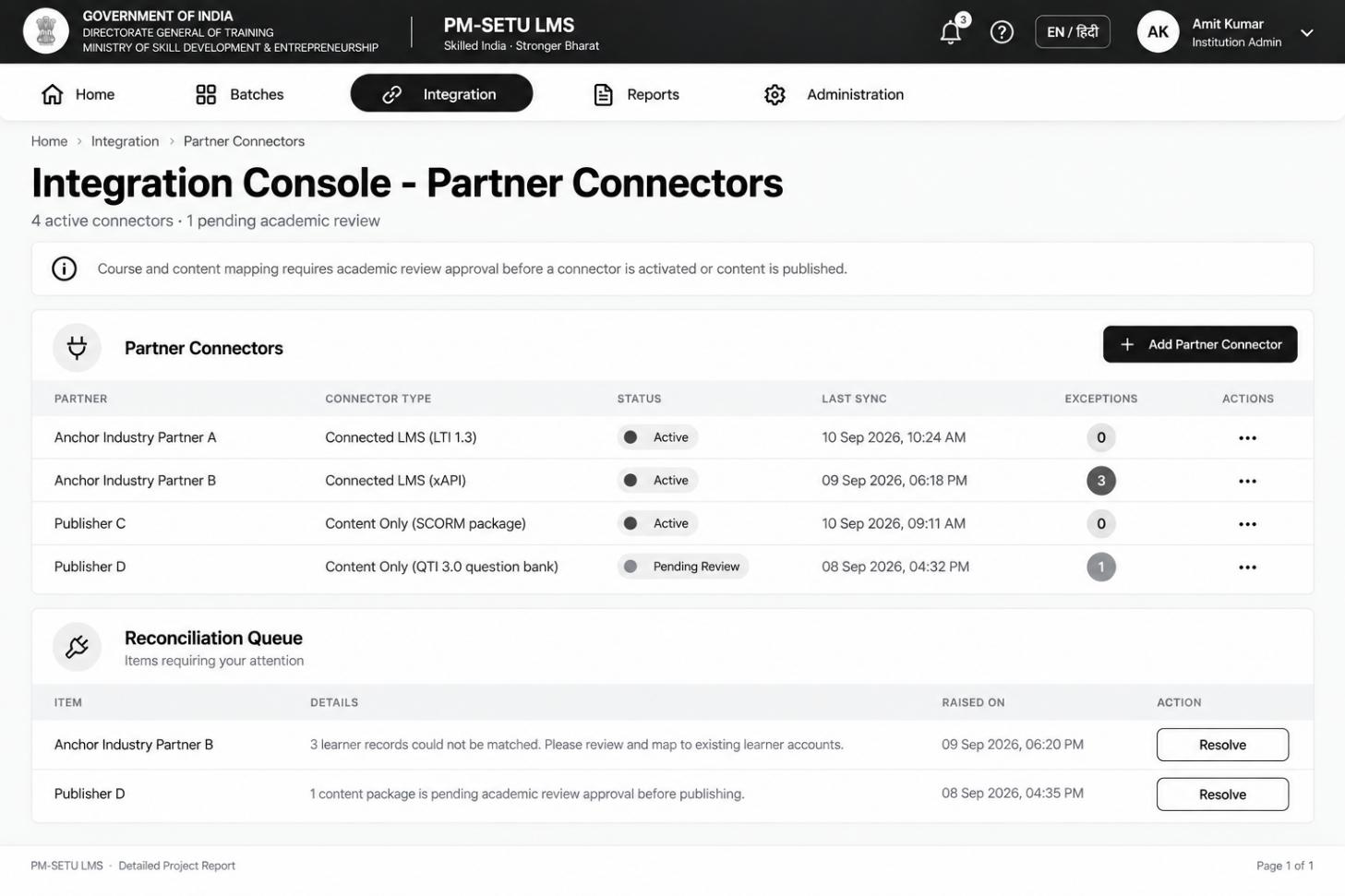
8.6 AI Learning Assistance interaction process designPDF p.85
- 21.The learner or trainer submits a query through the AI Learning Assistance entry point on their existing workspace (Pillar 8, Pillar 10).
- 22.The AI Gateway routes the query to the Retrieval-Augmented Generation service, which retrieves candidate passages from the indexed, approved content of the active course version only.
- 23.If retrieval confidence meets the configured threshold, a grounded answer is generated and returned with its source citation; if not, the explicit unavailability response is returned instead.
- 24.The interaction, including the retrieved source and the response, is logged by AI Observability for audit and quality review.
- 25.The user may flag the response; a flagged response is routed to institution or program review without interrupting the capability for other users.
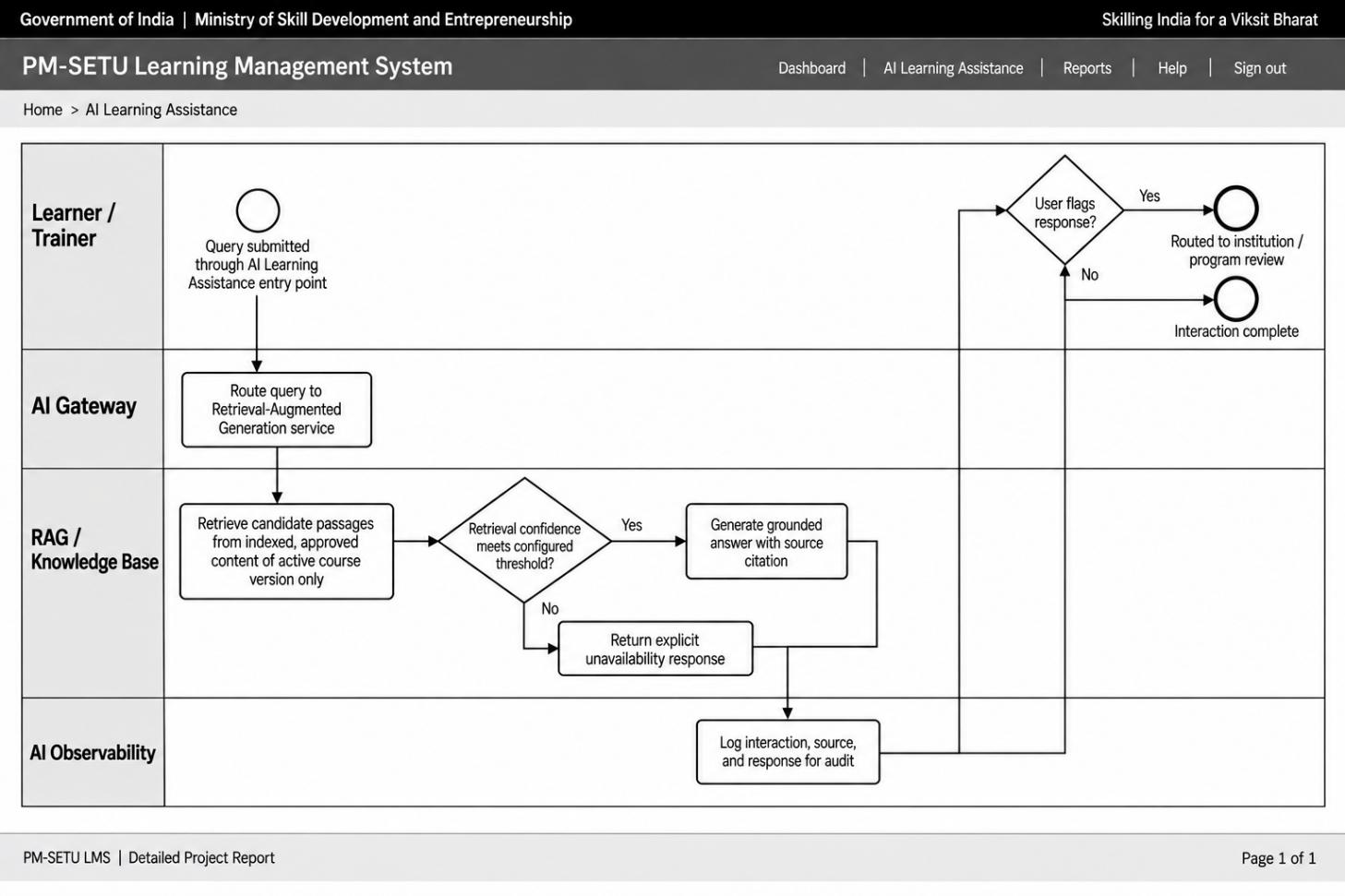
The mockup below shows the resulting conversational panel referenced in the process design above, including the source citation, the multilingual translation note, and the input controls.
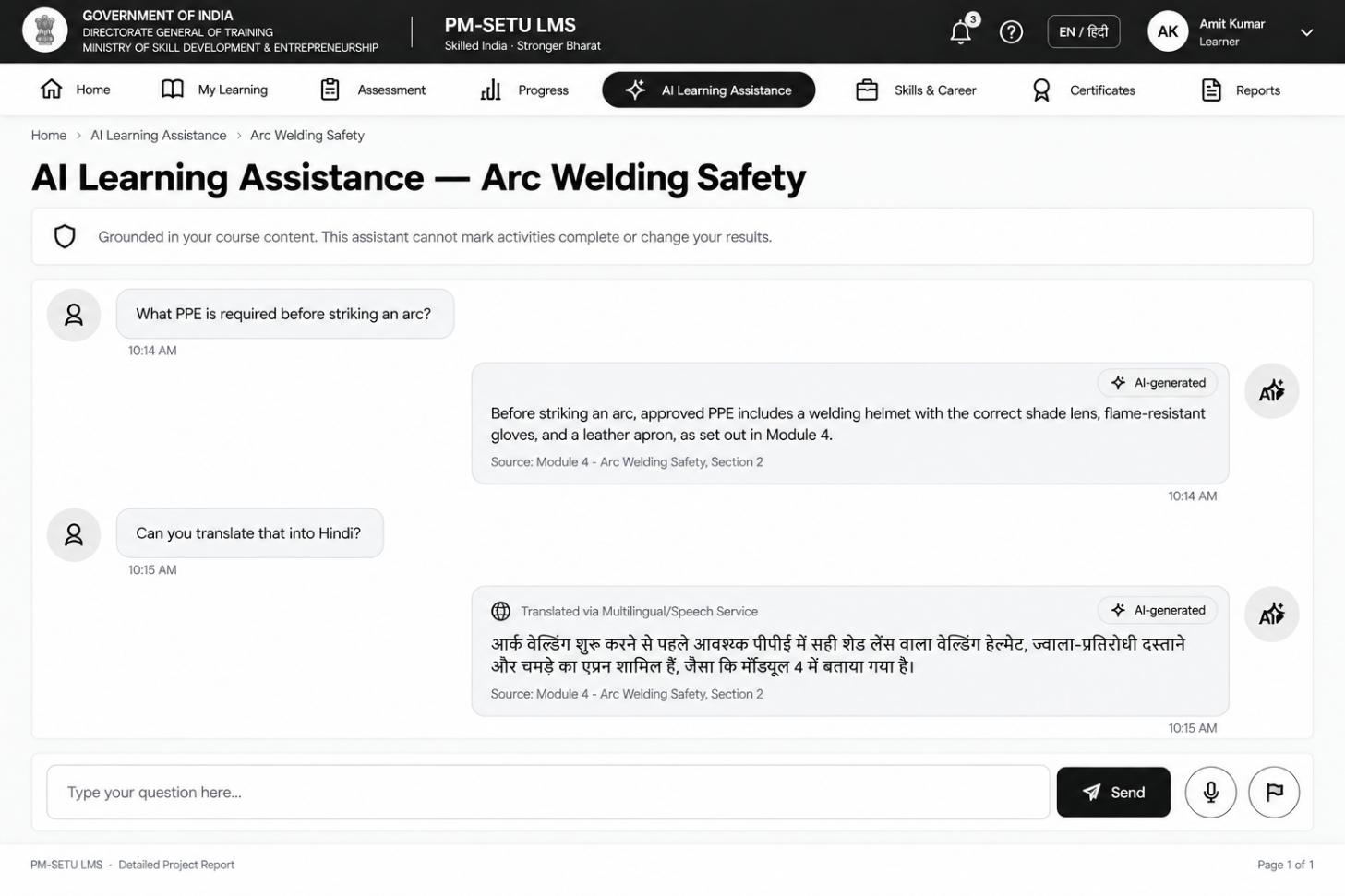
8.7 AI predictive indicator and intervention process designPDF p.86
- 26.Validated attendance, progress, engagement, and assessment signals accumulate in the learner's Pillar 5 record.
- 27.The Predictive-Analytics Service computes advisory risk and completion indicators on the configured schedule, provided sufficient signal history exists; otherwise, the prediction is suppressed.
- 28.The indicator, with its explanation, is surfaced to the trainer and institution view (Pillar 8), visually distinguished from a recorded outcome.
- 29.The trainer reviews the indicator and, at their discretion, records an intervention, a follow-up date, and an eventual outcome (Pillar 5); no automated action results from the indicator alone.
- 30.Indicator quality and any disparity across learner groups are reviewed periodically by the model owner, consistent with Section 6.8.
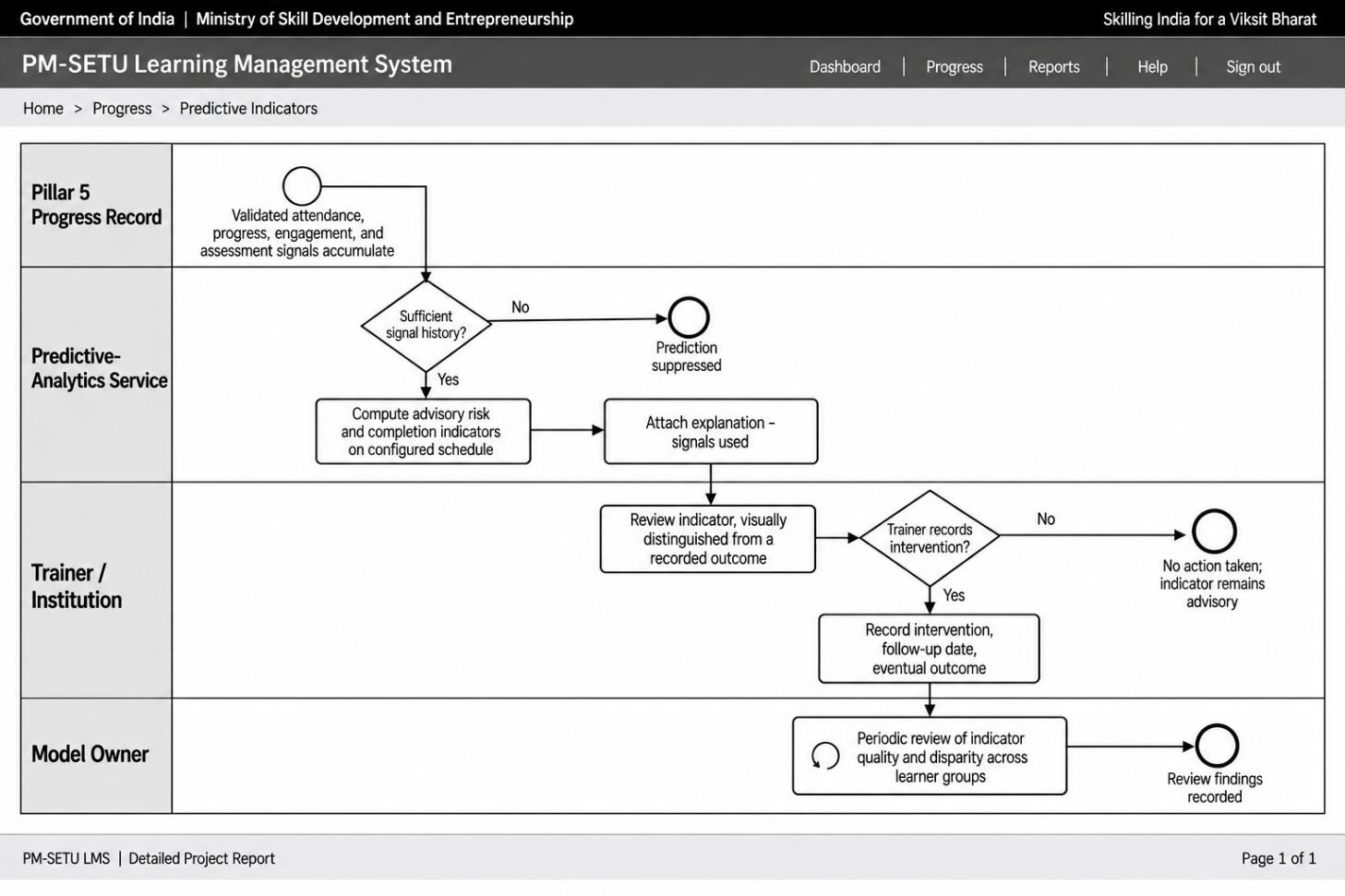
The mockup below shows the resulting trainer batch view referenced in the process design above, with the advisory risk indicator column visually distinguished from recorded attendance, progress, and assessment status.
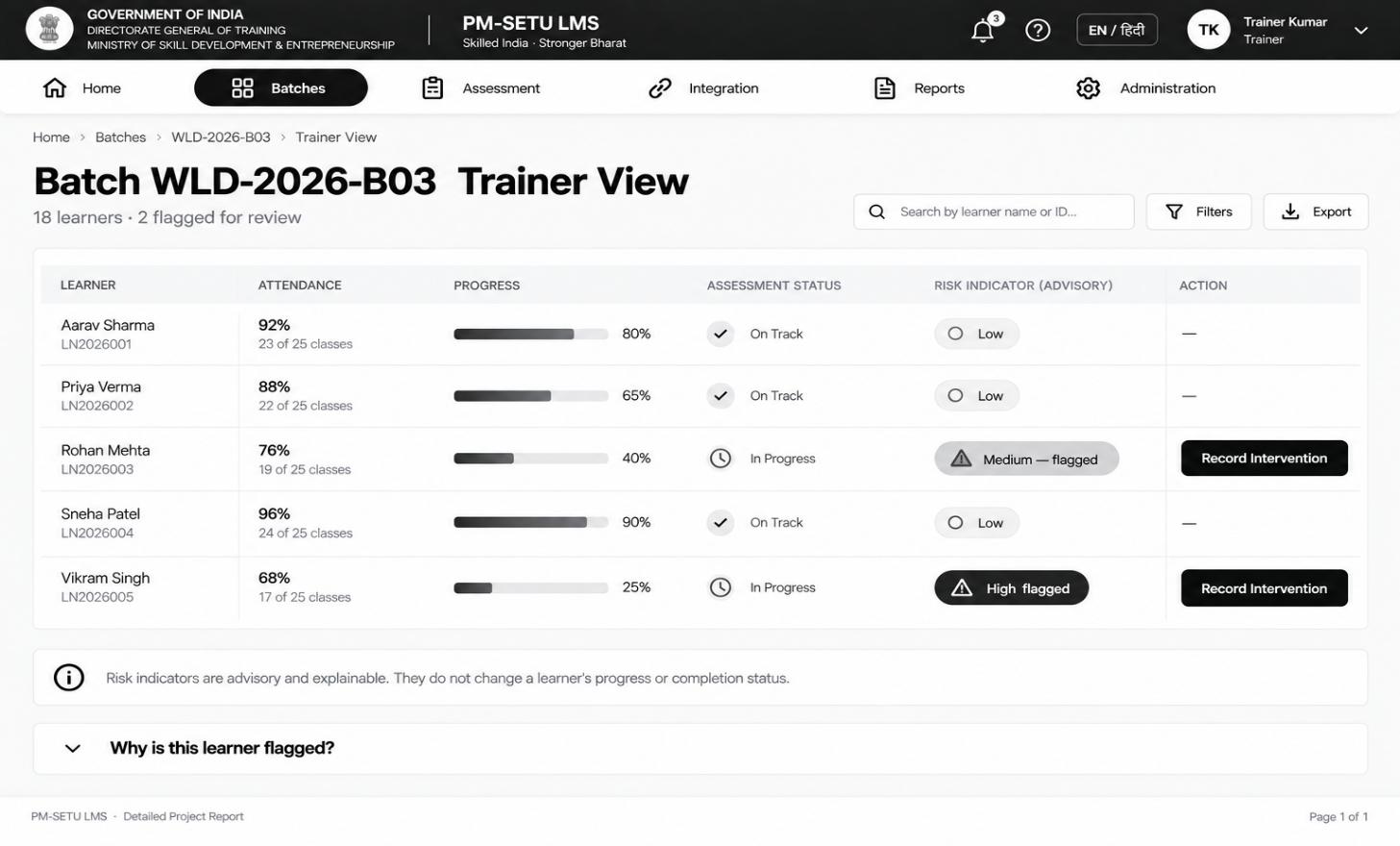
8.8 Skills and Career Intelligence process designPDF p.88
- 31.Recorded competency evidence from Pillar 3 (assessment) and Pillar 5 (progress) updates the learner's skills profile, anchored to NCVET/NSQF competency definitions (Pillar 11).
- 32.The Skills Graph Service estimates mastery for each evidenced competency and positions the learner within the skills/competency graph.
- 33.Where the National Career Service / Skill India Digital Hub interface is available, federated job, apprenticeship, and labor-market data is retrieved and matched against the learner's profile.
- 34.Advisory career path suggestions, job matches, and a job-readiness score are presented to the learner, each traceable to the specific evidence and federated data used.
- 35.The learner may query the AI Career Assistant for further guidance, grounded in the same profile and federated data, under the same grounding and unavailability-fallback rules as Pillar 10.
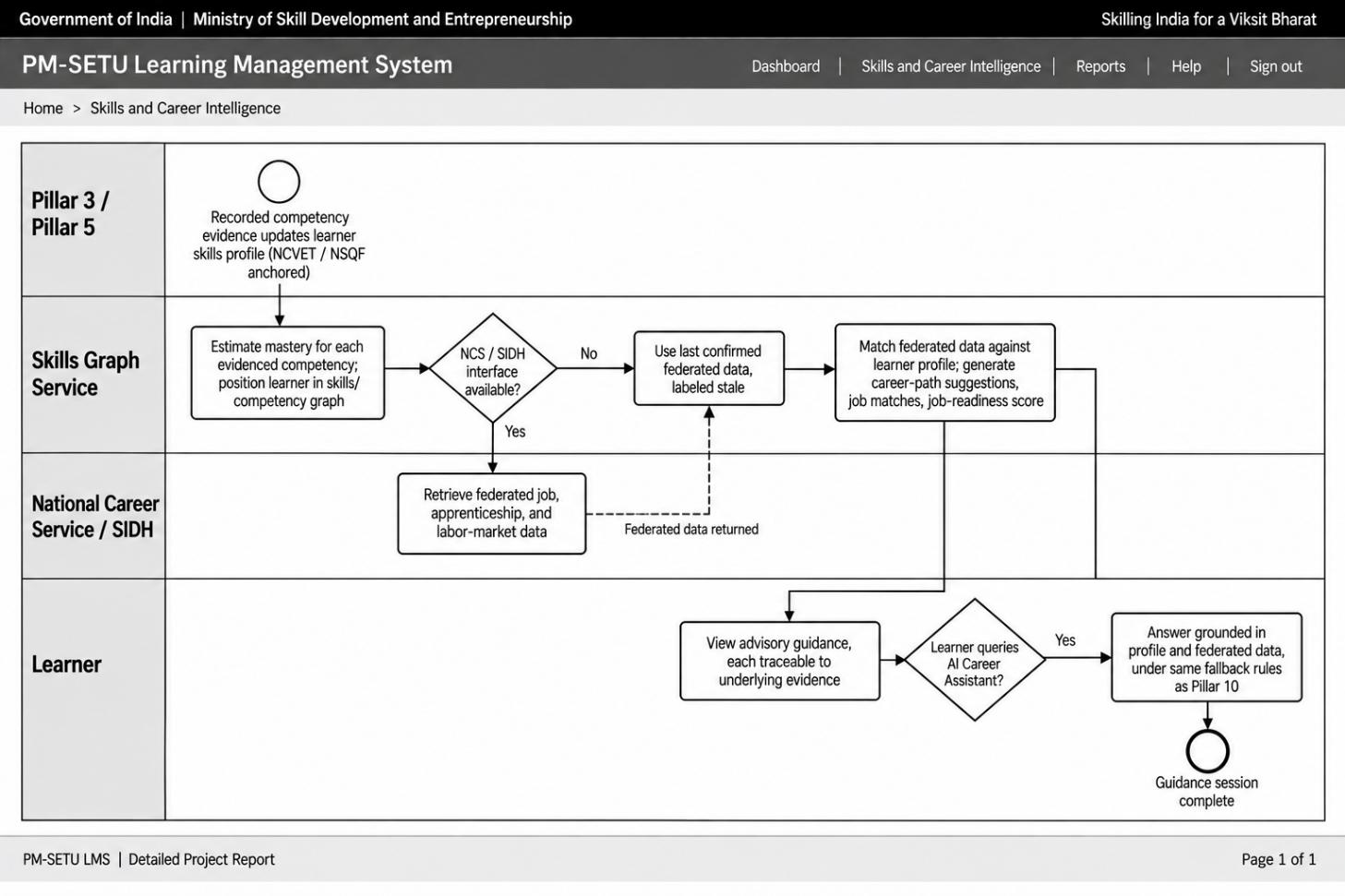
The mockup below shows the resulting career guidance screen referenced in the process design above, including suggested career paths, matched job opportunities federated from the National Career Service, the advisory job-readiness score, and the AI Career Assistant.
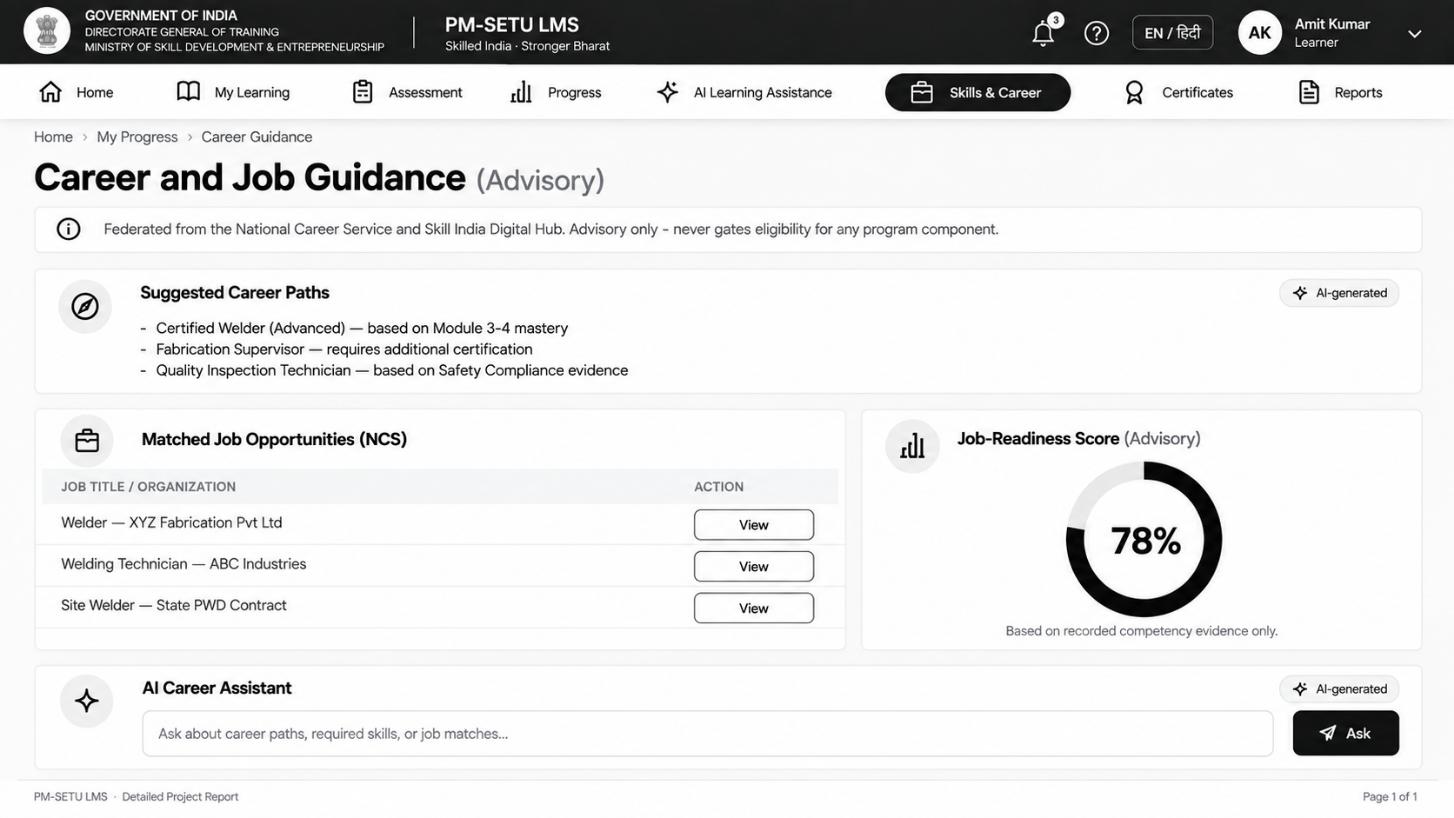
9 AnnexuresPDF p.89
The annexures below are supplementary reference material and do not introduce any requirement not already specified in Sections 1 through 8. Where a figure in an annexure appears to conflict with a figure in the main body of this report, the main body governs.
Annexure A: Persona-by-Pillar Access MatrixPDF p.89
This annexure states, for every stakeholder against every one of the eleven functional pillars, the exact access level granted. It elaborates the general access principles set out in Section 5.4 to the level of granularity required for solution design, test-plan preparation, and role-based access control configuration, and does not introduce a new access rule beyond what is specified pillar by pillar in Section 4. Where this matrix and Section 4 or Section 5.4 appear to conflict, the pillar-level requirement in Section 4 governs.
The matrix is read by row. Each cell states the access level for that stakeholder in that pillar, using the following access-level vocabulary consistently throughout: Full (create, update, and manage within the stated scope), View (read-only), Config (configuration or enablement authority without operational use), Own (limited to records the stakeholder itself owns or generated), Aggr., shown in full as Aggregate (cluster- or institution- level summary only, never an individual learner's underlying record), and N/A, shown in full as Not applicable (no access, by design, because the pillar's function does not extend to that stakeholder).
| Learne r Trainer ITI SPV/AI Industr y/Pvt Conten Centre Academic Integration Pillar Model Owner Admin P t Pvt /State Reviewer Admin |
| Pillar 1: Course Management View View Full View Own N/A Config View N/A View Own Full Own Full Pillar 2: Content Full View Full Config (review/appr N/A View Delivery ove only) |
| Pillar 3: Assessment and Evaluation Own Full View View Own N/A Config N/A Config (AI- scoring model only) N/A Pillar 4: Own Full N/A Personalized Config N/A N/A Config N/A Config N/A and Adaptive Learning Pillar 5: Learner Progress Tracking Own Full View N/A Own N/A Config N/A Config (predictive- indicator suspension) N/A Pillar 6: Own View Own Certification and View View N/A Config N/A N/A N/A Badges |
| Pillar 7: Digital Identity and Credential Integration Own N/A Config Config Own Own Config N/A N/A View Pillar 8: Student Own View Own Lifecycle View View Own View N/A View View Dashboards and Management Pillar 9: Interoperability and Integration N/A N/A View View Own Own Config Full (mapping review only) N/A Full Pillar 10: AI Own Full N/A Learning Config N/A N/A Config N/A Config N/A Assistance |
| Pillar 11: Skills and Career Intelligence Own View Aggr. Aggr. N/A* N/A* Config N/A Config N/A |
SPV/AI P
Conten t Pvt
Academic Reviewer Model Owner Integration
Full (review/appr ove only)
Pillar 2: Content Delivery Own Full Full View Own Full Config
Pillar 4: Personalized and Adaptive Learning
Pillar 6: Certification and Badges
Pillar 8: Student Lifecycle Dashboards and Management
Pillar 10: AI Learning Assistance
N/A* (Pillar 11, Industry / content partner column): Not applicable unless a specific federation agreement is in force. Where a stakeholder's access varies by scope within a pillar rather than being a single flat level, the specific scope is stated in the pillar's Functional Capabilities in Section 4 and in the narrative note below; this table states the governing access level only.
The Config access level carries a different specific scope in each pillar and is not a single undifferentiated permission: in Pillar 1 it is course-version publication and applicability; in Pillar 4 it is adaptive-recommendation model and rule configuration; in Pillar 7 it is user and identity provisioning, distinct for the ITI administrator (institution-level provisioning) and the SPV / Anchor Industry Partner (cluster-level provisioning); in Pillar 9 it is connector and mapping governance; in Pillars 10 and 11 it is AI Governance configuration under Section 6.8, including, for the ITI administrator in Pillar 10 specifically, the course- or batch-level enable and disable control described in Section 4.10.2. The specific scope of every Config, Own, View, and Aggregate entry is stated in full in the Functional Capabilities of the corresponding pillar in Section 4; this table states the governing access level for quick reference and does not restate every scope qualifier.
Two entries are highlighted here because they were the subject of specific review during requirements development. First, the SPV / Anchor Industry Partner has Not applicable access to Pillar 10 (AI Learning Assistance): this is a deliberate design choice, not an oversight, because AI Learning Assistance is a per-learner and per-trainer conversational capability with no cluster-level aggregate view defined anywhere in Section 4.10, consistent with the data-minimization principle in Section 6.8.2, which does not permit a cluster-level rollup of individual conversational interactions. Second, both the SPV / Anchor Industry Partner and the ITI administrator have Aggregate, not Own or Full, access to Pillar 11 (Skills and Career Intelligence): institution and cluster users see institution- and cluster-level skills and employability summaries presented through Pillar 8, never an individual learner's underlying skills profile or career conversation, unless the learner's own institution has separately enabled record-level sharing as stated for the trainer role.
Academic Reviewer's Full access on Pillars 2 and 9 is scoped strictly to the review/approve action on submitted content and mappings, not general content authoring or connector operation. Model Owner's Config access is scoped to AI model and rule governance specifically, not general pillar administration. These three roles are new additions to this matrix, resolving an inconsistency where each was operationally referenced in Section 4 and Section 8 but absent from this table.
Annexure B: AI Capability RegisterPDF p.92
This register resolves, as the single authoritative source, the AI capability count for this program. Seventy- four (74) distinct artificial intelligence capabilities were identified, evaluated, and classified during requirements development. This figure supersedes any differing count referenced in working or interim research material produced during development of this report. Capabilities are classified as Core (specified for initial delivery under normal governance), Enhanced (specified for initial delivery with the additional controls noted in the relevant pillar), Future (identified but deferred to a later program phase, not specified for initial delivery), or Excluded (identified and explicitly not recommended for this program, per Section 6.8.4).
| # | AI Capability | DPR Location | Classification |
| 1 | Adaptive Learning Path | Pillar 4 | Core |
| 2 | Next-Best-Action Recommendation | Pillar 4 | Core |
| 3 | Skill-Gap Detection (Course Level) | Pillar 4 | Core |
| 4 | Remedial Content Recommendation | Pillar 4 | Core |
| 5 | Advanced Content Recommendation | Pillar 4 | Core |
| 6 | Personalized Study Plan Generation | Pillar 4 | Core |
| 7 | Difficulty & Pace Adaptation | Pillar 4 | Core |
| 8 | Recommendation Explainability | Pillar 4 | Core |
| 9 10 | Trainer Accept / Defer / Override Recommendation History & Effectiveness Tracking | Pillar 4 Pillar 4 | Core Core |
| 11 | AI Curriculum Boundary Controls | Pillar 4 / Sec 6.8 | Core |
| 12 | Recommendation Model / Rule Versioning | Pillar 4 / Sec 6.8 | Core |
| 13 | AI Course Q&A Assistant | Pillar 10 | Core |
| 14 | Conversational AI Tutor (Socratic) | Pillar 10 | Enhanced |
| 15 | Context-Aware Learning Assistant | Pillar 10 | Core |
| 16 | AI Coaching & Nudges | Pillar 10 | Enhanced |
| 17 | Personalized Concept Explanations | Pillar 10 | Core |
| 18 | Personalized Practice Question Generation | Pillar 10 | Core |
| 19 | AI-Generated Content Summaries | Pillar 10 | Enhanced |
9 Trainer Accept / Defer / Override Pillar 4 Core
| # | AI Capability | DPR Location | Classification |
| 20 | AI-Generated Flashcards | Pillar 10 | Enhanced |
| 21 | AI Question Generation | Pillar 3 | Core |
| 22 | AI Distractor Generation | Pillar 3 | Enhanced |
| 23 | Question Difficulty Prediction | Pillar 3 | Enhanced |
| 24 | Adaptive Assessment (Dynamic Difficulty) | Pillar 3 | Enhanced |
| 25 | Intelligent Test Assembly | Pillar 3 | Enhanced |
| 26 | AI-Assisted Descriptive / Essay Scoring | Pillar 3 | Core |
| 27 | Rubric-Assisted Practical Scoring | Pillar 3 | Core |
| 28 | AI-Generated Assessment Feedback | Pillar 3 | Enhanced |
| 29 30 | Plagiarism Detection AI-Generated-Answer Detection | Pillar 3 Pillar 3 | Enhanced Enhanced (advisory-only, non-enforcement) |
| 31 | AI-Assisted Remote Proctoring | Pillar 3 | Future |
| 32 | Misconception Analysis | Pillar 3 | Enhanced |
| 33 | Assessment Analytics | Pillar 3 | Core |
| 34 | Oral / Speech-Based Assessment | Pillar 3 | Future |
| 35 | Trainer Copilot (Session Plan & Material Drafting) | Pillar 10 | Core |
| 36 | Learner Performance Summary for Trainers | Pillar 5 / Pillar 8 | Core |
| 37 | At-Risk Learner Flagging | Pillar 5 | Core |
| 38 | Intervention Recommendation | Pillar 5 | Core |
| 39 | Remedial-Group Identification | Pillar 5 | Enhanced |
| 40 | Natural-Language Access to Learner Data | Pillar 10 | Enhanced |
| 41 | Trainer Content Q&A Assistant | Pillar 10 | Enhanced |
| 42 | Dropout / Attrition Risk Prediction | Pillar 5 | Core |
| 43 | Completion Prediction | Pillar 5 | Enhanced |
29 Plagiarism Detection Pillar 3 Enhanced
| # | AI Capability | DPR Location | Classification |
| 44 | Assessment-Performance Prediction | Pillar 5 | Enhanced |
| 45 | Engagement Prediction | Pillar 5 | Enhanced |
| 46 | Cohort & Behaviour-Pattern Analysis | Pillar 5 / Pillar 8 | Enhanced |
| 47 | Course / Content Effectiveness Analysis | Pillar 5 / Pillar 8 | Enhanced |
| 48 | Prescriptive Intervention Analytics | Pillar 5 / Pillar 8 | Enhanced |
| 49 | Emotion / Affect Recognition | Sec 6.8.4 | Excluded |
| 50 | Skills Profiling | Pillar 11 | Core |
| 51 | Skill Mastery Estimation | Pillar 11 | Enhanced |
| 52 | Skills / Competency Graph | Pillar 11 | Core |
| 53 | Competency Evidence Analysis (RPL Support) | Pillar 11 | Future |
| 54 | Skill-Gap Analysis vs. Job Requirements | Pillar 11 | Core |
| 55 | Career-Path Recommendation | Pillar 11 | Core |
| 56 | Skill-to-Job / Course-to-Job Matching | Pillar 11 | Enhanced |
| 57 | Job-Readiness Scoring | Pillar 11 | Enhanced |
| 58 | Labor-Market-Informed Recommendations | Pillar 11 | Enhanced |
| 59 | AI Career Assistant (Conversational) | Pillar 11 | Enhanced |
| 60 | AI-Powered Course Catalogue Search | Pillar 10 | Core |
| 61 | Conversational Course Search (Ask My Course) | Pillar 10 | Core |
| 62 | Natural-Language Platform Navigation | Pillar 10 | Future |
| 63 | Natural-Language Reporting | Platform Layer / Pillar 8 | Enhanced |
| 64 | AI-Generated Report Summaries | Platform Layer / Pillar 8 | Enhanced |
| 65 | AI Anomaly / Exception Detection | Platform Layer / Pillar 9 | Enhanced |
| 66 | AI Duplicate & Data-Quality Detection | Platform Layer / Pillar 9 | Core |
| 67 | Support-Ticket Classification / AI Helpdesk | Platform Layer | Core |
| 68 | Administrative Copilot | Platform Layer | Enhanced |
| # 69 70 | AI Capability On-Demand AI Quiz / Exercise Generation Learner Support Agent (Agentic) | DPR Location Pillar 10 / Pillar 3 Sec 6.8.4 Future roadmap | Classification Core Future |
| 71 72 | Content-Authoring Agent (Agentic) Administrative / Reporting Agent (Agentic) | Sec 6.8.4 Future roadmap Sec 6.8.4 Future roadmap | Future Future |
| 73 74 | Integration / Reconciliation Agent (Agentic) Fully Autonomous Grading / Decision Agent | Sec 6.8.4 Future roadmap Sec 6.8.4 | Future Excluded |
# AI Capability DPR Location Classification
Verified: Core 34 + Enhanced 30 + Future 8 + Excluded 2 = 74, matching the stated total exactly. Sequential 1-74, no gaps or duplicates.
Annexure C: Glossary and AbbreviationsPDF p.95
| Term ABC AIP AI Gateway Bhashini | Meaning Academic Bank of Credits Anchor Industry Partner The internal service through which every call to an AI model, internal or external, is routed, authenticated, and logged MeitY's national language-translation and speech infrastructure platform |
| cmi5 CSTARI DGT DigiLocker | An xAPI profile defining a structured, standardized way for a Learning Management System to launch and track content Central Staff Training and Research Institute Directorate General of Training India's national digital document wallet and credential-verification service |
| DPDP Act ITI LMS | Digital Personal Data Protection Act, 2023 Industrial Training Institute Learning Management System |
AIP Anchor Industry Partner
ITI Industrial Training Institute
LMS Learning Management System
| Term LTI | Meaning Learning Tools Interoperability, a standard for launching and exchanging data with an external learning tool |
| MSDE NCVET NCVT NCS NIMI NSDC NSQF OJT QP-NOS QTI | Ministry of Skill Development and Entrepreneurship National Council for Vocational Education and Training National Council for Vocational Training National Career Service National Instructional Media Institute National Skill Development Corporation National Skills Qualification Framework On-the-Job Training Qualification Pack - National Occupational Standards Question and Test Interoperability, a standard for exchanging assessment content and results |
| RAG RPL SCORM SIDH SPMU SPV SSC WCAG xAPI Analytics Portal | Retrieval-Augmented Generation - a technique that grounds AI- generated output in retrieved, approved content rather than the model's unguided output Recognition of Prior Learning Sharable Content Object Reference Model, a standard for packaging and launching e-learning content (NEW) Skill India Digital Hub State Program Management Unit State Project / Skill Vehicle Sector Skill Council / State Skill Corporation, as applicable Web Content Accessibility Guidelines Experience API, also known as Tin Can API, a standard for recording learning activity data The separate national, State, and cross-system reporting and dashboard platform referenced throughout this report (Sections 1.1, 2.4, 5.4, 8) as the destination for validated operational events this platform publishes; program- |
NCS National Career Service
| Term | Meaning wide analytics are delivered through that portal and are outside the scope of this report. |
| PMU | Program Management Unit, the Centre-level counterpart to the State Program Management Unit (SPMU) referenced in Section 1.2's stakeholder table. |
Annexure D: Regulatory and Standards ReferencesPDF p.97
| Reference Digital Personal Data Protection Act, 2023 and Rules, 2025 Information Technology Act, 2000 CERT-In Directions and Guidelines, 2022 Guidelines for Indian Government Websites (GIGW) 3.0 NITI Aayog Responsible AI Principles ISO/IEC 27001:2022 | Category Legal requirement Legal requirement Government guidance / legal reporting obligation Government standard Government guidance International standard | Application in this Report Data protection, consent, minor safeguards (Sections 6.2, 6.8.3) Reasonable security practices (Section 6.2) Incident reporting, log retention (Section 6.2) Accessibility and interface quality (Sections 6.2, 6.6) AI Governance framework design principles (Section 6.8.3) Information Security Management System (Section 6.2) |
| ISO/IEC 42001 NIST Cybersecurity Framework 2.0 | International standard (benchmark) International standard (benchmark) | AI management system maturity benchmark, not mandated for initial go-live (Section 6.8.3) Security architecture reference model (Section 6.2) |
| European Union Artificial Intelligence Act WCAG 2.1 Level AA | International standard (benchmark, non- binding) International standard | High-risk classification used as a rigor benchmark for assessment AI controls (Section 6.8.3) Accessibility conformance (Section 6.6) |
| Open Badges 3.0 / W3C Verifiable Credentials | International standard | Digital badge and micro-credential format (Pillar 6) |
Reference Category Application in this Report
ISO/IEC 27001:2022 International standard
| Reference | Category | Application in this Report |
| LTI 1.3, SCORM, xAPI, cmi5, QTI 3.0, OneRoster | International standard | Content and assessment interoperability (Pillar 2, Pillar 3, Pillar 9) |
| NIST AI Risk Management Framework 1.0 | International standard (benchmark) | AI risk identification and management benchmark (Section 6.8.3) |
| UNESCO Guidance for Generative AI in Education and Research | International guidance | Generative AI grounding and oversight principles for education (Section 6.8.3) |
Annexure E: Project Governance StructurePDF p.98
This program shall be governed through a tiered structure consistent with the roles already referenced throughout this report, formalized here for clarity of reporting lines and decision authority.
Program-level governance
A State Project Management Unit (SPMU) shall hold overall program accountability, including approval of course and qualification standards changes, AI Governance framework changes per Section 6.8, and go/no- go decisions for each phased rollout described in Section 7.3. The SPMU shall be chaired by [client to confirm designated authority] and shall meet on a [client to confirm cadence, e.g. monthly] basis.
Cluster-level governance
Each SPV / Anchor Industry Partner shall be accountable for delivery coordination and reconciliation across its Hub-and-Spoke cluster, as specified in Section 3.5, reporting cluster-level status to the SPMU on a schedule to be confirmed.
Institution-level governance
Each participating ITI shall be accountable for course and batch operations, data-quality resolution, and institutional reporting, as specified in Section 4.8 and Section 4.9, with escalation to the SPV/AIP or SPMU where an exception exceeds institutional resolution authority.
AI Governance oversight
Consistent with Section 6.8, a designated AI Governance function, reporting to the SPMU, shall be accountable for model/rule version approval, periodic disparity review (Section 6.8.2), and the exclusion/inclusion decisions recorded in Section 6.8.4. This function does not sit within any single pillar and holds authority across all AI-enabled capabilities in this report.
Decision authority summary
| Decision | Authority |
| Course/qualification standard changes | [Client to confirm - likely DGT/NCVET per existing academic authority] |
| AI Governance framework changes | SPMU, on recommendation of the AI Governance |
| (Section 6.8) | function |
| Decision | Authority |
| Phased rollouts go/no-go (Section 7.3) Institution-level exception resolution | SPMU ITI Administrator, escalating to SPV/AIP where required |
| Partner connector onboarding approval | [Client to confirm - likely SPMU or designated integration authority] |
This structure formalizes reporting relationships already implied by the roles and escalation patterns described throughout Sections 3, 4, and 8 of this report; it does not introduce a new organizational entity beyond what those sections already assume.
Annexure F: Indicative Implementation TimelinePDF p.99
The phasing principle for this program is already established in Section 7.3: rollout begins with initial Hub- and-Spoke clusters and expands after reconciliation, user support, and performance are proven, with AI capabilities enabled progressively per pillar rather than platform-wide on day one. This annexure sets out an indicative phase structure consistent with that principle. Durations shown are indicative planning assumptions, not committed dates; actual scheduling shall be confirmed by the SPMU against program funding and readiness.
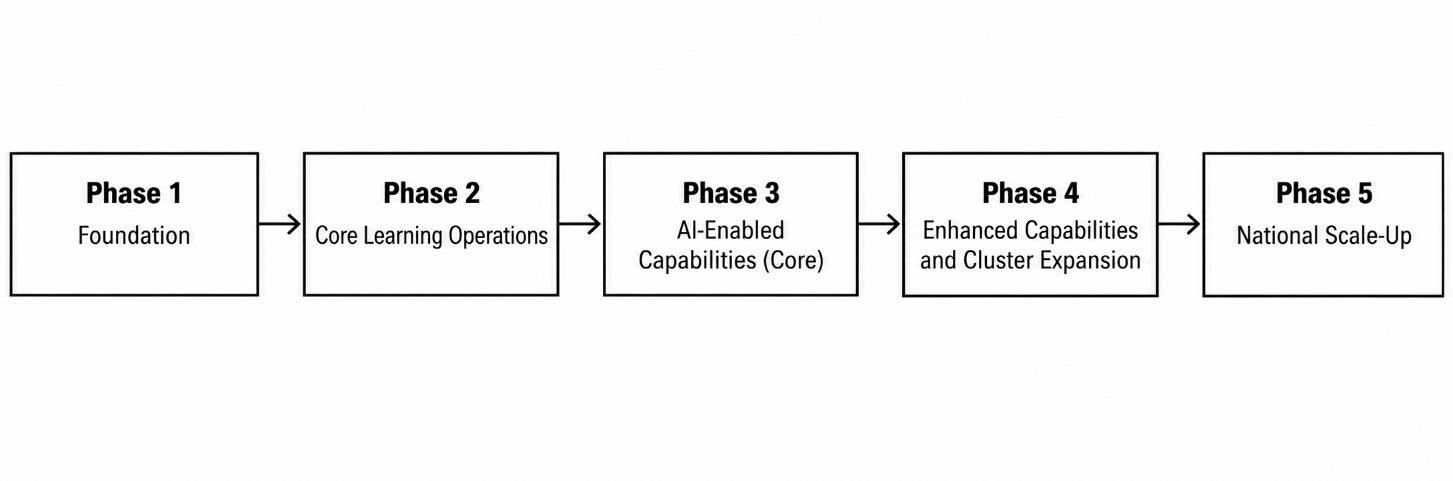
| Phase Scope Sequencing Rationale |
| Phase 1 - Foundation Environment setup, core Pillars 1, 2, 7, identity integration, initial Hub-and- Spoke cluster onboarding Course Management and Content Delivery are structural prerequisites every other pillar depends on; identity resolution (Pillar 7) must precede any learner-facing access, per Section 4.7's own access-gating rule |
| Assessment, progress tracking, certification, and lifecycle |
| Phase 2 - Core dashboards depend on Phase 1's course and identity |
| Pillars 3, 5, 6, 8 at Core |
| Learning foundation being live; these are the pillars a learner directly |
| classification |
| Operations experiences day to day, prioritized before AI-enabled |
| layers |
Phase 2 - Core Learning Operations
| Phase Scope Sequencing Rationale Phase 3 - AI- Enabled Capabilities (Core) Pillars 4, 10, 11 Core capabilities, AI Governance framework fully operational AI-enabled pillars are sequenced after their non-AI dependencies are proven live, consistent with Section 6.8's principle that AI capabilities are evaluated against a working system, not a hypothetical one Phase 4 - Enhanced capabilities extend, rather than replace, Core Enhanced Enhanced-classified AI capabilities already proven in Phase 3; cluster expansion Capabilities and capabilities, expansion is gated on the reconciliation and performance evidence Cluster beyond initial clusters Section 7.3 requires before scaling Expansion |
| Phase 5 - National Scale-Up Full Hub-and-Spoke rollout, remaining Enhanced capabilities, sustained operations Scale-up follows only once every prior phase's gate has been satisfied across the initial cluster set, consistent with the phased-rollout discipline in Section 7.3 |
Phase 4 - Enhanced Capabilities and Cluster Expansion
Enhanced-classified AI capabilities, expansion beyond initial clusters
Future-phase and excluded capabilities (Section 6.8.4, Annexure B) are intentionally not scheduled in any phase above; a Future-phase capability shall only enter a future timeline revision once it has been brought within the AI Governance framework per Section 6.8.4's own requirement.
Advancement from one rollout tier to the next is gated on demonstrated evidence, not calendar time alone. Specifically, advancement from Base to Middle tier requires a demonstrated Base-tier course-completion rate of no less than [client to confirm threshold] and an application-crash rate within [client to confirm SLA]. This gating is directly informed by external evidence: the Rajya Sabha Standing Committee on Education's report of February 2025 found that fewer than 4% of enrolees on the SWAYAM platform have completed their courses since 2017, and independent reporting on DIKSHA documents ongoing reliability complaints despite substantial reach. This report's phased advancement is accordingly evidence-gated, so that Middle- and Progressive-tier features, including AI-assisted and predictive capabilities, are not layered onto a platform whose Base-tier reliability and learner completion are not yet proven.
Annexure G: Risk RegisterPDF p.100
The risks below are drawn directly from the boundaries, fallback behaviours, and exception-management provisions already specified throughout this report, restated here as a consolidated register rather than introduced as new concerns.
| Source in this |
| Risk Mitigation Already Specified |
| Report |
| An AI-generated output is treated as authoritative by a user Core governance principle, Section 6.8.1 Four-tier classification (Advisory/Human- approved/System-enforced/Authoritative); AI output is never classified Authoritative for curriculum, assessment result, completion state, or credential |
| Mandatory RAG grounding; explicit unavailability |
| Ungrounded or hallucinated Section 4.10, Section fallback when retrieval confidence is below |
| AI content reaches a learner 7.1 threshold; grounding-rate and hallucination-audit |
| testing (Section 7.1) |
Risk Source in this Report Mitigation Already Specified
| Source in this Risk Mitigation Already Specified Report |
| AI-content or predictive outputs disadvantage a learner group Section 6.8.2 Periodic disparity review across language, region, gender, and institution type; bias and disparity-audit testing (Section 7.1) A connected partner's externally sourced data is Section 8.5, Section Externally sourced records are explicitly labelled silently treated as PM- 8.6 and never re-processed by PM-SETU AI services SETU's own AI output |
| Duplicate or reconciliation failure between PM-SETU and a connected system Section 7.1 (Integration and reconciliation testing) Identifier mapping, duplicate handling, retry, and stale-data testing required before a partner connector is accepted An AI-content-detection Assessment-integrity-flag testing; a flag alone Section 4.3, Section false positive penalizes a never triggers a penalty without a recorded 7.1 non-native-English learner evaluator decision |
| Data breach or unauthorized access to learner records Section 6.2 ISO/IEC 27001:2022, encryption standards, role- based access with segregation of duties, CERT-In incident reporting within 6 hours Service unavailability during 99.9% availability commitment during declared Section 6.1, Section a scheduled assessment assessment windows; disaster recovery with 4- 6.3 window hour RTO / 15-minute RPO |
| An excluded AI capability (Section 6.8.4) is reintroduced without governance review Section 6.8.4 Any future-phase capability must be brought within the full AI Governance framework before being enabled for any user Program-level risks outside Not addressed [Client to confirm - outside the technical scope of this report's technical scope elsewhere in this this DPR; typically owned by the SPMU under the (funding continuity, staffing, report governance structure in Annexure E] procurement delays) |
Risk Source in this Report Mitigation Already Specified
Section 8.5, Section 8.6
Service unavailability during a scheduled assessment window
Section 6.1, Section 6.3
Program-level risks outside this report's technical scope (funding continuity, staffing, procurement delays)
Not addressed elsewhere in this report
This register deliberately does not include generic project-management risks (funding, staffing, procurement) that are not addressed anywhere else in the technical body of this report; adding invented mitigations for those here would misrepresent this document's actual scope. That last row is included specifically so the gap is visible, not silently absent.
Annexure H: Change Management and Capacity BuildingPDF p.101
This report's accessibility, multilingual, and human-in-the-loop requirements (Sections 6.6 and 6.8) imply a corresponding adoption and training need for each stakeholder role. This annexure states that need formally, without prescribing a training program this report has no basis to design in detail.
Trainer and evaluator readiness: Trainers and evaluators shall require orientation on the AI-assisted authoring and scoring-support workflows specified in Section 4.3 and Section 8.3, with particular emphasis on the confirm/edit/reject action required before any AI-suggested question or score is used or recorded, and on when and how to record a human override with its required reason (Section 6.8.2).
Institution administrator readiness: ITI Administrators shall require orientation on exception review (Section 8.7's advisory findings, never automatic corrections) and on the institution-level analytics introduced in Section 4.8, so that an advisory indicator is correctly understood as advisory rather than acted upon as a directive.
Learner readiness: Learner-facing AI capabilities (Pillar 10, Pillar 11) shall be introduced with in-product explanation consistent with the explainability requirement in Section 4.4, so a learner understands a recommendation's advisory nature without requiring separate training material.
Multilingual and accessibility rollout: Consistent with Section 6.6, capacity-building material itself shall be made available in the platform's supported regional languages and in an accessible format, rather than only in English.
Institution digital-readiness assessment: Given the low current digital maturity at institution level described in Section 2.2, adoption planning shall be informed by a per-institution digital-readiness assessment prior to onboarding, rather than a uniform rollout assumption across all institutions. [Client to confirm: the specific readiness index or scoring method to be used, and the threshold below which an institution receives additional onboarding support before go-live.] This assessment directly addresses the adoption gap this report's own Section 2.2 diagnoses, rather than assuming it away.
Scope note [Client to confirm ownership and detailed curriculum for this capacity-building effort; this annexure states the need this report's own requirements create, not a complete training program.]
Annexure I: Procurement ApproachPDF p.102
Consistent with the procurement-neutrality principle underlying the AI Gateway design (Section 5.2), no AI model provider, cloud provider, or system integrator is named or presumed in this report. [Client to confirm single-integrator or multi-vendor delivery model; empanelment route (e.g., GeM, MeitY panel); and the evaluation criteria by which an AI model provider is selected and rotated behind the AI Gateway.]
Any procurement decision made under this approach shall preserve the provider-abstraction principle already established in Section 5.2, so that no future capability in this report becomes dependent on a single named commercial provider.
Annexure J: Data Migration ApproachPDF p.102
Section 2.2 describes the current state at institution level as predominantly attendance registers, spreadsheets, and informal messaging-group coordination. [Client to confirm whether any existing institution- held learner history is to be migrated into PM-SETU at go-live, or whether each learner's record begins fresh at enrolment.]
Where migration is confirmed, the migrated record shall carry its original source and date, consistent with the source-lineage principle already applied to externally sourced records elsewhere in this report (Section 8.6), so a migrated record is never presented as if it were platform-generated.
Annexure K: Support and Helpdesk ModelPDF p.102
AI Support-Ticket Classification (Capability #67, Annexure B) classifies an incoming ticket; it does not resolve it. [Client to confirm the L1/L2/L3 escalation structure: L1 owner and response-time target, L2 escalation criteria and owner, and L3 (platform/technical) escalation path.]
Every ticket, regardless of tier, shall remain linked to its AI-assigned classification and any human re
classification for audit purposes, consistent with Section 6.5.
Annexure L: Comprehensive Feature RegisterPDF p.103
This register consolidates every functional capability specified in Section 4 of this report, one table per pillar, so the complete capability set can be reviewed in a single location. The "AI-Governed" column cites the exact Annexure B capability number(s) a row corresponds to. Where a single row bundles more than one individually numbered Annexure B entry, that reflects a shared capability area, not an omission - Annexure B remains authoritative for the full 74-capability count.
Methodology: Base tier capabilities are those without which the platform cannot support a real ITI batch. Middle tier capabilities meaningfully strengthen delivery once Base tier is proven working. Progressive tier capabilities are advanced, predominantly predictive or advisory AI capabilities, layered on top only once Base and Middle tier reliability is demonstrated.
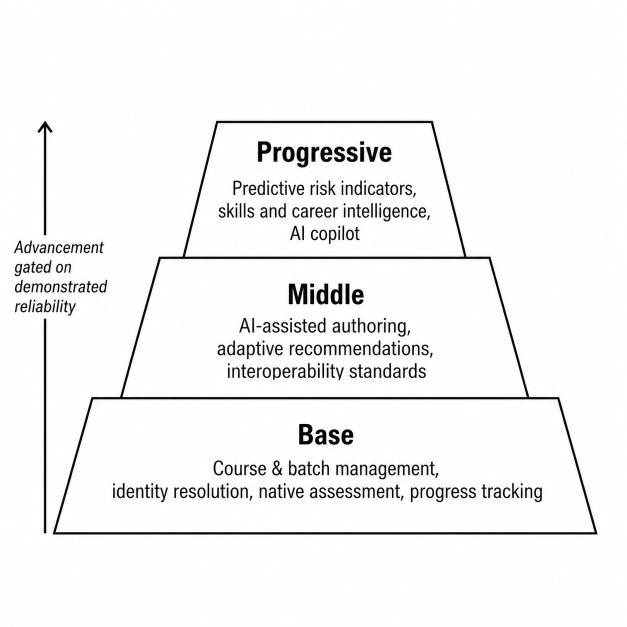
Annexure B capabilities classified Future or Excluded (#31, #34, #49, #53, #62, #70-74) are intentionally not assigned a rollout tier, consistent with Section 6.8.4.
Pillar 1: Course Management
| AI-Governed (Annexure Functional Capability Rollout Tier B #) | ||
| Catalogue and qualification mapping | No | Base |
| Course composition and creation | No | Base |
| Versioning and applicability | No | Base |
| Batch and cohort management | No | Base |
| Partner and institution course mapping | No | Middle |
Functional Capability AI-Governed (Annexure B #) Rollout Tier
Pillar 2: Content Delivery
| AI-Governed (Annexure Functional Capability Rollout Tier B #) |
| Blended content presentation (online, offline, low bandwidth) No Base Standards-based content ingests (SCORM, xAPI, cmi5, No Middle QTI 3.0) |
| Partner content and LTI 1.3 launch No Middle Activity capture and reconciliation No Base |
Functional Capability AI-Governed (Annexure B #) Rollout Tier
Pillar 3: Assessment and Evaluation
| AI-Governed (Annexure Functional Capability Rollout Tier B #) | ||
| Assessment planning (type, threshold, weighting) | No | Base |
| Attempt management and scoring | No | Base |
| Authoritative external results | No | Base |
| AI-assisted question and distractor authoring | Yes - #21, #22, #23, #25 | Middle |
| AI-assisted evaluator scoring support | Yes - #26, #27, #28, #32 | Middle |
| Assessment-integrity signal detection | Yes - #29, #30 | Progressive |
| Assessment analytics and adaptive difficulty (new row) | Yes - #24, #33 | Middle |
Functional Capability AI-Governed (Annexure B #) Rollout Tier
Pillar 4: Personalized and Adaptive Learning
| AI-Governed (Annexure Functional Capability Rollout Tier B #) | ||
| Recommendation generation | Yes - #1, #2, #3, #4, #5, #6 | Middle |
| Difficulty and pace adaptation | Yes - #7 | Progressive |
| Explainability and human control | Yes - #8, #9, #10, #11, #12 | Middle |
Functional Capability AI-Governed (Annexure B #) Rollout Tier
Pillar 5: Learner Progress Tracking
| AI-Governed (Annexure |
| Functional Capability Rollout Tier |
| B #) |
| Progress state maintenance No Base |
Functional Capability AI-Governed (Annexure B #) Rollout Tier
| AI-Governed (Annexure |
| Functional Capability Rollout Tier |
| B #) |
| Event validation and lineage No Base |
| AI predictive risk and completion indicators Yes - #37, #38, #39, #42, #43, #44, #45, #46, #47, #48 Progressive |
Functional Capability AI-Governed (Annexure B #) Rollout Tier
Pillar 6: Certification and Badges
| AI-Governed (Annexure Functional Capability Rollout Tier B #) | ||
| Completion evaluation | No | Base |
| Credential issuance and mapping | No | Base |
| Verification and standards (Open Badges, Verifiable Credentials) | No | Middle |
Functional Capability AI-Governed (Annexure B #) Rollout Tier
Pillar 7: Digital Identity and Credential Integration
| AI-Governed (Annexure Functional Capability Rollout Tier B #) | ||
| Identity resolution and role mapping | No | Base |
| Consent and data minimization | No | Base |
| Credential and academic-credit linkage | No | Middle |
Functional Capability AI-Governed (Annexure B #) Rollout Tier
Pillar 8: Student Lifecycle Dashboards and Management
| AI-Governed (Annexure |
| Functional Capability Rollout Tier |
| B #) |
| Learner workspace No Base |
| Trainer and institution views No Base |
| Attrition and lifecycle indicators No Middle |
| Yes - #36, #63, #64 |
| AI-informed institutional analytics and reporting (new row) (shares #46-48 with Pillar Middle |
| 5) |
Functional Capability AI-Governed (Annexure B #) Rollout Tier
Pillar 9: Interoperability and Integration
| AI-Governed (Annexure |
| Functional Capability Rollout Tier |
| B #) |
| Integration gateway No Middle |
Functional Capability AI-Governed (Annexure B #) Rollout Tier
| AI-Governed (Annexure |
| Functional Capability Rollout Tier |
| B #) |
| Partner onboarding No Middle |
| AI duplicate and anomaly detection (new row) Yes - #65, #66 Middle |
Functional Capability AI-Governed (Annexure B #) Rollout Tier
Pillar 10: AI Learning Assistance
| AI-Governed (Annexure Functional Capability Rollout Tier B #) |
| AI Course Q&A Assistant Yes - #13, #14, #15 Middle Yes - #16, #17, #18, #19, Study and revision support Middle #20 |
| Trainer-facing AI Copilot Yes - #35, #40, #41 Progressive AI-powered catalogue search Yes - #60, #61 Middle On-demand quiz generation Yes - #69 Progressive |
Functional Capability AI-Governed (Annexure B #) Rollout Tier
Study and revision support Yes - #16, #17, #18, #19, #20 Middle
Pillar 11: Skills and Career Intelligence
| AI-Governed (Annexure |
| Functional Capability Rollout Tier |
| B #) |
| Skills profiling and mastery estimation Yes - #50, #51, #52 Progressive |
| Yes - #54, #55, #56, #57, |
| Career and employability guidance, job-readiness score Progressive |
| #58, #59 |
Functional Capability AI-Governed (Annexure B #) Rollout Tier
#58, #59 Progressive
Platform Layer (not tied to a single pillar)
| AI-Governed (Annexure |
| Functional Capability Rollout Tier |
| B #) |
| Support-ticket classification Yes - #67 (cross- referenced in Annexure K) Middle |
| Administrative copilot Yes - #68 Progressive |
Functional Capability AI-Governed (Annexure B #) Rollout Tier
Annexure M: LMS Platform BenchmarkingPDF p.107
Part A: Basis of Comparison
This annexure benchmarks the platform described in this report against three tiers of comparator: Indian public-sector systems this platform operates alongside (Skill India Digital Hub, NIMI/Bharat Skills); the open- source technical baseline underlying comparable government deployments (Moodle); and commercial best- in-class platforms (Docebo, Talent-LMS, Canvas, D2L Brightspace, Coursera for Business). Comparator capabilities are stated as confirmed from the comparator's own published documentation as of [insert month/year at time of finalization], not inferred; where a comparator's documentation does not describe a capability, this report states "not publicly documented," not "does not support," since absence of documentation is not proof of absence.
Part B1: Government of India PlatformsPDF p.107
| PM-SETU Capability SIDH | NIMI DIKSHA | SWAYAM Plus | iGOT Karmayogi | |||
| Course/content management Summative assessment engine | Yes Yes, confirmed | Yes Routed to agencies | Repository only No | Yes Not core | Yes Yes | Yes No |
| AI-assisted authoring AI Q&A grounded in content | Yes Yes | Not documented No, recommender | No No | Not documented Not documented | Not documented Not documented | Yes Yes |
| Credentialing / badging | Open Badges 3.0 | DigiLocker/NCV ET | No | Certificates | Certificates | Certificates |
| Standards (SCORM/xAPI/QTI/LTI) | All, native Not documented | Via Moodle | Not documented | Not documented Not documented | ||
| Reported user base | N/A, proposed | National scale | National ITI | National scale | National scale | 1+ crore |
Capability PM-SETU SIDH NIMI DIKSHA SWAYAM Plus
Course/content management Yes Yes Repository only Yes Yes Yes
Summative assessment engine Yes, confirmed Routed to
agencies No Not core Yes No
Part B2: Open-Source and Enterprise Commercial PlatformsPDF p.107
| Capability Course/content management Summative assessment | PM-SETU Yes Yes, confirmed | Moodle Yes Yes | Docebo Yes Yes | Canvas Yes Basic | Brightspace Yes Yes |
| AI-assisted authoring | Yes | Text/image only | Yes, AI Creator | Yes, Ignite AI | Yes, Lumi |
| AI Q&A grounded in content | Yes | No | Yes, Harmony | 3rd-party | Yes, Lumi |
| SCORM | Yes | Yes | Yes | Yes | Yes |
| xAPI | Yes | Plugin + LRS | Yes | Partial | Yes |
| QTI 3.0 Open Badges 3.0 | Yes Yes | No, native Plugin | No Roadmap | No Canvas Credentials | No Yes, Achievement+ |
Capability PM-SETU Moodle Docebo Canvas Brightspace
Summative assessment Yes, confirmed Yes Yes Basic Yes
QTI 3.0 Yes No, native No No No
Open Badges 3.0 Yes Plugin Roadmap Canvas Credentials
Part B3: Consumer-Facing and MOOC-Style Commercial PlatformsPDF p.107
| Capability | PM-SETU | Coursera | LinkedIn Learning | Udemy Business | Blackboard |
| Course/content management | Yes | Yes | Yes | Yes | Yes |
| Summative assessment | Yes, confirmed | Yes | No | No | Yes |
| Capability | PM-SETU | Coursera | LinkedIn Learning | Udemy Business | Blackboard |
| AI-assisted authoring AI Q&A grounded in content SCORM xAPI | Yes Yes Yes Yes | Yes, Course Builder Yes, Coach N/A N/A | Not documented No Not documented Yes, API integration | Not documented No Via embed only Yes, Enterprise plan | Partial Partial Yes Yes |
| QTI 3.0 | Yes | No | Not documented | Not documented | Partial |
| Open Badges 3.0 | Yes | No | Not documented | Not documented | Partial |
AI Q&A grounded in content Yes Yes, Coach No No Partial
SCORM Yes N/A Not documented Via embed only Yes
xAPI Yes N/A Yes, API integration Yes, Enterprise plan Yes
Annexure N: Business Case for a Dedicated PM-SETU LMSPDF p.108
The Question
Given that Skill India Digital Hub (SIDH) already exists as a national platform, and that Bharat Skills, NIMI, DIKSHA, and SWAYAM Plus are also already operating nationally, why does PM-SETU require its own Learning Management System rather than extending SIDH or adopting one of these other existing solutions?
The Answer
Every one of these systems performs a genuine, valuable function at national scale, but none of them, individually or in combination, performs the specific function PM-SETU delivery requires: a batch-level operational teaching record, held for a specific cohort at a specific institution, with evaluator-confirmed assessment and a governed AI layer bound to that record - this is a role no existing platform occupies, not a feature gap in an otherwise-suitable one.
Part 1: Why SIDH Specifically Cannot Be Extended to Do This
This report's own Section 2.1 already establishes SIDH's role precisely, in terms worth restating here directly:
“It is not an instructional delivery system. It does not maintain the batch-level teaching record, the trainer- recorded practical evidence, the assessment attempt history, the module-level progress state, or the intervention record on which day-to-day ITI delivery depends.”
Four reasons follow from this, each a difference in system role, not a gap that a feature release would close:
- ●Operating scale and record granularity. SIDH's stated function is national discovery, identity
resolution, and career intelligence, consolidating participation data for national reporting. It operates at convergence scale - aggregating what has happened across the ecosystem - not at the granularity of a specific batch's daily attendance, a specific trainer's practical evidence, or a specific learner's module-by-module progress. Adding this granularity would not extend SIDH's role; it would require SIDH to become an operational system of record for every institution and partner nationally, which is a different platform by definition, not a new feature of the existing one.
- ●Assessment authority. SIDH has no native, evaluator-confirmed summative assessment engine;
formal assessment is routed to external NCVET agencies. PM-SETU's core requirement - LMS- controlled assessment with mandatory human confirmation of every AI-suggested score, and a governed distinction between an LMS-scored attempt and an externally authoritative result - has no equivalent anywhere in SIDH's current architecture and building one would itself constitute building a new LMS inside SIDH.
- ●AI grounding boundary. SIDH's AI capability, the Skill India Assistant (SIA), is explicitly a
recommendation and course/scheme-discovery chatbot operating at the national convergence layer. PM-SETU's requirement is an assistant grounded in the specific, active, approved content of one
learner's one course, answering from that content with a citation and an honest fallback when it cannot answer. These are different problems with different grounding data, different governance requirements, and different failure modes; they would need to coexist as separate systems even if built by the same engineering team under the same program.
- ●Access-control model. SIDH's reporting and identity functions are consumed nationally, without the
fine-grained, per-institution and per-batch access boundary this report's role-based access model requires (an ITI Administrator scoped to their own institution, an SPV/AIP scoped to their own cluster, a trainer scoped to their own batch). Retrofitting this access model onto a national convergence platform is a governance and security re-architecture, not a configuration change.
Part 2: Why the Other Existing National Platforms Also Do Not Close This Gap
The comment this annexure responds to named SIDH specifically but asked about “any other existing solution.” The three other national platforms already documented in Section 2.1 were examined on the same basis; none change the conclusion, for reasons specific to each:
| Platform Why It Cannot Substitute for a Dedicated LMS |
| Bharat Skills / NIMI Authoritative content repository for curriculum, trade learning material, and question banks - but a repository, not a learning management system. It has no mechanism to record which learner consumed which resource, in what sequence, against which batch or course version, or to what completion outcome. |
| DIKSHA (NCERT, Ministry of Education) School-education platform for Class 9 to 12; its vocational-adjacent content is PSSCIVE career-exposure material aimed at schoolchildren, not NCVET-aligned ITI trade certification. Its Sunbird RC verifiable-credential infrastructure is a useful precedent (referenced in Annexure M), but the platform itself operates in a different domain, for a different learner population, under a different certifying authority. |
| SWAYAM Plus (IIT Madras, Ministry of Education) Employability-focused MOOC aggregator for higher-education students and working professionals earning academic credit - not ITI trainees pursuing trade certification. Its parent platform, SWAYAM, has a documented completion rate below 4 percent since 2017 (Rajya Sabha Standing Committee, February 2025), which this report's own phased, evidence-gated rollout is explicitly designed to avoid repeating, not a precedent to build on. DGT and NCVT MIS Governs trade and institution approval, examination scheduling, and certificate issuance at examination-cycle granularity. It holds the authoritative formal result but carries no formative assessment, practical evaluation, or in-course progress - by design, since that is not its function. |
Part 3: What This Costs If Left Unaddressed
Section 2.3 of this report already documents nine specifics, observed gaps in the current landscape. Each is a direct consequence of no dedicated operational system existing today, and each would persist unchanged under any of the alternatives examined above, since none of them are designed to hold an operational teaching record in the first place. Three with the most direct bearing on this decision:
- ●No system carries the learner end to end - identity sits on one platform, curriculum in another, results
in a third, and delivery in none of them. This is the direct, unavoidable consequence of relying on systems that were each built for a different, narrower purpose.
- ●The teaching record is not digitized at batch level - attendance, practical evidence, and module
completion exist nowhere as one verifiable record, because no existing national platform is built to hold one.
- ●Formal results and in-course assessment are conflated - without a system that distinguishes an LMS-
scored attempt from an externally authoritative result, the two continue to be treated as interchangeable, which this report's own evaluator-confirmation model is specifically designed to end.
Part 4: Precedent - What Fragmentation Looks Like in Practice
This report's own benchmarking work (Annexure M) surfaced a directly relevant cautionary precedent: AIIMS operates no single, unified learning platform across its campuses - Delhi, Bilaspur, Bathinda, and Rishikesh each run separate systems. This is offered here not as a comparator on capability, but as a concrete illustration of the failure mode that results when an institution or program proceeds without a single system of record: fragmentation by default, institution by institution, is what happens in the absence of a deliberate decision to build one shared operational system. PM-SETU's single-system-of-record design is a direct response to avoiding this outcome at national ITI scale.
Part 5: Why This Is Not Duplication
PM-SETU LMS federates with every platform examined above rather than replacing any part of what they do well: identity resolution defers to the approved identity channel (Section 4.7); career-path and job-matching guidance draws on SIDH and the National Career Service rather than rebuilding them (Section 4.11); formal credential custody remains with DigiLocker and the Academic Bank of Credits (Section 4.7); and curriculum and question-bank content is sourced from Bharat Skills and NIMI rather than re-authored (Section 4.1, Section 4.2). The full capability-level comparison against fifteen platforms is provided at Annexure M; this annexure states the architectural reason a separate operational system is required at all, independent of any single feature-by-feature comparison.
Part 6: What Extending SIDH Instead Would Actually Require
To make this concrete rather than asserted, retrofitting SIDH to perform PM-SETU's function would require, at minimum, all of the following to be added to a platform explicitly designed as a lightweight, federated discovery layer:
- ●Batch and cohort management, scoped per institution, for every ITI nationally - a data model SIDH
does not currently hold
- ●A native, evaluator-confirmed summative assessment engine, replacing the current routing to
external NCVET agencies
- ●Trainer-facing tools for practical-evidence capture, attendance, and intervention recording at daily
operational cadence
- ●A role-based access model scoped to institution and batch, layered onto a platform currently built for
national-scale, largely learner-facing access
- ●A course-content-grounded AI assistant, architecturally distinct from the existing national
recommendation chatbot (SIA), with its own governance and observability requirements
This is not a feature roadmap; it is a description of building a second platform inside the first one, while the first continues performing its own national function. A purpose-built LMS that federates with SIDH's existing, already-working scope is the smaller, lower-risk undertaking of the two.
Conclusion
The decision to build a dedicated PM-SETU LMS is a decision about system role, made once, at the architecture level - not a series of feature decisions that could be revisited platform by platform. Every existing national system examined in this annexure performs its own function well; none of them performs this one, and none could be made without becoming, in substance, a new system built inside an existing one.