On this page: jump to a section
- 1. Overview
- 1.1 Two governance layers, not one
- 1.2 Scope
- 1.3 Key Assumptions
- 1.4 Stakeholders
- 2. Business Requirements
- 2.0 Functional structure
- 2.1 Access and login journey
- 2.2 Industry relationship owner (CRM) journey
- 2.3 Anchor Industry Partner onboarding journey
- 2.4 ITI industry-liaison (Institution Administrator) journey
- 2.5 Training-and-Placement Officer journey
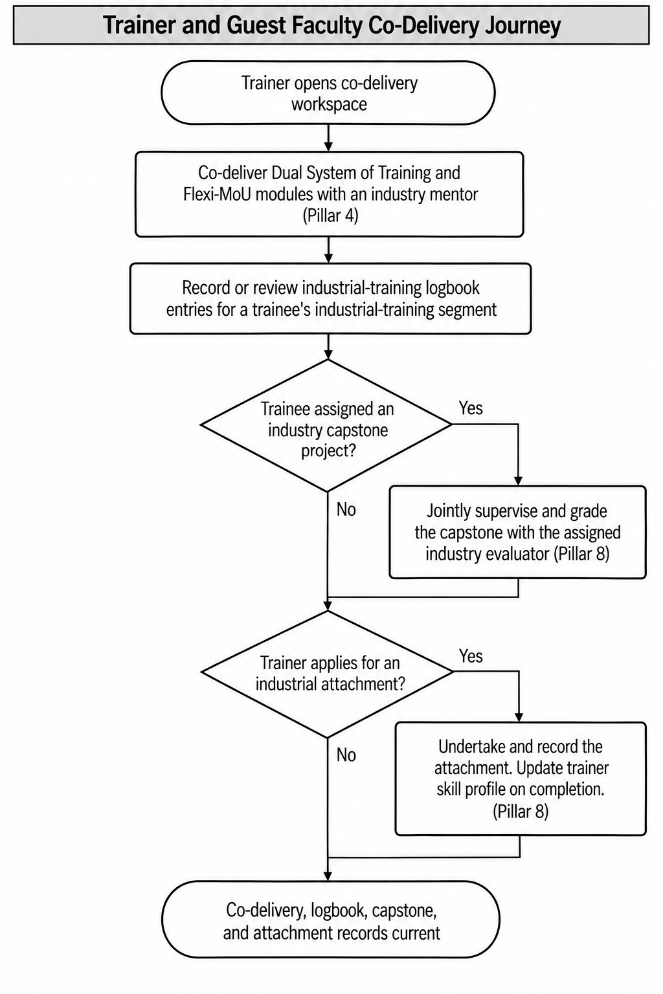
- 2.6 Trainer / guest-faculty co-delivery journey
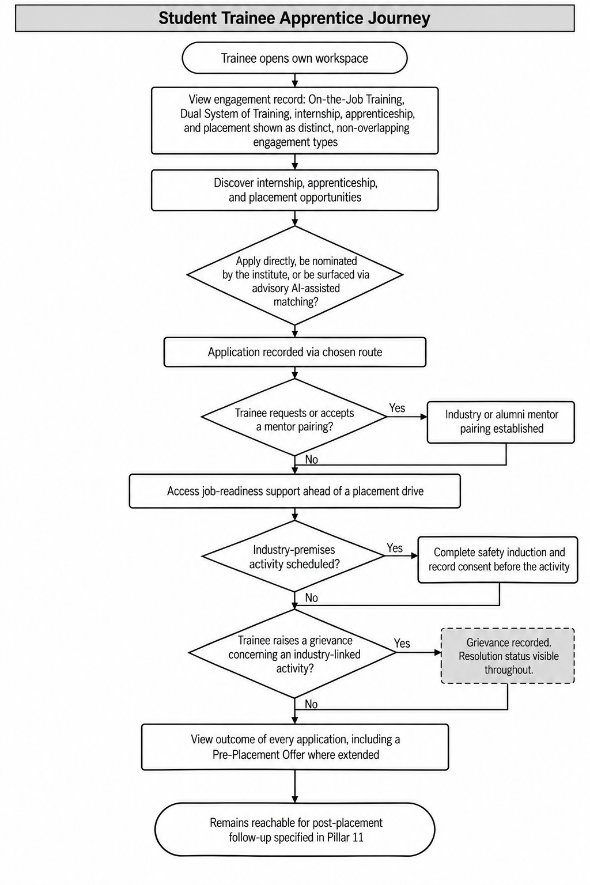
- 2.7 Student / Trainee / Apprentice journey
- 2.8 Employer / Apprenticeship establishment journey
- 2.9 Alumni journey
- 3.1 Pillar 1: Industry Registry & Customer-Relationship Management
- Functional Capabilities
- Acceptance Criteria
- Validation Rules
- Exception Management
- 3.2 Pillar 2: Anchor Industry Partner / SPV / Institute Management Committee Governance
- Functional Capabilities
- Acceptance Criteria
- Validation Rules
- Exception Management
- 3.3 Pillar 3: Memorandum of Understanding, Partnership & Industry Contributions Management
- Functional Capabilities
- Acceptance Criteria
- Validation Rules
- Exception Management
- 3.4 Pillar 4: Dual System of Training & Flexi-MoU Management
- Functional Capabilities
- Acceptance Criteria
- Validation Rules
- Exception Management
- 3.5 Pillar 5: Apprenticeship Management
- Functional Capabilities
- Acceptance Criteria
- Validation Rules
- Exception Management
- 3.6 Pillar 6: Industrial Exposure, On-the-Job Training & Safety
- Functional Capabilities
- Acceptance Criteria
- Validation Rules
- Exception Management
- 3.7 Pillar 7: Curriculum & Skill Intelligence
- Functional Capabilities
- Acceptance Criteria
- Validation Rules
- Exception Management
- 3.8 Pillar 8: Guest Faculty, Trainer Engagement & Live Industry Projects
- Functional Capabilities
- Acceptance Criteria
- Validation Rules
- Exception Management
- 3.9 Pillar 9: Internship Management
- Functional Capabilities
- Acceptance Criteria
- Validation Rules
- Exception Management
- 3.10 Pillar 10: Placement & Employer Management
- Functional Capabilities
- Acceptance Criteria
- Validation Rules
- Exception Management
- 3.11 Pillar 11: Alumni & Tracer Management
- Functional Capabilities
- Acceptance Criteria
- Validation Rules
- Exception Management
- 3.12 Pillar 12: Grievance, Incident & Safety Management
- Functional Capabilities
- Acceptance Criteria
- Validation Rules
- Exception Management
- 3.13 Pillar 13: Industry Performance & Analytics
- Functional Capabilities
- Acceptance Criteria
- Validation Rules
- Exception Management
- 3.14 Artificial Intelligence and Intelligence Layer (Cross-Cutting) [GOVERNANCE]
- 3.14.1 Governed Artificial Intelligence Capabilities
- 3.14.2 AI Behavior, Data, and Human Control
- 3.14.3 Excluded Capabilities
- 3.14.4 Capability-Specific Performance Metrics
- Acceptance Criteria
- Validation Rules
- Exception Management
- 4. Solution Architecture
- 4.1 Data Layer
- 4.2 Platform Layer
- 4.2.1 SLA & Escalation Service
- 4.2.2 AI Services
- 4.3 User Access Layer
- 4.4 Integration Catalogue and Data Contracts
- 4.5 Skill, Occupation, and Competency Master
- 4.6 Industry Establishment and Facility Master
- 4.7 Notification Framework
- 5. Non-Functional Requirements
- 5.1 Performance requirements
- 5.2 Security requirements
- 5.3 Availability and disaster recovery requirements
- 5.4 Backup and data retention requirements
- 5.5 Audit logging and monitoring requirements
- 5.6 Compliance requirements
- 5.7 Data classification and privacy governance matrix
- 5.8 Accessibility, mobile, and low-bandwidth requirements
- 6. Testing Strategy and Deployment Approach
- 6.1 Testing strategy
- 6.2 Acceptance criteria
- 6.3 CI/CD and deployment approach
- 7. Process Designs and Mockups
- 7.1 Partner onboarding and SPV formation process design
- 7.2 MoU commitment, SLA and renewal engine process design
- 7.3 Curriculum co-design and skill-intelligence feedback loop
- 7.4 Dual System of Training operations process design
- 7.5 Apprenticeship lifecycle process design
- 7.6 Training-and-Placement Cell, placement drive, and post-placement tracking
- 7.7 AI-assisted employer-trainee placement matching
- 7.8 Industry contribution approval and reconciliation (Pillar 3, Pillar 8)
- 7.9 Mockup and interface requirements
- 8. Annexures
- Annexure A: Data Migration Strategy
- Migration life cycle
- Migration scope and sequencing
- Annexure B: Implementation Roadmap
- Annexure C: Financial and Resource Plan
- Cost structure
- Resourcing and funding boundaries
- Annexure D: Operating and Support Model
- Support tiers
- Incident, problem, change, and release management
- Annexure E: Change and Adoption Plan
- Adoption activities
- Adoption monitoring
- Annexure F: National Benchmarking
- What the national benchmark confirms and what it warns against
- Annexure G: Global Benchmarking
- Annexure H: Comparable Products and Demos Reviewed
- Apprenticeship management software
- Career services, placement, and internship platforms
- Education-focused Customer-Relationship-Management platforms
- Skills intelligence and labour-market analytics platforms
- Indian ed-tech, gov-tech vendors, and system integrators
- Annexure I: Governance Structure
- Benchmarked governance models
- Proposed governance structure for this platform


Detailed Project Report for Industry Management System
1. OverviewPDF p.6
This report defines the business, functional, technical, and implementation requirements for the PM- SETU / DGT ITI–Industry Engagement, Training, Apprenticeship, Employment and Outcome Management Platform: a centralized digital platform governing the relationship between DGT's ITI ecosystem and industry, from first industry contact through trainee employment and post-placement outcome. Its functional scope aligns to DGT's own published mechanisms - the Dual System of Training, the Flexi-MoU / Industrial Training Partner scheme, Institute Management Committees, and PM-SETU's Anchor Industry Partner and Special Purpose Vehicle model - and to DGT's tracer-study findings on Training-cum-Placement Cell practice.
The platform's purpose is not "how does DGT manage industry participation" but "how does DGT continuously create, approve, execute, monitor, measure, and improve the ITI–Industry relationship." Every pillar in Section 3 is organized around that continuous life cycle, not a fixed set of transaction types.
1.1 Two governance layers, not onePDF p.6
The platform accommodates two distinct relationship layers, under different governance logic, that must not be collapsed into one workflow.
- •The Anchor Industry Partner / Special Purpose Vehicle layer is a strategic, cluster-level
governance relationship: an Anchor Industry Partner is admitted through an Expression of Interest and Request for Proposal process and receives a governance role in a Section-8 company Special Purpose Vehicle overseeing a Hub-and-Spoke cluster, measured against its Strategic Investment Plan commitments and PM-SETU Disbursement-Linked Indicators. Pillar 2 governs SPV formation, board composition, equity share, and Disbursement-Linked Indicator evidence. The Strategic Investment Plan's financial content, its preparation, submission, and approval, along with fund custody and CAPEX/OPEX disbursement, are owned by the Fiduciary Management System; Pillar 2 references that approved plan rather than capturing it.
- •The ordinary ITI–Industry engagement layer is an operational relationship an institute builds directly with local employers, Micro, Small and Medium Enterprises, industry associations, and individual industry professionals, through a Memorandum of Understanding, the Dual System of Training, Flexi-MoU, guest faculty, industrial visits, apprenticeship, and placement. A typical ITI holds dozens of such relationships concurrently at different stages of maturity, requiring a Customer-Relationship-Management operating discipline a cluster-level governance workflow does not provide. This layer is specified across every pillar in Section 3 except Pillar 2 above. Both layers reference the same Industry Master Profile (Pillar 1), so a company that is simultaneously an Anchor Industry Partner in one cluster and an ordinary Dual System of Training partner elsewhere is represented once, not as two disconnected records.
1.2 ScopePDF p.6
The platform provides a centralized digital record of the industry-engagement, training, apprenticeship, placement, and outcome life cycle, organized into thirteen functional pillars set out in full in Section 3: Industry Registry and Customer-Relationship Management; Anchor Industry Partner, Special Purpose Vehicle, and Institute Management Committee Governance; Memorandum of Understanding, Partnership, and Industry Contributions Management, including a generalized commitment-to-outcome reconciliation engine and a Service-Level-Agreement and renewal engine; Dual System of Training and Flexi-MoU Management; Apprenticeship Management; Industrial Exposure, On-the-Job Training, and Safety Management; Curriculum and Skill Intelligence; Guest Faculty, Trainer Engagement, and Live Industry Projects; Internship Management, kept explicitly distinct from apprenticeship, On-the-Job Training, Dual System of Training, and placement; Placement and Employer Management, including placement drives and job fairs; Alumni and Tracer Management; Grievance, Incident, and Safety Management; Industry Performance and Analytics; and a governed, cross-cutting Artificial Intelligence and Intelligence Layer.
1.3 Key AssumptionsPDF p.7
- •All Anchor Industry Partners, ordinary industry partners, Special Purpose Vehicles, State Skill Development Missions, participating ITIs, trainers, Training-and-Placement Officers, employers, apprenticeship establishments, and alumni will use this platform as the single record for industry engagement, agreements, training delivery, apprenticeship, placement, and outcome tracking.
- •Curriculum and qualification approval authority remains with DGT, NCVET, CSTARI, and the Sector Skill Councils; this platform records, routes, and provides traceability for industry and Sector-Skill- Council curriculum input and does not itself approve a curriculum change.
- •Anchor Industry Partner eligibility, Expression of Interest and Request for Proposal process, Strategic Investment Plan content, and Special Purpose Vehicle formation remain governed by the PM-SETU scheme guidelines; an ordinary industry partner's Memorandum of Understanding remains governed by the applicable Dual System of Training, Flexi-MoU, or State partnership guideline. This platform digitizes and tracks both governed processes rather than defining them.
- •Apprenticeship registration, stipend rules, and establishment obligations remain governed by the Apprentices Act, 1961, and the National Apprenticeship Promotion Scheme; this platform records and reconciles apprenticeship activity against that framework rather than replacing the statutory apprenticeship system of record.
- •Funding contributions an industry partner makes - infrastructure co-financing, equipment grants, or scholarship funding - reconcile with the Fiduciary Management System's Budget and Annual Operating Plan Management and Fund Flow Tracker modules rather than being held as a parallel financial ledger within this platform.
- •Grievance, incident, and safety records concerning a trainee are handled as sensitive personal data under the Digital Personal Data Protection Act, 2023, with access strictly limited to the roles specified in Pillar 12, and with particular care where the trainee is a minor.
- •Placement, apprenticeship, and employment-outcome data published by this platform feeds the Analytics Portal's Performance Analytics pillar and, where the relevant integration is enabled, the National Apprenticeship Promotion Scheme portal and the National Career Service.
- •Artificial intelligence capabilities specified in this report will operate on infrastructure procured or empanelled in accordance with applicable Government of India information-technology procurement policy, with the underlying model provider abstracted behind an internal Artificial- Intelligence Gateway, consistent with the procurement-neutrality principle already established for the PM-SETU LMS.
1.4 StakeholdersPDF p.7
| Stakeholder | Role in the ITI–Industry Ecosystem |
| DGT / Centre / MSDE | National policy, Anchor Industry Partner eligibility norms, apprenticeship policy alignment, National Steering Committee cluster approval, and access to the industry-intelligence dashboards and copilot specified in Pillar 13 and the AI and Intelligence Layer. |
| State Directorate / SPMU / RDSDE | State-level Expression of Interest, Request for Proposal, Institute Management Committee and Special Purpose Vehicle onboarding; signs Flexi-MoU / Industrial Training Partner agreements directly; SLA- escalation authority for delayed State-level decisions. |
| SPV / Anchor Industry Partner | Leads cluster-level industry engagement, curriculum co-design, guest- faculty deployment, placement and apprenticeship commitments, and industry contributions; chairs the SPV board and, where applicable, the Institute Management Committee. |
| Ordinary Industry Partner (MoU / DST / Flexi-MoU / CSR / Vendor) | Engages one or more institutes directly through a Memorandum of Understanding, without necessarily holding Anchor Industry Partner or Special Purpose Vehicle status; the great majority of an institute's day- to-day industry relationships fall in this category. |
| Stakeholder | Role in the ITI–Industry Ecosystem |
| Apprenticeship Establishment | A registered establishment offering apprenticeship seats under the Apprentices Act, 1961, and the National Apprenticeship Promotion Scheme, distinct from an employer offering direct placement. |
| ITI / Institution Administrator (Industry Liaison) | Manages institute-level guest-faculty scheduling, industrial visits, Dual System of Training batch coordination, placement-cell operations, and industry-contribution intake. |
| Training-and-Placement Officer / Placement Coordinator | Operates the Training-and-Placement Cell: employer pipeline, job- readiness support, placement drives, and post-placement follow-up (Pillar 10). |
| Industry Relationship Owner | The named individual accountable for a specific industry relationship's Customer-Relationship-Management record, engagement history, and renewal status (Pillar 1). |
| Instructor / Trainer | Co-delivers Dual System of Training and Flexi-MoU modules, records the industrial training logbook, supervises capstone projects, and undertakes industrial attachment for capacity-building (Pillar 4 and Pillar 8). |
| Student / Trainee / Apprentice | Progresses through On-the-Job Training, the Dual System of Training, internship, apprenticeship, mentorship, and placement, each tracked as a distinct engagement type, and may raise a grievance concerning any industry-linked activity. |
| Employer / Recruiter | Posts internship, apprenticeship, and placement opportunities; participates in placement drives; records selection outcomes and structured feedback at multiple stages of a trainee's engagement. |
| Alumni | Maintains a post-completion career-outcome profile, participates as a mentor, and may pursue and report on an entrepreneurship pathway. |
| Sector Skill Council Representative | Submits Qualification Pack and National Occupational Standard-aligned curriculum input and contributes to the industry skill-demand and skill- gap intelligence in Pillar 7. |
| Grievance and Safety Officer | Receives and processes industry-linked grievances and safety incidents escalated from an institute's Training-and-Placement Officer (Pillar 12). |
| Auditor / Independent Monitoring Agency | Reviews industry funding-contribution compliance, Memorandum-of- Understanding commitment fulfilment, and apprenticeship and placement outcome evidence feeding the Fiduciary Management System and DGT oversight. |
2. Business RequirementsPDF p.9
The platform digitizes and governs the end-to-end ITI–Industry life cycle through six core business processes. The life cycle commences with industry discovery and relationship management, under which a prospective industry contact is identified, qualified, and, where appropriate, progressed to a signed agreement. Governed agreement management then tracks every Memorandum of Understanding, Strategic Investment Plan, and apprenticeship contract from commitment through to reconciled outcome, with a Service-Level-Agreement and renewal engine preventing silent lapse. Training-delivery processes govern the Dual System of Training, Flexi-MoU, industrial visits, and On- the-Job Training, each captured through a shared logbook and joint assessment model. Apprenticeship and transition-to-work processes govern apprenticeship, internship, placement, placement drives, and job-readiness support through a Training-and-Placement-Cell operating discipline. Protection and assurance processes govern safety, incident, and grievance handling for every industry-linked activity a trainee undertakes. Finally, intelligence and outcome processes convert the resulting record into industry performance scorecards, skill-demand and skill-gap intelligence, post-placement and alumni tracer data, and governed artificial-intelligence-assisted decision support.
These processes are inherently complex to administer. A single institute may concurrently hold twenty or more industry contacts at varying stages of maturity, eight active agreements, several Dual System of Training partners, multiple apprenticeship employers, and a larger number of placement-only relationships - each requiring a different data model, a different commitment structure, and a different outcome measure, and each capable of generating a grievance, a safety incident, or a Service-Level- Agreement breach that must be escalated promptly. Managing this life cycle without a dedicated relationship-management, agreement, and Service-Level-Agreement layer would leave DGT unable to demonstrate, with the rigour its Disbursement-Linked Indicators and tracer studies require, that a given industry commitment has translated into training delivered, apprentices converted, or graduates placed and retained.
2.0 Functional structurePDF p.9
The platform is organized into thirteen functional pillars, specified in full in Section 3:
- •Pillar 1 – Industry Registry & Customer-Relationship Management
- •Pillar 2 – Anchor Industry Partner / Special Purpose Vehicle / Institute Management Committee Governance
- •Pillar 3 – Memorandum of Understanding, Partnership & Industry Contributions Management
- •Pillar 4 – Dual System of Training & Flexi-MoU Management
- •Pillar 5 – Apprenticeship Management
- •Pillar 6 – Industrial Exposure, On-the-Job Training & Safety
- •Pillar 7 – Curriculum & Skill Intelligence
- •Pillar 8 – Guest Faculty, Trainer Engagement & Live Industry Projects
- •Pillar 9 – Internship Management
- •Pillar 10 – Placement & Employer Management
- •Pillar 11 – Alumni & Tracer Management
- •Pillar 12 – Grievance, Incident & Safety Management
- •Pillar 13 – Industry Performance & Analytics
- •Artificial Intelligence & Intelligence Layer (cross-cutting, Section 3.14)
2.1 Access and login journeyPDF p.10
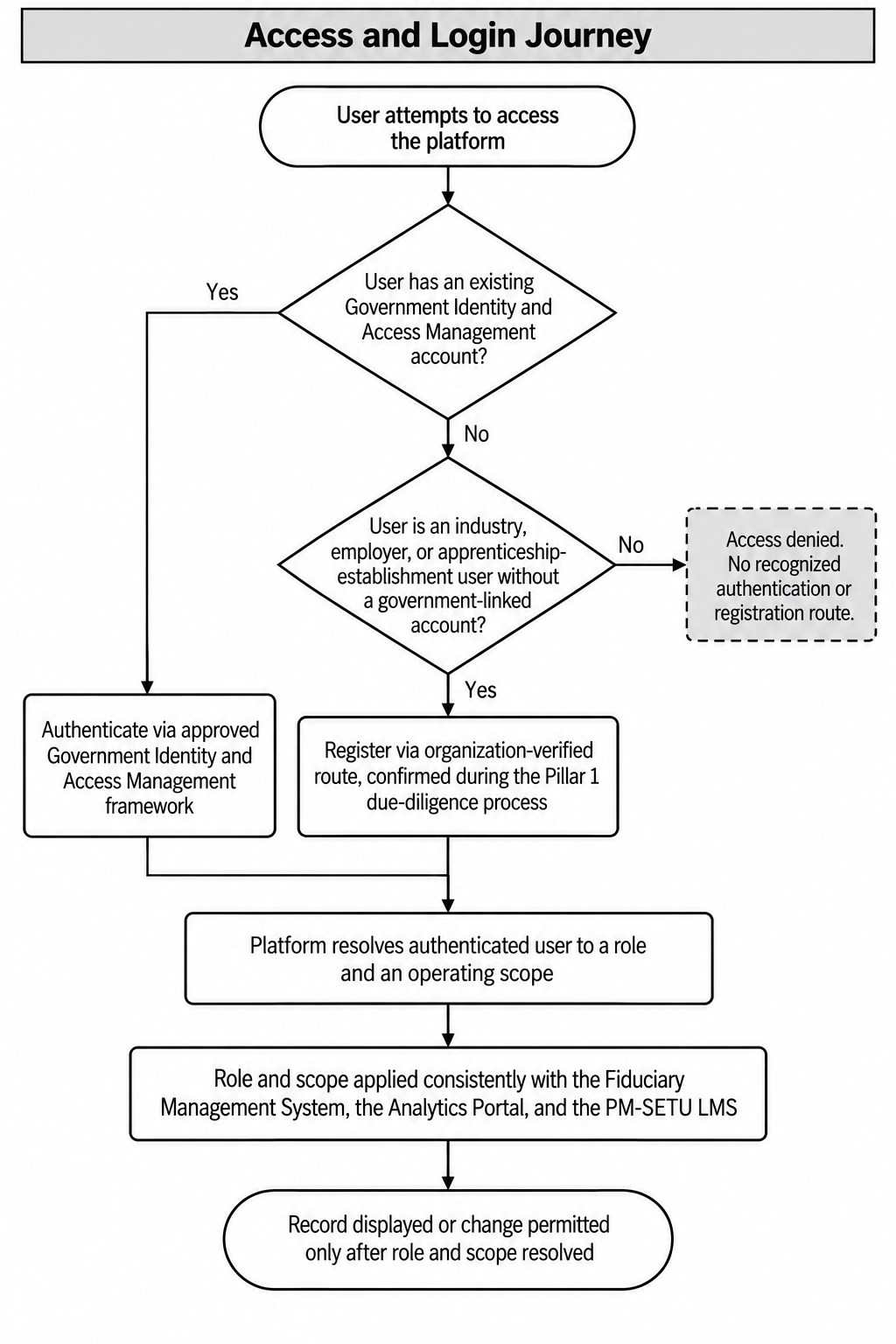
Every user authenticates through the approved Government Identity and Access Management framework, or, for an industry, employer, or apprenticeship-establishment user without an existing government-linked account, through an organization-verified registration route confirmed during the due-diligence process specified in Pillar 1. The platform resolves the authenticated user to a role and an operating scope before any record is displayed or changed, consistent with the access-resolution pattern already established for the Fiduciary Management System, the Analytics Portal, and the PM- SETU LMS.
2.2 Industry relationship owner (CRM) journeyPDF p.10
- •Lead capture: The relationship owner records a new industry lead, its source, and initial contact details against the Industry Master Profile, or creates a new profile where the organization has no prior record on the platform. Lead is Stage 1 of the thirteen-stage relationship life cycle.
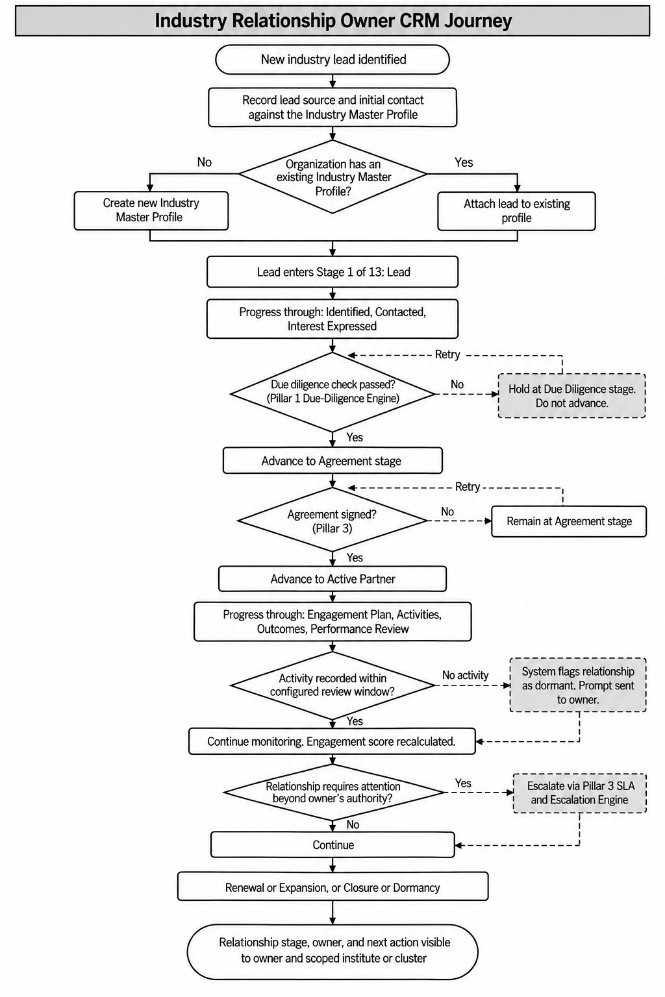
- •Pipeline management: The relationship owner progresses the lead through the remaining twelve stages of the thirteen-stage relationship life cycle: Identified, Contacted, Interest Expressed, Due Diligence, Agreement, Active Partner, Engagement Plan, Activities, Outcomes, Performance Review, Renewal or Expansion, and Closure or Dormancy, recording contact and meeting history and the next scheduled action at each stage.
- •Engagement monitoring: The relationship
owner views the engagement score and dormancy status computed for each assigned relationship and receives a system-generated prompt where a relationship has recorded no activity within the configured review window.
- •Escalation: Where a relationship requires attention beyond the owner's authority - a stalled due-diligence check or an agreement nearing expiry without renewal action - the owner raises it through the Service-Level- Agreement and escalation engine specified in Pillar 3.
2.3 Anchor Industry Partner onboarding journeyPDF p.11
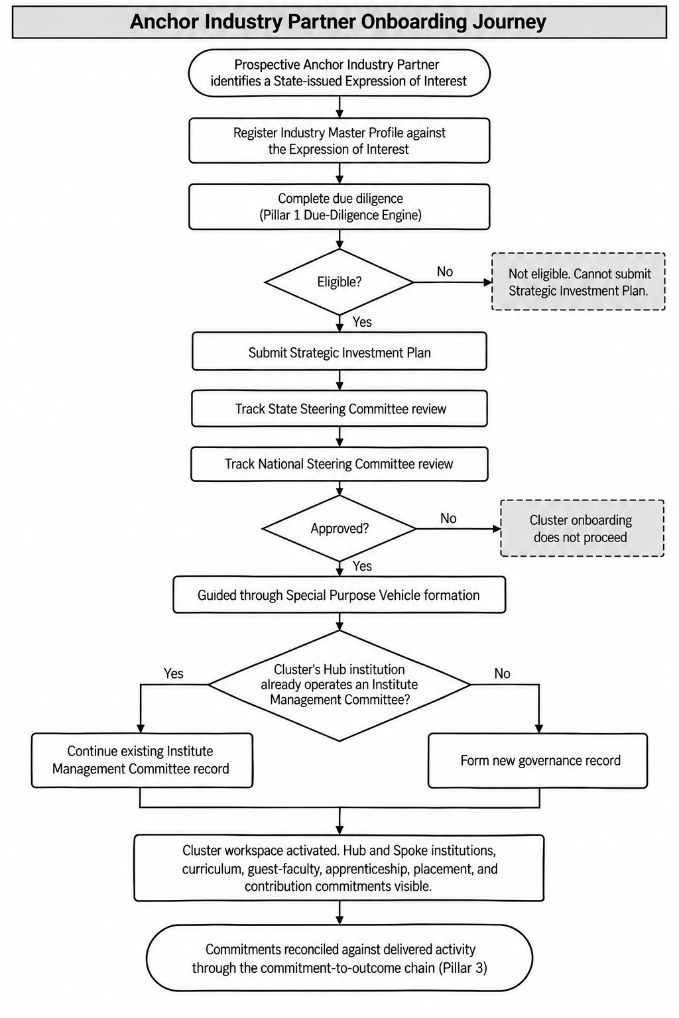
- •Onboarding: A prospective Anchor Industry Partner registers its Industry Master Profile against a State-issued Expression of Interest, completes due diligence, and, once eligible, submits the Strategic Investment Plan.
- •Approval and SPV formation: The partner
tracks State and National Steering Committee review and, on approval, is guided through Special Purpose Vehicle formation, continuing an existing Institute Management Committee's record where one already governs the cluster's Hub institution.
- •Cluster workspace: The partner's workspace presents the Hub and Spoke institutions in its cluster and its curriculum, guest-faculty, apprenticeship, placement, and contribution commitments, each reconciled against delivered activity through the commitment-to- outcome chain established in Pillar 3.
2.4 ITI industry-liaison (Institution Administrator) journeyPDF p.12
- •Relationship and agreement oversight: The
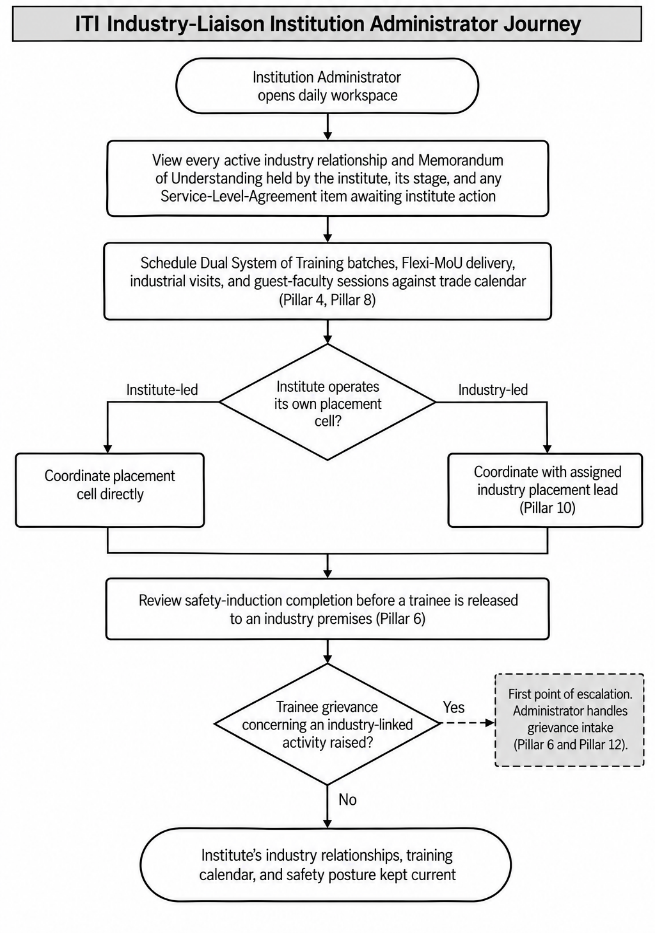
administrator views every active industry relationship and Memorandum of Understanding held by the institute, its stage, and any Service-Level-Agreement item awaiting institute action.
- •Training delivery coordination:
The administrator schedules Dual System of Training batches, Flexi-MoU delivery, industrial visits, and guest-faculty sessions against the institute's trade calendar.
- •Placement-cell operation: Where the institute
operates its own placement cell, the administrator coordinates it directly; where it is industry-led, the administrator coordinates with the assigned industry placement lead (Pillar 10).
- •Safety and grievance oversight:
The administrator reviews safety-induction completion before a trainee is released to an industry premises and is the first point of escalation for a trainee grievance concerning an industry-linked activity (Pillar 6 and Pillar 12).
2.5 Training-and-Placement Officer journeyPDF p.12
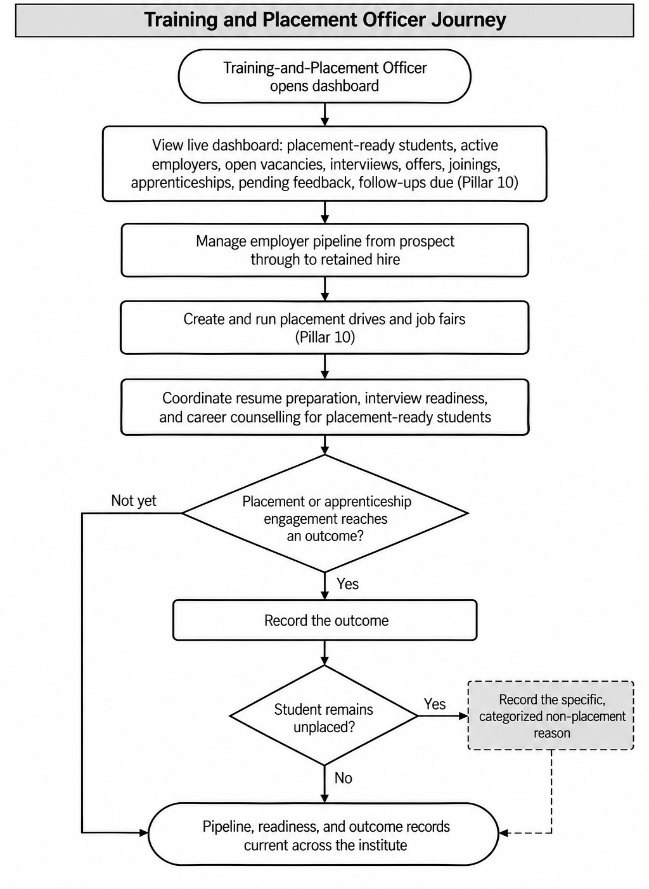
- •Operating dashboard: The Training-and-
Placement Officer opens a live dashboard of placement-ready students, active employers, open vacancies, scheduled interviews, offers, joinings, active apprenticeships, pending employer feedback, and post-placement follow- ups due (Pillar 10).
- •Employer pipeline management: The officer
manages the employer pipeline from prospect to retained hire and creates and runs placement drives and job fairs (Pillar 10).
- •Job-readiness support:
The officer coordinates resume preparation, interview readiness, and career counselling for placement-ready students, and reviews each student's job-readiness status.
- •Outcome and non-placement tracking: The
officer records the outcome of every placement and apprenticeship engagement, and, for a student who remains unplaced, records the specific, categorized reason.
2.6 Trainer / guest-faculty co-delivery journeyPDF p.12
- •Co-delivery and logbook: The trainer co-delivers Dual System of Training and Flexi-MoU modules with an industry mentor, and records or reviews the industrial training logbook entries generated during a trainee's industrial-training segment.
- •Capstone supervision: The trainer jointly supervises and grades an industry capstone project alongside the assigned industry evaluator (Pillar 8).
- •Industrial attachment: The trainer may apply for, undertake, and record an industrial attachment of their own, updating their trainer skill profile on completion (Pillar 8).
2.7 Student / Trainee / Apprentice journeyPDF p.13
- •Distinguished engagement record: The trainee's own workspace clearly distinguishes On-the- Job Training, Dual System of Training, internship, apprenticeship, and placement activity as separate, non-overlapping engagement types, each with its own status and evidence.
- •Discovery and application: The trainee discovers internship, apprenticeship, and placement opportunities, applies directly or is nominated by the institute, and, where enabled, is surfaced through the advisory Artificial-Intelligence-assisted matching capability.
- •Mentorship and job readiness: The trainee may request or accept an industry or alumni mentor pairing, and accesses job-readiness support ahead of a placement drive.
- •Safety, consent, and grievance: The trainee completes safety induction and records consent before an industry-premises activity and may raise a grievance concerning any industry-linked activity, with the resolution status visible throughout.
- •Outcome visibility: The trainee views the outcome of every application, including a Pre-Placement Offer where extended, and, after placement, remains reachable for the post-placement follow-up specified in Pillar 11.
2.8 Employer / Apprenticeship establishment journeyPDF p.14
- •Registration and due diligence: An employer or
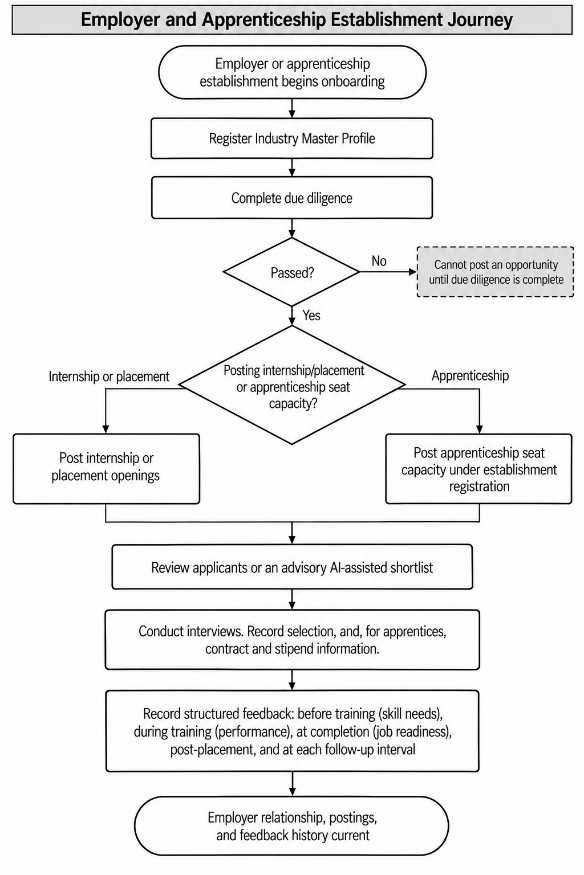
apprenticeship establishment registers its Industry Master Profile and completes due diligence before posting an opportunity.
- •Opportunity posting: The organization posts internship, apprenticeship, or placement openings, and, separately, apprenticeship seat capacity under its establishment registration.
- •Candidate management: The organization
reviews applicants or an advisory Artificial- Intelligence-assisted shortlist, conducts interviews, and records selection and, for apprentices, contract and stipend information.
- •Feedback at multiple stages: The organization
records structured feedback before training begins (skill needs), during training (performance against expectation), at completion (job readiness), immediately after placement, and at each post-placement follow-up interval.
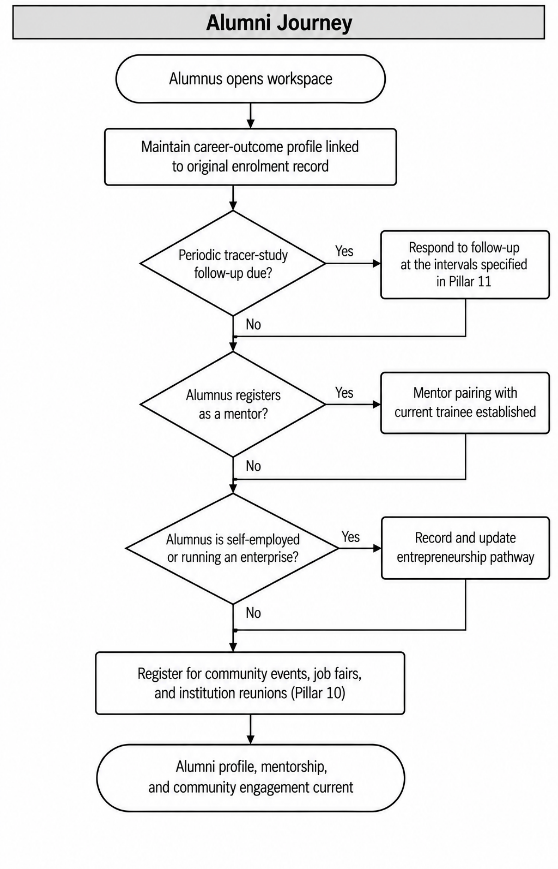
2.9 Alumni journeyPDF p.15
- •Profile and tracer participation: An alumnus
maintains a career-outcome profile linked to the original enrolment record and responds to periodic tracer-study follow-up at the intervals specified in Pillar 11.
- •Mentorship and entrepreneurship:
The alumnus may register as a mentor to current trainees and may separately record and update an entrepreneurship pathway where self- employed or running an enterprise.
- •Community engagement:
The alumnus registers for community events, job fairs, and institution reunions coordinated through the platform (Pillar 10).
- 3.Functional System Requirements This section sets out the functional requirements of the thirteen pillars introduced in Section 2, each specified in the same form: description, Functional Capabilities, Acceptance Criteria, Validation Rules, and Exception Management. A High or Medium priority tag shows relative sequencing weight; an untagged pillar is foundational to every other pillar. Every pillar carrying a Service-Level-Agreement, an AI capability, or a commitment-to-outcome reconciliation draws on the shared engines specified once, in Pillar 1, Pillar 3, and the AI and Intelligence Layer. A capability-map diagram is maintained for every pillar in this section, illustrating its functional groups, actors, cross-pillar links, and outcome at a glance.
3.1 Pillar 1: Industry Registry & Customer-Relationship ManagementPDF p.15
The system shall maintain the Industry Master Profile as the single master-data object for every organization the platform interacts with - an Anchor Industry Partner, an ordinary Dual System of Training or Flexi-MoU partner, an employer, an apprenticeship establishment, a Corporate Social Responsibility contributor, an industry association, a Public Sector Undertaking, a Micro, Small or Medium Enterprise, a technology or equipment vendor, or a Sector Skill Council - comprising organization and legal-entity identity, locations and facilities, industry sector and sub-sector, trades supported, workforce strength, infrastructure and training and apprenticeship and hiring and Corporate Social Responsibility and guest-faculty and mentoring capability, equipment-contribution capacity, every existing Memorandum of Understanding and Dual System of Training and Flexi-MoU and apprenticeship relationship, placement history, performance record, and compliance and due-diligence status. Every pillar in Section 3 reads and writes against this single object rather than maintaining a parallel organization record, and shall manage the relationship life cycle - Lead, Identified, Contacted, Interest Expressed, Due Diligence, Agreement, Active Partner, Engagement Plan, Activities, Outcomes, Performance Review, Renewal or Expansion, and Closure or Dormancy - through a Customer- Relationship-Management layer with a named relationship owner, contact history, and an engagement score.
This pillar also hosts the two-sided Industry Opportunity Marketplace through which industry publishes opportunities and an institute publishes requirements, and the reusable Due-Diligence Engine on which Anchor Industry Partner onboarding (Pillar 2) and ordinary industry-partner onboarding both depend.
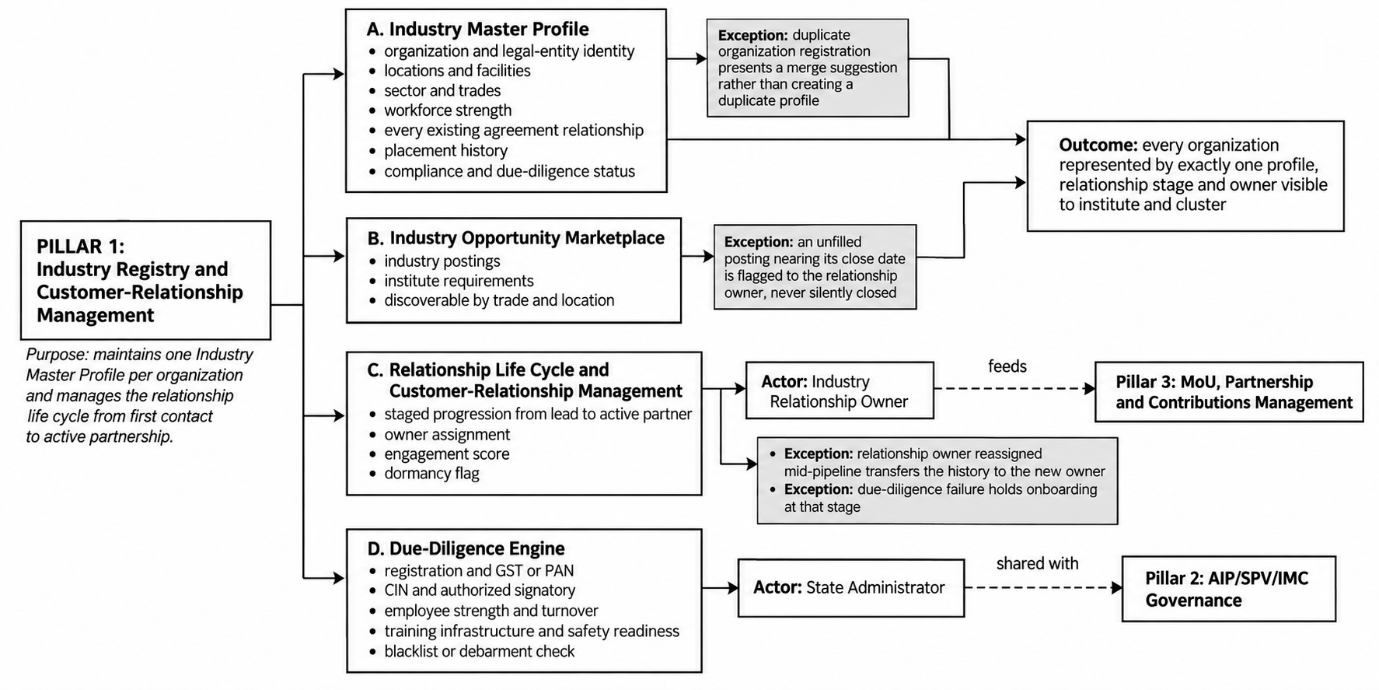
Functional CapabilitiesPDF p.16
Industry Master Profile: Every organization type the platform interacts with - Anchor Industry Partner, ordinary industry partner, employer, apprenticeship establishment, Dual System of Training partner, Flexi-MoU Industrial Training Partner, Corporate Social Responsibility contributor, industry expert, mentor, industry association, Public Sector Undertaking, Micro, Small or Medium Enterprise, technology or equipment vendor, and Sector Skill Council - is represented as one profile, tagged by every relationship type that applies to it.
- •Capture organization and legal-entity identity, locations and facilities, sector and sub-sector, and trades supported.
- •Capture workforce strength, and training, apprenticeship, hiring, Corporate Social Responsibility, guest-faculty, and mentoring capability.
- •Maintain a single reference to every Memorandum of Understanding, Strategic Investment Plan, Dual System of Training, Flexi-MoU, and apprenticeship relationship the organization holds, drawn from Pillar 2, Pillar 3, Pillar 4, and Pillar 5.
- •Present placement history, performance record (Pillar 13), and compliance and due-diligence status against the profile.
Relationship life cycle and Customer-Relationship Management: A relationship progresses
through thirteen defined stages, with a named owner accountable at every stage.
- •Capture lead source and progress a relationship through the defined life-cycle stages, recording the date and user responsible for each transition.
- •Assign a relationship owner and permit reassignment with a preserved transfer history.
- •Record contact and meeting history, and the next scheduled action, against each relationship.
- •Compute an engagement score from recorded activity frequency and recency and automatically flag a relationship as dormant where no activity is recorded within the configured review window.
- •Present an opportunity pipeline view, filterable by stage, trade, State, and relationship owner. Due-Diligence Engine: A reusable verification workflow, invoked by this pillar during ordinary onboarding and by Pillar 2 during Anchor Industry Partner onboarding.
- •Capture registration, Goods and Services Tax and Permanent Account Number references, Corporate Identification Number, authorized signatory, employee strength, and turnover.
- •Capture training infrastructure, safety readiness, and relevant certifications.
- •Run a blacklist or debarment check where an applicable reference database is configured.
- •Hold an organization at Due Diligence stage, ineligible for agreement signing, until every mandatory check is complete. Industry Opportunity Marketplace: A two-sided discovery feed connecting industry-published opportunities to institute-published requirements.
- •Permit an industry profile to publish an opportunity of any type recognized elsewhere in this report - internship, apprenticeship, placement, guest lecture, mentoring, industrial visit, trainer attachment, equipment donation, Corporate Social Responsibility contribution, capstone project, or technology workshop.
- •Permit an institute to publish a requirement, such as a stated need for apprenticeship seats, an industry expert in a named technology, or trainer-training seats.
- •Make every posting discoverable by trade, location, and opportunity type, and flag an unfilled posting approaching its closing date to the relationship owner.
Acceptance CriteriaPDF p.17
- •Every organization the platform interacts with is represented by exactly one Industry Master Profile, referenced rather than duplicated by every other pillar.
- •A relationship's current life-cycle stage, owner, and next scheduled action are visible to the owner and to the institute or cluster the relationship is scoped to.
- •An organization cannot be admitted to Agreement stage without a completed due-diligence record.
- •A dormancy flag is raised only after the configured no-activity window has elapsed and is cleared automatically on the next recorded activity.
Validation RulesPDF p.17
- •A duplicate Industry Master Profile for the same legal entity is prevented at creation, with a merge suggestion presented to the user attempting the duplicate registration.
- •A relationship cannot be marked Active Partner without a signed agreement referenced from Pillar
- 3.•
An Industry Master Profile cannot be deleted; it may only be closed or marked dormant, preserving its history.
Exception ManagementPDF p.17
| Exception | System Action |
| Due-diligence check fails | Hold the organization at Due Diligence stage, state the specific failed check, and notify the State administrator. |
| Duplicate organization registration detected | Present a merge suggestion instead of creating a second profile. |
| Relationship owner reassigned mid-pipeline | Transfer the relationship's history to the new owner and log the transfer. |
| Marketplace posting expires unfilled | Flag the posting to the relationship owner rather than silently closing it. |
3.2 Pillar 2: Anchor Industry Partner / SPV / Institute Management Committee GovernancePDF p.17
The system shall manage the admission of an Anchor Industry Partner to a PM-SETU cluster and the formation of the resulting governance structure, continuing rather than displacing the pre-existing
Institute Management Committee model operated at government ITIs since the 2007 Public-Private- Partnership scheme, and digitizing the Expression of Interest, Request for Proposal, Strategic Investment Plan, and Special Purpose Vehicle formation sequence introduced under PM-SETU. This pillar is the strategic governance layer described in Section 1.1, distinct from the operational Memorandum-of-Understanding layer specified in Pillar 3.
This pillar covers not only formation and onboarding, but the continuing operation of the governance body once formed, and the evidence and verification chain by which a cluster's progress against PM- SETU Disbursement-Linked Indicators is established, reviewed, and reported. The cluster-level governance this pillar specifies is one tier of the platform's overall four-tier governance structure; the National Steering Committee, Project Management Unit, and Data Governance Board tiers above it, benchmarked against comparable national and international programmes, are set out in Annexure I.
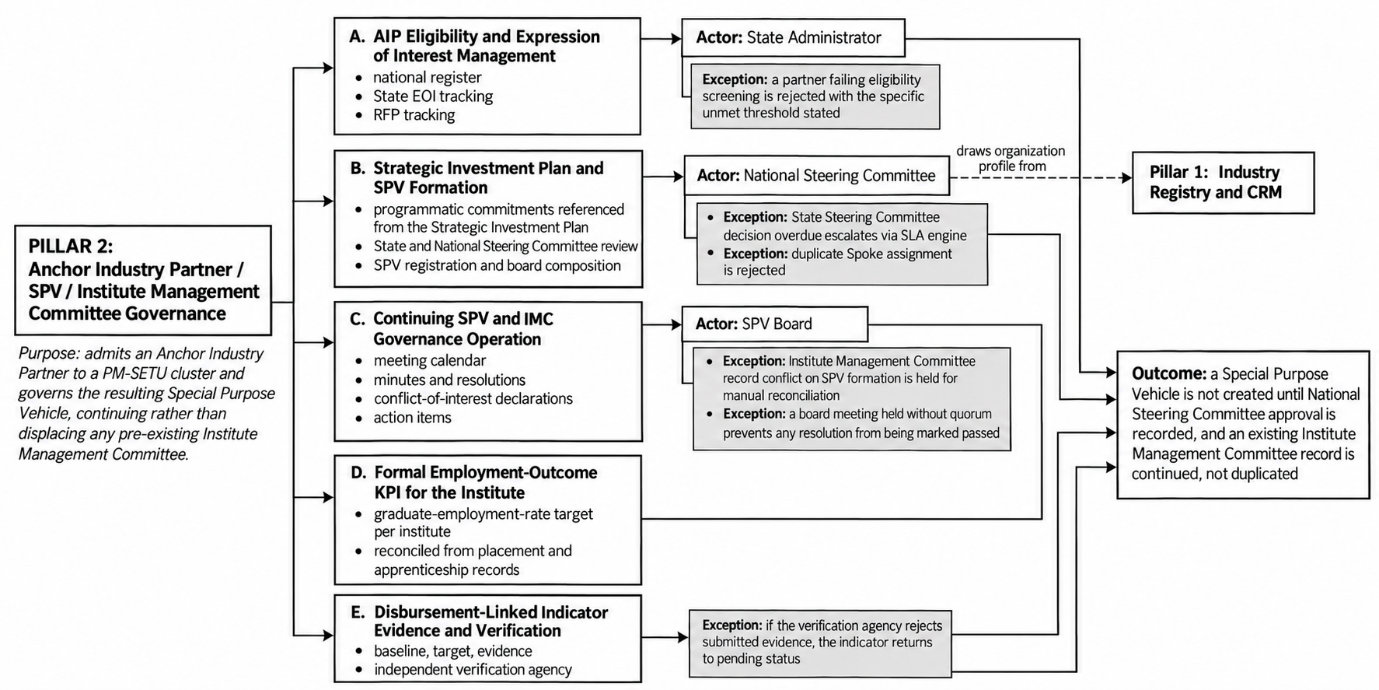
Functional CapabilitiesPDF p.18
AIP eligibility and Expression of Interest management: Eligibility is screened against turnover,
employee-count, and years-of-operation thresholds published in the State's Expression of Interest, drawing the organization's profile from Pillar 1.
- •Validate an applicant's Industry Master Profile against the eligibility thresholds published for the specific State Expression of Interest.
- •Track Expression of Interest and Request for Proposal status from submission through State shortlisting.
- •Publish every State's active Expression of Interest and Request for Proposal notice in a single, national, searchable listing, replacing the fragmented state-by-state Expression of Interest pages documented in the ITI Feature Master List, and surface a prospective partner's own eligibility and application status across every State it has applied to.
- •Maintain a national register of eligible Anchor Industry Partners searchable by trade sector, State, and turnover band.
Strategic Investment Plan and Special Purpose Vehicle formation: The programmatic content of
the Strategic Investment Plan, meaning the curriculum, guest-faculty, apprenticeship, and placement commitments a partner proposes for the cluster, is the master commitment record against which activity is tracked through this platform's commitment-to-outcome chain. The Strategic Investment Plan's financial content, meaning its capital and operating expenditure figures, is prepared, submitted, and approved in the Fiduciary Management System; this platform references that approved plan rather than capturing or duplicating its financial fields.
- •Capture the trade focus, cluster preference, and the curriculum, guest-faculty, apprenticeship, and placement commitments a partner proposes for the cluster, referencing the corresponding Strategic
Investment Plan record held in the Fiduciary Management System rather than re-entering its capital and operating expenditure content.
- •Route the submission through State and National Steering Committee review, recording the decision, deciding authority, and timestamp at each stage.
- •On National Steering Committee approval, record Special Purpose Vehicle registration, board composition, and industry equity share, and continue an existing Institute Management Committee's membership and decision history where the cluster's Hub institution already operates one, rather than creating a duplicate governance record.
- •Maintain the list of Spoke institutions assigned to the cluster and the Anchor Industry Partner's declared trade focus for each.
Continuing SPV and IMC governance operation: Formation is the beginning of the governance
relationship, not its conclusion. The platform shall support the board's ongoing operation for as long as the Special Purpose Vehicle or Institute Management Committee remains active.
- •Maintain a meeting calendar, issue a meeting notice with agenda, and record attendance and quorum for each Special Purpose Vehicle board or Institute Management Committee meeting.
- •Capture minutes, resolutions, and the recorded vote against each resolution.
- •Capture a conflict-of-interest declaration from a board member where a matter before the board concerns that member's own organization.
- •Track action items arising from a meeting, each with a named owner, a due date, and a closure record.
- •Record board or committee member changes, including resignation and replacement, and maintain a document and evidence repository against the governance body.
- •Schedule and record a dedicated Disbursement-Linked Indicator review meeting on the cadence the applicable PM-SETU scheme guideline requires.
- •Track a minimum assured share of female representation on the Special Purpose Vehicle board and Institute Management Committee against the target the applicable PM-SETU scheme guideline sets and flag a board whose composition falls below it for State remediation.
Formal employment-outcome KPI for the institute: The formal graduate-employment-rate Key
Performance Indicator applies to every institute in a cluster, not only to the cluster-level Disbursement- Linked Indicator target.
- •Record a formal employment-outcome Key Performance Indicator against each institute, drawn from the graduate-employment-rate target the applicable Disbursement-Linked Indicator sets for its cluster.
- •Present the institute's current employment-outcome performance against that Key Performance Indicator to the State administrator and the Special Purpose Vehicle, reconciled from the placement and apprenticeship-conversion records in Pillar 5 and Pillar 10.
- •Flag an institute whose employment-outcome performance falls materially behind its Key Performance Indicator for review, consistent with the escalation pattern in Pillar 3.
Disbursement-Linked Indicator evidence and verification: The generalized commitment-to-
outcome chain specified in Pillar 3 provides the underlying activity data; this capability adds formal evidence, verification, and reporting chain a Disbursement-Linked Indicator specifically requires.
- •Record, for each Disbursement-Linked Indicator applicable to a cluster, its baseline, its target, and the evidence the applicable PM-SETU scheme guideline requires to demonstrate achievement.
- •Link the required evidence to the underlying activity data already captured elsewhere in the platform, and support upload of supplementary evidence documents where the underlying activity data alone is insufficient.
- •Route assembled evidence to the independent verification agency referenced in the PM-SETU programme structure, recording the verification decision and the date.
- •On verification, record the approved achievement against the Disbursement-Linked Indicator, and make the resulting figure available for DGT and Multilateral Development Bank reporting.
Acceptance CriteriaPDF p.20
- •An Anchor Industry Partner cannot proceed to Strategic Investment Plan submission until eligibility is confirmed.
- •A Special Purpose Vehicle is not created until National Steering Committee approval is recorded.
- •Where a Hub institution already operates an Institute Management Committee, that committee's record is continued, not duplicated, on Special Purpose Vehicle formation.
- •Every approved Strategic Investment Plan is retained as the immutable baseline referenced by the commitment-to-outcome chain.
- •Every Special Purpose Vehicle board or Institute Management Committee meeting held after formation is recorded, with minutes, resolutions, and action items traceable to that meeting.
- •A Disbursement-Linked Indicator's approved achievement is traceable to the specific evidence and verification decision that established it.
Validation RulesPDF p.20
- •Eligibility thresholds are evaluated against the specific State Expression of Interest under which the partner applied.
- •A cluster assignment cannot list a Spoke institution already assigned to another active cluster.
- •Special Purpose Vehicle equity structure fields are provisional until confirmed against the applicable PM-SETU scheme guideline for the State concerned.
- •A board resolution cannot be recorded as passed without a recorded vote and quorum confirmation.
- •A Disbursement-Linked Indicator cannot be marked achieved without a recorded verification decision from the designated verification agency.
Exception ManagementPDF p.20
| Exception | System Action |
| Partner fails eligibility screening | Reject the Expression of Interest submission and state the specific threshold not met. |
| State Steering Committee decision overdue | Escalate through the Service-Level-Agreement engine specified in Pillar 3. |
| Institute Management Committee record conflict on SPV formation | Hold the Special Purpose Vehicle formation as an exception and route the State administrator for manual reconciliation. |
| Duplicate Spoke assignment detected | Reject the assignment and identify the cluster to which the institution is already assigned. |
| Board meeting held without quorum | Record the meeting as held without quorum and prevent any resolution from that meeting being marked passed. |
| Verification agency rejects submitted evidence | Return the Disbursement-Linked Indicator to pending status with the stated reason and notify the Special Purpose Vehicle. |
3.3 Pillar 3: Memorandum of Understanding, Partnership & Industry Contributions ManagementPDF p.20
The system shall provide a generalized agreement register covering every industry agreement type - an ordinary Memorandum of Understanding, a Dual System of Training agreement, a Flexi-MoU, an apprenticeship contract, or a Strategic Investment Plan - and shall apply a single commitment-to- outcome reconciliation chain to every one of them: a partner's proposed commitment is retained as an immutable baseline against which delivered activity is reconciled, following the chain Agreement (MoU
/ SIP) to Commitment to Activity to Output to Outcome to Impact. For example, an industry partner commits 50 apprenticeship opportunities (Commitment); 50 seats are created and 43 candidates are
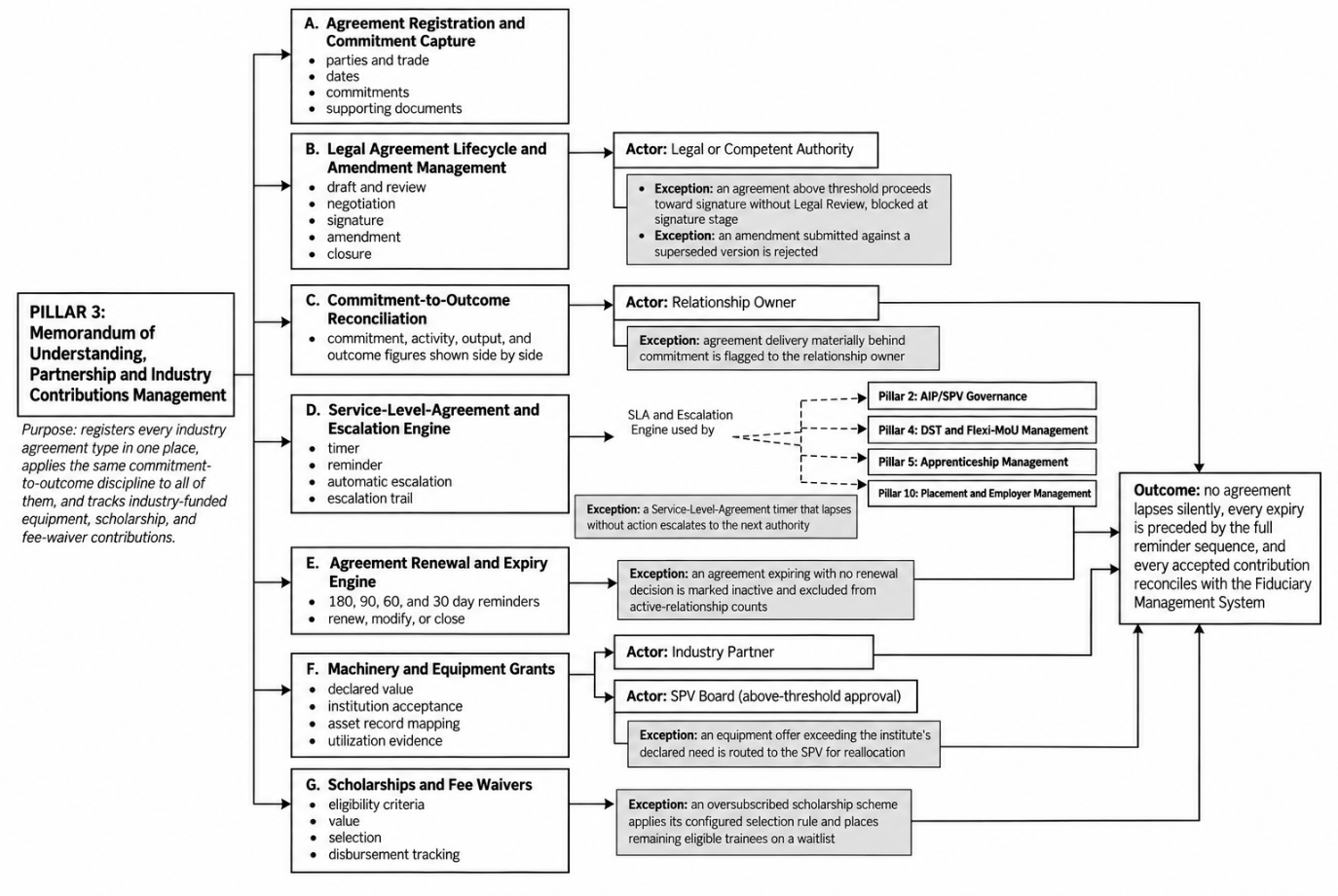
selected (Activity); 39 join and 35 complete (Output); 28 convert to employment at a recorded average salary (Outcome); and, aggregated across partners and clusters, this contributes to the State's or DGT's employability-rate evidence base (Impact). This pillar also hosts the Service-Level-Agreement and escalation engine, the agreement renewal and expiry engine shared across the platform, and the intake, acceptance-routing, and utilization tracking of industry-funded machinery, equipment, scholarship, and fee-waiver contributions.
Functional CapabilitiesPDF p.21
Agreement registration and commitment capture: Every agreement, regardless of type, is
registered with a consistent core structure.
- •Capture agreement type, the Industry Master Profile party, the institute or cluster party, trade, number of trainees covered, start date, end date, and renewal date.
- •Capture scope, commitments (training, apprenticeship, placement, and financial, as applicable), signatories, and supporting documents.
- •Capture compliance requirements and the agreed review frequency.
Legal agreement lifecycle and amendment management: A government-facing agreement requires
a formal drafting, review, and execution workflow, not only a signed-document upload.
- •Progress an agreement through Draft, Internal Review, Legal or Competent Authority Review, Negotiation, Finalization, Signature, Active, Amendment, Renewal, and Closure stages, recording the responsible party and date at each stage.
- •Support signature capture through the approved electronic-signature mechanism, recording signatory authority and signature timestamp for each party.
- •Maintain agreement version and amendment history, including clause-level change tracking, and retain the executed copy of each version, marking a superseded version accordingly rather than overwriting it.
- •Require a recorded Legal or Competent Authority Review decision before an agreement above a configured value or trainee-count threshold proceeds to signature.
Commitment-to-outcome reconciliation: Every agreement's declared commitments are reconciled against activity recorded elsewhere on the platform.
- •Reconcile a Dual System of Training agreement's declared trainee count against batches recorded in Pillar 4, an apprenticeship contract's declared seats against Pillar 5, and a Corporate Social Responsibility offer's declared value against Pillar 3.
- •Present, for every agreement, the commitment, activity-to-date, output, and outcome figures side by side.
- •Flag an agreement whose delivered activity falls materially behind its declared commitment for relationship-owner review.
Service-Level-Agreement and escalation engine: A shared, configurable engine invoked wherever
this report specifies a timed response requirement - State Steering Committee review (Pillar 2), employer response to a shortlist (Pillar 10), apprenticeship-contract signing (Pillar 5), or industry- supervisor confirmation (Pillar 4).
- •Start a Service-Level-Agreement timer against a configured event type and duration.
- •Issue a reminder before the timer lapses and escalate automatically to the next authority where it lapses without action.
- •Retain the escalation trail, comprising the originating office, each escalation level, and the current owner. Agreement renewal and expiry engine: Every agreement is tracked against its expiry date on a fixed reminder cadence.
- •Issue reminders at 180, 90, 60, and 30 days before an agreement's expiry date.
- •Mark an agreement inactive on expiry without a recorded renewal decision.
- •Support a renew, modify, or close decision against an expiring agreement, recorded with the deciding user and date. Machinery and equipment grants: Industry partners donate or fund modern machinery, tools, and software beyond the baseline DGT-provisioned list.
- •Register an equipment or machinery contribution offer with declared value, specification, and target institution.
- •Route the offer to the institution administrator, and, above a configured value threshold, to the Special Purpose Vehicle, for acceptance.
- •Map an accepted contribution to the institute's asset record and capture ongoing utilization or condition evidence over time. Scholarships and fee waivers: Industry partners fund scholarships or fee waivers to reduce dropout driven by financial hardship.
- •Register a scholarship or fee-waiver scheme with eligibility criteria, value, and applicable trade or cluster.
- •Match eligible trainees against the scheme and route selection to the institution administrator or industry partner.
- •Track disbursement status per trainee.
Acceptance CriteriaPDF p.22
- •Every agreement's commitment, activity, output, and outcome figures are visible in one reconciled view.
- •A Service-Level-Agreement breach is visible to both the original responsible party and the escalation authority.
- •No agreement lapses silently; every expiry is preceded by the full 180/90/60/30-day reminder sequence.
- •An agreement above the configured value or trainee-count threshold does not reach Signature stage without a recorded Legal or Competent Authority Review decision.
- •Every amendment to an active agreement is traceable to a specific version and preserves the superseded version intact.
- •Every accepted contribution is traceable to its offering industry partner, declared value, and target institution or trainee.
- •Contribution value publishes to the Fiduciary Management System for reconciliation through Pillar
3.
Validation RulesPDF p.23
- •An agreement cannot be marked Active without the mandatory core fields - parties, trade, dates, and commitments - completed.
- •A Service-Level-Agreement timer is configured once per event type and is not duplicated across pillars.
- •An expired agreement with no renewal decision is marked inactive and is excluded from active relationship counts.
- •An agreement cannot be recorded as signed without a signatory authority and signature timestamp for each required party.
- •An equipment contribution above the configured threshold is not accepted without Special Purpose Vehicle confirmation.
- •A scholarship disbursement cannot exceed the scheme's declared value per eligible trainee.
Exception ManagementPDF p.23
| Exception | System Action |
| Agreement delivery materially behind commitment | Flag to the relationship owner and, above a configured variance, to the State administrator. |
| Service-Level-Agreement timer lapses without action | Escalate to the next authority and notify both the original and escalation recipient. |
| Agreement expires with no renewal decision recorded | Mark inactive and exclude from active relationship counts and dashboards. |
| Conflicting renewal decisions submitted concurrently | Apply the first recorded decision, reject the second, and raise an exception to the administrator. |
| Agreement above threshold proceeds toward signature without Legal Review | Block signature stage and return the agreement to Legal or Competent Authority Review. |
| Amendment submitted against a superseded version | Reject the amendment and require it to be raised against the current active version. |
| Equipment offer exceeds institute's declared need | Route to the Special Purpose Vehicle for reallocation decision rather than auto-accepting. |
| Scholarship scheme oversubscribed | Apply the scheme's configured selection rule and place remaining eligible trainees on a waitlist. |
3.4 Pillar 4: Dual System of Training & Flexi-MoU ManagementPDF p.23
The system shall provide a dedicated operational engine for industry-delivered practical training in its two recognized forms: the Dual System of Training, delivered under a Memorandum of Understanding with industrial-training proportion scaled to course duration in a block, multiple-block, or mixed-mode pattern; and the Flexi-MoU / Industrial Training Partner route, in which a Regional Directorate of Skill Development and Entrepreneurship signs directly with an eligible industry partner, training is delivered primarily on industry premises, and DGT retains assessment and certification authority. Both replace a
simple yes/no flag with the full operational sequence: trade and industry identification, batch and capacity definition, trainee nomination and industrial onboarding, logbook-based delivery, joint
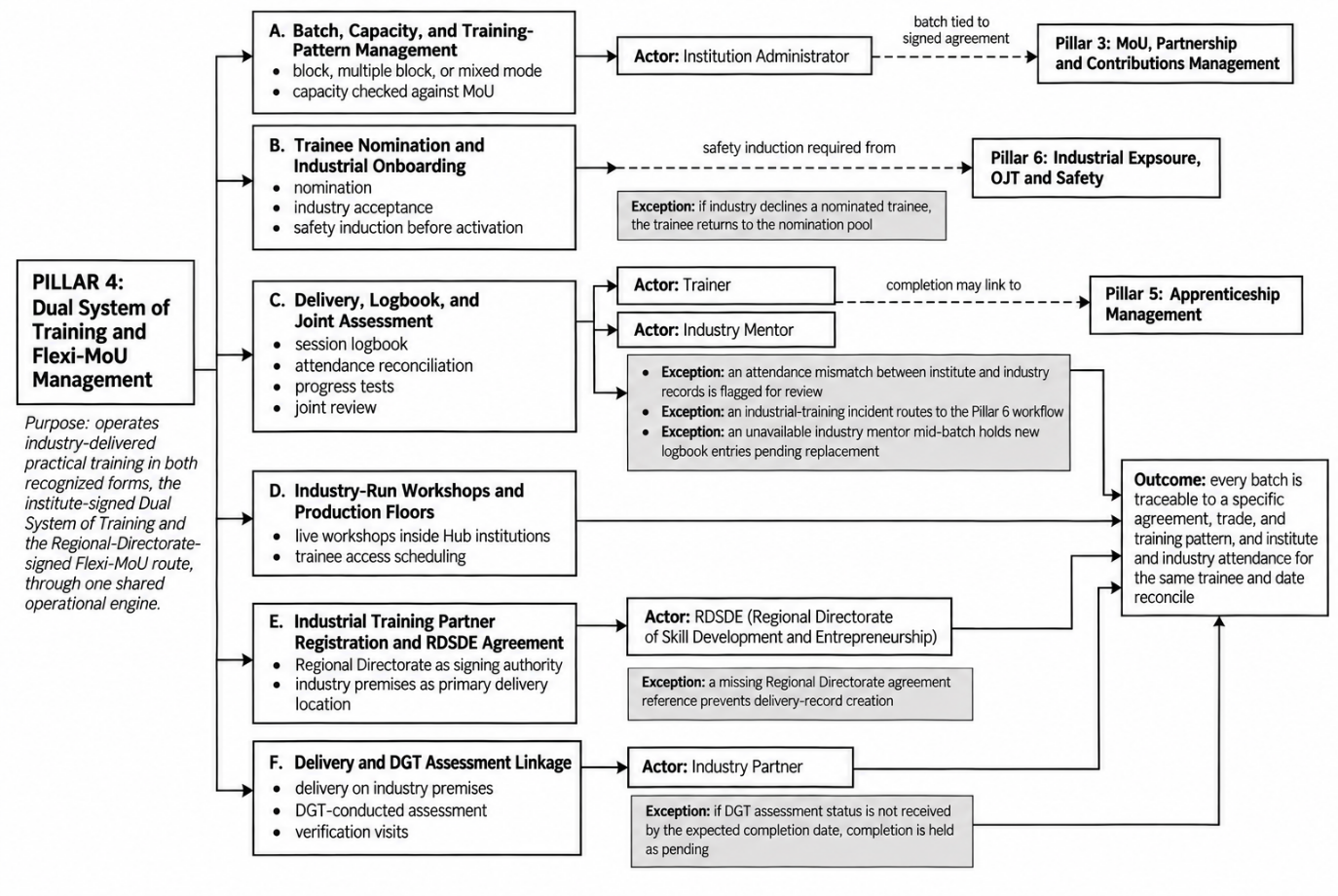
assessment, and completion linkage to certification, apprenticeship, or placement.
Functional CapabilitiesPDF p.24
Batch, capacity, and training-pattern management: A Dual System of Training engagement is
defined at the batch level against a specific industry partner and Memorandum of Understanding.
- •Check declared industry training capacity against the Memorandum of Understanding referenced from Pillar 3 before batch creation.
- •Define a batch's trade, trainee capacity, and training pattern - block, multiple blocks, or mixed mode - as agreed between the institute and the industry partner.
- •Maintain the training calendar and shift pattern applicable to the batch, coordinated with the institute's Learning Management System batch calendar.
Trainee nomination and industrial onboarding: A nominated trainee must be accepted by the
industry partner and complete safety induction before industrial training begins.
- •Nominate trainees to a batch and route the nomination to the industry partner for acceptance.
- •Require completion of safety induction, recorded under Pillar 6, before a nominated trainee's industrial-training segment is activated.
- •Record the industrial mentor or supervisor assigned to the batch at the industry premises. Delivery, logbook, and joint assessment: Every industrial-training session generates a logbook entry, reconciled with institute-side attendance, and progress is jointly reviewed.
- •Capture an industrial training logbook entry per session, comprising date, machine or task, skill practiced, hours, supervising industry mentor, and any supporting evidence.
- •Reconcile institute-recorded attendance with industry-recorded attendance for the same trainee and date, flagging a mismatch rather than silently accepting both records.
- •Record periodic progress tests and a joint institute-and-industry review of trainee progress.
- •Record an industrial-training incident through the incident-management workflow specified in Pillar 6 where one occurs.
- •On completion, capture industry feedback on the batch, and link the trainee's record to the applicable All India Trade Test certification, apprenticeship (Pillar 5), or placement (Pillar 10) pathway, and to National Apprenticeship Promotion Scheme registration where the industry partner's dual-mode status qualifies the trainee for it. Industry-run workshops and production floors: An industry partner may operate a live workshop or production floor within a Hub institution, distinct from an off-site Dual System of Training batch, for sustained real-world-readiness training.
- •Register an industry-run workshop or production floor against the Hub institution and the trades it serves, with the industry partner's own supervisor of record.
- •Schedule trainee access and record attendance against the workshop, using the same logbook structure as an off-site industrial-training session.
- •Reconcile a workshop's declared operating hours and trainee throughput against the relevant Memorandum of Understanding or Strategic Investment Plan commitment through Pillar 3.
Industrial Training Partner registration and RDSDE agreement: A Flexi-MoU is signed by the
Regional Directorate of Skill Development and Entrepreneurship rather than by the institute directly.
- •Record the Regional Directorate of Skill Development and Entrepreneurship as the signing authority, referencing the underlying agreement in Pillar 3.
- •Capture the industry premises designated as the primary delivery location, distinct from the sponsoring institute. Delivery and DGT assessment linkage: Delivery occurs primarily on industry premises, with DGT conducting assessment and certification.
- •Schedule and record delivery against the industry premises location, using the same logbook structure specified in Pillar 4.
- •Link trainee completion to DGT-conducted assessment and certification, distinct from an institute- administered assessment.
- •Record the Regional Directorate's verification of visits and findings against the delivery record.
Acceptance CriteriaPDF p.25
- •Every Dual System of Training batch is traceable to a specific Memorandum of Understanding, trade, training pattern, and industry mentor.
- •A trainee's industrial-training logbook is complete and attributable to a specific session, task, and supervising mentor.
- •Institute and industry attendance for the same trainee and date reconcile, or the mismatch is visibly flagged.
- •Cumulative Dual System of Training delivery per cluster reconciles against the Memorandum of Understanding's declared trainee count through the Pillar 3 commitment-to-outcome chain.
- •Every Flexi-MoU delivery record is attributable to the Regional Directorate agreement and the designated industry premises.
- •Completion is not recorded without the linked DGT assessment and certification status.
Validation RulesPDF p.25
- •A batch cannot be activated without a referenced, active Memorandum of Understanding and confirmed industry capacity.
- •A trainee's industrial-training segment cannot begin without a recorded safety-induction completion.
- •A logbook entry requires a supervising industry mentor to be recorded before it is accepted.
- •A Flexi-MoU delivery record cannot be created without a signed Regional Directorate of Skill Development and Entrepreneurship agreement reference.
- •Verification-visit findings are retained against the delivery record and are not overwritten by a subsequent visit.
Exception ManagementPDF p.26
| Exception | System Action |
| Industry declines a nominated trainee | Return the trainee to the nomination pool and notify the institute. |
| Attendance mismatch between institute and industry records | Flag the inconsistency for institute review and retain both records intact. |
| Industrial-training incident reported | Route to the Pillar 6 incident-management workflow and suspend the affected trainee's industrial-training segment pending review. |
| Industry mentor unavailable mid-batch | Notify the institute and hold new logbook entries pending a replacement mentor assignment. |
| Regional Directorate agreement reference missing | Prevent delivery-record creation and require agreement reference. |
| DGT assessment status not received at expected completion date | Hold completion as pending and notify the Regional Directorate. |
3.5 Pillar 5: Apprenticeship ManagementPDF p.26
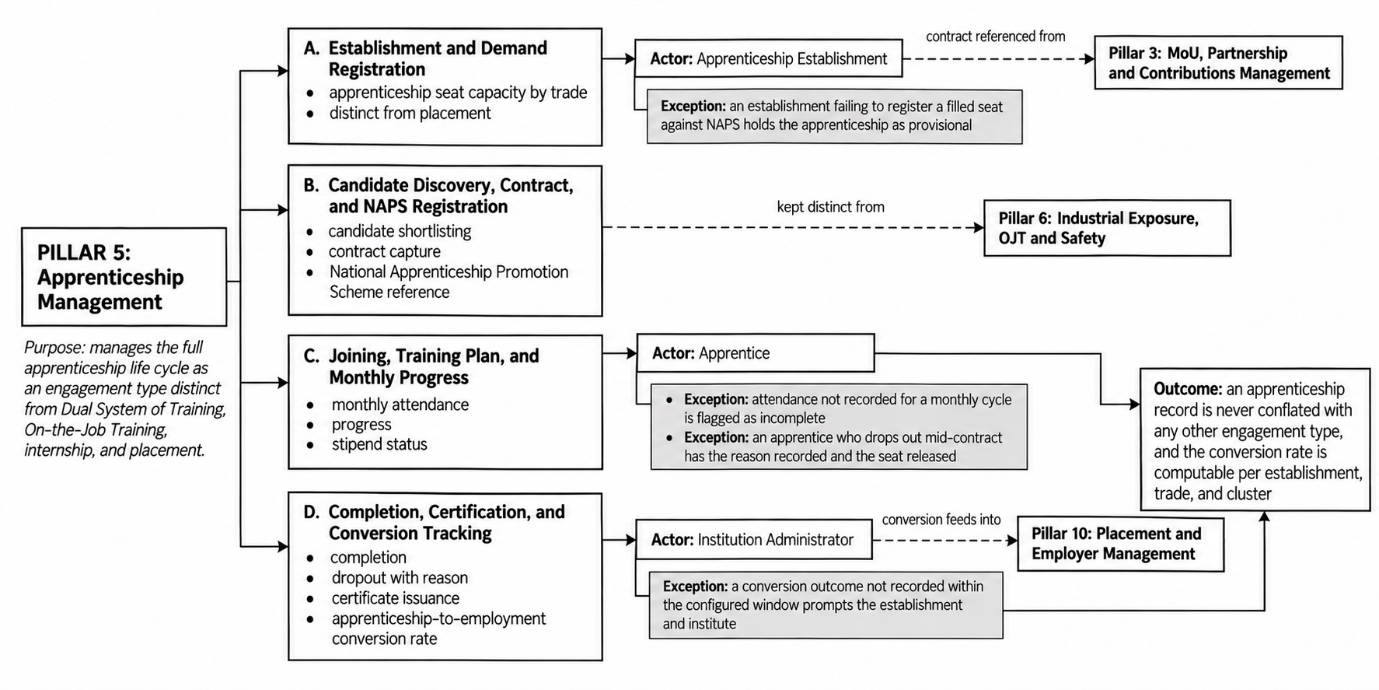
The system shall manage the full apprenticeship life cycle as a distinct engagement type, per the engagement-type distinction Pillar 9 enforces platform-wide. This pillar specifies apprenticeship as a dedicated life cycle - establishment and demand registration, candidate discovery and contract, joining and monthly progress, and completion, certification, and conversion to employment - reflecting the Apprentices Act, 1961, and the National Apprenticeship Promotion Scheme's registration requirement, and the linkage DGT's own Dual System of Training guidelines already draw between dual-mode industry partners and apprenticeship registration.
Functional CapabilitiesPDF p.26
Establishment and demand registration: An apprenticeship establishment is a distinct role on the Industry Master Profile, registering seat demand separately from any placement vacancy it may also post.
- •Register an establishment's apprenticeship seat capacity by trade, distinct from internship or placement postings.
- •Map declared seats to specific trades and the institutes or clusters they are open to.
Candidate discovery, contract, and NAPS registration: A candidate is selected and formally
contracted before joining.
- •Support candidate discovery and shortlisting against declared seats, including through the advisory Artificial-Intelligence-assisted matching capability specified in Pillar 10.
- •Capture the apprenticeship contract and register it against the National Apprenticeship Promotion Scheme reference.
- •Record the offer and the candidate's acceptance before joining is activated. Joining, training plan, and monthly progress: An active apprentice is tracked on a monthly cycle distinct from an institute's academic term.
- •Activate the apprentice's training plan on joining and record monthly attendance and progress.
- •Record stipend status and claims against each monthly cycle.
- •Capture periodic assessment results distinct from the institute's own examination cycle.
Completion, certification, and conversion tracking: Apprenticeship completion is a distinct outcome
from placement, with its own conversion metric.
- •Record completion, dropout with reason, and certificate issuance.
- •Record whether a completed apprenticeship converts to a regular employment offer with the same establishment and compute the apprenticeship-to-employment conversion rate per establishment, trade, and cluster.
Acceptance CriteriaPDF p.27
- •An apprenticeship record is never conflated with a Dual System of Training, On-the-Job Training, internship, or placement record for the same trainee; each engagement type is separately identifiable.
- •Every apprenticeship contract is registered against the National Apprenticeship Promotion Scheme reference before joining is activated.
- •Monthly attendance, progress, and stipend status are recorded for every active apprentice.
- •The apprenticeship-to-employment conversion rate is computable per establishment, trade, and cluster.
Validation RulesPDF p.27
- •A seat of apprenticeship cannot be filled without a signed contract and National Apprenticeship Promotion Scheme registration reference.
- •A trainee cannot hold simultaneous active records of a type of this pillar, and Pillar 4, Pillar 6, and Pillar 9, each define as mutually exclusive engagement types, without an explicit, recorded exception.
- •A stipend claim cannot be recorded against a month with no corresponding attendance record.
Exception ManagementPDF p.27
| Exception | System Action |
| Establishment fails to register a filled seat against NAPS | Hold the apprenticeship as provisional and escalate through the Pillar 3 Service-Level-Agreement engine. |
| Apprentice attendance not recorded for a monthly cycle | Flag the cycle as incomplete and notify the institute and establishment. |
| Exception | System Action |
| Apprentice drops out mid-contract | Record the reason, close the contract, and release the seat for re-filling. |
| Conversion outcome not recorded within the configured window after completion | Prompt the establishment and institute for the outcome before excluding it from the conversion-rate calculation. |
3.6 Pillar 6: Industrial Exposure, On-the-Job Training & SafetyPDF p.28
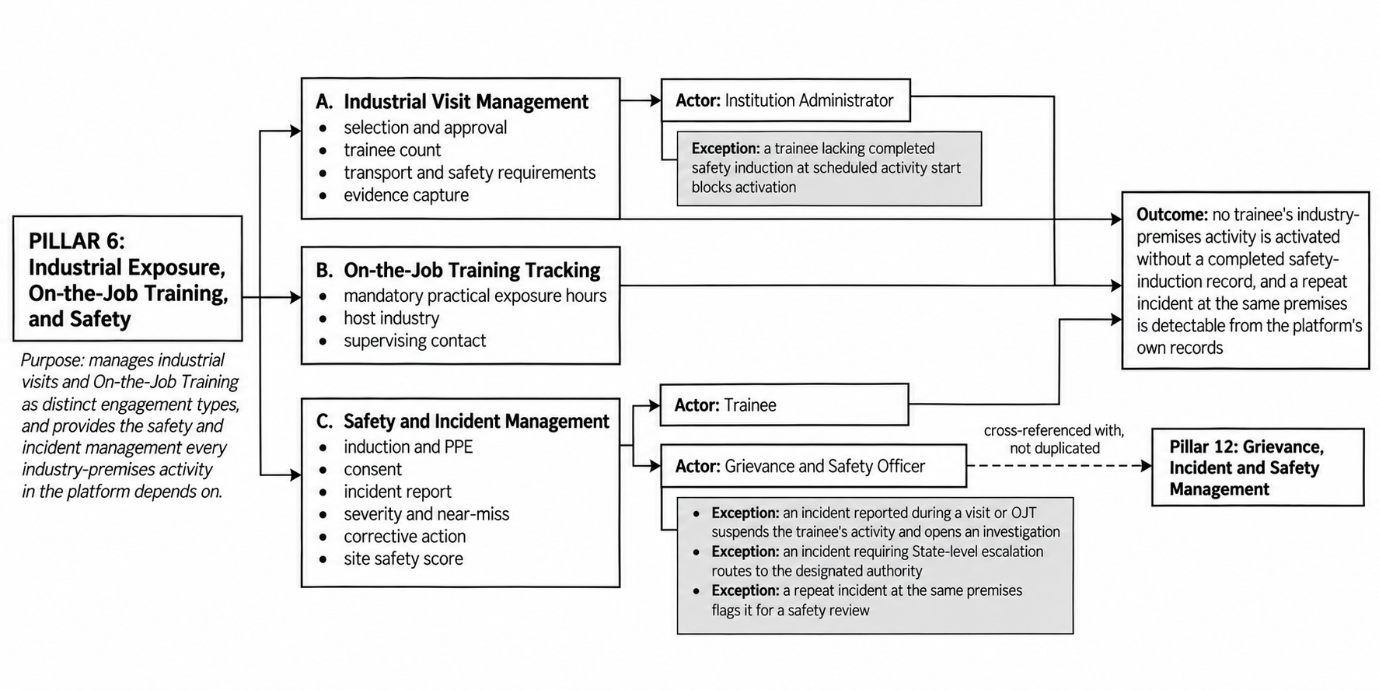
The system shall manage industrial visits and On-the-Job Training as engagement types distinct from the Dual System of Training, Flexi-MoU, internship, and apprenticeship, and shall provide a Safety and Incident Management workflow applicable to every activity in this report that places trainees on an industry premises. On-the-Job Training in this pillar refers to the mandatory industry-linked practical exposure already built into the Craftsmen Training Scheme, tracked here as a first-class record rather than an unstructured attendance note.
Functional CapabilitiesPDF p.28
Industrial visit management: An industrial visit is a shorter, cohort-level exposure activity distinct from an individual trainee's sustained industrial training.
- •Capture industry selection, visit request, and institute approval, including date, trainee count, trade, accompanying faculty, and industry coordinator.
- •Capture transport and safety requirements, and trainee consent, before the visit is confirmed.
- •Record attendance, photographic or documentary evidence, the recorded learning outcome, and industry feedback after the visit. On-the-Job Training tracking: The mandatory industry-linked practical exposure component of the Craftsmen Training Scheme is tracked as its own record, reconciled with the PM-SETU Learning Management System.
- •Record On-the-Job Training hours, host industry, and supervising contact against the trainee's course record.
- •Distinguish an On-the-Job Training record from a Dual System of Training, internship, or apprenticeship record for the same trainee
Safety and incident management: Every activity that places a trainee on an industry premises - Dual System of Training, Flexi-MoU, On-the-Job Training, internship, apprenticeship, or an industrial visit - requires a completed safety record before the trainee is released.
- •Capture safety-induction completion, Personal Protective Equipment issuance, safety briefing, emergency contact information, and, where applicable, insurance or coverage details and workplace-rules acknowledgement, before an industry-premises activity is activated.
- •Capture trainee consent, and, where the trainee is a minor, the additional consent pathway specified for minors under Section 5.6.
- •Record an incident report where one arises, and route it: industry notified, institute notified, State or designated authority notified where required, investigation conducted, corrective action recorded, and closure confirmed.
- •Classify an incident by severity, and separately capture a near-miss report, distinct from an incident, where an unsafe condition or practice was observed but did not result in harm.
- •Record a root cause against an investigated incident or near miss and track the resulting corrective and preventive action to closure.
- •Maintain a safety checklist per activity type and trade, an inspection schedule for industry premises hosting a Dual System of Training or apprenticeship batch, and safety-certification expiry tracking for the industry premises concerned.
- •Compute a site safety score per industry premises from recorded incident, near-miss, and inspection history, and flag a repeat incident at the same premises for review.
Acceptance CriteriaPDF p.29
- •Every industrial visit, On-the-Job Training record, and safety record is attributable to a specific trainee, industry premises, and date.
- •No trainee's industry premises activity is activated without a complete safety-induction record.
- •An incident report's status - reported, investigated, corrective action recorded, closed - is visible to the institute and, where escalated, to the State authority.
- •A repeat incident at the same industry premises is detectable from the platform's own records, not only from manual review.
Validation RulesPDF p.29
- •An industrial visit cannot be confirmed without recorded transport, safety requirements, and trainee consent.
- •A safety-induction record must be completed and dated before the corresponding industry-premises activity's start date.
- •An incident report cannot be closed without a recorded corrective action.
- •A near-miss report cannot be classified as an incident, and an incident cannot be reclassified as a near-miss, without a recorded justification.
Exception ManagementPDF p.29
| Exception | System Action |
| Trainee lacks completed safety induction at scheduled activity start | Block activation of the industry-premises activity and notify the institute administrator. |
| Incident reported during an industrial visit or On-the-Job Training | Suspend the affected trainee's activity, notify industry and institute, and open an investigation record. |
| Incident requires State-level escalation | Route to the designated State authority and retain the escalation in the audit trail. |
| Repeat incident detected at the same industry premises | Flag the premises for a safety review before further trainee placement there is approved. |
3.7 Pillar 7: Curriculum & Skill IntelligencePDF p.30
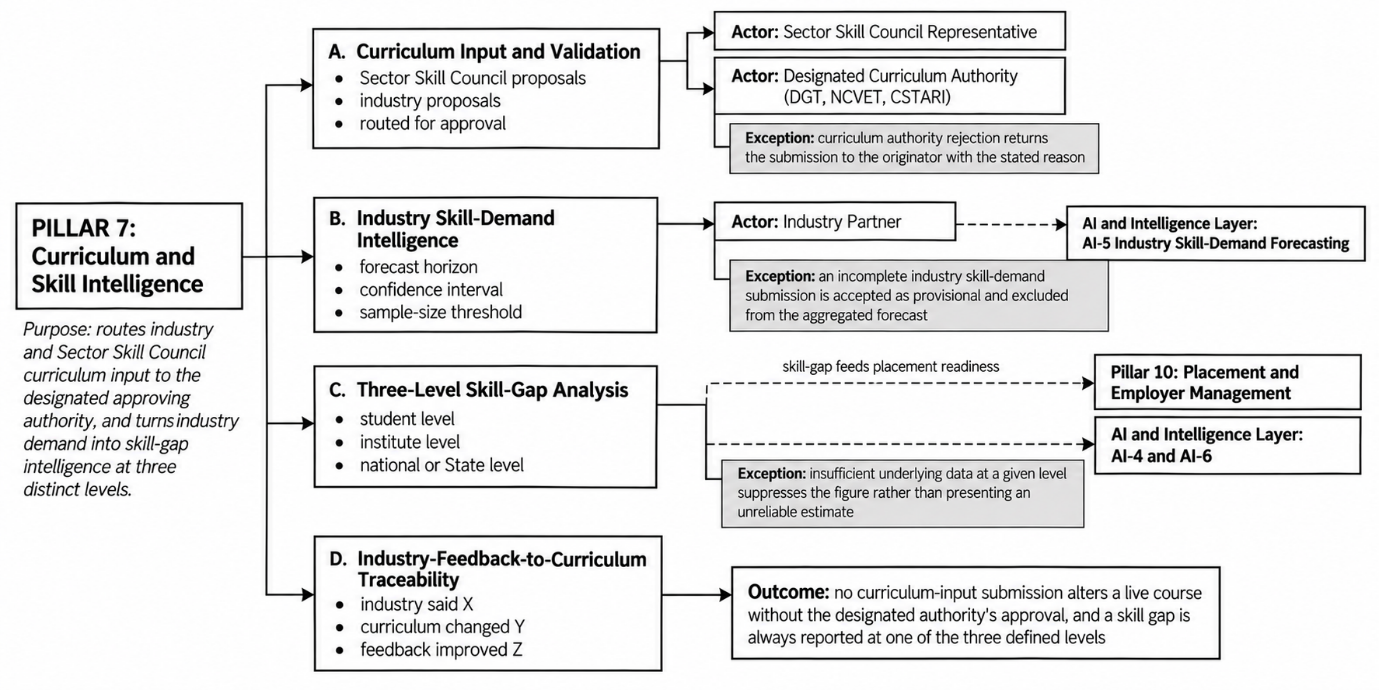
The system shall capture industry and Sector Skill Council curriculum input, aggregate industry- submitted skill-demand data into forecasting and skill-gap intelligence at three distinct levels and maintain an explicit traceability record linking industry feedback through curriculum change to trainee outcome and renewed employer feedback. This pillar does not approve a curriculum change itself: DGT, NCVET, CSTARI, and the Sector Skill Councils remain the approving authority, consistent with the curriculum-authority positioning already established for the PM-SETU LMS.
Every competency, skill, and job-role reference used in this pillar, and in the AI capabilities specified in the AI and Intelligence Layer, is drawn from the Skill, Occupation, and Competency Master specified in Section 4.5, so that a skill-gap or demand figure computed here is comparable across institutes, States, and time.
Functional CapabilitiesPDF p.30
Curriculum input and validation: Sector Skill Councils create Qualification Packs and National Occupational Standards; Anchor Industry Partners and ordinary industry partners separately propose curriculum alignment.
- •Capture Sector Skill Council Qualification Pack and National Occupational Standard submissions, and industry curriculum-alignment proposals.
- •Route every submission to the designated curriculum authority for review, holding it as pending until approved.
- •Publish an approved submission's reference to the PM-SETU LMS Course Management pillar without altering the authoritative course record directly. Industry skill-demand intelligence: Industry periodically submits forward-looking manpower and technology requirements, aggregated into a demand-to-capacity pipeline using a defined forecasting methodology.
- •Capture periodic industry submissions of manpower requirement, trades, skills, emerging technologies, expected hiring, salary range, location, equipment, and certification needs.
- •Aggregate submissions into an industry-demand, skill-demand, and trade-demand view, comparable against recorded Institute capacity by trade and location.
- •Compute a forecast at a defined horizon of 6, 12, 24, or 36 months, refreshed on a fixed cadence, and require a configured minimum data-sufficiency threshold and regional sample size before a forecast is published for a given trade and geography.
- •Present each forecast with a stated confidence interval, apply source weighting where submissions vary in reliability or recency, and account for seasonality where a trade's industry demand is known to vary within a year.
- •Measure forecast accuracy against subsequently observed demand and suppress a forecast for a trade and geography combination where accuracy has been persistently poor, pending review.
- •Surface the resulting skill gap as a curriculum recommendation and a training-capacity planning input for DGT and State review.
Three-level skill-gap analysis: Skill gap is measured at three distinct levels, not conflated into one figure.
- •Compute a student-level skill gap comparing a trainee's recorded competency evidence against a target job role's requirement.
- •Compute an institute-level skill gap comparing an institute's trade and equipment capability against the industry requirement recorded for its service area.
- •Compute a national or State-level skill gap comparing aggregated industry demand against aggregated institute supply by trade and geography. Industry-feedback-to-curriculum traceability: The platform maintains an explicit, queryable record connecting an industry-origin input to the curriculum change, the trainees subsequently trained, and the resulting employer feedback.
- •Link a curriculum-approval decision to the specific industry-feedback or skill-demand submission that prompted it, where one exists.
- •Link the trainees subsequently trained under a revised curriculum to the originating change of record.
- •Link subsequent employer feedback (Pillar 10) on those trainees back to the same change record, closing the evidence loop.
Acceptance CriteriaPDF p.31
- •Every curriculum-input submission is traceable to its originating Sector Skill Council or industry source and its approval status.
- •No curriculum-input submission alters a live PM-SETU LMS course version without the designated curriculum authority's recorded approval.
- •A skill gap is always reported at one of the three defined levels, never presented as an undifferentiated single figure.
- •A traceability query - "industry said X, curriculum changed Y, trainees trained, employer feedback improved Z" - is answerable from the platform's own records for a curriculum change originating in this pillar.
Validation RulesPDF p.31
- •A curriculum-input submission cannot be marked approved by any role other than the designated curriculum authority.
- •A skill-demand submission cannot be attributed to an industry profile that has not completed due diligence.
- •A traceability link cannot be created to a curriculum change the platform did not itself record the originating input for.
Exception ManagementPDF p.31
| Exception | System Action |
| Curriculum authority rejects submission | Return the submission to the originator with the stated reason and hold it as not approved. |
| Industry skill-demand submission incomplete | Accept the submission as provisional and exclude it from the aggregated forecast until completed. |
| Exception | System Action |
| Skill-gap computation lacks sufficient underlying data at a given level | Suppress the figure for that level rather than presenting an unreliable estimate. |
3.8 Pillar 8: Guest Faculty, Trainer Engagement & Live Industry ProjectsPDF p.32
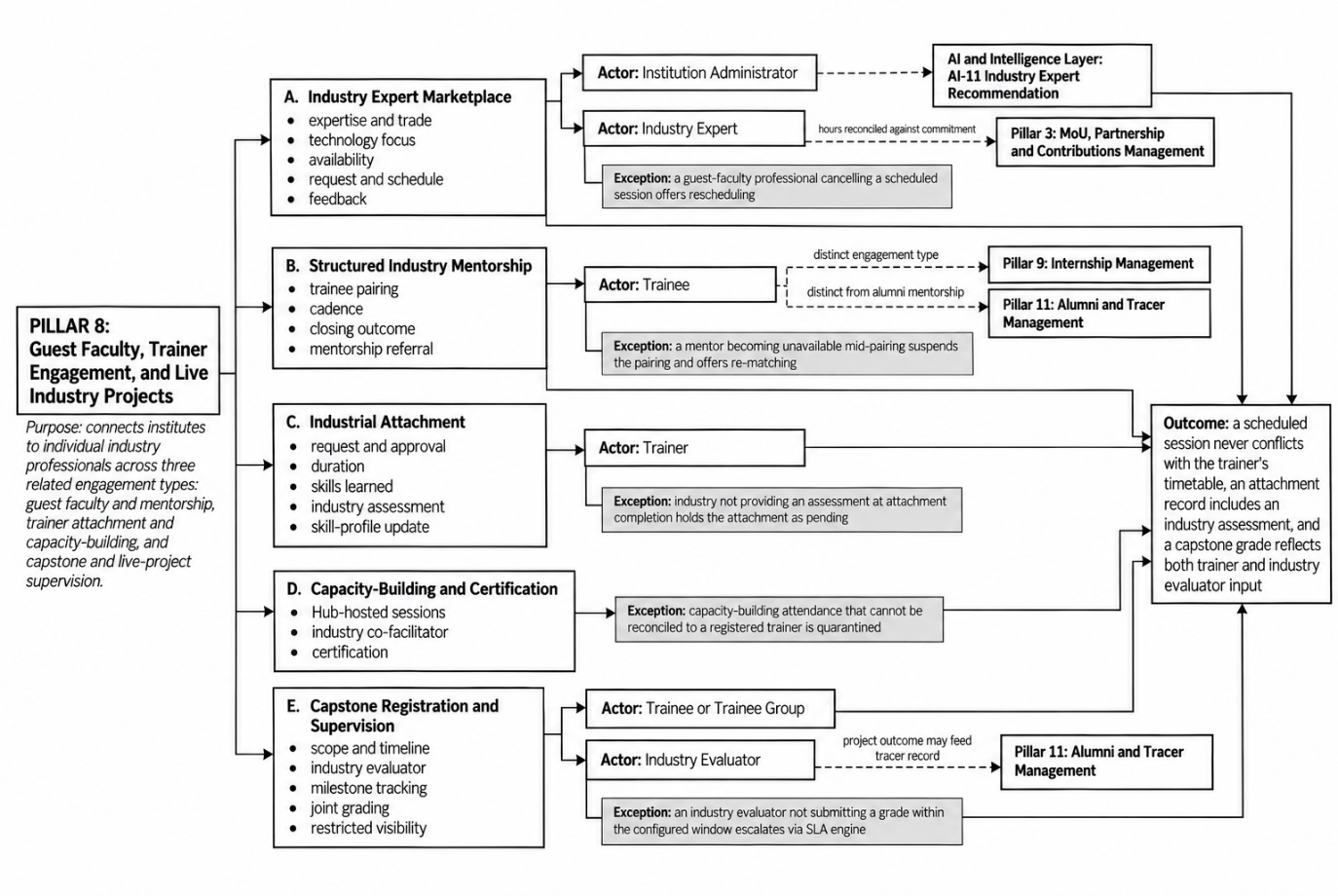
The system shall connect institutes to individual industry professionals across the three related ways they contribute to trainee development: an industry-expert marketplace for guest faculty and structured mentorship; a trainer's own industrial attachment and Hub-hosted capacity-building; and industry- assigned capstone and live-project supervision with joint grading. All three are person-to-person engagement types, distinguished from the organization-level agreements specified in Pillar 3.
Functional CapabilitiesPDF p.32
Industry expert marketplace: An industry professional registers expertise, and an institute searches and requests a session.
- •Register an industry professional's expertise, trade, technology focus, years of experience, availability, location, delivery mode, topics, and language.
- •Support institute search against these attributes, and present a ranked, explainable suggestion where the advisory Artificial-Intelligence-assisted capability specified in the AI and Intelligence Layer is enabled.
- •Route a request through industry approval, scheduling, session delivery, attendance capture, feedback, and a recorded impact note. Structured industry mentorship: Working industry professionals are formally paired with individual trainees for career mentorship through the training period.
- •Match a nominated trainee to an available industry mentor by trade and, where recorded, stated interest.
- •Record the mentorship pairing's start date, cadence, and a closing outcome note.
- •Permit a trainer to record a mentorship referral distinct from an academic remedial referral, consistent with the referral distinction already established for the PM-SETU LMS. Industrial attachment: A trainer applies for, undertakes, and records an attachment at an industry premises.
- •Support a trainer's request for industrial attachment against a named industry partner and technology area and record institute and industry approval.
- •Record attachment duration, skills learned, and supporting evidence, and capture the industry's assessment of the trainer on completion.
- •Update the trainer's skill profile with the attachment outcome. Capacity-building and certification: Hub institutions host structured trainer capacity-building programmes delivered in partnership with the Anchor Industry Partner.
- •Schedule a trainer capacity-building session at a Hub institution and register attending trainers, including those from Spoke institutions.
- •Record the topic, industry co-facilitator, and completion status per trainer, and any resulting certification.
- •Present cumulative trainer capacity-building coverage per cluster, reconciled against the relevant Disbursement-Linked Indicator target through Pillar 3. Capstone registration and supervision: Trainees complete a real, industry-assigned project as a capstone component.
- •Register an industry-assigned capstone project with scope, timeline, and the assigned industry evaluator.
- •Assign a trainee or trainee group and track milestone progress.
- •Capture the joint grade recorded by the trainer and industry evaluator, consistent with the assessment-authority pattern already established for the PM-SETU LMS, under which the trainer's confirmed evaluation remains authoritative for the academic record.
- •Record an intellectual-property or non-disclosure requirement attached to a capstone project, capture the trainee's acknowledgement of it, and restrict visibility of project artifacts and documentation to the trainer, the assigned trainee or group, and the industry evaluator, consistent with the confidentiality requirement the industry partner has declared.
Acceptance CriteriaPDF p.33
- •A scheduled guest-faculty session does not create a scheduling conflict with the assigned trainer's existing timetable.
- •Cumulative guest-faculty hours per cluster reconcile against the relevant Memorandum-of- Understanding or Strategic-Investment-Plan commitment through Pillar 3.
- •A mentorship pairing is visible to the trainee, the mentor, and the institute, and to no other trainee's mentor.
- •A trainer's industrial attachment record includes institute and industry approval, duration, and an industry assessment.
- •A trainer's skill profile reflects the outcome of every completed attachment and capacity-building session.
- •A capstone project's final grade reflects both the trainer's and the industry evaluator's recorded input.
Validation RulesPDF p.33
- •A guest-faculty session cannot be scheduled against a trade the registered professional has not declared availability for.
- •A mentorship pairing cannot be created for a trainee who has not been nominated or has opted out.
- •An attachment cannot be recorded as complete without an industry assessment.
- •A capacity-building session's completion status cannot be marked for a trainer not recorded as attending.
- •A capstone grade is not finalized until both the trainer's and the industry evaluator's scores are recorded.
Exception ManagementPDF p.34
| Exception | System Action |
| Guest-faculty professional cancels a scheduled session | Notify the institute and assigned trainer; offer rescheduling within the same trade calendar. |
| Mentor becomes unavailable mid-pairing | Suspend the pairing, notify the trainee, and offer re- matching. |
| Industry does not provide an assessment at attachment completion | Hold the attachment as pending and escalate through the Pillar 3 Service-Level-Agreement engine. |
| Capacity-building attendance cannot be reconciled to a registered trainer | Quarantine the record and route to the institution administrator for correction. |
| Industry evaluator does not submit a grade within the configured window | Escalate through the Pillar 3 Service-Level-Agreement engine and hold the grade as pending. |
3.9 Pillar 9: Internship ManagementPDF p.34
The system shall support a formal internship pipeline explicitly distinct from Apprenticeship (Pillar 5), On-the-Job Training (Pillar 6), the Dual System of Training (Pillar 4), and Placement (Pillar 10). These five engagement types shall never be conflated in the platform's data model; this pillar enforces that distinction for internship records.
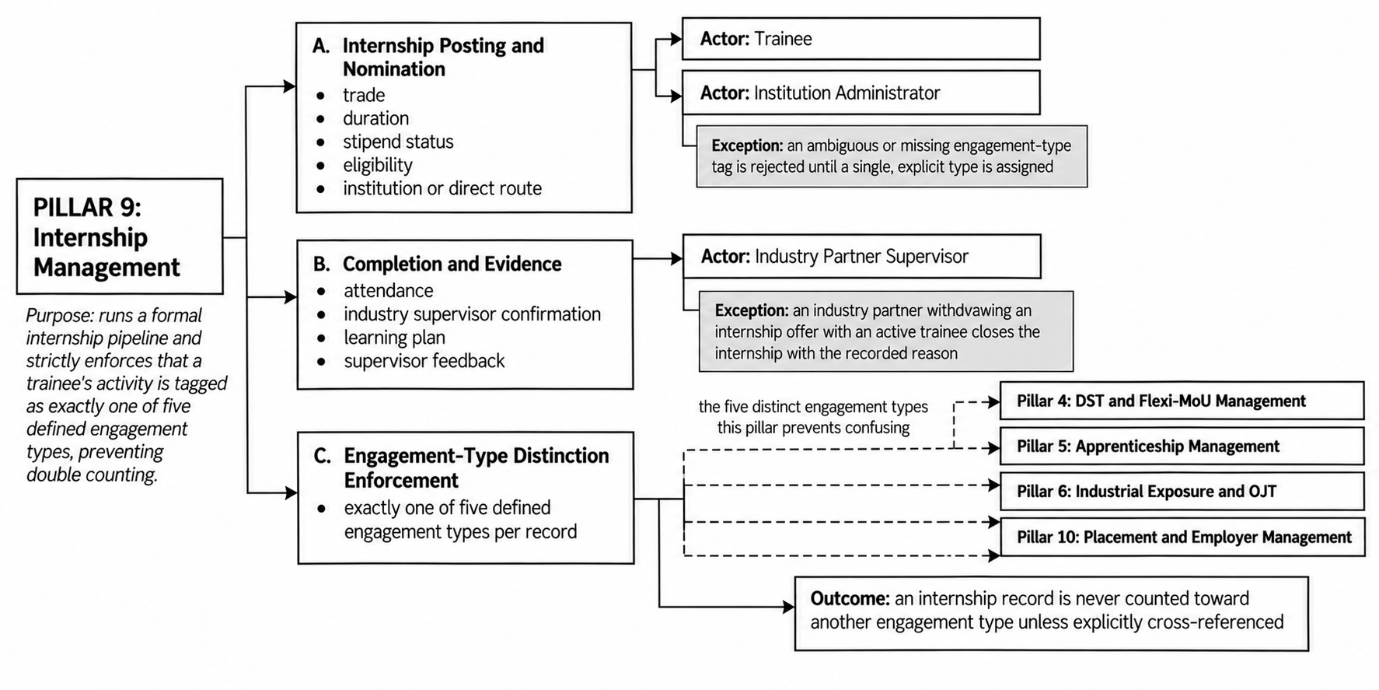
Functional CapabilitiesPDF p.34
Internship posting and nomination: Industry partners offer structured, often paid internship slots during the course.
- •Register an internship opening with trade, duration, stipend status, and eligibility criteria, distinct from an apprenticeship seat or placement vacancy.
- •Route a trainee's application through institution nomination or direct application, according to the opening's configured route.
Completion and evidence: An internship generates its own evidence record.
- •Capture attendance, industry supervisor confirmation, and a completion or dropout outcome.
- •Capture a learning plan agreed with the industry supervisor at the start of the internship, and record supervisor feedback against that plan at completion.
- •Cross-reference an internship record to a trainee's mandatory On-the-Job Training record only where the institute explicitly configures the internship to satisfy that requirement. Engagement-type distinction enforcement: A single trainee's total industry-engagement record must remain unambiguous.
- •Tag every trainee industry-engagement record with exactly one of the five defined engagement types - On-the-Job Training, Dual System of Training, Internship, Apprenticeship, or Placement - preventing an activity from being silently double-counted across outcome reports.
Acceptance CriteriaPDF p.35
- •An internship record is never presented as, or counted toward, an apprenticeship, Dual System of Training, On-the-Job Training, or placement outcome unless explicitly cross-referenced.
- •Every internship is traceable to its industry partner, trade, and duration.
Validation RulesPDF p.35
- •An internship record requires exactly one engagement-type tag.
- •A trainee cannot hold two concurrent internship records against the same industry partner and trade without an explicit override.
Exception ManagementPDF p.35
| Exception | System Action |
| Internship engagement-type tag missing or ambiguous | Reject the record until a single, explicit engagement type is assigned. |
| Industry partner withdraws an internship offer with an active trainee | Notify the trainee and institute and close the internship with the recorded reason. |
3.10 Pillar 10: Placement & Employer ManagementPDF p.35
The system shall operate the Training-and-Placement Cell end to end, from job readiness through advisory AI-assisted employer-trainee matching to outcome capture, always requiring explicit human confirmation before a shortlist is treated as final. Placement drives and job fairs are the event format
through which this same employer pipeline is activated at scale, sharing one national campus- recruitment calendar so outreach is never duplicated across clusters.
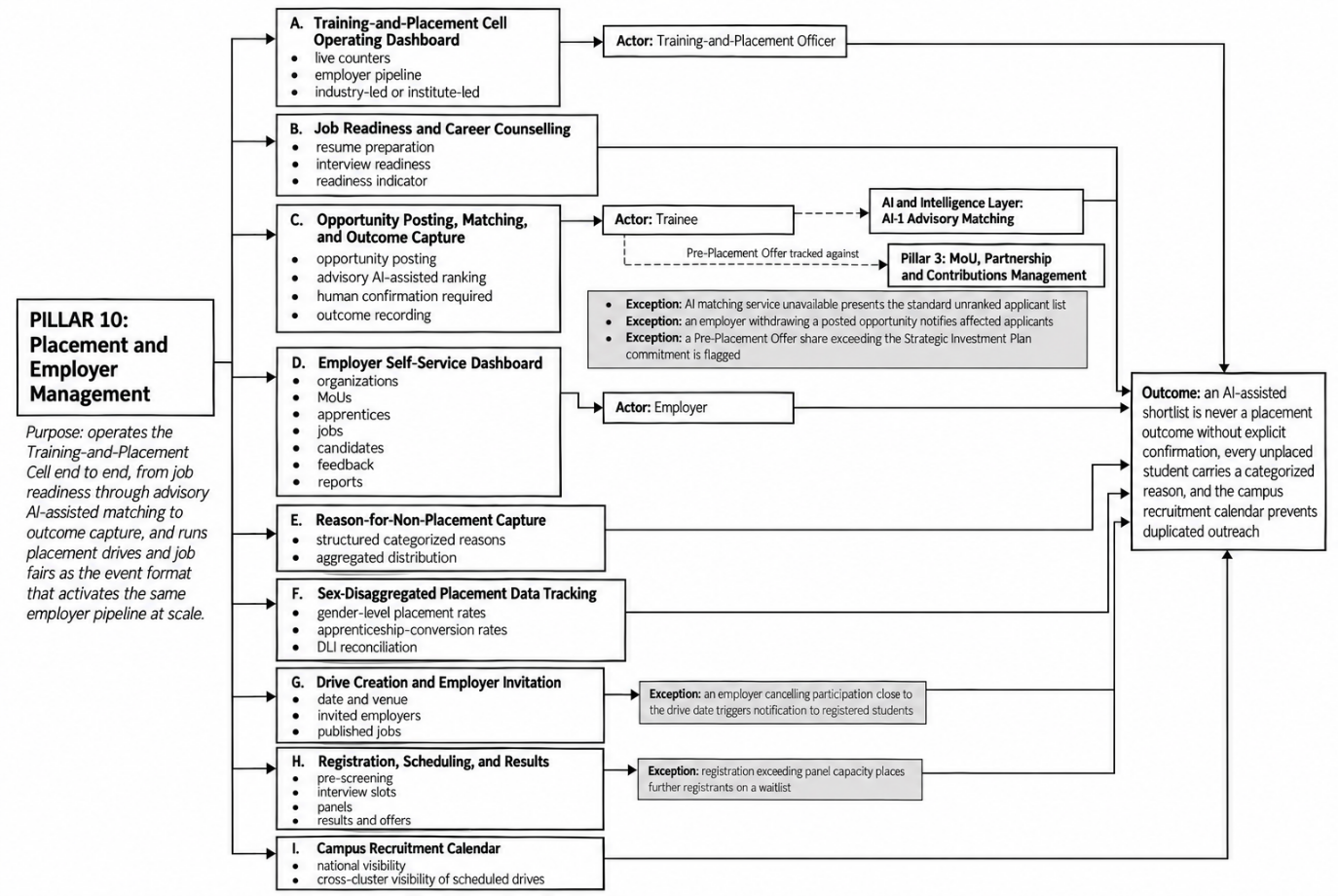
Functional CapabilitiesPDF p.36
Training-and-Placement Cell operating dashboard: A live, counter-based dashboard gives the
Training-and-Placement Officer an operational view of the entire pipeline.
- •Present, updated in near-real time: students eligible for placement, students placement-ready, active employers, open vacancies, interviews scheduled in the current period, offers extended, joining confirmed, active apprenticeships, employer feedback pending, and post-placement follow- ups due.
- •Present the employer pipeline from Prospect through Contacted, Interested, Memorandum of Understanding, Vacancy, Campus Drive, Interview, Offer, Joining, and Retention.
- •Configure a placement cell as industry-led or institute-led per institution, and assign the responsible placement coordinator, industry or institute, accordingly. Job readiness and career counselling: A student's placement journey begins before an application is submitted.
- •Support resume and curriculum-vitae preparation, interview-readiness practice, aptitude, technical, and communication-skill self-assessment.
- •Compute and present a job-readiness indicator per student, and career pathway guidance grounded in the student's recorded competency evidence.
Opportunity posting, matching, and outcome capture: Placement follows the discovery-to-outcome
sequence, with Artificial-Intelligence-assisted matching as an advisory step.
- •Permit a registered employer to post, edit, and close a placement opening, and review applicants within the applicant's own consent scope.
- •Rank candidate trainees against an open opportunity using recorded competency and skills-profile evidence, presenting the ranking as an advisory, explainable shortlist; require the placement
coordinator's or employer's explicit confirmation before a ranked candidate is treated as shortlisted; the ranking never itself records a placement outcome.
- •Capture the employer's interview and selection decision, and the resulting placement outcome, including whether a Pre-Placement Offer applies, tracked against the relevant Strategic Investment Plan or Memorandum-of-Understanding commitment through Pillar 3. Employer self-service dashboard: The employer's own workspace consolidates every relationship it holds with the ecosystem.
- •Present, within the employer's own workspace: its organizations, institutes, Memoranda of Understanding, training programmes, apprentices, internships, jobs, candidates, interviews, offers, guest-faculty engagements, mentors, contributions, feedback submitted, and available reports.
Reason-for-non-placement capture: An unplaced student's status is explained, not merely reported as a residual percentage.
- •Record a structured, categorized reason where a student remains unplaced at course completion - not interested, pursuing higher education, pursuing entrepreneurship, skill gap, communication gap, salary mismatch, location constraint, employer rejection, candidate rejection, family reason, health or personal reason, pursuing further apprenticeship, or job search ongoing.
- •Present the aggregated distribution of non-placement reasons per institute, trade, cluster, and State. Sex-disaggregated placement data tracking: Placement, apprenticeship, and Pre-Placement-Offer outcomes are tracked by gender at every level, addressing the current data gap the ADB Report and Recommendation of the President explicitly records for PM-SETU.
- •Record gender against every placement, apprenticeship, and Pre-Placement-Offer outcome, drawn from the trainee's own enrolment record rather than re-collected at placement.
- •Present placement and apprenticeship-conversion rates disaggregated by gender at institute, trade, cluster, and State level, alongside the aggregate figure.
- •Reconcile the female-placement figure against the female-graduate-employment-rate target the applicable Disbursement-Linked Indicator sets, through Pillar 3. Drive creation and employer invitation: A Training-and-Placement Officer or Special Purpose Vehicle creates a drive and invites employers.
- •Create a placement drive or job fair against an institute or cluster, with date, venue, and invited employers.
- •Publish jobs against the drive and open registration to eligible students. Registration, scheduling, and results: The drive itself follows a structured, timed sequence.
- •Support student registration and pre-screening, interview-slot and panel scheduling, and quick- response-code-based attendance.
- •Capture interview results, offers, and joining status against the drive. Campus recruitment calendar: A national, cross-cluster view of scheduled drives supports coordination and prevents duplication.
- •Publish every scheduled drive to a national calendar, visible to DGT, State, and cluster users, showing employer, institute, date, and trade focus.
Acceptance CriteriaPDF p.37
- •The Training-and-Placement Cell dashboard's counters reconcile with the underlying employer, vacancy, interview, offer, and outcome records.
- •An Artificial-Intelligence-assisted shortlist is never treated as a placement outcome without an explicit coordinator or employer confirmation.
- •Every unplaced student at course completion carries a recorded, categorized non-placement reason.
- •Cumulative Pre-Placement Offer and placement performance per cluster reconciles against the Strategic Investment Plan or Memorandum-of-Understanding commitment.
- •Every drive's registration, interview, offer, and joining figures reconcile with the underlying placement records in Pillar 10.
- •The campus recruitment calendar is visible to every authorized State and cluster user, supporting coordination across clusters.
Validation RulesPDF p.38
- •A placement outcome cannot be recorded without a corresponding opportunity and employer record.
- •An Artificial-Intelligence-assisted ranking output is Advisory only; it cannot itself write a placement outcome, Pre-Placement Offer status, or shortlist confirmation.
- •A non-placement reason must be selected from the defined category list; a free-text-only reason is not accepted for aggregate reporting.
- •A drive's registration cannot exceed the declared venue or panel capacity.
- •An interview result cannot be recorded against a candidate not registered for the drive.
Exception ManagementPDF p.38
| Exception | System Action |
| AI matching service unavailable | Present the standard, non-ranked applicant list and mark the ranking panel as unavailable. |
| Employer withdraws a posted opportunity with pending applications | Notify affected applicants and close the opportunity with the recorded reason. |
| Student completes course with no recorded placement outcome and no non-placement reason | Flag to the Training-and-Placement Officer as an incomplete record rather than defaulting too "unplaced". |
| Pre-Placement Offer share exceeds Strategic Investment Plan commitment | Flag the exception to the Special Purpose Vehicle and State administrator rather than silently accepting it. |
| Employer cancels participation close to the drive date | Notify registered students and adjust the published job list. |
| Registration exceeds panel capacity | Close registration and place further registrants on a waitlist. |
3.11 Pillar 11: Alumni & Tracer ManagementPDF p.38
The system shall maintain a durable alumni career-outcome record, a structured post-placement tracer follow-up at defined intervals, an entrepreneurship pathway for self-employed alumni, and community
and event management, closing the post-placement evidence gap between placement and long-term employment outcome.
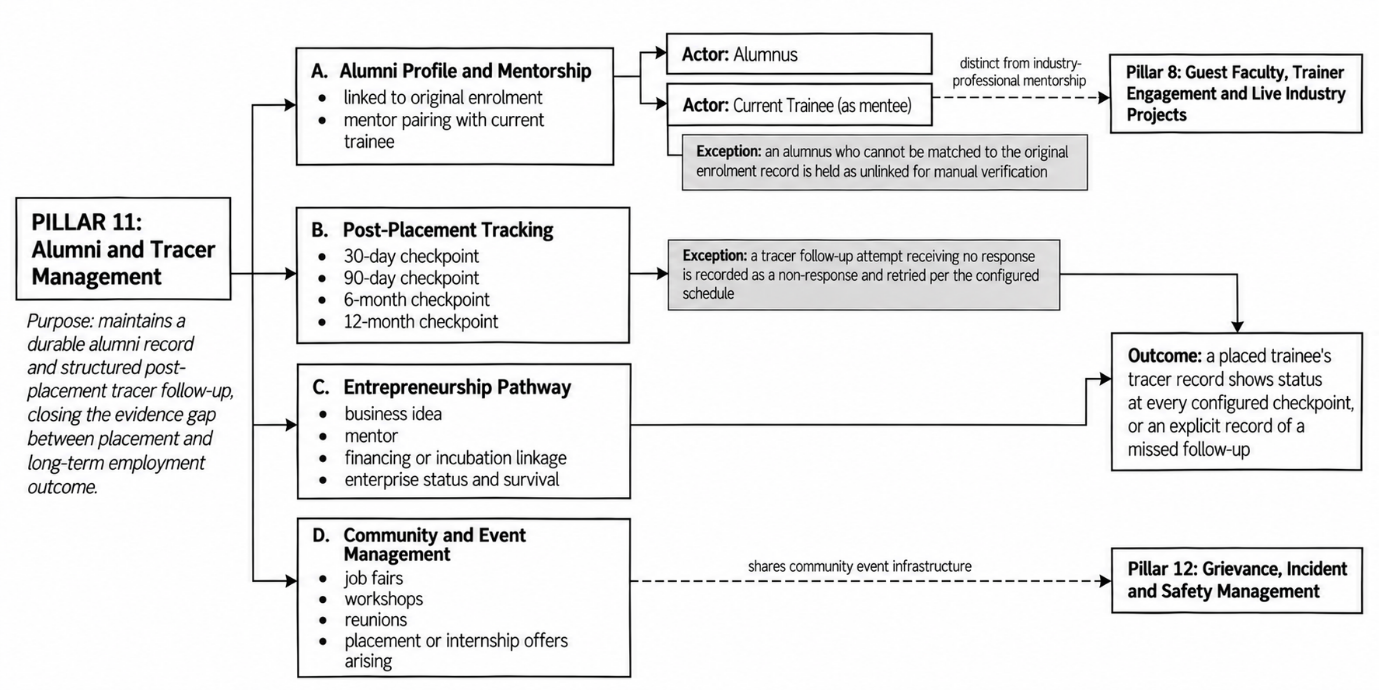
Functional CapabilitiesPDF p.39
Alumni profile and mentorship: An alumnus's profile is linked to the original PM-SETU enrolment and completion record.
- •Link an alumnus's profile to the original enrolment, course, and completion record held in the PM- SETU LMS.
- •Register an alumnus as a mentor and match to a nominated current trainee, distinct from the industry-professional mentorship pairing in Pillar 8. Post-placement tracking: Placement is followed by structured tracer contact at defined intervals, not treated as a single terminal event.
- •Track a placed trainee through 30-day, 90-day, 6-month, and 12-month follow-up checkpoints.
- •Capture, at each checkpoint, employment status, salary band, employer, trade or job role, retention status, any job changes and its reason, observed skill gaps, and employer satisfaction. Entrepreneurship pathway: An ITI outcome may be self-employment rather than wage employment.
- •Capture a business idea, entrepreneurial training undertaken, an assigned mentor, and financing or incubation linkage.
- •Track enterprise creation, business status, revenue band, and survival over time. Community and event management: The platform manages job fairs, workshops, and community events coordinated between institutions and industry.
- •Register a community event against an institution or cluster, with date, venue, and participating employers or industry partners.
- •Permit trainees and alumni to register and record attendance and capture any placement or internship offers arising from the event.
Acceptance CriteriaPDF p.39
- •An alumnus's career-outcome record is traceable to the alumnus's original enrolment and completion record.
- •A placed trainee's tracer record shows status at every configured follow-up checkpoint, or an explicit record of a missed follow-up.
- •An entrepreneurship pathway's status is trackable over time, not recorded once and left static.
Validation RulesPDF p.40
- •An alumnus's career-outcome record can only be updated by the alumnus or through a governed connected-platform interface, not by an institution administrator directly.
- •A tracer follow-up checkpoint cannot be marked completely without a recorded response or a recorded non-response reason.
Exception ManagementPDF p.40
| Exception | System Action |
| Alumnus cannot be matched to the original enrolment record | Hold the profile as unlinked and route to the institution administrator for manual verification. |
| Tracer follow-up attempt receives no response | Record the non-response, retry per the configured schedule, and mark the checkpoint accordingly rather than leaving it blank. |
3.12 Pillar 12: Grievance, Incident & Safety ManagementPDF p.40
The system shall provide a dedicated grievance-redressal mechanism for any trainee concern arising from an industry-linked activity, distinct from, but cross-referenced to, the safety-induction and incident- reporting workflow specified in Pillar 6. Industry-level grievance linkages for apprentices can be weak in practice, with the Training-and-Placement Officer often the sole point of contact and trainees not always aware of the mechanism available to them; this pillar makes the mechanism explicit and its status visible to the trainee throughout.
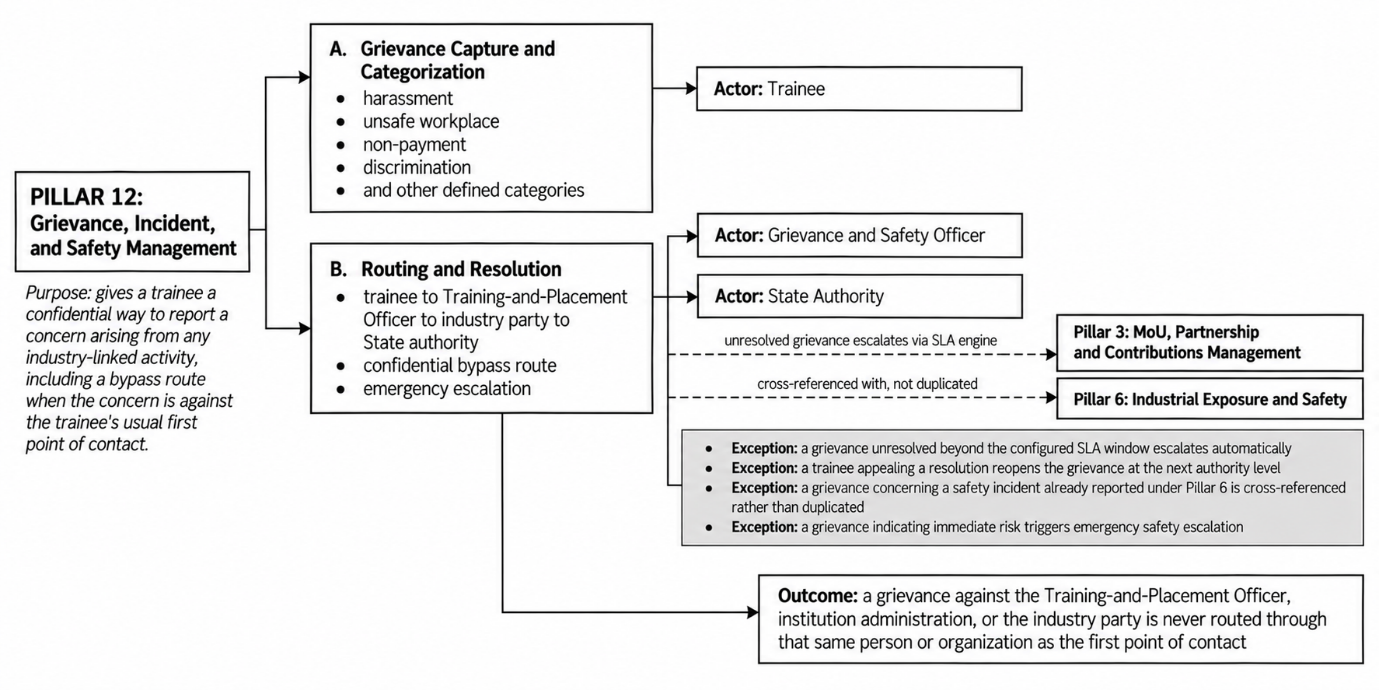
Functional CapabilitiesPDF p.40
Grievance capture and categorization: A trainee may report a concern arising from any industry- linked activity - Dual System of Training, Flexi-MoU, On-the-Job Training, internship, apprenticeship, or placement.
- •Support trainee-initiated grievance reporting under defined categories: harassment, unsafe workplace, non-payment or stipend issue, attendance dispute, discrimination, inappropriate work assignment, supervisor conduct, accommodation, transport, or premature termination.
- •Attach the grievance to the specific engagement record it concerns, referencing Pillar 4, Pillar 6, Pillar 9, or Pillar 5, as applicable. Routing and resolution: A grievance follows a defined escalation path with visible status throughout, and the platform provides a confidential bypass route, so a trainee is never required to report a concern to the person or organization the concern is against.
- •Route a grievance from the trainee to the institute's Training-and-Placement Officer, then to the industry party concerned, and, where unresolved, to the State or designated authority.
- •Where the grievance concerns the Training-and-Placement Officer, institution administration, the employer or industry party itself, or is flagged as harassment, discrimination, or a retaliation concern, route the grievance directly to the Grievance and Safety Officer or a designated alternate authority, bypassing the normal first point of contact.
- •Support an anonymous or confidential flag on a grievance where the trainee requests it and the category permits it and support a non-retaliation flag protecting a trainee who has raised a grievance from adverse treatment.
- •Support emergency safety escalation for a grievance indicating immediate risk, routed ahead of the standard queue.
- •Assign an investigation to a specific officer, capture supporting evidence, and track the corrective action arising from the grievance to closure.
- •Record the resolution and, where the trainee is dissatisfied, support an appeal.
- •Make the grievance's status visible to the reporting trainee at every stage, without requiring the trainee to re-contact the Training-and-Placement Officer for an update.
Acceptance CriteriaPDF p.41
- •A trainee can locate and use the grievance mechanism from within any industry-linked engagement record without needing to identify the correct contact manually.
- •A grievance's status is visible to the reporting trainee at every stage of routing, investigation, and resolution.
- •A grievance concerning a minor is handled under the same restricted-access and consent principles specified in Section 5.6.
- •A grievance against the Training-and-Placement Officer, institution administration, or the industry party itself is never routed through that same person or organization as the first point of contact.
Validation RulesPDF p.41
- •A grievance cannot be closed without a recorded resolution.
- •Grievance records are visible only to the roles specified in Pillar 12 - the reporting trainee, the institute Training-and-Placement Officer, the Grievance and Safety Officer, and, where escalated, the State authority - and to no other role by default.
- •A grievance flagged for confidential bypass routing is not visible to the Training-and-Placement Officer where the grievance concerns that officer.
Exception ManagementPDF p.41
| Exception | System Action |
| Grievance unresolved beyond the configured Service-Level-Agreement window | Escalate automatically to the next authority through the Pillar 3 engine. |
| Trainee appeals a resolution | Reopen the grievance at the next authority level and retain the original resolution in the record. |
| Exception | System Action |
| Grievance concerns a safety incident already reported under Pillar 6 | Cross-reference rather than duplicate the incident record. |
| Grievance indicates immediate risk to the trainee | Trigger emergency safety escalation ahead of the standard routing queue. |
3.13 Pillar 13: Industry Performance & AnalyticsPDF p.42
The system shall compute a rules-based Industry Performance scorecard per partner - not an artificial- intelligence model in this initial delivery - and publish the DGT and State-level industry analytics drawn from it, since both are read-only views over activity already recorded elsewhere in this platform rather than independent operating engines.
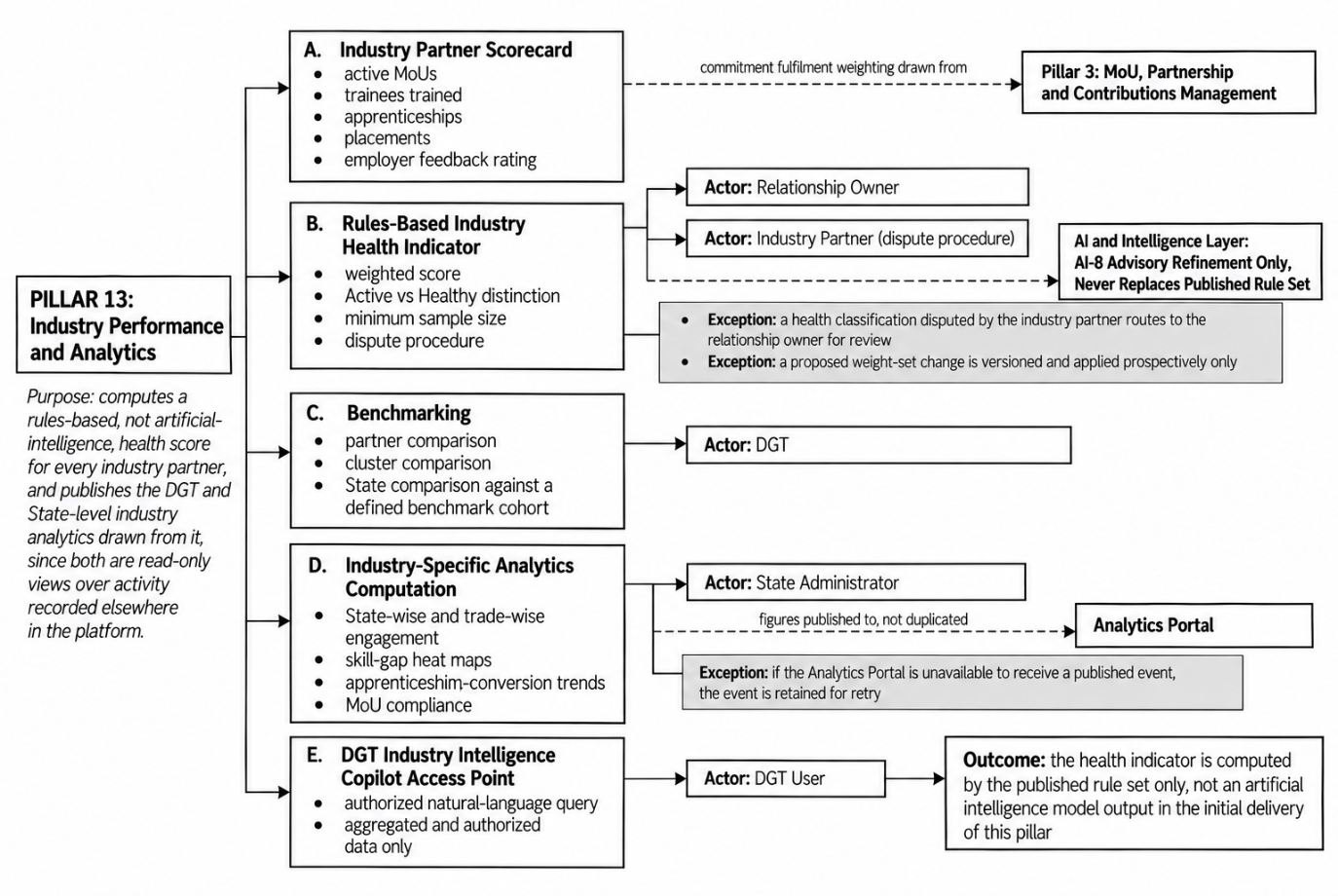
Functional CapabilitiesPDF p.42
Industry partner scorecard: A consistent set of measures is computed for every industry partner from records held across this platform.
- •Compute, per industry partner: active Memoranda of Understanding, trainees trained, Dual System of Training trainees, apprenticeships, placements, placement-conversion rate, guest-faculty sessions, mentor hours, trainer-capacity-building sessions hosted, equipment-contribution value, curriculum inputs submitted, industrial visits hosted, average employer feedback rating, and Memorandum-of-Understanding compliance rate.
- •Present the scorecard at partner, cluster, and State roll-up levels. Rules-based industry health indicator: A deterministic, explainable rule set classifies each relationship, without an artificial-intelligence model in the first instance.
- •Classify each Industry Master Profile from a defined, weighted rule set: Engagement Recency 15 percent, Commitment Fulfilment 25 percent, Training Contribution 15 percent, hiring 15 percent, Apprenticeship 10 percent, Responsiveness 10 percent, and Compliance 10 percent, each measure
normalized to a 0 to 100 scale before weighting. These weights are indicative and shall be confirmed and formally published during solution design, but a partner's classification shall always be computed from a published, versioned weight set rather than an undisclosed rule.
- •Distinguish Active from Healthy explicitly: Active describes whether the relationship currently holds at least one agreement in force under Pillar 3, irrespective of performance; Healthy additionally requires the weighted score above to meet a configured minimum threshold. A relationship can therefore be Active without being Healthy but cannot be Healthy without being Active.
- •Classify each Industry Master Profile as Active and Healthy, Active and At Risk, Active and Dormant where engagement has lapsed despite a nominally active agreement or Closed where no agreement is in force.
- •Require a minimum sample size, specifically a configured minimum number of recorded activity events, before a weighted score is computed; present a relationship below that minimum as "insufficient history" rather than assigning a score.
- •Recompute the weighted score and classification on a fixed refresh cadence, and immediately on a material event such as agreement expiry or a new safety incident.
- •Trigger a review workflow where a partner's classification changes to At Risk or Dormant - for example, no recorded engagement within a configured window - routed to the relationship owner.
- •Support a dispute procedure through which an industry partner may contest its classification, routed to the relationship owner with the underlying rule inputs shown. Benchmarking: A partner's or cluster's performance is presented in comparative context.
- •Present a partner's, cluster's, or State's scorecard measures alongside the comparable sector, cluster, or national average, computed from a defined benchmark cohort of comparable partners by sector, size, and cluster type.
Industry-specific analytics computation: This platform computes the industry-specific figures; the Analytics Portal presents them alongside fiduciary and academic data.
- •Compute State-wise and trade-wise industry-engagement volume, skill-gap heat-maps drawn from Pillar 7, apprenticeship-conversion trends drawn from Pillar 5, and Memorandum-of-Understanding compliance drawn from Pillar 3.
- •Publish these computed figures to the Analytics Portal's Performance Analytics pillar with source and freshness metadata, rather than duplicating a dashboard within this platform.
DGT Industry Intelligence Copilot access point: An authorized DGT or State user may pose a
natural-language question over this platform's own, authorized data.
- •Provide the access point through which an authorized DGT or State user queries this platform's aggregated, authorized data in natural language, with the underlying capability specified as Advisory in the AI and Intelligence Layer.
Acceptance CriteriaPDF p.43
- •Every scorecard measure is traceable to the underlying records in the pillar that generates it.
- •The health-indicator rule set, including its published weights, threshold, and minimum sample size, is consistently applied; the same inputs always produce the same classification.
- •A classification change to At Risk or Dormant generates a review task for the relationship owner.
- •The distinction between Active and Healthy is applied consistently and is visible wherever a classification is displayed.
- •Every figure published to the Analytics Portal from this platform carries its source and freshness metadata.
- •No national, State, or cross-system dashboard is duplicated within this platform outside the scorecard views specified in Pillar 13.
Validation RulesPDF p.43
- •The health indicator is computed by the published rule set only; it is not an artificial-intelligence model output in the initial delivery of this pillar.
- •A scorecard measure cannot be manually overridden without a recorded reason and approving user.
- •A weighted score is not computed, and the relationship is instead labelled insufficient history, where the configured minimum sample size is not met.
- •A computed analytic is published only after the underlying source records, as applicable, have passed their own validation rules.
Exception ManagementPDF p.44
| Exception | System Action |
| Insufficient data to compute a scorecard measure for a new partner | Suppress the measure and label it "insufficient history" rather than presenting a zero or default value. |
| Health classification disputed by the industry partner | Route to the relationship owner for review through the dispute procedure, with the underlying rule inputs shown. |
| Weight-set change proposed | Version the new weight set, apply it prospectively only, and retain the prior weight set for historical score re- computation if required. |
| Analytics Portal unavailable to receive a published event | Retain the event for retry and mark the figure as pending publication. |
3.14 Artificial Intelligence and Intelligence Layer (Cross-Cutting) [GOVERNANCE]PDF p.44
This pillar generalizes the artificial-intelligence governance principle already established for the PM- SETU LMS - advisory-only output, explainability, human override, and prospective-only versioning - across every artificial-intelligence capability specified anywhere in this report. This governance approach is deliberately held constant, not weakened, as the number of governed capabilities is broadened.
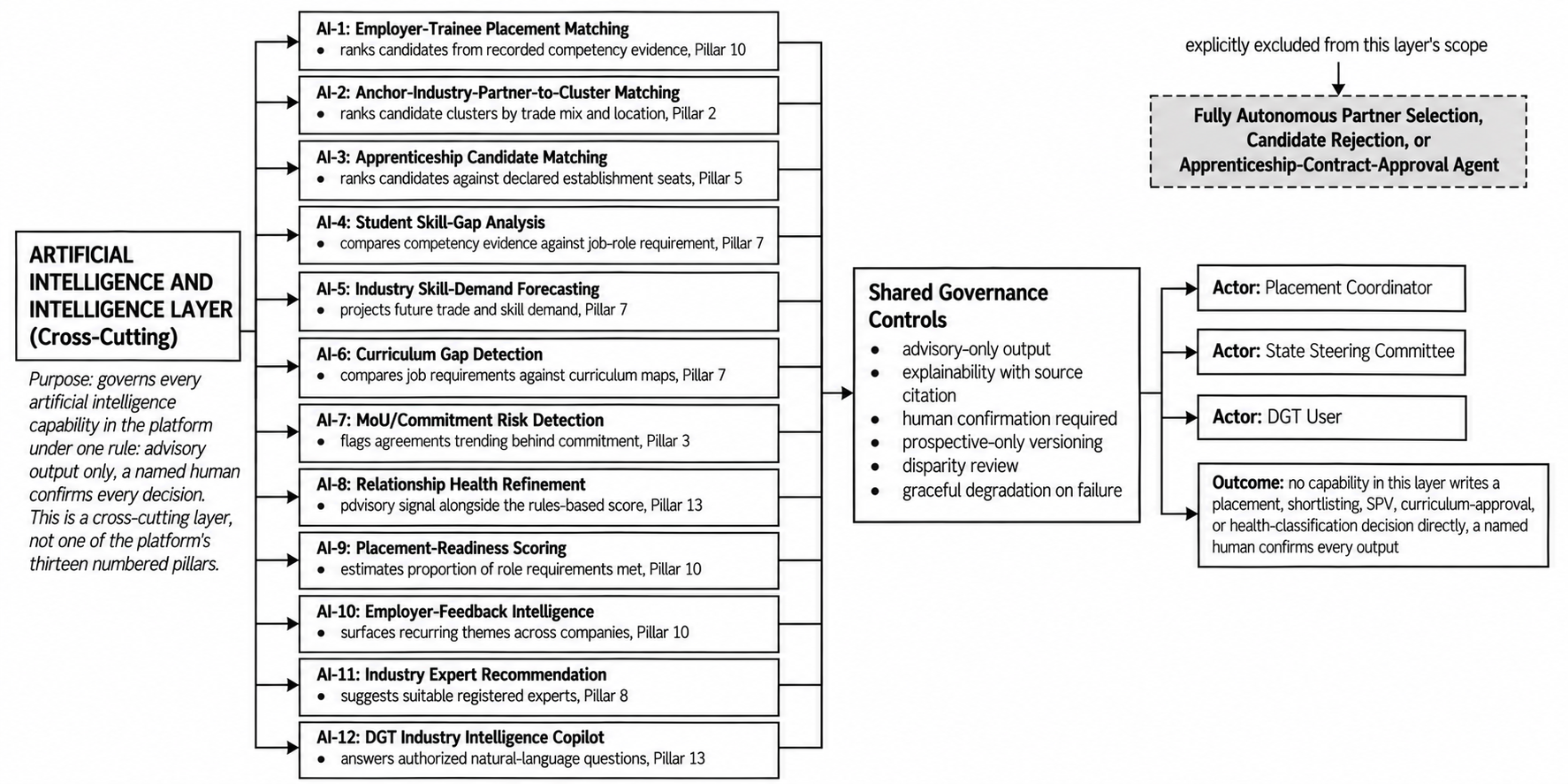
3.14.1 Governed Artificial Intelligence CapabilitiesPDF p.45
The following capabilities are specified for this platform, each Advisory in every instance:
| Serial No. | Capability | Pillar | Function |
| 1 | Employer-Trainee Placement Matching | 10 | Ranks candidate trainees against an employer opening from recorded competency evidence. |
| 2 | Anchor-Industry- Partner-to-Cluster Matching | 2 | Ranks candidate clusters for a prospective Anchor Industry Partner by trade mix, location, and investment fit. |
| 3 | Apprenticeship Candidate Matching | 5 | Ranks candidate apprentices against declared establishment seats, configured separately from AI-1 to respect the distinct apprenticeship data model. |
| 4 | Student Skill-Gap Analysis | 7 | Compares a trainee's recorded competency evidence against a target job role's requirement. |
| 5 | Industry Skill-Demand Forecasting | 7 | Projects future trade and skill demand from aggregated industry submissions, vacancies, and hiring trends. |
| 6 | Curriculum Gap Detection | 7 | Compares aggregated job-requirement data against current curriculum competency maps to flag a candidate gap for the designated curriculum authority's review. |
| 7 | Memorandum-of- Understanding / Commitment Risk Detection | 3 | Flags an agreement whose delivered activity is trending behind its declared commitment, ahead of the rules-based variance threshold in Pillar 3. |
| 8 | Relationship Health Refinement | 13 | Provides an advisory refinement signal alongside the rules-based health indicator in Pillar 13; never replaces the published rule set. |
| 9 | Placement-Readiness Scoring | 10 | Estimates the proportion of a target job role's requirements a student's recorded profile meets. |
| 10 | Employer-Feedback Intelligence | 10 | Aggregates structured and free-text employer feedback across companies to surface recurring themes for institute and DGT review. |
| 11 | Industry Expert Recommendation | 8 | Suggests suitable registered industry experts for a stated institute requirement. |
| 12 | DGT Industry Intelligence Copilot | 13 | Answers an authorized DGT or State user's natural-language question over this platform's own aggregated, authorized data - for example, which States show the highest industry engagement, which trades show weak industry participation, which Anchor Industry Partners are behind their commitments, or where apprenticeship conversion is low. |
3.14.2 AI Behavior, Data, and Human ControlPDF p.46
| Dimension | Specification |
| AI Behavior | Ranking, ranking-explanation, forecasting, and natural-language query- answering from recorded platform data; never generative of a binding decision, and never conversational with an unauthenticated user. |
| Inputs | Recorded competency and skills-profile evidence from the PM-SETU LMS; agreement, commitment, and activity records from across this platform's functional domains; employer and industry feedback; aggregated, authorized platform data for the Copilot. |
| Outputs | An explainable, ranked, advisory shortlist or suggestion; a forecast or gap estimate; a natural-language answer with a citation to the underlying record - each traceable to the specific signals used. |
| Human Control | A placement coordinator, employer, State Steering Committee, relationship owner, or DGT user confirms or acts on every output; no capability in this pillar writes a placement, shortlisting, Special Purpose Vehicle, curriculum- approval, or health-classification decision directly. |
| Output Classification | Advisory in every instance, consistent with the AI output classification already established for the PM-SETU LMS. |
| Governance | Every model and rule configuration is versioned and applied prospectively only; every AI generation and human confirmation or override is logged; each capability is subject to periodic disparity review across language, region, gender, and institution type; each degrades gracefully to its non-AI, manual-review pathway on failure. |
3.14.3 Excluded CapabilitiesPDF p.46
Consistent with the exclusion discipline already established for the PM-SETU LMS, a Fully Autonomous Partner Selection, Candidate Rejection, or Apprenticeship-Contract-Approval Agent - an artificial- intelligence system that would finalize an industry-partner shortlist, reject a candidate, or approve an apprenticeship contract without human confirmation - is explicitly excluded from this platform's scope. This is a deliberate governance decision, not an oversight: it is directly contrary to the Advisory-only, human-confirmed principle applied without exception throughout this pillar.
3.14.4 Capability-Specific Performance MetricsPDF p.46
Advisory-only governance defines the boundary within which an AI capability must operate; it does not by itself say whether the capability is any good at its task. Each capability shall additionally be measured against the metric appropriate to its function, reviewed on the disparity-review cadence specified in Section 3.14.2, so that AI testing in Section 6 has a measurable target rather than governance behaviour alone.
| Capability Group | Metric | Applies To |
| Matching (AI-1, AI-2, AI-3, AI-11) | Precision at K, recall at K, human acceptance rate, and human override rate | Placement, cluster, apprenticeship, and expert-recommendation matching |
| Forecasting (AI-5) | Forecast error against subsequently observed demand, and confidence calibration | Industry skill-demand forecasting |
| Skill-gap and curriculum- gap analysis (AI-4, AI-6) | Agreement rate with a subject-matter- expert assessment on a sample review set | Student, institute, and curriculum-gap analysis |
| Capability Group | Metric | Applies To |
| Risk and health signals (AI-7, AI-8) | Precision and recall against a subsequently confirmed at-risk or dormant outcome | MoU/commitment risk detection and relationship- health refinement |
| Readiness scoring (AI-9) | Correlation between the readiness score and the subsequently observed placement outcome | Placement-readiness scoring |
| Feedback intelligence (AI- 10) | Precision of extracted themes against a manually reviewed sample | Employer-feedback intelligence |
| Copilot (AI-12) | Answer-grounding rate, citation accuracy, and unsupported-answer rate | DGT Industry Intelligence Copilot |
A capability falling below its agreed metric threshold for two consecutive review cycles shall be flagged for retraining, reconfiguration, or, where the underlying signal proves unreliable, suspension back to its manual pathway, consistent with the graceful-degradation requirement in Section 3.14.2.
Acceptance CriteriaPDF p.47
- •Every governed capability's output is traceable to the specific signals, records, or citations that produced it.
- •No capability in this pillar writes a binding decision to any record maintained by this platform without an explicit, logged human confirmation.
- •A model or rule configuration change is versioned and applied prospectively only, with the version in force for any historical output recoverable.
- •Every capability degrades gracefully to its underlying manual-review pathway when the AI service is unavailable.
Validation RulesPDF p.47
- •An AI output's classification is Advisory in every instance specified in this pillar; no capability is configured at System-enforced or Authoritative tier.
- •A capability uses only the input signal set defined in its approved configuration; unrelated personal data is not combined solely to generate an output.
- •The DGT Industry Intelligence Copilot answers only from aggregated, authorized platform data within the querying user's own access scope; it does not surface an individual trainee's grievance, safety, or personal record.
Exception ManagementPDF p.47
| Exception | System Action |
| An AI capability is unavailable | Present the corresponding manual-review pathway and mark the AI panel as unavailable. |
| A ranking or forecast has low confidence | Suppress the output for that instance rather than presenting an unreliable estimate. |
| A model or rule configuration change fails validation | Retain the previous approved version in service and notify the model owner. |
| A Copilot query would return data outside the requesting user's authorized scope | Deny the query and log the attempt, consistent with Section 5.5. |
4. Solution ArchitecturePDF p.48
The platform is a unified digital operating system for the ITI–Industry relationship, with the Industry Master Profile (Pillar 1) and the commitment-to-outcome chain (Pillar 3) as its structural backbone. The architecture has three layers connected by an integration boundary.
- •Data Layer - the sources from which the Industry Master Profile, agreement, training-delivery, apprenticeship, placement, contribution, safety, grievance, and alumni information originate, and the operational store that retains it.
- •Platform Layer - the thirteen functional pillars specified in Section 3, with cross-cutting access control, the Service-Level-Agreement and Escalation Service, the integration gateway, and the AI Services block.
- •User Access Layer - role-scoped workspaces for DGT, State, Special Purpose Vehicle, institution, Training-and-Placement Officer, trainer, student, apprentice, employer, and alumni users. Per the benchmarking in Annexure G, this architecture favours buying and configuring a proven product over a bespoke build wherever one exists: products reviewed against apprenticeship management (Pillar 4, 5), career services and placement (Pillar 8, 9, 10), CRM (Pillar 1), and skills intelligence (Pillar 7, 13) are listed in Annexure H for evaluation during solution design.
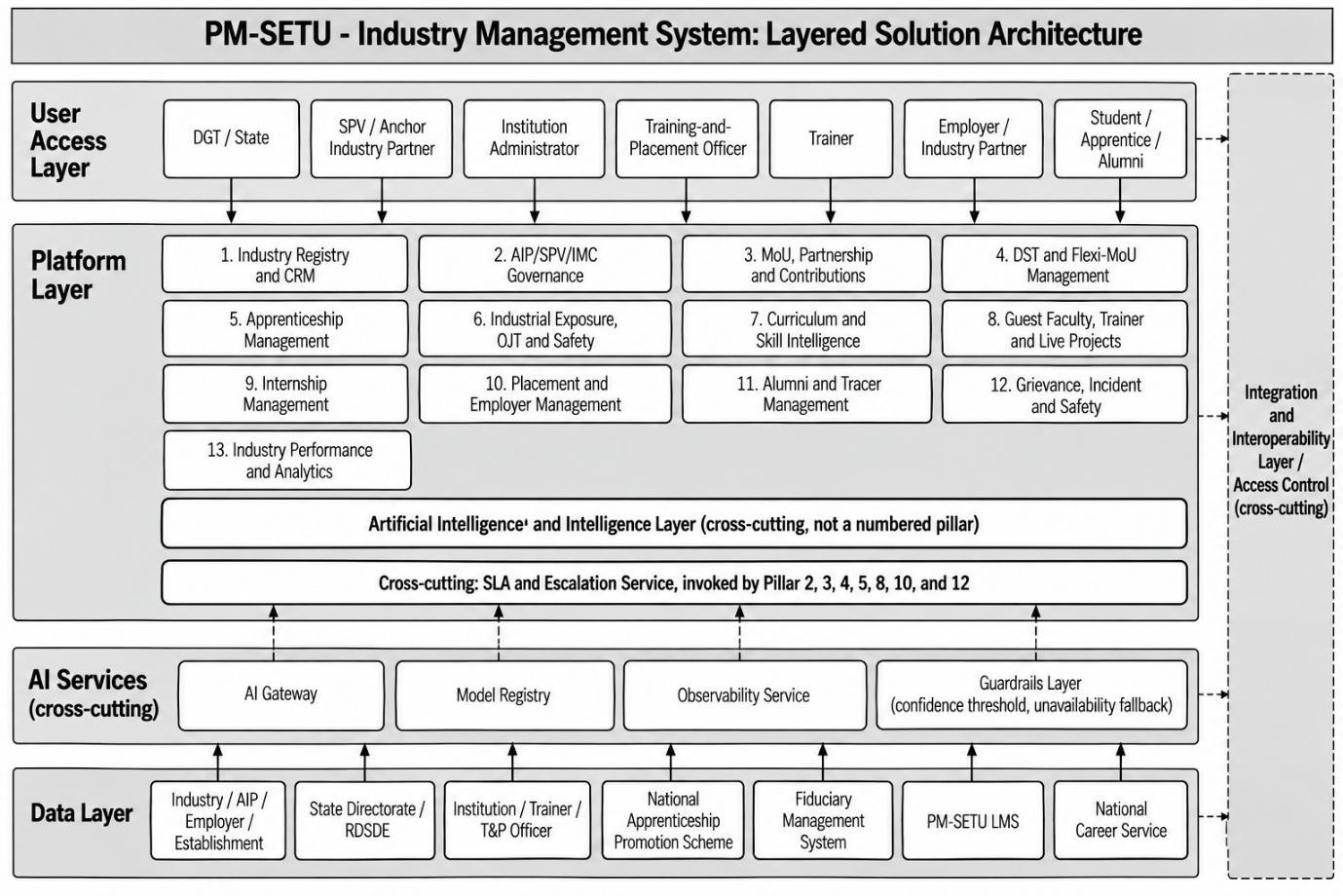
4.1 Data LayerPDF p.48
The Industry Master Profile (Pillar 1) is the Data Layer's central object. Every pillar concerning a given organization - its agreements, training delivery, apprenticeship seats, mentoring activity, contributions, and scorecard - reads and writes against this same profile rather than a parallel record.
| Source | Information Supplied | Owner of Record |
| Industry / Anchor Industry Partner / Employer / Establishment | Industry Master Profile, agreement commitments, guest-faculty and mentor availability, apprenticeship seats, contribution offers, feedback | This platform |
| Source | Information Supplied | Owner of Record |
| State Directorate / RDSDE / Steering Committees | Expression of Interest and Request for Proposal notices, Flexi-MoU agreements, shortlisting and approval decisions | State Directorate / RDSDE |
| Institution / Trainer / Training- and-Placement Officer | Batch scheduling, attendance, industrial- training logbook entries, safety records, placement-pipeline activity | This platform (institution-entered) |
| National Apprenticeship Promotion Scheme | Apprenticeship contract registration and statutory reference | National Apprenticeship Promotion Scheme |
| Fiduciary Management System | Approved CAPEX/OPEX budget envelope, funding-contribution reconciliation status | Fiduciary Management System |
| PM-SETU LMS | Learner competency and skills-profile evidence used for matching; approved course version for curriculum-input reconciliation | PM-SETU LMS |
| National Career Service | Apprenticeship and job-matching references, where the corresponding integration is enabled | National Career Service |
The operational store holds every record specified across Section 3 - profile, agreement, delivery, apprenticeship, safety, curriculum, placement, contribution, and alumni - each with a source identifier and freshness timestamp for externally sourced records. Grievance and safety records are held with restricted access per Section 5.6. Where a source is unavailable, the platform retains the last confirmed state and marks the affected record pending or stale rather than inferring a new outcome.
4.2 Platform LayerPDF p.49
| Component | Function within the Platform Layer |
| Pillar 1 – Industry Registry & CRM | Industry Master Profile, relationship life cycle, due diligence, marketplace |
| Pillar 2 – AIP / SPV / IMC Governance | Strategic cluster-level partner and governance management |
| Pillar 3 – MoU, Partnership & Contributions | Generalized agreement registers, commitment-to-outcome reconciliation, SLA/escalation, renewal engine, industry contribution intake |
| Pillar 4 – DST & Flexi-MoU Management | Batch, training-pattern, logbook, joint-assessment operations, and RDSDE-signed Flexi-MoU delivery |
| Pillar 5 – Apprenticeship Management | Establishment demand, contract, NAPS registration, monthly progress, conversion |
| Pillar 6 – Industrial Exposure, OJT & Safety | Industrial visits, OJT tracking, safety induction and incident management |
| Pillar 7 – Curriculum & Skill Intelligence | Curriculum input, skill-demand forecasting, three-level skill-gap analysis, traceability |
| Pillar 8 – Guest Faculty, Trainer & Live Projects | Industry expert marketplace, structured mentorship, trainer attachment, capstone and live-project supervision |
| Pillar 9 – Internship Management | Distinct internship pipeline and engagement-type enforcement |
| Component | Function within the Platform Layer |
| Pillar 10 – Placement & Employer Management | T&P Cell dashboard, job readiness, employer self-service, AI matching, non-placement reasons, drives and job fairs |
| Pillar 11 – Alumni & Tracer | Alumni profile, post-placement tracking, entrepreneurship, events |
| Pillar 12 – Grievance, Incident & Safety | Industry-linked grievance redressal and cross-referenced incident handling |
| Pillar 13 – Industry Performance & Analytics | Scorecard, rules-based health indicator, benchmarking, DGT/State analytics published to the Analytics Portal |
| Artificial Intelligence & Intelligence Layer (cross-cutting) | Twelve governed, advisory AI capabilities and their shared governance controls |
| Cross-cutting services | Access control at every service call; SLA & Escalation Service; integration gateway; AI Services block |
4.2.1 SLA & Escalation ServicePDF p.50
Specified once as shared infrastructure, invoked by Pillar 2, 3, 4, 5, 8, 10, and 12 wherever this report specifies a timed response requirement.
- •Register an event type, its own pillar, its response window, and its escalation chain.
- •Start a timer on a configured triggering event, issue a reminder ahead of the deadline, and escalate automatically on breach.
- •Retain the full escalation trail - originating office, each escalation level, and current owner - for every event.
4.2.2 AI ServicesPDF p.50
Shared infrastructure underlying the twelve governed AI capabilities: an AI Gateway routing every model call, a Model Registry versioning every configuration, an Observability service logging every generation and human confirmation, and a Guardrails layer enforcing the confidence threshold and unavailability fallback.
4.3 User Access LayerPDF p.50
| Stakeholder | Workspace and Access | Data Scope |
| DGT / Centre | National policy, apprenticeship-policy alignment, National Steering Committee approvals, industry-intelligence dashboards and Copilot | National |
| State Directorate / SPMU / RDSDE | State EOI/RFP management, Flexi-MoU agreements, State Steering Committee decisions | The State concerned |
| SPV / Anchor Industry Partner | Cluster workspace: curriculum input, guest faculty, apprenticeship, placement, contributions | The SPV and its cluster institutions |
| Ordinary Industry Partner / Employer / Establishment | Industry Master Profile, agreements, opportunity postings, candidate review, feedback | The organization's own relationships |
| Stakeholder | Workspace and Access | Data Scope |
| ITI / Institution Administrator | Institution workspace: scheduling, safety oversight, placement-cell operation, contribution intake | The institution concerned |
| Training-and-Placement Officer | T&P Cell dashboard, employer pipeline, placement drives, non-placement reasons | Assigned institution and clusters |
| Industry Relationship Owner | CRM pipeline, due diligence, marketplace | Assigned relationships |
| Trainer | Co-delivery, logbook, capstone supervision, industrial attachment | Assigned institution, trades, and trainees |
| Student / Trainee / Apprentice | Own engagement, mentorship, grievance, and placement record | The trainee's own record |
| Alumni | Own career-outcome profile, mentorship, entrepreneurship, event registration | The alumnus's own record |
| Grievance & Safety Officer | Grievance and incident review and resolution | Assigned institutions and clusters |
| Auditor / Independent Monitoring Agency | Contribution-compliance and agreement- fulfilment review | Assigned States and clusters, summary level |
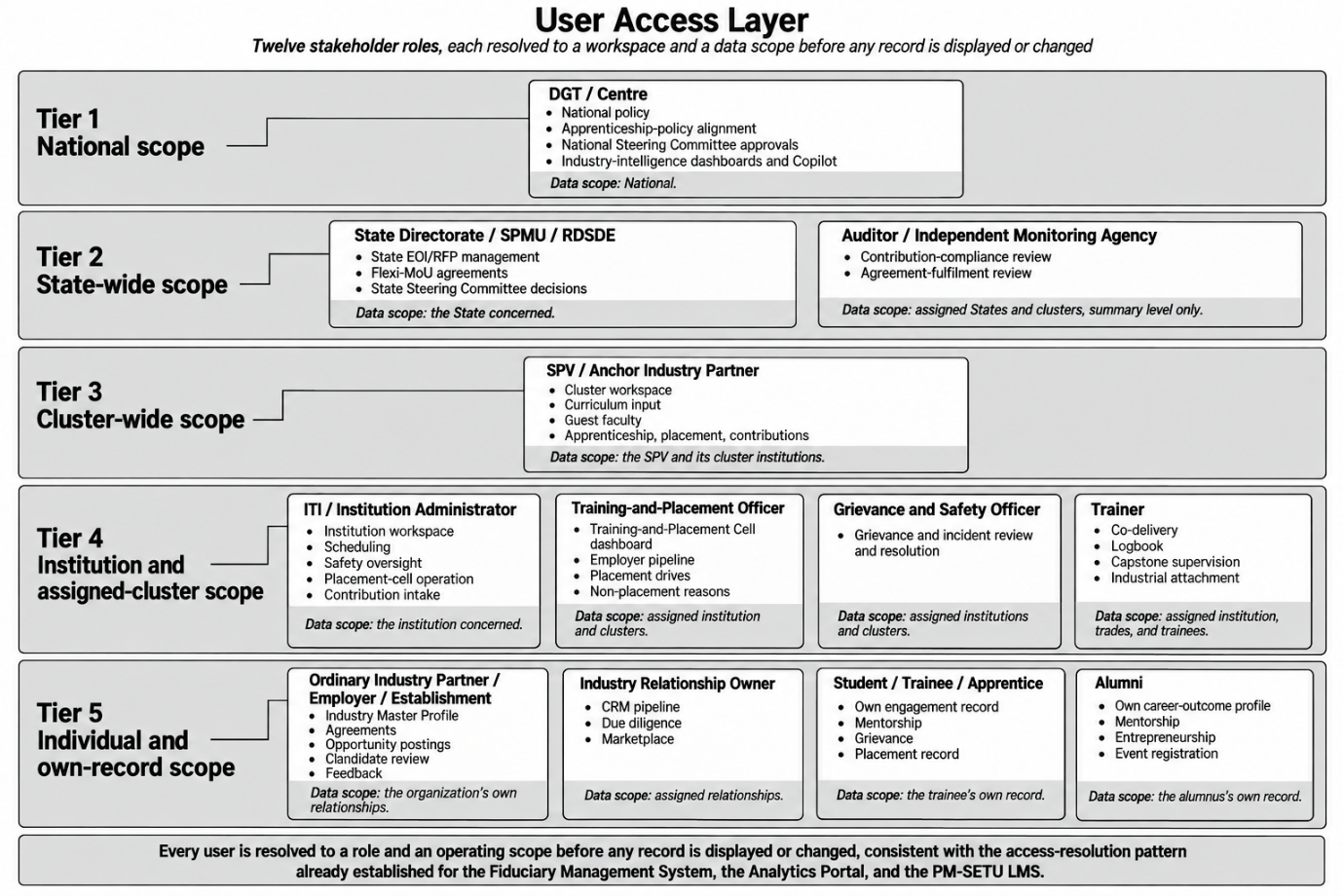
4.4 Integration Catalogue and Data ContractsPDF p.51
Every interface between this platform and an external system shall be defined by the contract structure below before it is built, so an implementation team can construct it without an undocumented assumption.
| Integration | Direction | Data Exchanged | Frequency | Protocol | Source of Truth |
| PM-SETU LMS | Bidirectional | Learner competency, skills profile, course and batch reference, training logbook events | Near real time | API and event | PM-SETU LMS for learner competency; this platform is for logbook and engagement events |
| National Apprenticeship Promotion Scheme | Bidirectional | Apprenticeship contract registration, stipend and completion reference | Near real time with batch reconciliation | API | National Apprenticeship Promotion Scheme for the statutory reference |
| Fiduciary Management System | Bidirectional | Approved budget envelope, contribution and commitment reconciliation | Event with daily batch reconciliation | API and event | Fiduciary Management System |
| Analytics Portal | Outbound | Computed industry- specific analytics, scorecards, and Key Performance Indicators | Batch and event | API and event | This platform, published with source and freshness metadata |
| National Career Service | Bidirectional | Job and apprenticeship matching references | Configurable, where the integration is enabled | API | National Career Service where applicable |
| Connected Anchor Industry Partner platform | Bidirectional | Placement, guest- faculty, mentorship, and contribution records owned by the partner's own system | Near real time with end-of-day reconciliation | API | The connected partner platform for its own records |
For every interface listed above, the following contract elements shall be defined during solution design and held under version control:
- •A field-level mapping between this platform's data model and the external system's data model, including the identifier used to reconcile a record across the two systems.
- •The validation rules an inbound record must pass before acceptance, and the rejection or quarantine behaviour where it fails.
- •A retry policy for a failed call, and an idempotency key so a retried call does not create a duplicate record.
- •A conflict-resolution rule for the case where the same record has been updated on both sides since the last successful synchronization, consistent with the principle, already stated in Section 4.1, that a stale external value is preserved and labelled rather than overwritten by an inference.
- •A replay mechanism allowing a failed batch of events to be reprocessed once the underlying fault is resolved, and a dead-letter queue for an event that repeatedly fails processing, visible to the integration administrator.
- •A scheduled reconciliation job comparing record counts and key totals on each side of the interface, with a variance report raised where the two do not match.
- •A defined failure-recovery procedure, including the maximum acceptable data-loss window and the manual recovery steps where automated retry is exhausted.
4.5 Skill, Occupation, and Competency MasterPDF p.53
Skill-gap analysis, skill-demand forecasting, and AI-assisted matching (Pillar 7, Pillar 10, the AI and Intelligence Layer) all depend on a shared, canonical vocabulary connecting a trade to the specific skills and technologies an employer requires, so a figure computed for one institute is comparable to another. The platform shall therefore maintain a dedicated Skill, Occupation, and Competency Master, distinct from but referenced by the Industry Master Profile.
The taxonomy shall be structured as the following connected hierarchy, each level versioned and separately owned:
ITI Trade -> Qualification -> National Occupational Standard / Qualification Pack -> Competency -> Skill -> Technology -> Occupation / Job Role -> Employer Requirement
For example: the Electrician trade maps to competency in industrial motor control, which maps to skills in Programmable Logic Controller programming, which maps to job roles an employer defines requirements against. Every AI-assisted capability reads its references from this master rather than a free-text field, and every skill-demand submission is mapped to it, with an unmapped submission held for manual classification.
- •Maintain the taxonomy as a versioned reference dataset, with a named owner responsible for approving a new skill, technology, or occupation entry.
- •Map every trade, Qualification Pack, and National Occupational Standard reference used elsewhere in the platform to this taxonomy.
- •Require a skill-demand submission, a competency-evidence record, or an employer job-role requirement to reference a taxonomy entry and hold an unmapped submission for manual classification rather than admitting it to a computation unclassified.
- •Publish taxonomy changes with an effective date and apply a change prospectively so that a historical skill-gap or forecast figure remains computed against the taxonomy version in force at the time.
4.6 Industry Establishment and Facility MasterPDF p.53
A large industry partner commonly operates more than one site - several plants, a training center, a corporate office - each with its own capacity, trades, machinery, and safety profile. Apprenticeship seat capacity, Dual System of Training delivery, safety induction, and industrial-visit hosting all resolve correctly only at the specific site a trainee attends, not the parent company. The platform shall therefore model industry identity as a hierarchy, with the Industry Master Profile (Pillar 1) as its top two levels:
Legal Entity -> Organization (Industry Master Profile) -> Establishment -> Facility / Site
- •Register each Establishment and Facility under its parent Organization, with its own address, capacity, trades supported, machinery, safety readiness, working hours, accommodation and transport availability, and accessibility information.
- •Assign a named supervisor or industry mentor to a specific Facility, distinct from the Organization's overall relationship owner in Pillar 1.
- •Resolve apprenticeship seat capacity (Pillar 5), Dual System of Training batch capacity (Pillar 4), and safety and incident records (Pillar 6) to the specific Facility a trainee attends, not only to the parent Organization.
- •Permit a single Organization to hold multiple active agreements, apprenticeship seats, or Dual System of Training batches concurrently, distributed across more than one of its Facilities.
4.7 Notification FrameworkPDF p.53
A shared, channel-agnostic notification service underlies every reminder, escalation, and status update in this report: an SLA reminder in Pillar 3, a grievance-status update in Pillar 12, a stipend-claim
reminder in Pillar 5, and a tracer-follow-up prompt in Pillar 11 all route through this one service rather than each pillar implementing its own messaging logic.
- •Support delivery over the channels appropriate to the recipient and message category: in-platform notification, Short Message Service, email, and push notification to a mobile application where one exists.
- •Respect each user's configured channel and language preference, and a configured quiet-hours window for non-urgent notifications.
- •Escalate an undelivered urgent notification, such as an emergency safety escalation under Pillar 12, to an alternate channel rather than treating a single delivery attempt as sufficient.
- •Log every notification's delivery status for audit, consistent with Section 5.5.
5. Non-Functional RequirementsPDF p.54
The platform will be used directly by industry partners, employers, apprenticeship establishments, institutions, Training-and-Placement Officers, trainers, students, apprentices, and alumni, at scale and often during concentrated Expression-of-Interest, placement-drive, and apprenticeship-cycle periods. Its non-functional requirements are framed around responsive interaction, reliable capture of relationship and engagement records, security of partner and personal data - including the sensitive grievance and safety records - availability during peak scheme events, and auditability of every governance, Service-Level-Agreement, and AI-assisted decision.
5.1 Performance requirementsPDF p.54
| Performance Parameter | Minimum Requirement |
| Page and workspace load time | Core workspace pages, including the T&P Cell dashboard, shall load within 3 seconds for 90% of requests under normal load, and within 5 seconds under peak load. |
| Transactional operations | Save, submit, approve, and workflow transition actions shall complete within 2 seconds for 95% of transactions. |
| SLA & Escalation Service | A Service-Level-Agreement reminder or escalation shall be dispatched within 5 minutes of the configured trigger. |
| AI capability response | An advisory ranking, forecast, or Copilot answer shall be returned within an interactive response time appropriate to on-screen review; specific numeric targets shall be confirmed during solution design against the selected AI infrastructure. |
| Concurrent usage | The platform shall support a minimum of 500 concurrent users across all stakeholder groups, scaling to 1,200 during peak periods such as Expression-of-Interest windows, placement drives, and apprenticeship- cycle transitions. |
| Partner and NAPS synchronization | Records exchanged with a connected industry platform or the National Apprenticeship Promotion Scheme shall be validated and reflected within 15 minutes of receipt, with end-of-day reconciliation completed by 08:00 hours on T+1. |
| Industry partners bring- your-own-platform integration | Where an industry partner operates its own placement, guest-faculty, mentorship, or contribution system and elects to connect it rather than use this platform's own workspace, the connector specified in Section 4.4 (Connected Anchor Industry Partner platform) shall onboard within a configured provisioning window, exchange records bidirectionally within the same 15-minute and end-of-day reconciliation targets as NAPS synchronization above, and the partner's own system shall remain the source of truth for the records it originates. |
| Performance Parameter | Minimum Requirement |
| System availability | The platform shall provide a minimum of 99.5% monthly availability, excluding pre-notified planned maintenance scheduled outside business hours. |
| Scalability headroom | The architecture shall support at least 25% year-on-year growth in industry profiles, agreements, apprentices, and transaction volumes over a five-year horizon through horizontal scaling, without architectural redesign. |
| Recovery objectives | Critical governance, grievance, and placement functions shall meet a recovery time objective of 4 hours and a recovery point objective of 30 minutes. |
5.2 Security requirementsPDF p.55
| Security Framework / Standard | Application to the Platform |
| ISO/IEC 27001:2022 | The platform and its hosting operations shall implement an Information Security Management System certified to ISO/IEC 27001:2022, covering all industry, apprenticeship, grievance, and safety data-processing environments. |
| CERT-In Directions and Guidelines (2022) | Cyber security incidents shall be reported to CERT-In within 6 hours of detection; logs shall be retained for a minimum of 180 days within India. |
| IT Act, 2000 and DPDP Act, 2023 | The platform shall comply with the Information Technology Act, 2000, and the Digital Personal Data Protection Act, 2023, covering lawful processing, purpose limitation, and data minimization for trainee, apprentices, alumni, and employer personal data, with particular care for grievance and safety-incident records and where a trainee is a minor. |
| MeitY empanelled cloud / GI Cloud (MeghRaj) | The solution shall be hosted on a MeitY-empanelled cloud service provider or National Informatics Centre infrastructure, with all data residing within Indian territory. |
| Security audit and certification | A CERT-In empanelled agency shall conduct Vulnerability Assessment and Penetration Testing prior to go-live, after every major release, and at least half-yearly thereafter. |
| Identity, access, and authentication | Multi-factor authentication shall be mandatory for State administrator, Steering Committee, Special Purpose Vehicle, and Grievance and Safety Officer roles; role-based access with segregation of duties shall be enforced, supported by quarterly access reviews. |
| Restricted-record access | Grievance and safety-incident records shall be visible only to the reporting trainee, the institute Training-and-Placement Officer, the Grievance and Safety Officer, and, where escalated, the State authority; any attempt at access outside this scope shall be denied and logged. |
| Encryption standards | Data in transit shall be protected using TLS 1.2 or higher; data at rest, including agreement, apprenticeship, grievance, and contribution records, shall be encrypted using AES-256. |
5.3 Availability and disaster recovery requirementsPDF p.56
A disaster recovery environment shall be maintained at a geographically separate location, prioritizing Industry Master Profiles, active agreements, open grievances and safety incidents, and active placement-drive data ahead of non-critical administrative views. Where an external source is unavailable, the platform shall continue serving the last confirmed status with a visible staleness indicator rather than failing entirely.
5.4 Backup and data retention requirementsPDF p.56
Automated backup shall cover the Industry Master Profile and CRM history, agreement and commitment records, training and apprenticeship logbooks, safety and grievance records, and alumni tracer data, performed at scheduled intervals per government data-protection guidelines. Historical records shall be preserved for the prescribed retention duration, remaining searchable and auditable throughout.
5.5 Audit logging and monitoring requirementsPDF p.56
Audit logging is mandatory, capturing due-diligence decisions, agreement and SPV governance actions, SLA escalations, training and apprenticeship logbook entries, safety and incident events, grievance routing and resolution, placement and Pre-Placement-Offer outcomes, contribution acceptance, every AI-assisted output with its human confirmation or rejection, and denied access attempts, including every attempt to access a restricted grievance or safety record outside the permitted scope. Logs shall include user or source identification, timestamp, action, affected record, previous and updated value, and, where AI is involved, the model or rule version in force.
5.6 Compliance requirementsPDF p.56
The platform shall align with National Digital Education Architecture interoperability guidelines and Government of India digital governance and cybersecurity standards. Apprenticeship records shall follow the Apprentices Act, 1961, and the National Apprenticeship Promotion Scheme. Grievance and safety-incident processing concerning a trainee shall follow the Digital Personal Data Protection Act, 2023, including age-appropriate consent and a prohibition on behavioural tracking of a minor. The platform shall support Multilateral Development Bank fiduciary requirements on contribution utilization and outcome evidence, maintaining immutable audit trails for all governance decisions and transactions.
5.7 Data classification and privacy governance matrixPDF p.56
Section 5.2 states the security controls that apply across the platform; this section makes those controls concrete for the specific data categories this platform holds.
| Data Element | Owner | Purpose | Who Sees It | Retention | Sharing |
| Trainee competency and skills evidence | PM-SETU LMS, referenced here | Matching, skill-gap analysis | Authorized roles within Pillar 7, Pillar 10, and the AI and Intelligence Layer only | Per the retention period defined in Section 5.4 | Controlled, within the platform only |
| Post-placement salary and employment outcome | This platform (Pillar 11) | Tracer study, outcome reporting | Restricted to the Training-and- Placement Officer, DGT, and State analytics roles | Per the retention period defined in Section 5.4 | Aggregate only outside the owning institute |
| Data Element | Owner | Purpose | Who Sees It | Retention | Sharing |
| Grievance record | This platform (Pillar 12) | Resolution | Highly restricted: reporting trainee, Grievance and Safety Officer, and, where escalated, the State authority only | Per the retention period defined in Section 5.4, with restricted access maintained throughout | Restricted; not shared outside the resolution chain |
| Safety incident record | This platform (Pillar 6) | Safety management | Restricted to institute, Grievance and Safety Officer, and escalation authority | Per the retention period defined in Section 5.4 | Escalation only, to the State authority where required |
| Employer and industry contact details | This platform (Pillar 1, Industry Master Profile) | Customer- Relationship Management | Scoped to the assigned relationship owner and the organization itself | Duration of the active relationship plus the configured record- retention period | Within the owning organization's own view only |
In addition to the classification above, the platform shall specify and enforce the following privacy controls:
- •A recorded consent version against every consent a trainee, employer, or industry contact gives, and a mechanism for the individual to withdraw consent where the underlying processing permits withdrawal.
- •A privacy notice presented at the point where personal data is first collected, stating the purpose, retention, and sharing behaviour applicable to that data.
- •A data-subject request handling process allowing a trainee, employer, or industry contact to request access to, correction of, or deletion of their own personal data, subject to the statutory and audit- retention exceptions defined in Section 5.4.
- •A defined retention and deletion schedule per data category, executed automatically at the end of the applicable retention period unless a legal hold applies.
- •A third-party processor control requiring any connected partner platform or cloud service provider handling personal data to be bound by a data-processing agreement consistent with the Digital Personal Data Protection Act, 2023.
- •A breach-response procedure, including notification timelines to the affected individual and to the applicable regulator, consistent with the Digital Personal Data Protection Act, 2023, and the CERT- In incident-reporting requirement in Section 5.2.
5.8 Accessibility, mobile, and low-bandwidth requirementsPDF p.57
The platform's users span every State, including institutes and industry premises with limited connectivity, and stakeholders relying on assistive technology. Accessibility and low-bandwidth operation are therefore specified as testable requirements.
- •The platform's web interface shall conform to the Web Content Accessibility Guidelines 2.1, Level AA, covering screen-reader compatibility, full keyboard navigation, sufficient color contrast, and accessible form labelling.
- •The platform shall provide a multilingual user interface, covering Hindi, English, and the principal regional languages of the participating States, with the language set selectable by the user and honored by the notification framework specified in Section 4.7.
- •The platform's interface shall be designed mobile-first and responsive, remaining fully usable on a low-cost Android device and on a narrow viewport, consistent with the device profile common among trainees, trainers, and Training-and-Placement Officers.
- •The platform shall provide a defined low-bandwidth mode for core transactional screens, minimizing payload size and image weight where network conditions are constrained, such as at rural ITI or an industry premises with limited connectivity.
- •Where a field capability is used at an industry premises with unreliable connectivity, specifically the industrial-training logbook in Pillar 4, the industrial-visit attendance capture in Pillar 6, the platform shall support offline data capture to a local queue, with automatic synchronization on reconnection and a defined conflict-resolution rule where the same record has also been updated centrally in the interim.
6. Testing Strategy and Deployment ApproachPDF p.58
The platform shall adopt a structured testing and deployment framework covering the training and apprenticeship operational engines, the Service-Level-Agreement and escalation engine, and the restricted-access grievance and safety workflow.
6.1 Testing strategyPDF p.58
The testing lifecycle shall include Unit Testing, System Integration Testing, User Acceptance Testing, Performance Testing, Security Testing, AI Governance Testing, and Production Validation Testing.
- •Functional and journey testing. End-to-end scenarios shall cover industry onboarding through due diligence and agreement signing; Dual System of Training batch operation from nomination through completion and NAPS linkage; the full apprenticeship life cycle from establishment demand through conversion tracking; industrial visits and safety-induction gating; placement-drive operation; industry-contribution reconciliation; and grievance routing through to resolution and appeal.
- •Commitment-to-outcome reconciliation testing. Every agreement type - Memorandum of
Understanding, Dual System of Training, Flexi-MoU, apprenticeship, Strategic Investment Plan, and Corporate Social Responsibility offer - shall be tested to confirm its commitment, activity, output, and outcome figures reconcile correctly through the Pillar 3 chain.
- •Service-Level-Agreement and escalation testing. Every configured event type shall be tested for
correct reminder timing, on-time escalation, and complete retention of the escalation trail.
- •Access-control and restricted-record testing. Every stakeholder role shall be tested against its permitted data scope, with specific confirmation that grievance and safety-incident records are accessible only to the roles specified in Section 5.2, and that denied attempts are logged.
- •AI governance testing. For every one of the twelve capabilities specified in the AI and Intelligence Layer: confirm the Advisory output classification; confirm every output is explainable and traceable to its source signal; confirm human confirmation is required before an output is acted upon; confirm model-version recoverability and prospective-only application of a configuration change; and confirm graceful degradation on AI service failure.
- •Performance and security testing. Load, peak apprenticeship-cycle and placement-drive concurrency, integration-failure, backup and restore, and failover scenarios shall be executed against the minimum requirements at Section 5. Vulnerability Assessment and Penetration Testing shall be completed by a CERT-In empanelled agency before production go-live.
- •Migration testing. Every migrated record type specified in Annexure A shall be tested for extraction accuracy, deduplication correctness, Industry Master Profile and Establishment master matching, and post-migration business reconciliation against the source system's own reported totals, before a source system is retired.
- •Accessibility testing. Core trainee, employer, and Training-and-Placement Officer journeys shall be tested against Web Content Accessibility Guidelines 2.1, Level AA, using both automated scanning and manual assistive-technology testing, consistent with Section 5.8.
- •Offline and synchronization testing. The industrial-training logbook and industrial-visit attendance capabilities specified in Pillar 4 and Pillar 6 shall be tested for correct offline queuing,
synchronization on reconnection, and conflict resolution where the same record has also been updated centrally in the interim. User Acceptance Testing shall be conducted with nominated representatives from DGT, State authorities, Special Purpose Vehicles, institutions, Training-and-Placement Officers, employers, apprenticeship establishments, students, and alumni. Successful completion of User Acceptance Testing shall constitute formal business sign-off for production deployment.
6.2 Acceptance criteriaPDF p.59
- •All critical journeys pass end to end, with governance, curriculum-input, Dual System of Training, apprenticeship, placement, and contribution status reconciling to the underlying source records.
- •Role and entity access tests pass for every stakeholder, including verified restriction of grievance and safety-incident records to their permitted roles.
- •Every Service-Level-Agreement event type demonstrates correct reminder, escalation, and audit- trail behaviour under test.
- •All twelve AI capabilities demonstrate their specified Advisory classification, explainability, human- confirmation, and graceful-degradation behaviour under test.
- •All critical and high-severity defects are resolved and retested; all application security findings categorized as critical or high risk are closed.
- •User Acceptance Testing sign-off is obtained from nominated representatives across every stakeholder group listed in Section 6.1.
6.3 CI/CD and deployment approachPDF p.59
The solution shall adopt continuous integration and continuous delivery, with automated build pipelines, quality checks, test suites, and security scanning integrated into a centralized DevSecOps framework. A change to an AI model, rule configuration, or health-indicator rule set shall pass through the same pipeline gates as an application-code change.
Production rollout shall be phased per the agreed PM-SETU implementation plan, beginning with the initial Hub-and-Spoke clusters and expanding once reconciliation, user support, and performance are proven. The thirteen pillars and the AI and Intelligence Layer shall roll out in three tranches: Tranche 1, the foundational Industry Master Profile registry, due diligence, AIP/SPV governance, and the generalized agreement, SLA, and renewal engine (Pillar 1, 2, 3), on which every other pillar depends; Tranche 2, the training, apprenticeship, safety, internship, and placement operating engines (Pillar 4, 5, 6, 9, 10); and Tranche 3, the intelligence, engagement, performance, and governed AI layer (Pillar 7, 8, 11, 12, 13, and the AI and Intelligence Layer), enabled only once its non-AI dependencies are proven live.
7. Process Designs and MockupsPDF p.59
This section presents the core operating engines introduced or substantially deepened by this expanded scope, each specified as a numbered process design and paired with the interface mockup that shows the screen a user reaches at the end of, or at the decisive point within, that process. Every subsection heading below states the specific pillar or pillars from Section 3 it is built from, so the two sections read as one aligned pair: Section 3 specifies what each pillar shall provide, and this section shows how that pillar's process actually runs and what the user sees. Every numbered step trace to the corresponding pillar's Functional Capabilities, Validation Rules, or Exception Management table, referenced inline. The process design and its mockup are one continuous illustration of the same subsection: the mockup uses the same terminology, the same named screen, and shows the same actors and outcomes the process design establishes. Business Process Model and Notation 2.0 diagrams and interface mockups for each process design below, built to a single fixed portal chrome and a consistent monochrome design system, are maintained as a separate visual asset package and are not embedded in this document at this stage. All values and step counts shown in this section are illustrative and do not represent actual programme data.
7.1 Partner onboarding and SPV formation process designPDF p.59
- 1.A prospective Anchor Industry Partner's Industry Master Profile is registered, and eligibility is
screened against the State's published thresholds (Pillar 1).
- 2.An eligible partner submits a Strategic Investment Plan, reviewed first by the State Steering
Committee and then by the National Steering Committee (Pillar 2).
- 3.On National Steering Committee approval, a Special Purpose Vehicle is formed as a Section-
8 company, continuing an existing Institute Management Committee's record where one already governs the cluster's Hub institution, rather than creating a duplicate governance record (Pillar 2).
- 4.The activated cluster becomes visible to the Fiduciary Management System and the PM-SETU
LMS, and its Hub and Spoke institutions, curriculum, guest-faculty, apprenticeship, and placement commitments are shown in the cluster workspace (Pillar 2).
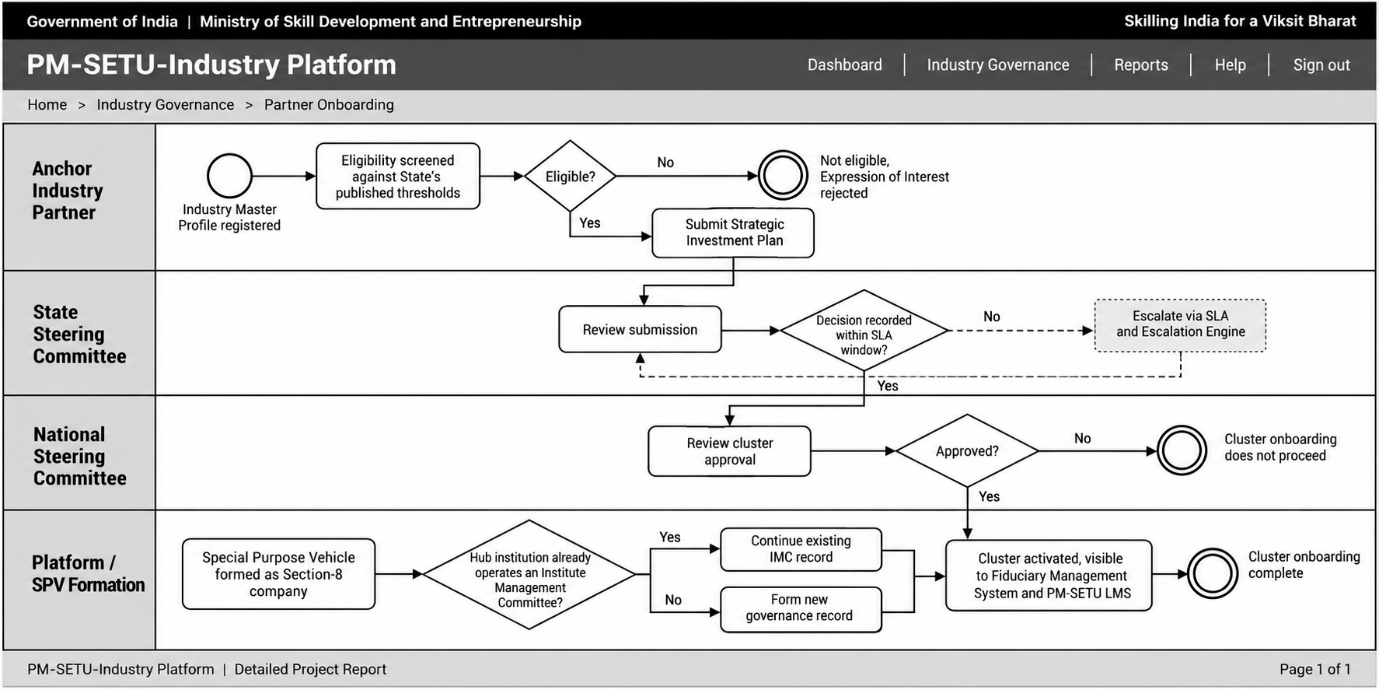
The mockup below shows the resulting cluster workspace referenced in the process design above, including the Hub and Spoke institution list, the Institute Management Committee continuity indicator, and the programmatic commitment summary.
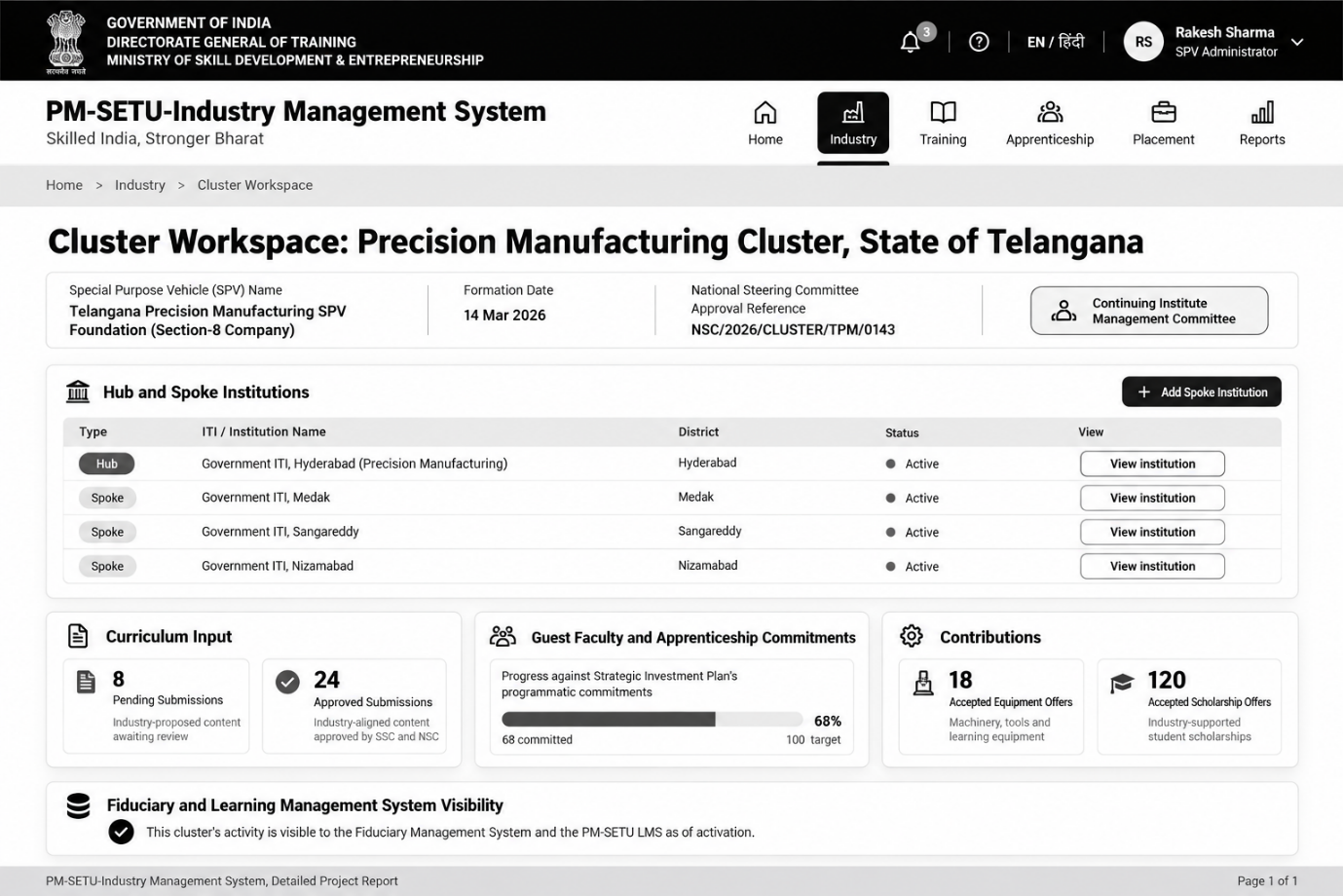
7.2 MoU commitment, SLA and renewal engine process designPDF p.61
- 1.Every agreement type - an ordinary Memorandum of Understanding, a Dual System of Training
agreement, a Flexi-MoU, an apprenticeship contract, or a Strategic Investment Plan - records its commitments at signing (Pillar 3).
- 2.As activity is executed, it is logged against the agreement, and the Service-Level-Agreement
timer tracks the configured response and review window (Pillar 3).
- 3.Reminders fire automatically at 180, 90, 60, and 30 days ahead of expiry; where no action is
recorded, the item escalates automatically to the next authority (Pillar 3).
- 4.The agreement is ultimately renewed, modified, or closed by a recorded decision, and the
commitment-to-outcome chain reconciles commitment, activity, output, and outcome figures side by side (Pillar 3).
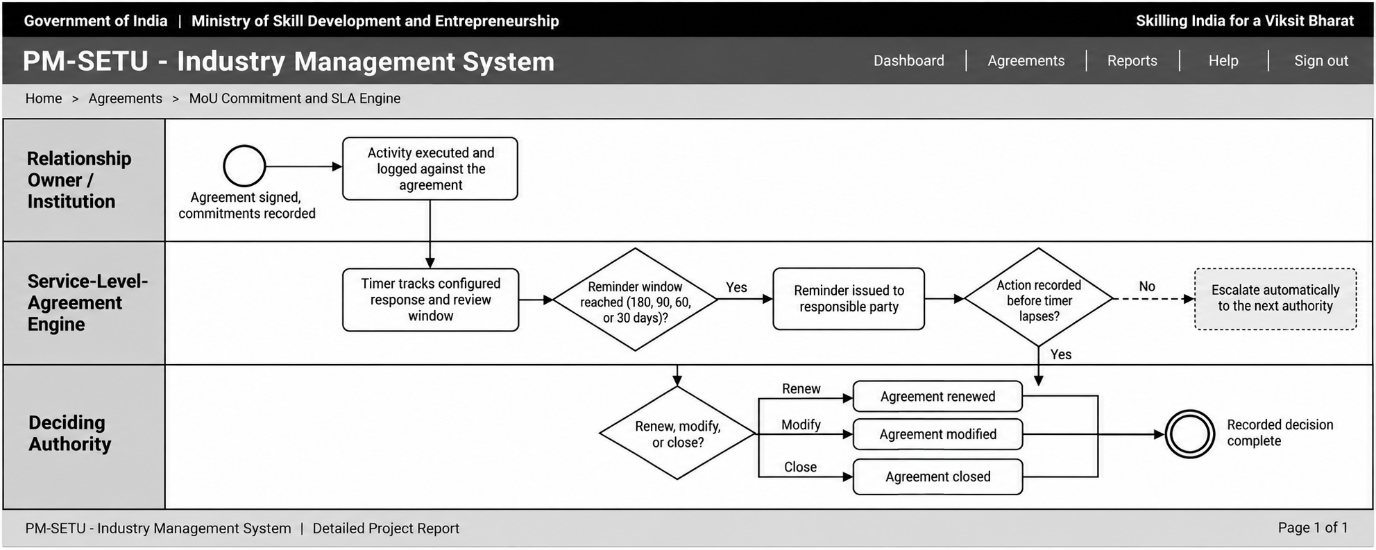
The mockup below shows the resulting agreement detail screen referenced in the process design above, including the Service-Level-Agreement timer, the escalation history, and the renew, modify, or close actions.
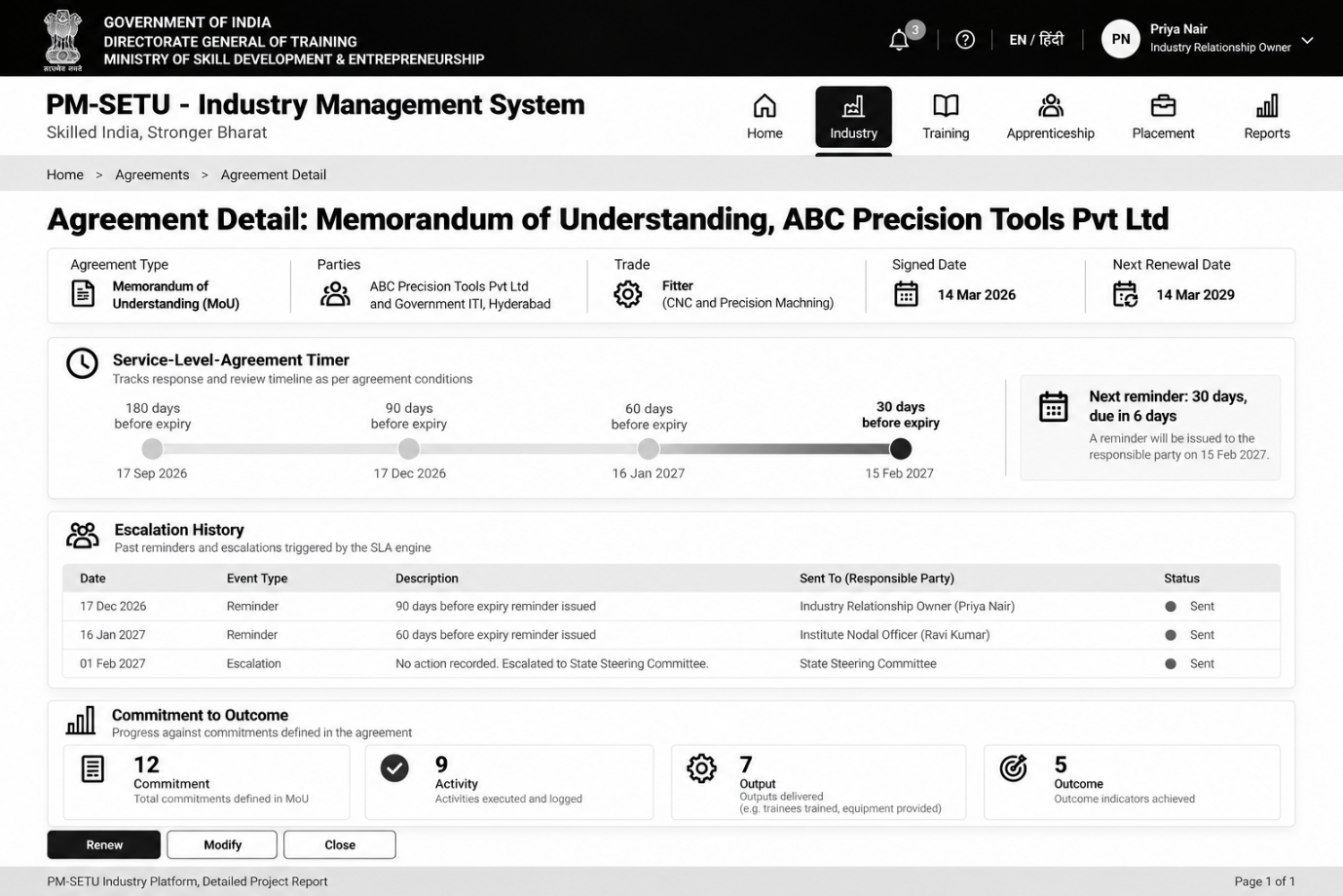
7.3 Curriculum co-design and skill-intelligence feedback loopPDF p.62
- 1.A Sector Skill Council or industry partner submits curriculum input or a skill-demand signal
(Pillar 7).
- 2.An academic reviewer validates the submission before it is routed to the designated curriculum
authority - DGT, NCVET, or CSTARI - for approval (Pillar 7).
- 3.An unapproved submission is returned to the originator for a stated reason and does not reach
a live course (Pillar 7).
- 4.On approval, the submission is published to the PM-SETU LMS course version, and trainees
subsequently trained under the revised curriculum are linked back to the originating submission (Pillar 7).
- 5.Employer feedback on those trainees closes the evidence loop, completing the traceability
chain specified in Pillar 7.
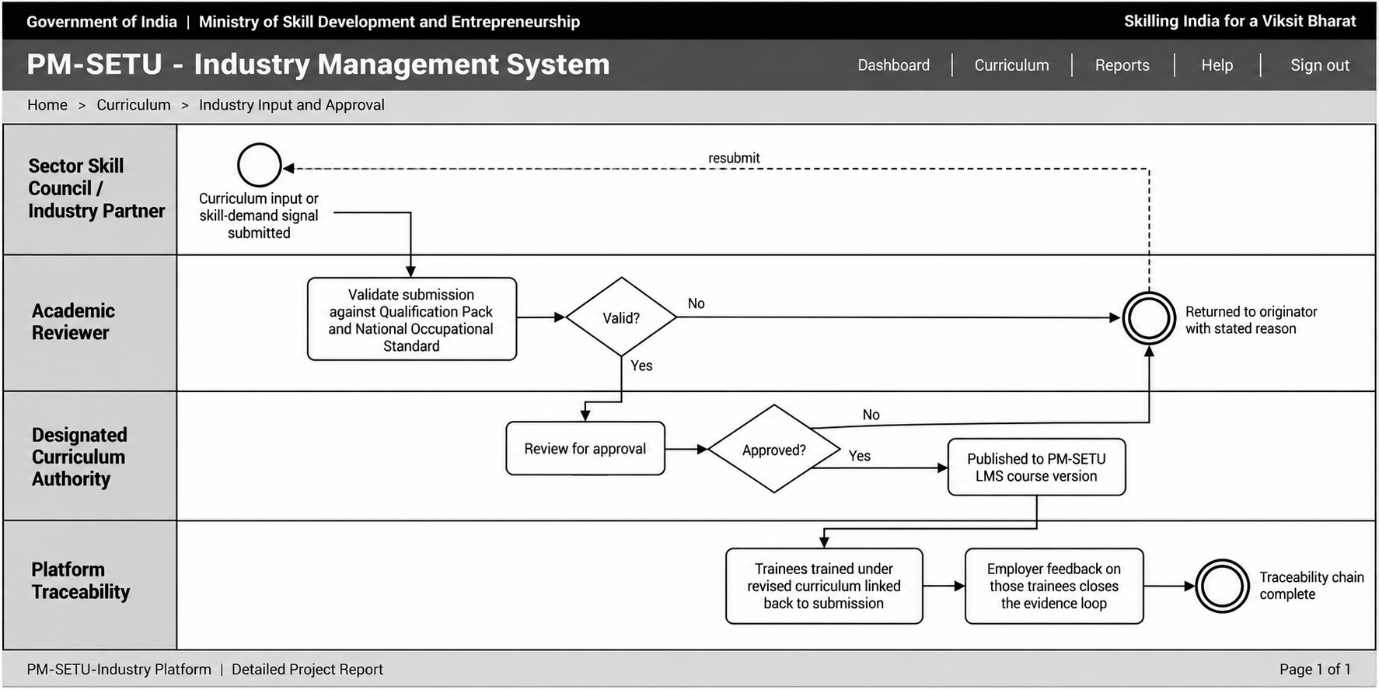
The mockup below shows the resulting curriculum approval queue referenced in the process design above, including the pending-submission table, the approve and return-with-reason actions, and the traceability note.
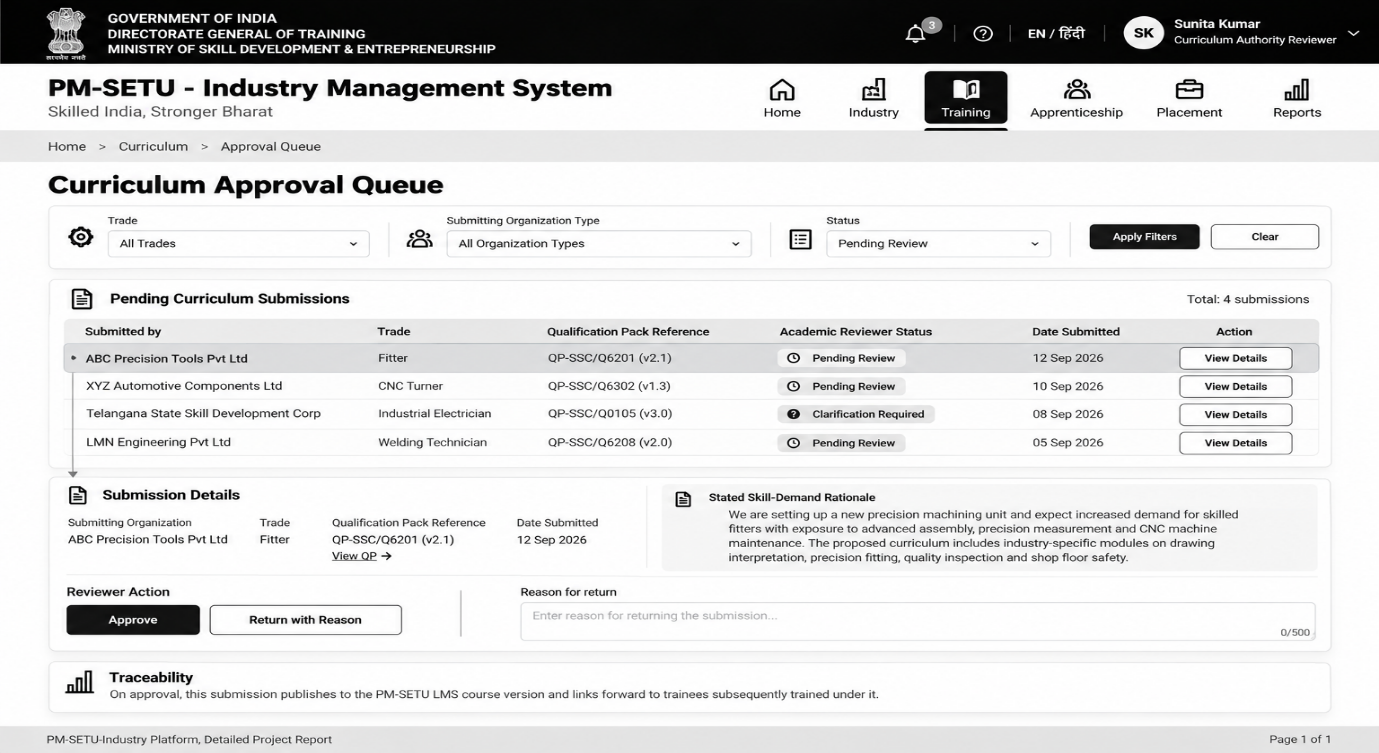
7.4 Dual System of Training operations process designPDF p.63
- 1.A trade and industry partner are identified against a signed Memorandum of Understanding,
and a training pattern - block, multiple blocks, or mixed mode - is agreed (Pillar 3, Pillar 4).
- 2.A batch is defined and trainees are nominated; the industry partner accepts or declines the
nomination (Pillar 4).
- 3.Safety induction is completed before industrial training begins (Pillar 6).
- 4.Delivery is captured through the training logbook, with institute-recorded and industry-recorded
attendance reconciled for the same trainee and date (Pillar 4).
- 5.Joint institute-and-industry progress assessment is recorded, before completion, certification,
and linkage onward to apprenticeship, further training, or placement (Pillar 4, Pillar 5, Pillar 10).
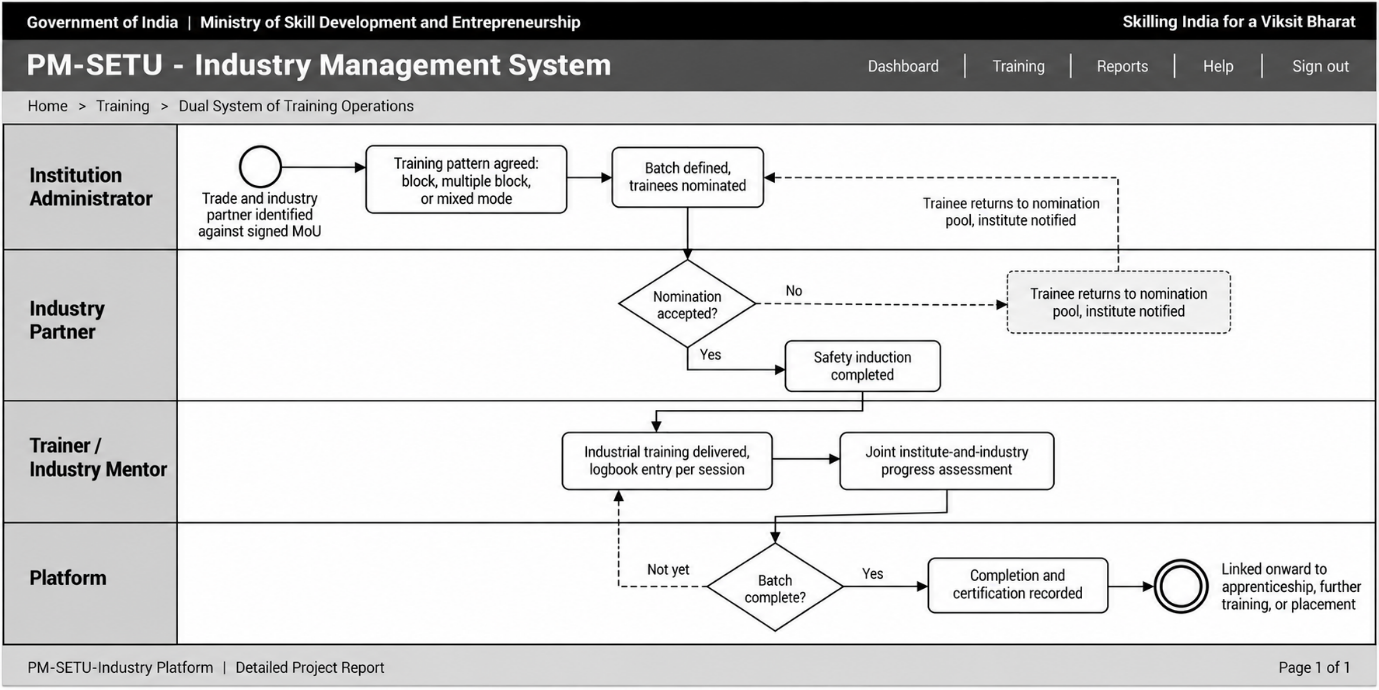
The mockup below shows the resulting batch logbook referenced in the process design above, including the session log, the attendance-reconciliation status, and the joint assessment record.
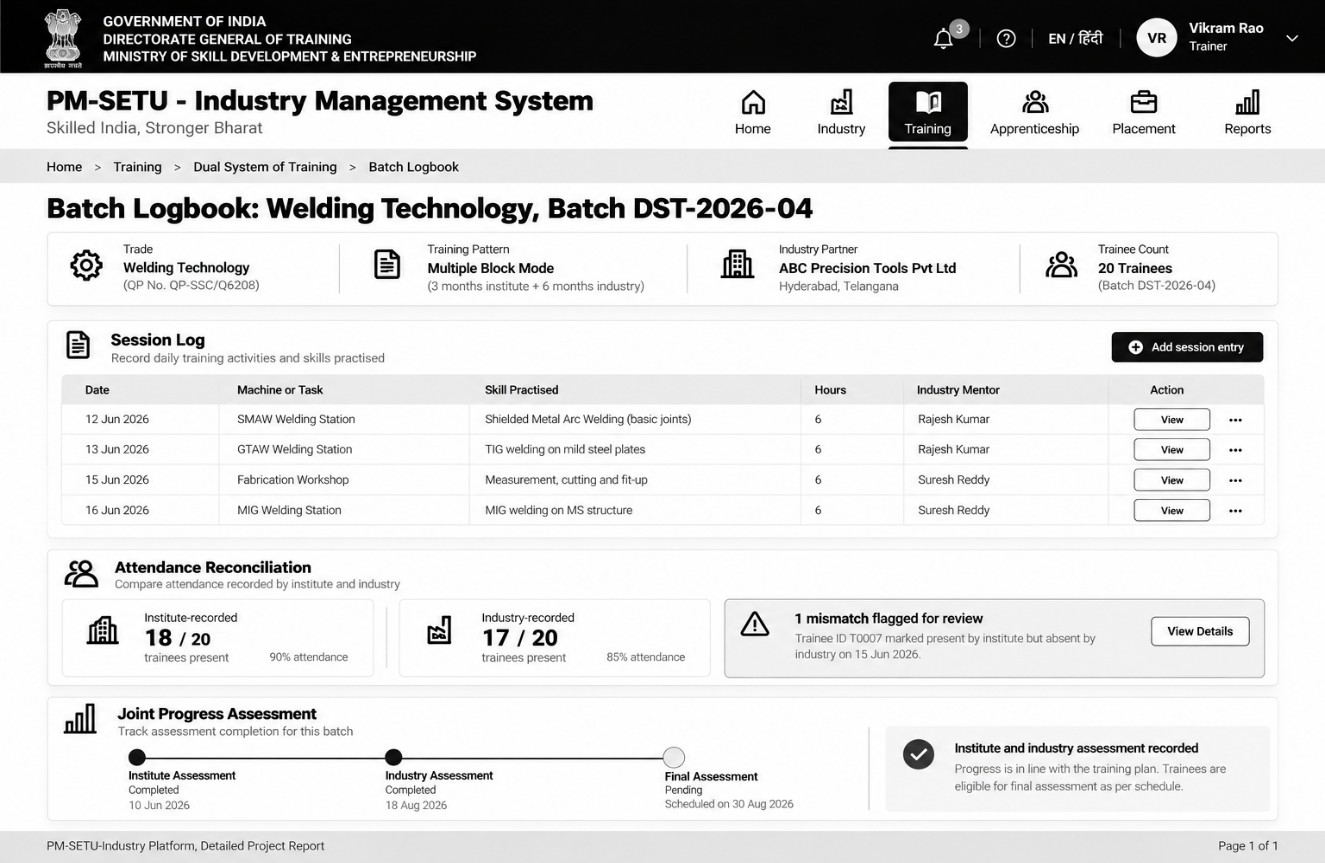
7.5 Apprenticeship lifecycle process designPDF p.64
- 1.An establishment registers apprenticeship seats by trade, distinct from a placement vacancy
(Pillar 5).
- 2.Candidates are discovered and shortlisted, and a contract is signed and registered against the
National Apprenticeship Promotion Scheme (Pillar 5).
- 3.The apprentice joins and is activated on a training plan tracked on a monthly cycle distinct from
the institute's academic term (Pillar 5).
- 4.Attendance, progress, and stipend claims are recorded each month (Pillar 5).
- 5.On completion, a certificate is issued, and the platform tracks whether the apprenticeship
converts to a regular employment offer (Pillar 5, Pillar 10).
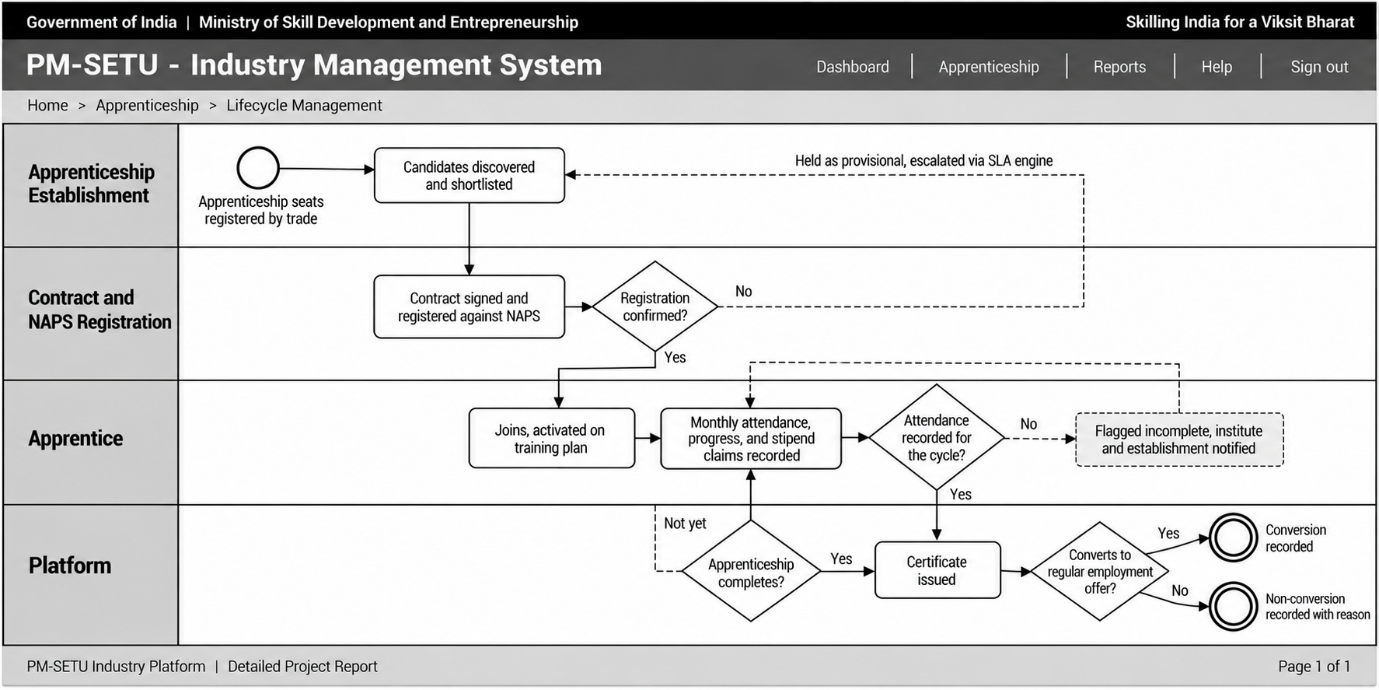
The mockup below shows the resulting apprenticeship tracker referenced in the process design above, including the monthly cycle indicators, the completion and conversion status, and the certificate record.
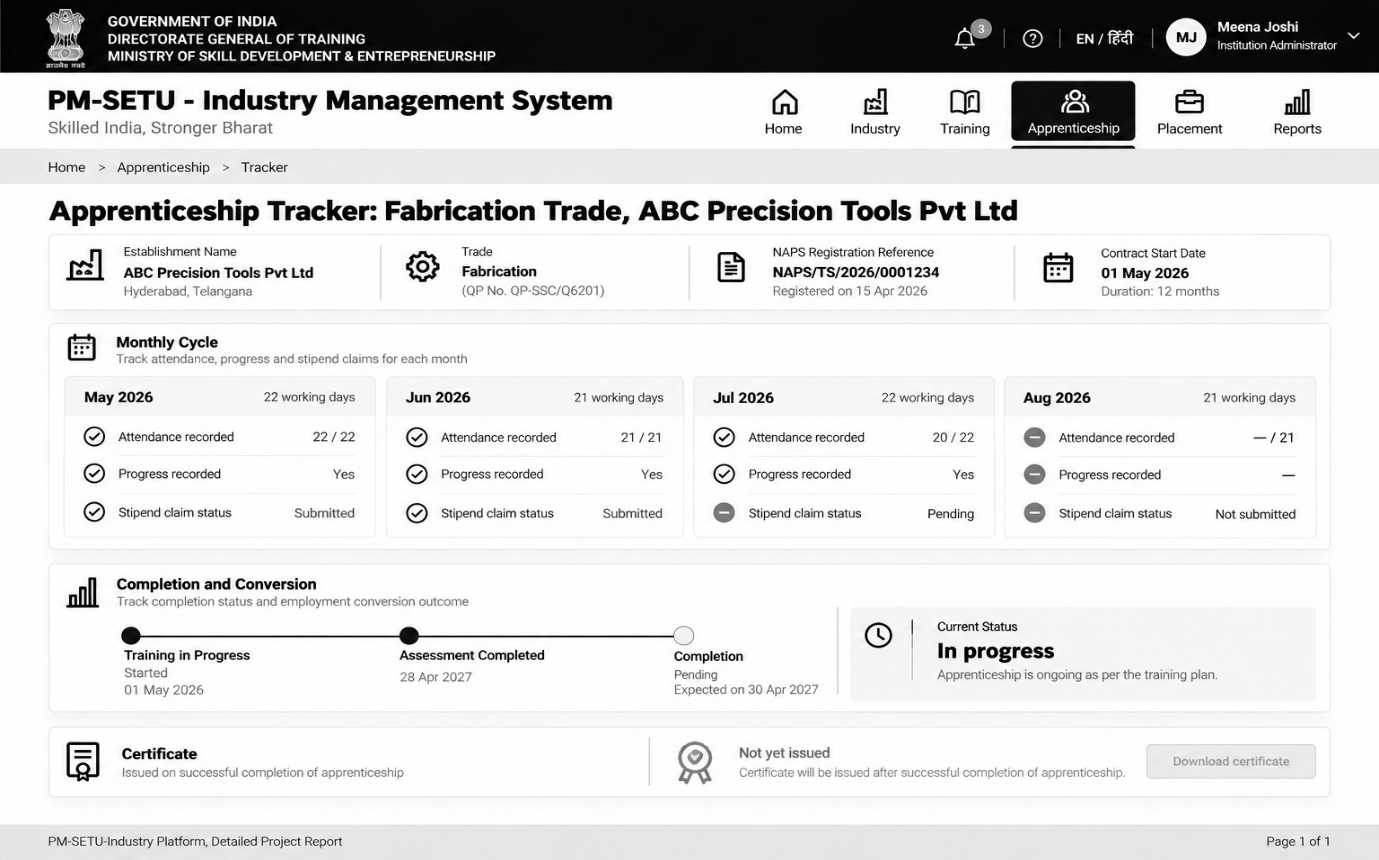
7.6 Training-and-Placement Cell, placement drive, and post-placement trackingPDF p.65
- 1.The Training-and-Placement Cell creates a placement drive and invites employers who publish
jobs against it (Pillar 10).
- 2.Eligible students register and are pre-screened, and interview slots and panels are scheduled
(Pillar 10).
- 3.Interviews are conducted, results are uploaded, offers are issued, and joining is tracked (Pillar
10, Pillar 10).
- 4.The trainee's outcome record does not close at joining: 30-day, 90-day, 6-month, and 12-month
follow-up checkpoints feed the tracer-study evidence base (Pillar 11).
- 5.Aggregated outcomes are published to the Analytics Portal (Pillar 13).
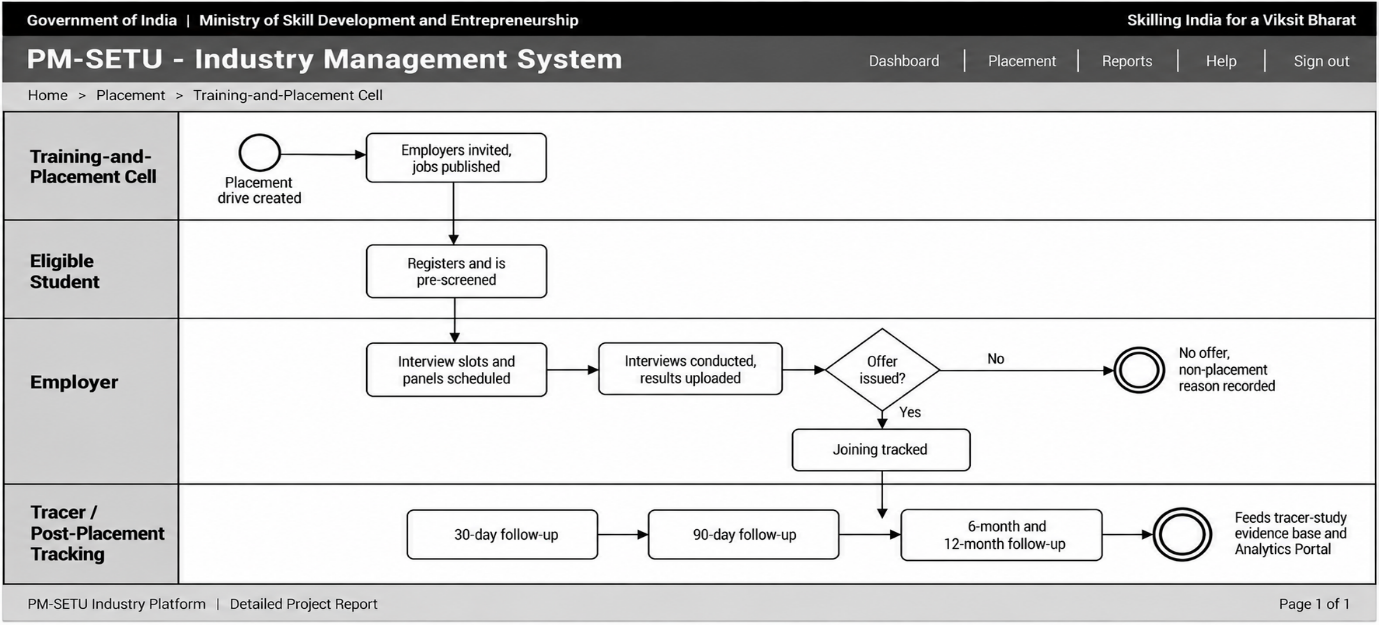
The mockup below shows the resulting Training-and-Placement Cell dashboard referenced in the process design above, including the live counters, the employer pipeline, and the post-placement follow- up table.
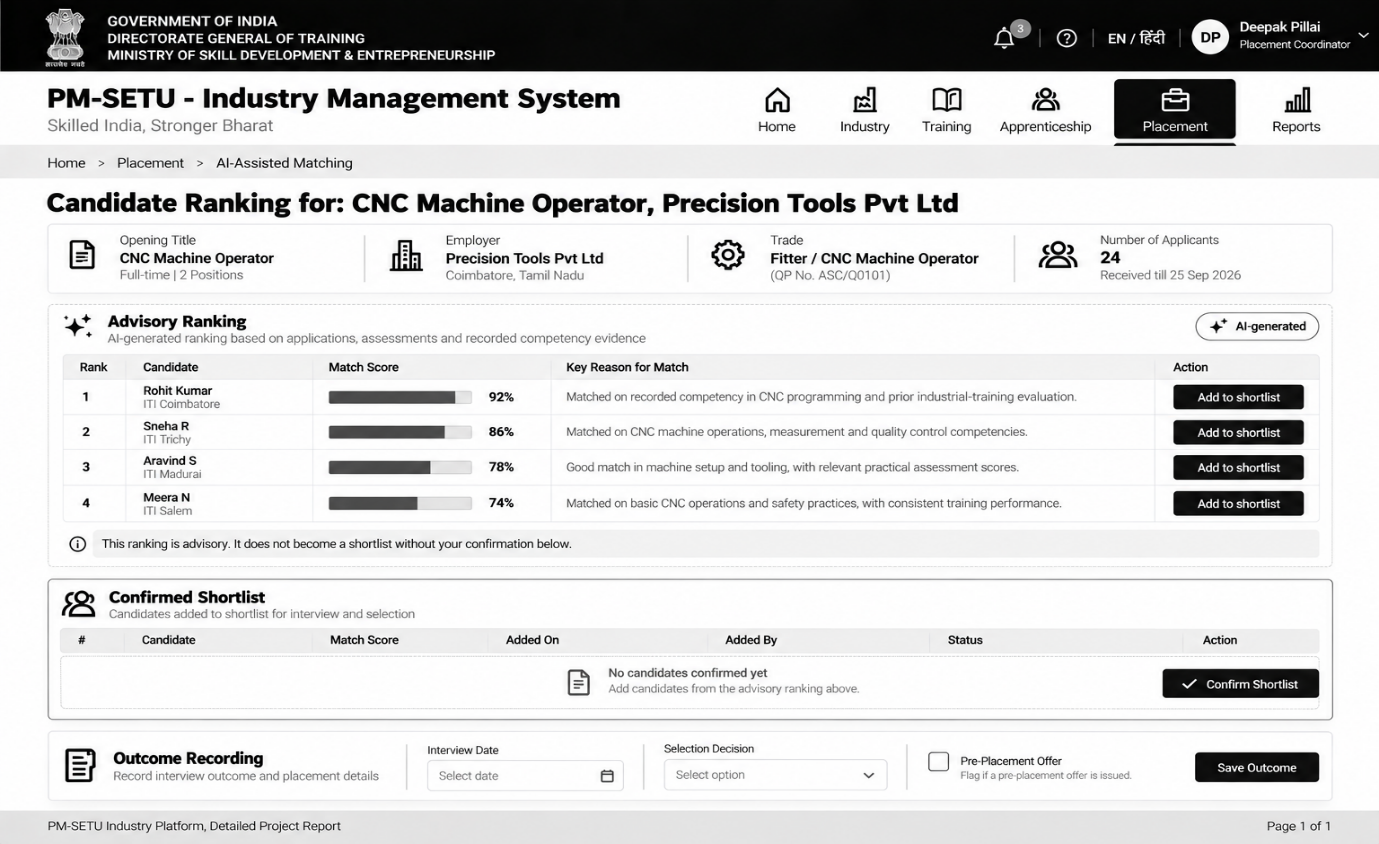
7.7 AI-assisted employer-trainee placement matchingPDF p.66
- 1.An employer posts a placement opening (Pillar 10).
- 2.A trainee applies directly, is nominated by the institution, or is surfaced through the advisory
AI-assisted matching capability, AI-1 (the AI and Intelligence Layer).
- 3.AI-1 ranks candidates against the opening using recorded competency evidence and presents
the ranking with its supporting explanation; this ranking never itself becomes a shortlist without explicit confirmation (the AI and Intelligence Layer).
- 4.The placement coordinator or employer reviews the ranking and confirms a shortlist before
proceeding to interview and selection (Pillar 10).
- 5.The outcome is recorded, with a Pre-Placement Offer flagged where applicable, and published
to the Analytics Portal and National Career Service (Pillar 10, Pillar 13).
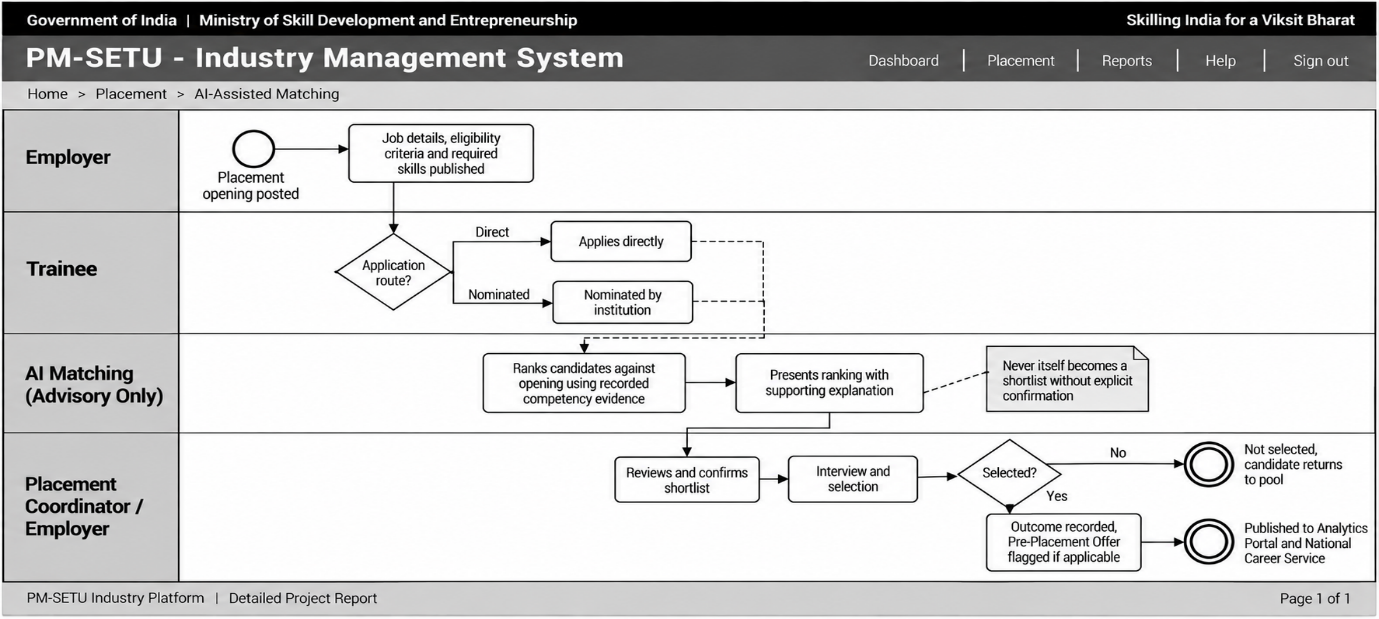
Internship matching is a manual, institution-nominated process under Pillar 9 and is not within AI-1's scope unless the AI and Intelligence Layer is explicitly reconfigured to extend it; apprenticeship candidate matching is a separate, distinctly configured capability, AI-3, reflecting the distinct data model required under Pillar 5. National Apprenticeship Promotion Scheme registration is not part of this placement flow; it applies only to the apprenticeship lifecycle specified in Pillar 5.
The mockup below shows the resulting candidate ranking screen referenced in the process design above, including the advisory AI ranking card with its AI-generated tag, the confirmed shortlist, and the outcome-recording fields.
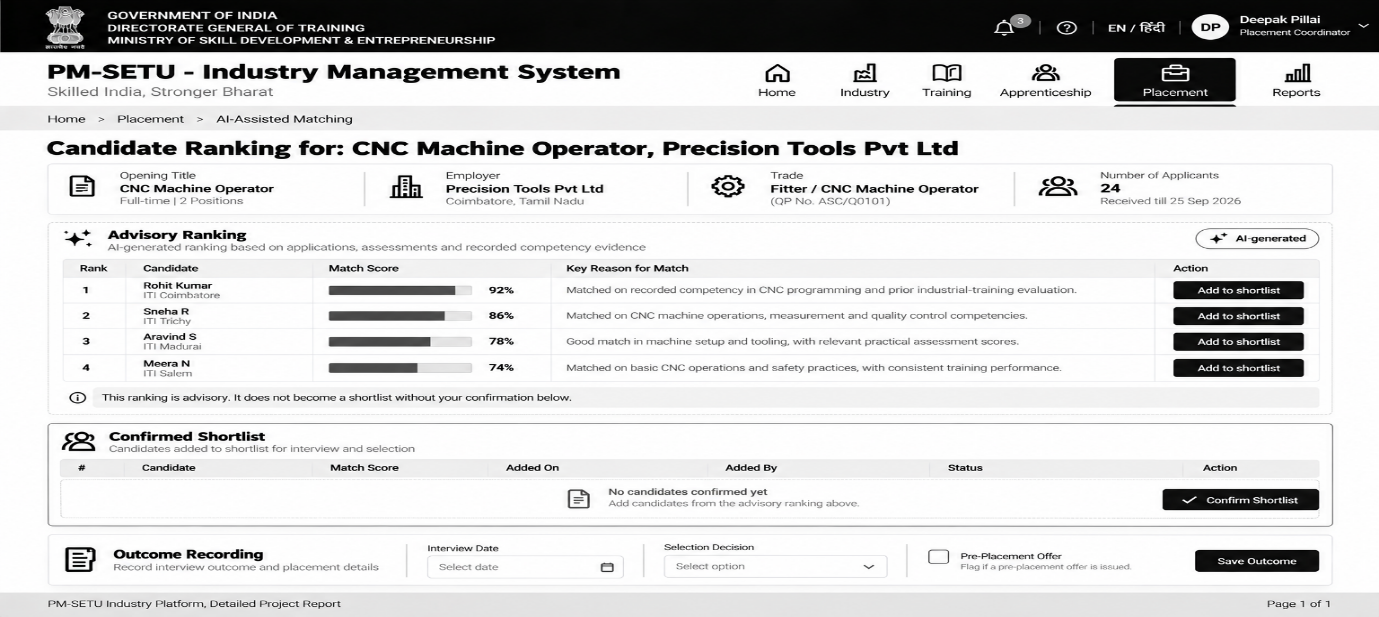
7.8 Industry contribution approval and reconciliation (Pillar 3, Pillar 8)PDF p.67
- 1.An industry partner offers equipment, scholarships, or capstone-project contribution (Pillar 3,
Pillar 8).
- 2.The contribution is logged and routed to the institution administrator, and, above a configured
value threshold, to the Special Purpose Vehicle, for acceptance (Pillar 3).
- 3.An accepted contribution is mapped to the relevant asset, trainee, or project record (Pillar 3,
Pillar 8).
- 4.Utilization evidence is captured over time (Pillar 3).
- 5.The contribution's value is reconciled with the corresponding entry in the Fiduciary
Management System's Budget and AOP Management module through the commitment-to- outcome chain (Pillar 3, Pillar 3).
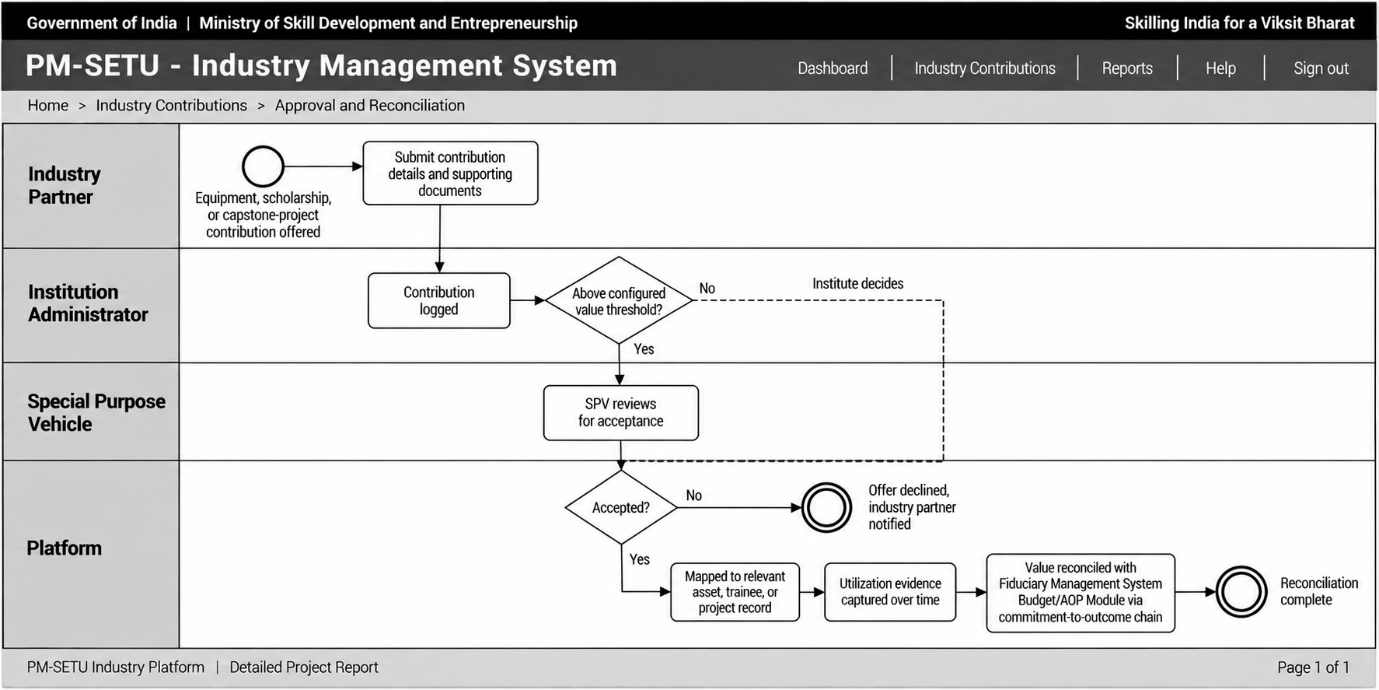
The mockup below shows the resulting contribution review screen referenced in the process design above, including the threshold-routing status, the mapping fields, and the Fiduciary Management System reconciliation note.
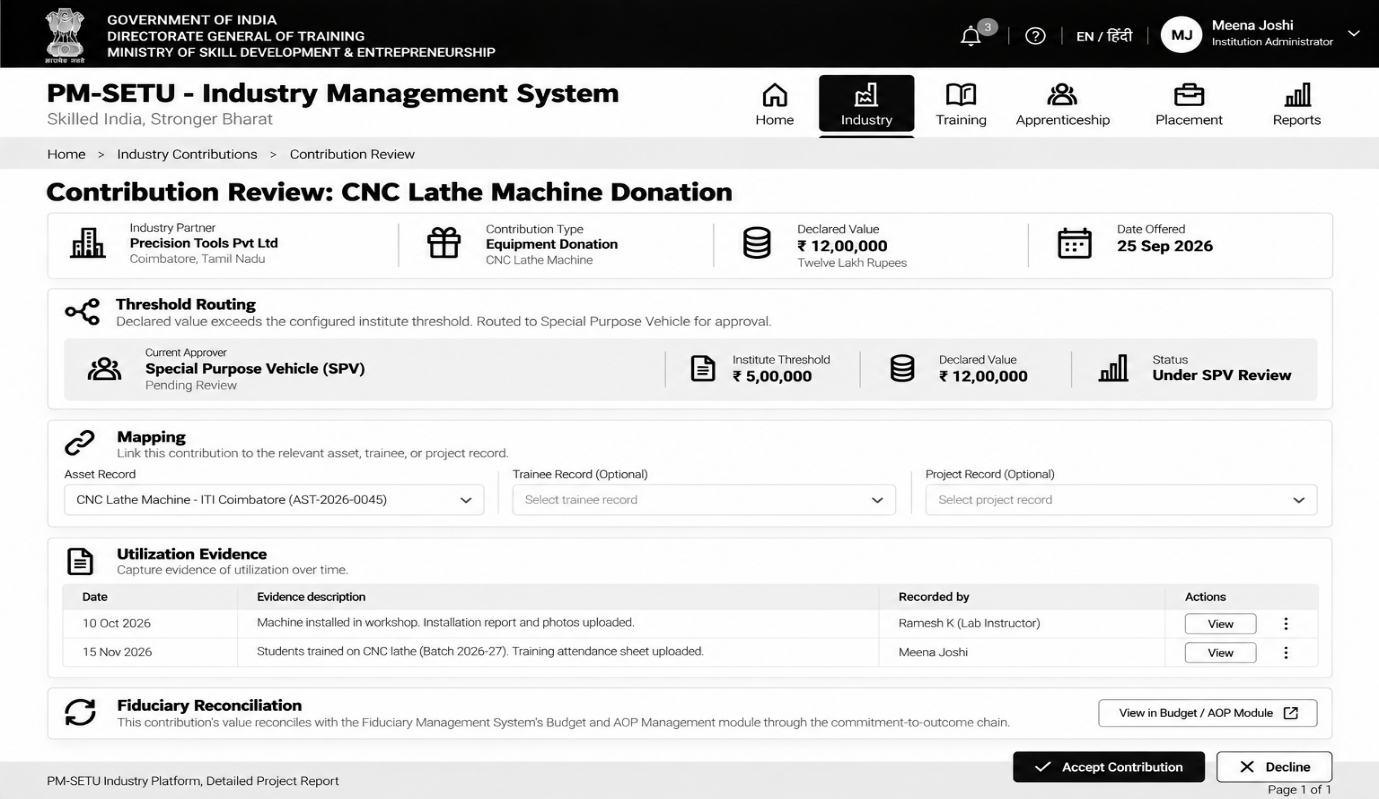
7.9 Mockup and interface requirementsPDF p.68
The following requirements apply to every screen produced during solution design for this platform, including each mockup referenced in Sections 7.1 through 7.8 above:
- •Every AI-assisted ranking, forecast, or Copilot answer is displayed with its stated reason or source citation, not as an unexplained output.
- •An AI-assisted output is visually and structurally distinct from a confirmed, recorded decision.
- •A Special Purpose Vehicle's or Institute Management Committee's continuity from a pre-PM-SETU governance record is clearly indicated, rather than presented as a newly created entity.
- •The five distinct trainee engagement types - On-the-Job Training, Dual System of Training, Internship, Apprenticeship, and Placement - are visually distinguishable wherever a trainee's activity record is displayed, so a user cannot mistake one for another.
- •A grievance or safety-incident record is never rendered on a screen accessible to a role outside the restricted scope specified in Section 5.2, regardless of the navigation path taken to reach it.
- •Every commitment-to-outcome view - for any agreement type - displays commitment, activity, output, and outcome figures side by side, consistent with the Pillar 3 reconciliation model.
- •A stale externally sourced value is labelled with the time of its last successful synchronization.
8. AnnexuresPDF p.69
Annexure A: Data Migration StrategyPDF p.69
This platform becomes the single record for the ITI-Industry relationship from go-live onward, but it does not begin with an empty ecosystem. Institutes, States, and existing Anchor Industry Partners already hold Memoranda of Understanding, employer lists, Institute Management Committee and Special Purpose Vehicle records, apprenticeship history, placement history, industry contribution records, and alumni data, much of it in spreadsheets, paper files, or systems this platform supersedes. This annexure specifies the strategy by which existing data becomes part of the platform's own record rather than being abandoned at go-live.
Migration life cyclePDF p.69
Every migrated data category shall pass through the following stages, in order, before the source system or record is retired:
Source Identification -> Extraction -> Cleaning -> Deduplication -> Industry Master Matching -> Validation -> Historical Migration -> Business Reconciliation -> Cutover -> Post-Cutover Audit
- •Source identification. Each participating State and institute catalogues its existing sources: MoU registers, employer contact lists, Institute Management Committee records, Special Purpose Vehicle registration documents, apprenticeship registers, placement records, contribution records, and alumni databases, whether digital or paper based.
- •Extraction and cleaning. Data is extracted from each identified source into a structured staging format, with obvious data-quality defects, such as missing mandatory fields or inconsistent trade names, corrected or flagged before proceeding.
- •Deduplication and Industry Master matching. A candidate industry record is matched against the Industry Master Profile structure specified in Pillar 1, using organization name, registration reference, and location as matching keys, with a human reviewer resolving an ambiguous match rather than the migration process guessing.
- •Validation. Every migrated record is checked against the validation rules already defined for its target pillar in Section 3, so that a record failing, for example, Pillar 5's requirement for a National Apprenticeship Promotion Scheme reference is flagged rather than silently loaded incomplete.
- •Historical migration. Validated records are loaded into the platform's operational store as historical records, explicitly tagged with their migration source and date, distinct from a record natively created in the platform after go-live.
- •Business reconciliation. The institute or State that owned the source record confirms that the migrated record count and key figures, such as active MoU count or apprenticeship seats, reconcile against what they know to be true before the source is retired.
- •Cutover and post-cutover audit. The platform becomes the system of record for the migrated category on an agreed cutover date, and a post-cutover audit is conducted at a defined interval after cutover to confirm no material discrepancy has emerged.
Migration scope and sequencingPDF p.69
Migration shall be sequenced to align with the three-tranche rollout defined in Section 6.3: Industry Master Profiles, due-diligence status, and active agreements migrate in Tranche 1, ahead of every pillar that depends on them; Dual System of Training, apprenticeship, placement, and safety history migrate
in Tranche 2, alongside the operational engines that will extend them; and alumni, tracer, and historical performance data migrate in Tranche 3, alongside the intelligence and scorecard capabilities that consume them.
Migration testing, specified in Section 6.1, shall be completed for a given data category before that category's source system is retired, and a defined rollback procedure shall exist for the cutover window in case a material reconciliation discrepancy is discovered after cutover but before the source system is decommissioned.
Annexure B: Implementation RoadmapPDF p.70
The three-tranche rollout sequencing defined in Section 6.3 states the order in which functional pillars go live; it is a release strategy. This annexure extends it into a complete implementation roadmap, stating what must be true before each phase begins, what must be true before it is considered complete, and the pilot scope through which each phase is proven before wider rollout.
| Phase | Focus | Entry Criteria | Exit Criteria | Pilot Scope |
| Phase 0: Discovery and data readiness | Source-system cataloguing, data- quality assessment, and Integration Catalogue finalization (Section 4.4) | Solution design approved; participating pilot States and institutes confirmed | Source data catalogued and quality-assessed; integration contracts signed off by every connected system owner | Not applicable: preparatory phase |
| Phase 1: Foundation | Pillar 1, Pillar 2, and Pillar 3: Industry Master Profile, due diligence, AIP/SPV/IMC governance, and the generalized MoU, SLA, and renewal engine | Phase 0 exit criteria met; Tranche 1 migration (Annexure A) complete for pilot scope | Foundation pillars live and in active use at pilot institutes; migrated Industry Master Profile and agreement data reconciled | A small number of Hub-and-Spoke clusters, agreed with DGT and the pilot States |
| Phase 2: Operational modules | Pillar 4, Pillar 5, Pillar 6, Pillar 9, and Pillar 10: training delivery, apprenticeship, safety, internship, placement, and placement-drive operation | Phase 1 exit criteria met; Tranche 2 migration complete for pilot scope; user training delivered to pilot-institute staff | Operational pillars live and in active use; User Acceptance Testing sign-off obtained per Section 6.1; hyper-care period completed without unresolved critical defects | The Phase 1 pilot clusters, extended to their full operational workload |
| Phase 3: Intelligence and governed AI | Pillar 7, Pillar 8, Pillar 11, Pillar 12, Pillar 13, and the AI and Intelligence Layer: curriculum and skill intelligence, guest faculty and live projects, alumni, grievance, performance and analytics, and the governed AI layer | Phase 2 exit criteria met; sufficient operational data accumulated to support AI capability training and validation per Section 3.14 | Intelligence and AI pillars live, each demonstrating its Section 3.14 acceptance criteria under production conditions | The Phase 1 and 2 pilot clusters |
| Phase | Focus | Entry Criteria | Exit Criteria | Pilot Scope |
| Phase 4: National expansion | Progressive onboarding of remaining Hub- and-Spoke clusters and States | Phase 3 exit criteria met; pilot success metrics achieved and reviewed with DGT | All planned clusters onboard and operating on the platform as their system of record | National, in State- by-State or cluster-by-cluster waves agreed with DGT |
For each phase, the detailed project plan produced during solution design shall additionally specify duration, dependencies, the training plan for that phase's newly onboarded users, the User Acceptance Testing schedule, the go-live date, a defined hyper-care period during which the implementation team provides elevated support, and the success metrics against which the phase is judged before the next phase begins. Success metrics shall include, at minimum, platform adoption rate among the phase's intended users, data-reconciliation accuracy against the migrated or newly captured source, and the absence of unresolved critical or high-severity defects at the end of the hyper-care period.
Annexure C: Financial and Resource PlanPDF p.71
This annexure provides the cost and resource structure a standalone Detailed Project Report requires. Where an element below is intended to be governed and funded through the parent PM-SETU programme budget or the Fiduciary Management System's Budget and Annual Operating Plan Management module rather than through a separate budget line for this platform, that intention is stated explicitly rather than left silent, consistent with the fiduciary-boundary principle already established in Section 1.1.
Cost structurePDF p.71
The total cost of ownership for this platform shall be planned and tracked under the following categories:
Capital Expenditure + Implementation + Integration + Migration + Security + Training and Adoption + Operating Expenditure + Support + Cloud Hosting + Artificial-Intelligence Inference + Disaster Recovery + Annual Maintenance Contract + Contingency
| Cost Category | Scope Covered | Indicative Basis |
| Capital expenditure | Initial platform build across the thirteen pillars specified in Section 3, and the Integration, Skill and Occupation, and Establishment masters specified in Section 4 | One-time, estimated during solution design against the approved technical architecture |
| Implementation and integration | Solution design, configuration, and construction of every interface listed in the Integration Catalogue (Section 4.4) | One-time per integration, scaled to the number of external systems and connected partner platforms |
| Data migration | Execution of the migration life cycle specified in Annexure A, including cleaning, deduplication, and reconciliation effort | One-time, scaled to the volume and quality of existing source data identified in Phase 0 |
| Security and compliance | ISO/IEC 27001:2022 certification, CERT-In empanelled Vulnerability Assessment and Penetration Testing, and ongoing compliance monitoring specified in Section 5.2 | One-time certification cost plus recurring half-yearly audit cost |
| Training and adoption | The Change and Adoption Plan specified in Annexure E, including train-the-trainer delivery, user manuals, and helpdesk setup | One-time per rollout phase, recurring for refresher training |
| Cost Category | Scope Covered | Indicative Basis |
| Cloud hosting and infrastructure | MeitY-empanelled cloud or National Informatics Centre hosting, sized to the concurrency and availability targets in Section 5.1 | Recurring, scaled to active user volume and data storage growth |
| Artificial-intelligence inference | Model hosting and inference cost for the twelve governed capabilities specified in the AI and Intelligence Layer | Recurring, scaled to query volume; to be estimated against the selected AI infrastructure during solution design |
| Disaster recovery | The geographically separate disaster recovery environment specified in Section 5.3 | Recurring, proportional to primary infrastructure cost |
| Operations, support, and Annual Maintenance Contract | The Operating and Support Model specified in Annexure D | Recurring, structured as an Annual Maintenance Contract with defined service levels |
| Contingency | Provision for scope refinement arising from solution design and for cost variance in categories above | A percentage of total estimated cost, to be agreed with DGT during budget finalization |
Resourcing and funding boundariesPDF p.72
Detailed cost figures against each category above shall be produced during solution design, once the technical architecture, hosting model, and AI infrastructure are finalized; this report establishes the cost structure and ownership boundary rather than a final cost budget. Where this platform's implementation is funded through the broader PM-SETU programme allocation described in the parent PM-SETU scheme documents and the Fiduciary Management System, this report defers the specific figures to that parent financial planning process, and the two documents shall be read together for a complete costed view. Resourcing for the implementation team, and for the ongoing operations team specified in Annexure D, shall similarly be finalized during solution design against the agreed delivery model.
Annexure D: Operating and Support ModelPDF p.72
The Service-Level-Agreement and Escalation Service, specified in Section 4.2.1, governs business- process timeliness, such as a delayed State review or an unresolved grievance. It is a distinct concern from application support, which governs the availability and correct operation of the platform itself. This annexure specifies the technical support and operations model required once the platform is live, addressing the concentrated-demand periods this report has repeatedly identified: placement drives, apprenticeship-cycle transitions, and Expression-of-Interest windows.
Support tiersPDF p.72
| Tier | Scope | Typical Handler |
| L1: User helpdesk | First-line user queries, password and access issues, basic navigation guidance, and initial triage of a reported defect | Helpdesk operator, supported by the user manuals and FAQs specified in Annexure E |
| L2: Application support | Configuration issues, data-correction requests, and functional defects not requiring a code change | Application support team with platform administrative access |
| L3: Engineering | Code-level defects, performance issues, and AI capability behaviour requiring investigation by the development team | Engineering team responsible for the platform's ongoing development |
| Tier | Scope | Typical Handler |
| L4: External integration and infrastructure | Issues originating in a connected external system, such as the PM-SETU LMS, the Fiduciary Management System, or a connected partner platform, or in underlying cloud infrastructure | Coordinated resolution with the owning team of the external system or infrastructure provider |
Incident, problem, change, and release managementPDF p.73
- •Incident management shall classify every reported issue by severity, with a defined response and resolution Service Level Agreement per severity level, and with production monitoring and alerting configured to detect a critical incident before it is user-reported wherever feasible.
- •Problem management shall track the recurring root cause behind repeated incidents, consistent with the repeat-incident detection principle already required for industry safety incidents in Pillar 6, applied here to platform-technical issues.
- •Change management and release management shall govern how a fix, an enhancement, or an AI model or rule-configuration change (Section 3.14.2) moves from development through testing to production, following the same continuous-integration and continuous-delivery pipeline specified in Section 6.3.
- •Defined maintenance windows shall be scheduled outside business hours wherever possible and shall exclude the concentrated-demand periods this report identifies: placement drives, apprenticeship-cycle transitions, and Expression-of-Interest windows.
- •On-call support and defined support hours shall be established for each tier, with extended or elevated coverage during a scheme-wide event such as a national placement drive.
Annexure E: Change and Adoption PlanPDF p.73
This platform assumes an unusually large and varied stakeholder base will use it as the single record for their part of the ITI-Industry relationship: DGT, State, Special Purpose Vehicle, institute, Training- and-Placement Officer, trainer, student, alumnus, employer, apprenticeship establishment, and industry expert. That assumption does not hold itself; it must be actively delivered through training, communication, and support, particularly for stakeholders, such as an ordinary industry partner or an apprenticeship establishment, who may have no prior experience of a DGT digital platform.
Adoption activitiesPDF p.73
- •Stakeholder-specific training, delivered separately for each major role identified in Section 1.4, covering the specific journey that role follows as set out in Section 2.
- •A train-the-trainer programme equipped with a nominated lead at each institute and State to support their own local users, reducing dependency on the central helpdesk for routine queries.
- •A structured institute-onboarding process, sequenced with the Phase 1 and Phase 2 pilot scope defined in Annexure B, and an equivalent industry-onboarding process for an Anchor Industry Partner or ordinary industry partner joining the platform for the first time.
- •User manuals, short instructional videos, and a maintained Frequently Asked Questions resource, in the languages specified in Section 5.8, covering every major stakeholder journey.
- •A helpdesk, operating as the L1 support tier specified in Annexure D, as the first point of contact for an adoption-related question distinct from a technical defect.
- •Migration support specific to the cutover period defined in Annexure A, helping an institute or State confirm that its migrated data is complete and correct before relying on the platform as its system of record.
- •A pilot-champion network at each Phase 1 and Phase 2 pilot institute, providing early feedback that shapes rollout to subsequent phases.
Adoption monitoringPDF p.73
- •Track defined adoption Key Performance Indicators per stakeholder group, including active-user rate against the eligible user base, and the proportion of relevant transactions (agreements,
batches, placements, grievances) recorded through the platform rather than through an offline or legacy channel.
- •Monitor usage patterns to identify a stakeholder group or institute with low adoption and route targeted support or re-training intervention accordingly.
- •Maintain a structured feedback loop from pilot users into the Phase 2 and Phase 3 rollout scope defined in Annexure B, so that adoption experience from earlier phases informs later ones.
Annexure F: National BenchmarkingPDF p.74
This annexure benchmarks the platform against the other national digital platforms already operating in India's skilling, apprenticeship, and employment space, so that design choices in Section 3 are made with clear knowledge of what already exists, what it does well, and where it has struggled. The governing principle drawn from this benchmarking, and applied throughout this report, is that the platform must plug into this existing national digital estate rather than duplicate it: identity, credentialing, and the base admissions and course record remain the responsibility of the Skill India Digital Hub and the PM-SETU LMS; this platform's distinct contribution is the industry-relationship, apprenticeship, and employment- outcome layer that no existing national platform currently provides in full.
| Platform | Owner / Governance | Scope | Scale (most recent reported) | Relevance to This Platform |
| NAPS / Apprenticeship India Portal (apprenticeshipindia.gov.in) | MSDE / DGT (Designated Trades); NSDC (Optional Trades); Central Apprenticeship Council issues certificates | Establishment and candidate registration, vacancy posting, contract creation, stipend tracking and Direct Benefit Transfer reimbursement | 9.85 lakh apprentices engaged in FY2024-25, rising to 11.84 lakh across calendar- year-2025 (Rajya Sabha reply, 11 March 2026; PIB PRID 2226495) | Direct precedent and mandatory integration point for Pillar 5 (Apprenticeship Management); its documented engagement- versus- registration gap directly informs Pillar 13's health- score design |
| NATS 2.0 (nats.education.gov.in) | Ministry of Education via the regional Boards of Apprenticeship / Practical Training (Mumbai, Chennai, Kanpur, Kolkata), with AICTE support | Apprenticeship for graduates, diploma holders, and sandwich- course students; registration, contract creation, certification, stipend disbursal | 5,23,024 apprentices engaged in calendar-year 2025 across all States and Union Territories (PIB PRID 2226495) | A second, structurally similar national apprenticeship system; confirms the value of a dedicated Apprenticeship pillar distinct from Placement |
| National Career Service (ncs.gov.in) | Ministry of Labour and Employment | Job matching, career counselling, vocational guidance, job fairs, and Model Career Centres | Over 6.02 crore jobseekers and 54.27 lakh employers registered, and over 8.17 crore vacancies | The designated national job- matching system this platform's Placement and Employer Management pillar integrates with rather than replicates |
| Platform | Owner / Governance | Scope | Scale (most recent reported) | Relevance to This Platform |
| mobilised since inception, as of 20 November 2025 (PIB) | ||||
| Skill India Digital Hub (skillindiadigital.gov.in) | MSDE, built and operated by NSDC / NSDC International | Unified Digital Public Infrastructure for training, assessment, certification, and job or apprenticeship discovery; Aadhaar- linked, DigiLocker- integrated | Over 7,000 training providers, more than 70 assessment agencies, over 68,000 employers or industry partners, and more than 1.5 crore candidates onboarded (MSDE, PIB PRID 2222120) | The Digital Public Infrastructure layer this platform's identity, admissions, and base credentialing depend on; this platform must be designed as a module within, not a parallel to, the Skill India Digital Hub |
| NCVT-MIS (ncvtmis.gov.in) | DGT; historically supported by Wipro | Legacy ITI examination, results, and certification management under the Craftsmen Training Scheme | Being progressively retired; data migration to the Skill India Digital Hub underway, with grievances closed after 15 September 2025 | A direct, cautionary precedent for platform consolidation risk: this platform's own migration strategy (Annexure A) must avoid the disruption a mid- life system retirement can cause |
| NSDC platforms (Skill India Portal / eSkill India) and Kaushal Panjee | National Skill Development Corporation, with the Ministry of Rural Development for Kaushal Panjee | National training- provider and course marketplace; rural mobilization tool for Deen Dayal Upadhyaya Grameen Kaushalya Yojana and RSETI | Not separately verified; superseded in significant part by the Skill India Digital Hub | Confirms NSDC's role as the operator of India's central skilling Digital Public Infrastructure, and the precedent for a majority-private- sector governance model (Annexure I) |
| State Skill Development Mission platforms (for | State-level not-for-profit or | State-level industry | Telangana Academy for | A precedent for the buy-and- |
| Platform | Owner / Governance | Scope | Scale (most recent reported) | Relevance to This Platform |
| example, Telangana Academy for Skill and Knowledge) | corporation bodies, typically under a State IT or Skill Development department | connects, internships, faculty development, and placement; increasingly layered with commercial career- services or labour-market- intelligence partners | Skill and Knowledge signed a memorandum of understanding with a commercial jobs platform (foundit) on 13 August 2026 to add career services and labour-market intelligence | integration approach recommended in Annexure H: a public skilling body layering a proven commercial product on top of its own platform rather than building equivalent capability from scratch |
What the national benchmark confirms and what it warns againstPDF p.76
Two findings from this national benchmarking directly shape this platform's design. First, no existing national platform combines industry relationship management, the full Dual System of Training and Flexi-MoU operational engines, a Training-and-Placement-Cell operating discipline, and an Industry Performance scorecard in one system; this platform fills a genuine gap rather than duplicating an existing national asset. Second, NAPS itself demonstrates a documented engagement-activation risk that this platform must design against directly: a 2026 NITI Aayog report found registered establishments fell from 2.03 lakh in FY2020-21 to 1.96 lakh in FY2024-25, and NAPS applications collapsed from 42.8 lakh in calendar-year 2022 to a little over 4 lakh in 2025, even as total apprentices engaged rose over the same period. This is precisely the failure mode the rules-based Industry Health Indicator in Pillar 13 and the relationship-lifecycle dormancy flag in Pillar 1 are designed to catch early, at the level of an individual industry partner, rather than allowing it to surface only as a national aggregate years later.
No dedicated, ITI-specific Industry Relationship Management or employer-engagement Customer- Relationship-Management system was identified operating anywhere in India at the time of this research; this platform's Pillar 1 (Industry Registry and Customer-Relationship Management) is, on the evidence available, the first of its kind for the ITI ecosystem.
Annexure G: Global BenchmarkingPDF p.76
This annexure benchmarks the platform against comparable vocational-training and apprenticeship systems internationally, kept explicitly separate from the National Benchmarking in Annexure F so that a reader can distinguish what is proven in the Indian regulatory and administrative context from what is a genuine cross-country design lesson. The overarching pattern across every mature system reviewed is a clean separation between a government-held backbone, which handles statutory registration, funding, and compliance, and a more flexible engagement or delivery layer, which is frequently run by an intermediary body, a contracted network, or a configurable commercial product. This platform's own architecture, in which the Skill India Digital Hub and the PM-SETU Learning Management System hold the statutory backbone while this platform runs the industry-engagement and employment-outcome layer, follows the same pattern.
| Country / System | Governance Model | Digital Approach | Scale (most recent reported) | Key Lesson for This Platform |
| Germany, dual Vocational Education and | Tripartite: federal government, | Decentralized: the self-governing chambers, not a | About 1.22 million active apprenticeship | A contract only becomes legally binding once |
| Country / System | Governance Model | Digital Approach | Scale (most recent reported) | Key Lesson for This Platform |
| Training (BIBB and the Chambers of Industry and Commerce or Crafts) | employers, and trade unions, coordinated through the Federal Institute for Vocational Education and Training (BIBB) | central portal, hold the statutory register of apprenticeship contracts, approve training companies, and run examinations | contracts in 2023, though new contracts fell from 570,000 in 2011 to 489,200 in 2023 (BIBB Data Report 2024) | registered by an intermediary body; this platform's Memorandum-of- Understanding and apprenticeship- contract registration in Pillar 3 and Pillar 5 follows the same discipline of registration as a gating, not merely a recording, step |
| Singapore, SkillsFuture Singapore (merging into the Skills and Workforce Development Agency from 1 July 2026) | A statutory board under the Ministry of Education, moving to a merged statutory board under the Ministry of Manpower | A single national portal (MySkillsFuture) coordinating funding, Skills Frameworks, and course discovery, built on cloud infrastructure | 260,000 Singaporeans used their SkillsFuture Credit in 2024, and about 1.05 million Singaporeans, 37% of the citizen population, have used it since 2016 (SkillsFuture Singapore, Year-In- Review 2024) | A single statutory board coordinating funding, standards, and the portal avoids the fragmentation documented in the United States (below); this favours this platform's own single-pillar-owner design over a fragmented multi- agency build |
| Australia, Australian Apprenticeships (Apprentice Connect Australia Providers, from 1 July 2024) | Federal funding and standards (Department of Employment and Workplace Relations; training.gov.au) with contracted intermediary providers delivering support and administration | A national training register (training.gov.au) plus an Apprenticeships Data Management System, with delivery contracted to a provider network | Spans 500 or more occupations nationally; support services contracted through to 30 June 2028 | A contracted- network delivery model, distinct from this platform's own Special Purpose Vehicle model in Pillar 2, but a useful reference point if a future phase considers contracting parts of Pillar 8 (Guest Faculty) or Pillar 10 (Placement Drives) delivery to a specialist intermediary |
| United Kingdom, Apprenticeship Service and the Institute for Apprenticeships and Technical | An employer- led statutory body (Institute for Apprenticeships and Technical | A digital apprenticeship- levy account lets a levy-paying employer browse standards, commit | The Apprenticeship Levy requires employers with a pay bill over 3 million | A cautionary precedent on institutional churn: an employer-led statutory body was abolished after eight |
| Country / System | Governance Model | Digital Approach | Scale (most recent reported) | Key Lesson for This Platform |
| Education (abolished 1 June 2025, functions transferred to Skills England) | Education) until 2025; now an executive agency of the Department for Education (Skills England) | funds, and manage apprenticeship programmes directly | pounds to contribute 0.5% of payroll, with a 10% government top-up | years; this platform's governance in Annexure I is deliberately built around durable Steering Committee and Project Management Unit structures rather than a single standalone statutory body, to reduce this risk |
| Switzerland, dual Vocational Education and Training | A Confederation, canton, and professional- organization partnership | Decentralized cantonal apprenticeship registers (for example, LENA in the canton of Aargau), with a nationally standardized contract form | Not separately verified in this research | A second confirmation, alongside Germany, that decentralized, legally binding registration at the point closest to the employer relationship is a mature-system pattern, consistent with this platform's institution- and cluster-level agreement registration in Pillar 3 |
| United States, Registered Apprenticeship (RAPIDS) and Apprenticeship.gov | The Department of Labor's Office of Apprenticeship and State Apprenticeship Agencies; administration is split, with about 25 states federally administered and the remainder state- administered | RAPIDS is the core registration and case-management system, migrated to a cloud-based architecture from 2017; Apprenticeship.gov is the public front door | Not separately verified in this research | The clearest cautionary precedent on federal-state data fragmentation: aggregate national statistics must be combined from federal and state systems that do not share one data model; this platform's Data Layer in Section 4.1 and its published, source- tagged data- freshness discipline are deliberately designed to avoid this fragmentation between DGT and the States |
| Canada, the Red Seal Program and Job Bank | Each province and territory manages its | Provincial systems remain distinct; a federal | Not separately verified in this research | A live, current example of a mature federal system only |
| Country / System | Governance Model | Digital Approach | Scale (most | Key Lesson for This Platform |
| recent | ||||
| reported) | ||||
| own apprenticeship registration; the Red Seal Program provides interprovincial standards across 50 or more trades | commitment is underway to digitize the Red Seal Program (online exams, digital logbooks, secure credentials) and create a single national registered- apprenticeship number | now unifying a national apprentice identity across jurisdictions, underscoring the value of this platform establishing a single Industry Master Profile and apprentice identity model, specified in Sections 1.2 and 4.5, from the outset rather than retrofitting one later |
Digital Approach Scale (most recent reported)
World Bank and Asian Development Bank Technical and Vocational Education and Training precedents
Because PM-SETU is itself co-financed by the Asian Development Bank and the World Bank through result-based loans covering up to 50% of the central government's share, the most directly comparable precedents are other multilateral-development-bank-financed Technical and Vocational Education and Training digital platform projects, rather than the higher-income systems above. The Asian Development Bank's "Supporting Innovation in the Philippine Technical and Vocational Education and Training System" project (project 54332-001, a 100 million United States dollar loan approved 6 December 2022) upgrades 17 Technical Education and Skills Development Authority Technology Institutions into industry-responsive innovation centres, strengthens the implementing authority's institutional capacity and information systems, and forges industry partnerships, delivered through a Project Management Unit. A related World Bank Philippines Skills Project (P508080, 2025) explicitly targets building the same authority's institutional capacity to steer the sector, addressing barriers to information, and strengthening information systems. Both projects confirm that a Project Management Unit, an industry-partnership mechanism, and a strengthened information system are considered standard, expected components of a multilateral-development-bank-financed Technical and Vocational Education and Training platform of this kind, directly supporting the governance structure this platform proposes in Annexure I.
Annexure H: Comparable Products and Demos ReviewedPDF p.80
This annexure lists the commercial and government-built products reviewed as comparable to individual pillars of this platform, organized by category, so that the implementation team can shortlist and demo them during solution design rather than building every pillar from an unproven, ground-up design. No single product reviewed covers the platform's full twenty-pillar scope; the recommended approach, consistent with the buy-and-configure principle stated in Section 4, is to anchor the platform on a proven education or workforce Customer-Relationship-Management core and integrate purpose-built components for apprenticeship management, career services, and skills intelligence around it, rather than commissioning a single monolithic build. Vendor-reported scale and client figures below are self- reported marketing claims and shall be independently re-verified at the demo and procurement stage.
Apprenticeship management softwarePDF p.80
| Product | Vendor | Coverage | Notable Deployments |
| Aptem | Aptem Ltd, London | End-to-end apprenticeship enrolment, compliance reporting, e-portfolio, off-the- job-training tracking, employer engagement, analytics, open Application Programming Interface | Corndel, since 2017 (vendor-reported); listed on the United Kingdom G-Cloud Digital Marketplace |
| Bud | Bud Systems Ltd, Bristol | End-to-end training and apprenticeship delivery, employer-engagement workflows, funding calculations, business-intelligence reporting | Listed on the United Kingdom G-Cloud Digital Marketplace |
| OneFile | OneFile | E-portfolio and evidence capture for apprenticeships and vocational training, mobile trainer-to-apprentice interaction | Widely used across United Kingdom apprenticeship providers (vendor- reported) |
Career services, placement, and internship platformsPDF p.80
| Product | Vendor | Coverage | Notable Deployments |
| Symplicity (Career Services Manager) | Symplicity Corporation | Job and internship postings, employer Customer- Relationship-Management, on-campus recruiting, virtual career fairs, outcomes tracking | Vendor claims 1,300 or more university career centres across approximately 35 countries |
| Handshake | Handshake | Early-career recruiting network connecting students, institutions, and employers | Vendor claims 1,400 to 1,600 higher-education partners, 15 to 25 million students and alumni, and 750,000 or more employers including the full Fortune 500, plus 260 or more community and technical colleges |
| 12Twenty | 12Twenty | Data-driven career services and outcomes analytics for graduate and professional programmes | Vendor and press reports cite use by 50 or more of the top 100 universities |
| Product | Vendor | Coverage | Notable Deployments |
| GradLeaders | GradLeaders | Configurable, white-labelled career-services management, campus recruiting, experiential and co-op management, outcomes surveys, virtual fairs | Serves four-year, two-year, graduate, and workforce- development agency clients |
| Riipen | Riipen Networks Inc. | Work-integrated and experiential-learning marketplace embedding real employer projects into curriculum | Vendor claims 760 or more education partners and 53,000 or more employers as of June 2026, including Arizona State University, Western Governors University, York University, and Seneca College |
| Parker Dewey | Parker Dewey | Paid Micro-Internships, ten to forty hours, for talent assessment and pipeline building | Vendor claims access to students from 3,000 to 5,900 or more schools |
| Forage | Forage | Free, employer-funded virtual work-experience job simulations, embeddable in coursework through Forage for Education | Employer-funded simulations from JPMorgan Chase, Citi, Accenture, Boston Consulting Group, and Deloitte, among others (vendor-reported) |
Education-focused Customer-Relationship-Management platformsPDF p.81
| Product | Vendor | Coverage | Notable Deployments |
| Education Cloud (including workforce- development capability) | Salesforce | Education-specific Customer- Relationship-Management spanning recruitment and admissions, student success, financials, advancement and alumni, and corporate or partner relationship management, with an embedded artificial-intelligence agent capability | Widely deployed across higher-education and workforce-development institutions (vendor- reported); the strongest single-vendor fit for this platform's Industry Master Profile, Memorandum-of- Understanding, and Alumni pillars |
| Ellucian Customer- Relationship- Management (Recruit, Advise, Advance) | Ellucian | Higher-education Customer- Relationship-Management suite, historically integrated with the Banner and Colleague systems of record | Announced migration onto the Microsoft Dynamics 365 platform in March 2025 |
| Dynamics 365 for Education | Microsoft | Assembled from Dynamics 365 Sales, Customer Insights, and the open-source Education Accelerator data model on the Power Platform | Employer-relationship management handled through standard sales- pipeline objects; a credible alternative core to Salesforce Education Cloud |
| HubSpot for Education | HubSpot | A relationship and engagement layer for lead capture, nurture, | Not a full student- information system; a |
| Product | Vendor | Coverage | Notable Deployments |
| pipeline reporting, and alumni communication | lighter-weight alternative for the Customer-Relationship- Management layer alone |
Skills intelligence and labour-market analytics platformsPDF p.82
| Product | Vendor | Coverage | Notable Deployments |
| Lightcast (formerly Emsi Burning Glass) | Lightcast | Real-time job-posting analytics, wage data, a skills taxonomy, and program-to-job alignment for workforce and economic-development planning | Vendor claims data coverage across 99% or more of the United States workforce and 40 or more countries; serves enterprise, education, and public-sector clients |
| Talent Insights | Talent-pool and company workforce analytics drawn from LinkedIn's own member and company data | Widely used for enterprise workforce planning; a caveat for this platform is that it measures LinkedIn members only, under-representing vocational and industrial cohorts of the kind ITI graduates and industry partners typically represent | |
| Faethm | Pearson (acquired September 2021) | Artificial-intelligence-driven forecasting of automation and technology impact on jobs and required skills | Used by large enterprises and by government bodies including the United Kingdom government (vendor- reported) |
| Gloat | Gloat | Artificial-intelligence internal talent marketplace for skills- based internal mobility and project staffing | Enterprise clients including Unilever, PepsiCo, and Standard Chartered (vendor- reported); a reference point for internal workforce mobility rather than a public placement analogue |
Indian ed-tech, gov-tech vendors, and system integratorsPDF p.82
| Vendor / Product | Documented Role | Relevance |
| iMocha | Artificial-intelligence skills-assessment and skills-intelligence platform; vendor claims 300 to 500 or more organizations across 70 or more countries | A candidate for assessment and placement-readiness scoring components referenced in Pillar 10 |
| TeamLease | Apprenticeship programme management under NAPS and NATS as a Third-Party Aggregator; runs NETAP, a public-private partnership with MSDE, TeamLease Skills University, the Confederation of Indian Industry, and the National Skill Development Corporation | A directly relevant Indian apprenticeship-delivery precedent; note that MSDE de-empanelled 11 Third- Party Aggregators and issued warnings to 32 others in June 2025, so TeamLease's current |
| Vendor / Product | Documented Role | Relevance |
| empanelment and entity status should be re-verified before engagement | ||
| Wipro | Confirmed operator and support provider for NCVT-MIS | A precedent for a systems- integrator-operated national DGT platform; a candidate implementation partner or a reference for migration planning in Annexure A |
| NSDC / NSDC International | Owner and operator of the Skill India Digital Hub | The mandatory integration partner for identity, admissions, and credentialing, referenced throughout Section 4 |
| TCS iON | Documented partnership with NSDC and eSkill India (2018 memorandum of understanding; 2020 Digital Glass Room); Sector Skill Council assessment deployments | A candidate systems- integration or assessment- delivery partner with existing National Skill Development Corporation relationships |
| National Informatics Centre | Builds and maintains major national government portals, including the Kaushal Panjee mobile application; its specific role on DGT apprenticeship portals is not verified | A standard government- platform-hosting option to evaluate alongside a MeitY- empanelled commercial cloud provider |
Infosys was not verified in this research as a builder or operator of any Government of India skilling platform; it appears in public sources only as an employer engaging apprentice, not as a platform vendor, and should not be assumed to be a systems-integration candidate on the strength of this research alone.
Annexure I: Governance StructurePDF p.83
This annexure sets out, first, the governance models of comparable national skilling and apprenticeship programmes benchmarked for this platform, and second, the governance structure this platform itself proposes, built on the strongest and most durable elements of those benchmarks. It should be read alongside Pillar 2, which specifies the platform's functional support for Anchor Industry Partner, Special Purpose Vehicle, and Institute Management Committee governance; this annexure addresses the governance of the platform programme itself, not only the digital capability the platform provides to the clusters it serves.
Benchmarked governance modelsPDF p.83
| Programme | Governance Model | Relevant Feature |
| PM-SETU (this programme) | Centrally Sponsored Scheme under the Ministry of Skill Development and Entrepreneurship; each upgraded cluster is run by an industry-led Special Purpose Vehicle in which the Anchor Industry Partner holds 51% and central and state governments together hold 49% | A "government-owned, industry- managed" model; States select Anchor Industry Partners through a two-stage Expression of Interest followed by a competitive Request for Proposal, specified in Pillar 2 |
| Programme | Governance Model | Relevant Feature |
| National Skill Development Corporation | A not-for-profit company under Section 25 of the Companies Act 1956, structured as a Public-Private Partnership: 49% Government of India shareholding (through the Ministry of Skill Development and Entrepreneurship) and 51% private- sector shareholding, governed by a roughly fourteen-member Board of Directors, Board Sub-Committees, and an Executive Council | The most direct Indian precedent for PM-SETU's own majority- private ownership model, and evidence that such a structure can operate durably as a national platform owner |
| NAPS and NATS | NAPS governed by the Ministry of Skill Development and Entrepreneurship and the Directorate General of Training, with the Central Apprenticeship Council issuing certificates; NATS governed by the Ministry of Education through the regional Boards of Apprenticeship and Practical Training, with All India Council for Technical Education support | Two parallel national apprenticeship governance tracks operating under the same Apprentices Act, 1961, confirming that a single statute can support more than one governance and delivery track without conflict |
| United Kingdom, Institute for Apprenticeships and Technical Education (abolished 1 June 2025) | An employer-led statutory body governed by an independent chair, a chief executive, and ten non- executive members appointed by the Secretary of State for Education, until its functions transferred to Skills England, an executive agency of the Department for Education | A cautionary precedent: an employer-led statutory body, however well designed, can be abolished within a decade if it does not retain ministerial confidence; this argues for embedding this platform's governance in durable Steering Committee and Project Management Unit structures rather than in a single standalone statutory body |
| Germany, dual Vocational Education and Training | Tripartite governance among the federal government, employers, and trade unions, coordinated through the Federal Institute for Vocational Education and Training's Main Board, with day-to-day registration and examination authority delegated to the self-governing Chambers of Industry and Commerce and Crafts | A precedent for delegating operational governance, specifically contract registration, to accountable intermediary bodies close to the employer relationship, rather than centralizing every decision nationally |
| Singapore, SkillsFuture Singapore, merging into the Skills and Workforce Development Agency from 1 July 2026 | A statutory board under a single ministry, with clear funding, standards, and portal ownership concentrated in one body | A precedent for concentrating platform ownership, funding policy, and standards authority in a single accountable body rather than splitting them across several agencies |
| Australia, Australian Apprenticeships | Federal funding and standards authority (the Department of Employment and Workplace Relations and training.gov.au) with delivery and support contracted to Apprentice Connect Australia | A precedent for a funder-regulator- versus-contracted-delivery split, relevant if a later phase of this platform considers contracting elements of guest-faculty or |
| Programme | Governance Model | Relevant Feature |
| Providers, alongside state and territory training authorities | placement-drive delivery to a specialist intermediary | |
| World Bank and Asian Development Bank Technical and Vocational Education and Training projects (for example, the Philippines Technical Education and Skills Development Authority projects) | A Project Steering Committee, a Project Management Unit with technical and safeguards focal points, an industry-partnership mechanism, and a strengthened information system, as standard components | The direct structural precedent for this platform's own proposed Project Management Unit and Steering Committee structure below, consistent with PM-SETU's own co-financing by the Asian Development Bank and the World Bank |
Proposed governance structure for this platformPDF p.85
Drawing on the benchmarks above, and consistent with the fiduciary-boundary and Service-Level- Agreement principles already established in Sections 1.3 and 4.2.1, this platform's own governance is structured in four tiers.
- •National Steering Committee. An inter-ministerial body chaired by the Directorate General of Training, with representation from the Ministry of Skill Development and Entrepreneurship, the Asian Development Bank and World Bank co-financing teams, and nominated State representatives, holding final approval authority over cluster onboarding (Pillar 2) and national policy questions this platform surfaces, such as a proposed change to the Industry Health Indicator weighting in Pillar 13 or the taxonomy governance in Section 4.5. This is the platform-programme- level equivalent of the Project Steering Committee structure the Asian Development Bank and World Bank precedents in this annexure document as standard.
- •Central and State Project Management Units. A central Project Management Unit under the
Directorate General of Training, and a State Project Management Unit in each participating State, responsible for day-to-day programme delivery, Anchor Industry Partner Expression-of-Interest and Request-for-Proposal administration, and the phased rollout defined in Annexure B. This mirrors the Project Management Unit structure the Asian Development Bank's Philippines Technical Education and Skills Development Authority project and the World Bank's Philippines Skills Project both document as the standard delivery vehicle for a Technical and Vocational Education and Training platform of this kind.
- •Data Governance Board and Technical Working Groups. A Data Governance Board, meeting
on a fixed cadence, holding authority over the Skill and Occupation Taxonomy in Section 4.5, the Industry Establishment and Facility Master in Section 4.6, and any proposed change to the Artificial Intelligence governance controls in Section 3.14, so that these shared, cross-cutting assets are not altered unilaterally by a single pillar owner. Technical Working Groups, convened as needed around a specific integration (Section 4.4) or a specific pillar's implementation, report into this Board.
- •Cluster-level governance (Special Purpose Vehicle and Institute Management Committee).
As already specified in Pillar 2: continuing board operation, meeting cadence, conflict-of-interest declarations, and Disbursement-Linked Indicator evidence and verification at the level of each individual cluster, feeding upward into the Central and State Project Management Units and, ultimately, the National Steering Committee. This four-tier structure is deliberately built around durable committee and unit structures, rather than around a single standalone statutory body of the kind the United Kingdom's Institute for Apprenticeships and Technical Education precedent shows can be abolished within a decade. Where a specific committee composition, meeting cadence, or delegation of authority is not yet confirmed in a published PM-SETU scheme guideline, it is presented here as a recommended structure for confirmation during solution design, consistent with the sourcing discipline applied throughout this report.