On this page: jump to a section
- 1. Overview
- Scope
- Key Assumptions
- 2. Business Requirements
- Content authoring and review user journey
- Assessment development of user journey
- Language, accessibility and guideline conformance user journey
- Immersive / AR-VR content production and delivery user journey
- Registration, library reuse and industry ingestion user journey
- AI support and content compliance assist user journey
- 3. Functional System Requirements
- Pillar 1: Content authoring
- Pillar 2: Assessment content development
- Pillar 3: Multimedia and multi-language integration
- Pillar 4: Immersive and simulation content development
- Pillar 5: Accessibility
- Pillar 6: Course development guidelines and standards conformance
- Pillar 7: Resource libraries
- Pillar 8: Integration
- 4. Solution Architecture
- Authoring and content layer
- Platform layer
- Immersive content pipeline and institute delivery
- User access layer
- 5. Nonfunctional Requirements
- Performance requirements
- Security requirements
- Availability, retention and disaster recovery
- Audit logging requirements
- Compliance requirements
- 6. Testing Strategy and Deployment Approach
- Testing strategy
- Acceptance criteria for go-live
- Deployment approach
- 7. Process designs and mockups
- Content authoring and review process design and mockup
- Assessment development process design and mockup
- Language, accessibility and guideline conformance process design and mockup
- Immersive content production and delivery process design and mockup
- Registration, library reuse and industry ingestion process design and mockup
- 8. References
- Annexure A - Existing Platform Position


Detailed Project Report for Digital TLM Development Tools
1. OverviewPDF p.3
This section defines the business, functional, and implementation requirements for the Digital TLM Development Tools module, forming part of the Learning and Operations Management System established under PM-SETU. The module is envisaged as the authoring and governance environment through which teaching-learning material is composed, reviewed, made accessible, packaged to interoperability standards, and retained for reuse, before it is delivered to learners through the Learning Management System. The module does not deliver instruction and does not maintain any record of learner progress; that boundary is deliberate and is carried through the rest of this document. Two capability areas distinguish this version from the module's first release. The f irst is a set of course development guidelines governing the structural form a course must take, the taxonomy in which its learning outcomes and assessment are expressed, spanning Bloom's cognitive domain together with a psychomotor and an affective domain suited to trade practice, and the interoperability standards, including SCORM, LTI Advantage, xAPI/cmi5 and QTI 3.0, to which packaged content must conform. The second is immersive and simulation content development, covering the authoring of augmented and virtual reality scenarios and the hardware and software estate an Industrial Training Institute needs to deliver them. Both capabilities are specified so that they govern any conformant platform or device rather than a named vendor or system, consistent with the neutral, capability-based drafting the scheme requires. In line with the Ministry's broader digital governance direction, the module has been designed to align with the interoperability and federated-architecture principles articulated under the National Digital Education Architecture (NDEAR). Adopting these principles will enable the module to interoperate with adjacent national platforms for learner, trainee, and credential data as the skilling ecosystem's digital backbone matures.
ScopePDF p.3
The module will provide a Content Authoring pillar for collaborative, version-controlled composition of material against an approved curriculum, with a defined pathway for an Anchor Industry Partner or Institute to contribute existing material rather than re-authoring it. It will provide an Assessment Content Development pillar spanning the formats prescribed for trade assessment, tagged to competency, taxonomy level and difficulty, and blueprinted before items are authored. A Multimedia and Multi-Language Integration pillar will provide media handling and regional-language versioning maintained against a source. An Immersive and Simulation Content Development pillar will provide the composition of scenario specifications, the ingestion and optimisation of portable three-dimensional assets, and the mapping of simulator telemetry to competency. An Accessibility pillar and a Course Development Guidelines pillar will each enforce conformance at the point of authoring rather than upon subsequent audit. A Resource Libraries pillar will retain approved material for reuse, and an Integration pillar will define the standards- based interfaces connecting the module to curriculum, identity, delivery, examination and telemetry systems outside it. The delivery of material to learners, the conduct of examinations, and the sanction of a trade curriculum prior to authoring are administered outside this module and are referenced only where they bear on its entry conditions. Immersive and simulation hardware deployed at an Institute remains the equipment of the Institute or its delivery partner; this module composes and governs the content that runs on it and does not host or render the content itself.
Key AssumptionsPDF p.3
- •Single sign-on: Single Sign-On through the Government Identity and Access Management
framework will be operational prior to rollout, resolving every stakeholder to a role and a content-owning entity.
- •Curriculum as an external record: The trade curriculum against which material is authored,
the qualification, the National Occupational Standards, the National Skills Qualifications Framework level and the modular and credit structure prescribed under the scheme, will be available from the Compliance and Accreditation Management module and will not be created within this module.
- •Stable framework, configurable rules: The curriculum framework prescribed under the
scheme, comprising 240-hour modules carrying eight credits, core and cluster-specific modules, and the routing of content through the National Instructional Media Institute for
uniformity, will remain the structural basis of authoring. Future revision is addressed by reconfiguring the standards and rule set defined in Section 3 and the reference register at Section 8, not by re-coding the module.
- •Rights position: Newly developed courses and content under the scheme are the property
of the Directorate General of Training and may be used in any Industrial Training Institute, whether within the scheme or outside it. The module records that position upon every published item.
- •Immersive delivery is hardware the module does not own: Immersive and simulation
content will be delivered upon hardware procured by the Special Purpose Vehicle under the Strategic Investment Plan, against the device-tier and AR/VR delivery requirements defined under Pillar 4. A learning record store conforming to xAPI will operate as a shared service of the wider Learning and Operations Management System; this module reads aggregate statistics from it and does not hold the learner-attributed statement. The table below sets out the stakeholders of the module and their role in its ecosystem.
| Stakeholder | Role in the Content Ecosystem |
| Content Author / Subject Matter Expert | Composes and contributes teaching-learning material against approved curriculum |
| Reviewing and Approving Authority | Decides publication; competent for the trade concerned |
| Assessment Author | Composes, tags and banks assessment items against a blueprint |
| Language and Accessibility Editor | Produces regional-language versions; remediates accessibility deficiencies |
| Instructional Design Authority | Owns the guideline rule set; adjudicates instructional- design review and exemptions |
| Immersive Content Producer | Authors immersive scenarios; ingests and optimises three-dimensional assets |
| National Content Standards Authority | Registers content for uniformity ahead of national publication |
| Industrial Training Institute / Trainer | Reuses the library; authors local material; launches immersive sessions |
| Anchor Industry Partner | Contributes existing training material into the module under a defined ingestion route |
| Module Administrator | Configures taxonomies, workflow, conformance rules and device tiers |
2. Business RequirementsPDF p.4
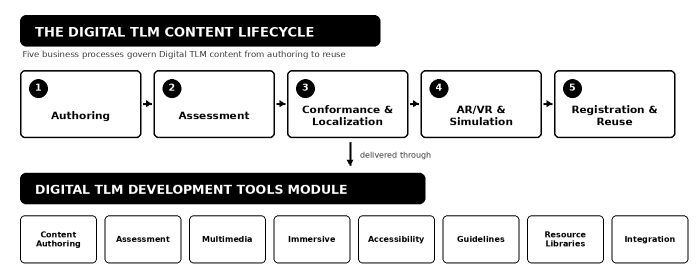
The Digital TLM Development Tools module digitises and governs the end -to-end content lifecycle of the programme through five business processes. The lifecycle commences with authoring, under which content is composed against an approved curriculum and within the structural and taxonomic form the guidelines prescribe. Assessment development then produces the items that measure it, blueprinted before items are authored and tagged to competency and taxonomy level. Language, accessibility and guideline conformance bring material to the standard required for a national, multi-language, multi-format library, this is also where a course is checked against the modular structure, the taxonomy and the interoperability standards the scheme prescribes. Immersive and simulation content development authors augmented and virtual reality scenarios, prepares the assets they depend on, and maps the telemetry a session returns to a competency. Finally, registration, library reuse and industry ingestion route approved content through the National Instructional Media Institute for uniformity, retain it for reuse by reference across clusters, and admit material contributed by an Anchor Industry Partner or an Institute on the same terms as authored content.
These processes are complex to administer. They span ten stakeholders, each with distinct authority and information needs, and they involve version-controlled multi-author composition, curriculum and competency mapping, a three-domain taxonomy, device-tier-aware immersive authoring, and standards-based packaging. Administering this lifecycle through fragmented or manual means would produce inconsistent material, weak traceability of authorship and approval, and content that cannot be reliably registered or certified. A dedicated content-authoring module is therefore required to act as the single source of truth for content and for the decisions taken upon it. The table below sets out the access rights available to each stakeholder across the module's eight functional pillars, described next.
| Stakeholder | Authori ng | Assessm ent | Multimedi a | Immersiv e | Accessibi lity | Guideline s | Libraries |
| Content Author / SME | Full | Contribut e | Full | Contribut e | Author | Conform | View / Reuse |
| Reviewing & Approving Authority | Approv e | Approve | Approve | Approve | Approve | Approve | View |
| Assessment Author | View | Full | View | View | Author | Conform | View / Reuse |
| Language & Accessibility Editor | View | View | Full | Translate only | Full | Conform | View |
| Instructional Design Authority | Revie w | Review | View | Review | View | Configure / Approve | View |
| Immersive Content Producer | Contrib ute only | Contribut e only | Contribut e only | Full | Author | Conform | View |
| National Content Standards Authority | Regist er | Register | Register | Register | View | View | View |
| ITI & Trainer | Local only | Formativ e only | View | Launch only | View | View | Full |
| Anchor Industry Partner | Contrib ute only | Contribut e only | Contribut e only | Contribut e only | View | Conform | View |
| Module Administrator | Config ure | Configur e | Configur e | Configur e | Configure | Configure | Configure |
Content authoring and review user journeyPDF p.6
- •Entry condition: A content development project may be raised only against a trade recorded as approved and notified by the Directorate General of Training; the qualification, National Occupational Standards and modular structure are read into the project from the curriculum record and are not entered by the author.
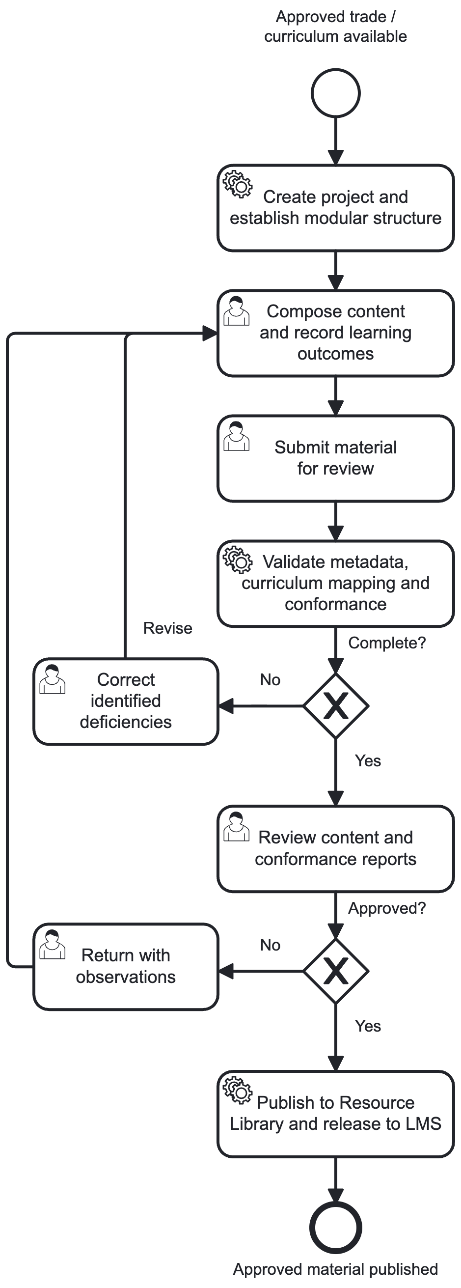
- •Structure established: The module establishes the 240-hour modular structure prescribed for the trade at project creation, distinguishing core modules, authored once and reused by reference across every cluster, from cluster-specific modules; a departure from the prescribed structure requires recorded approval by the Instructional Design Authority.
- •Composition: The author composes material against the structure established, recording a learning outcome against every module, session and topic in a verb drawn from the controlled taxonomy bank, and may associate further authors and subject matter experts, every contribution being attributed and every version retained.
- •Contribution route: An Anchor Industry Partner or an Institute may instead contribute existing material as a self-contained package or an externally hosted tool, associated with the trade it supports and routed through the same review as authored material.
- •Submission and validation: The author submits for
review; the module validates that metadata, curriculum mapping, and both conformance reports are complete before submission proceeds, and identifies the deficiency where they are not.
- •Review and decision: The Reviewing and Approving Authority, competent for the trade and never the author of the item under review, examines the material together with its conformance reports and either approves or returns it with observations recorded; an unresolved item escalates upon lapse of its service level.
- •Publication: Approved material is published to the Resource Library with the Directorate General of Training recorded as rights holder, released to the Learning Management System, and given a periodic review date.
Assessment development of user journeyPDF p.7
- •Blueprint before items: Before items are authored, the Assessment Author composes or reads the assessment blueprint for the module, stating the distribution of items and marks by taxonomy level, assessment mode and competency.
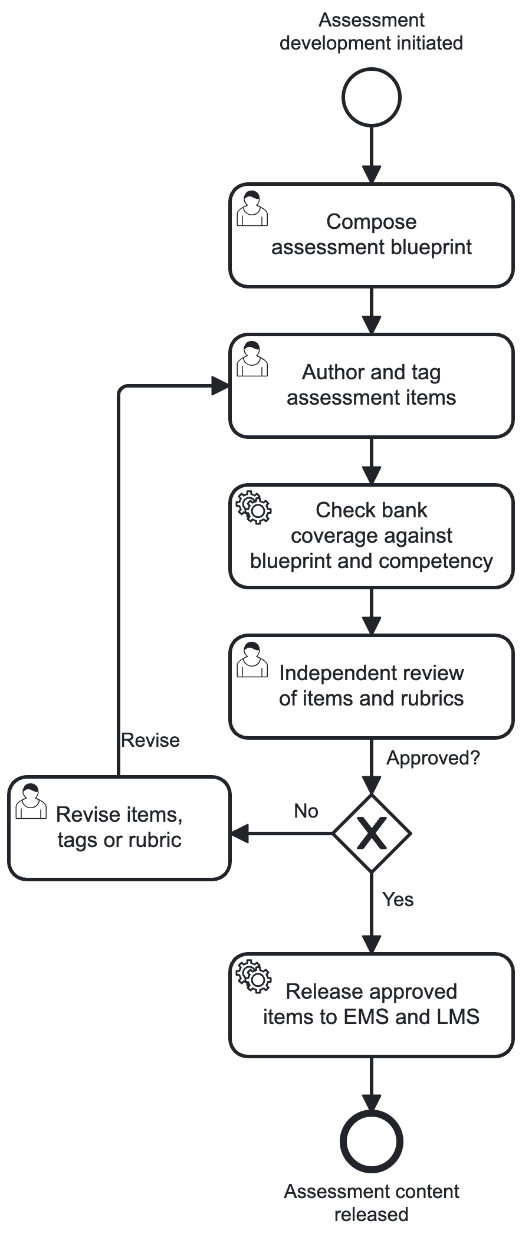
- •Composition and tagging: Items are composed in the formats the trade assessment pattern prescribes, objective, descriptive, practical task and observation rubric, and viva with rubric, and every item is tagged to the competency, the taxonomy domain and level, the difficulty, and the assessment mode; an untagged item cannot be submitted.
- •Bank reporting: The module reports the composition of a bank against its blueprint and against the qualification's competencies, identifying under- representation and any competency not covered.
- •Independent review: Review is conducted by an officer other than the author in every case; an item under embargo in a live examination cannot be edited, and an edit creates a new version rather than altering the item in use.
- •Release: Approved items are released to the Exam Management System for formal examination and to the Learning Management System for formative assessment, remaining under the control of this module throughout.
- •Simulation-linked assessment: Where a competency
is assessed by simulation, a telemetry threshold returned from an external simulator is mapped to that competency and converted to a score, and a simulator proficiency prerequisite may be enforced before a candidate proceeds to the corresponding physical workshop examination.
Language, accessibility and guideline conformance user journeyPDF p.8
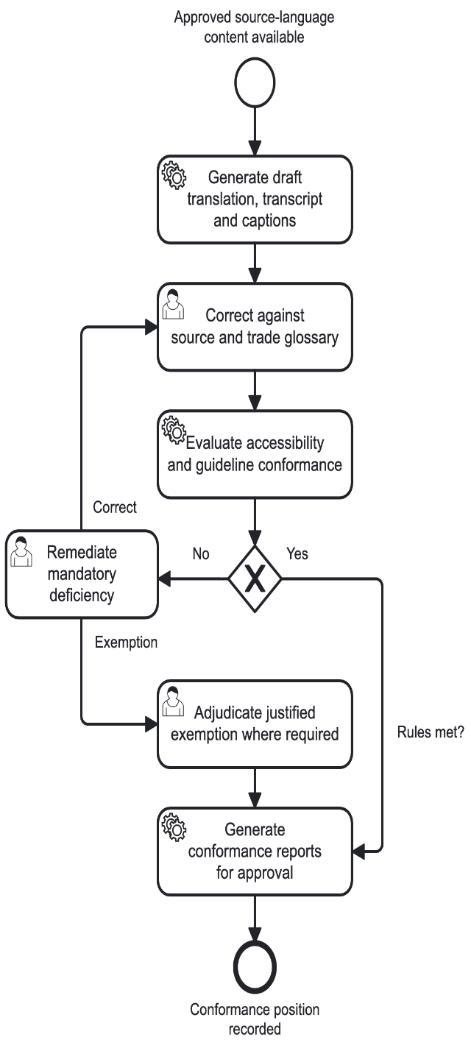
- •Draft and correct: Once an item is approved in its source language, the module produces a draft translation and, for video, audio or immersive string tables, a draft transcript or caption track; the Language and Accessibility Editor corrects the draft against the source and the trade glossary before it is submitted for review.
- •Accessibility at the point of authoring: Every item is
evaluated continuously against the accessibility rule set as it is composed, and a mandatory deficiency, alternative text, an accessible label, captions, or the provisions prescribed for immersive content, prevents submission until it is corrected.
- •Guideline conformance: The same evaluation
applies to the course development guidelines defined in this DPR and the standards reference register at Section 8: the taxonomy verb and level of a recorded learning outcome, the assessment blueprint composition, the metadata schema, and the interoperability standard a packaged item declares are each checked, and a mandatory deficiency prevents submission.
- •Exemption, not omission: Where a deficiency cannot be corrected by reason of the nature of the material, the Instructional Design Authority adjudicates an exemption, recording the officer, the ground and the period; an exemption is never granted by the author or by an officer of the authoring organisation.
- •Conformance report as a condition of approval: Both the accessibility and the guideline
conformance report are presented to the Reviewing and Approving Authority before an approval decision is taken, and a change to either rule set applies prospectively, raising published material for remediation rather than withdrawing it outright.
Immersive / AR-VR content production and delivery user journeyPDF p.9
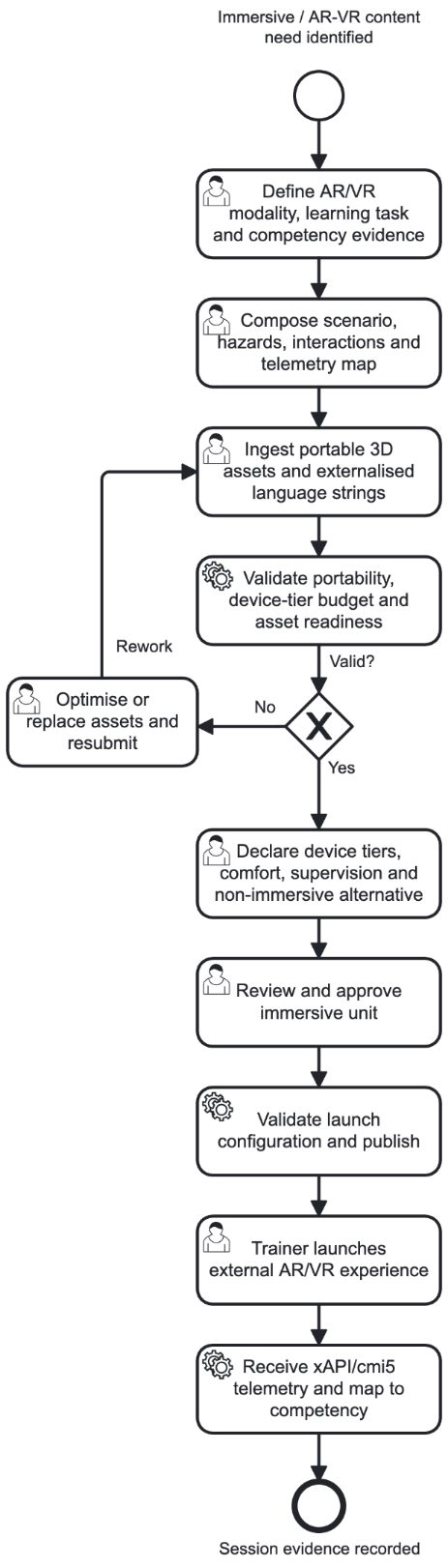
- •Scenario as an artefact of the module: The
Immersive Content Producer composes a scenario specification, the task, the environment, the hazards, the tolerances, the telemetry variables and the competency each evidences, as an artefact of this module; the software that renders the scenario is not.
- •Portable assets, not engine-locked ones: Three-
dimensional models and environments are ingested in the portable formats and interoperability standards identified in Section 8, validated against the polygon and texture budget of each device tier, and optimised into tier-specific renditions while the source asset is retained unaltered.
- •Tiers and a mandatory alternative: Every immersive
unit is authored to at least two device tiers and must carry a non-immersive alternative capable of evidencing the same learning outcome; a unit deliverable on a single tier alone cannot be published.
- •Comfort and safety declared, not assumed: The
locomotion method, comfort rating, maximum session duration, seated-mode availability and supervision requirement are recorded against every unit and presented to the Institute before it is selected.
- •Ordinary review, no shortcut: An immersive unit
enters the same review workflow as authored material and is examined for accessibility and guideline conformance on identical terms; no unit is published on a lighter review by reason of its format.
- •Launch and telemetry at the boundary: At delivery,
the Trainer launches the session through Learning Tools Interoperability; the external system renders the scenario and returns telemetry through xAPI or its cmi5 profile to the shared learning record store. A session for which telemetry is not received within the configured interval is recorded as incomplete rather than scored, so a fault in the interface never becomes a fault attributed to the candidate.
- •AR/VR content and experience design: The
Immersive Content Producer records whether the unit is augmented reality, virtual reality or another simulation mode, together with the learning task, three- dimensional environment, interactions, hazards and competency evidence. The modality and scenario are mapped to the delivery tier for which the unit is authored and to the non-immersive alternative that evidences the same learning outcome.
- •AR/VR delivery readiness: Before publication, the unit records the display or headset class, controller and tracking dependency, connectivity or offline-cache requirement, room or calibration condition, supervision requirement, maximum session duration and comfort position. Where the Institute does not hold a matching delivery tier, the unit remains available through its recorded non-immersive alternative rather than being represented as deliverable.
- •AR/VR learning evidence and telemetry: The launch configuration records the xAPI or cmi5 statements and performance variables expected from the external runtime, and every variable contributing to a score is mapped to a named competency and rubric threshold. Where the required telemetry is not received within the configured interval, the session is recorded as incomplete rather than scored.
Registration, library reuse and industry ingestion user journeyPDF p.10
- •Standards validation: Packaged output, SCORM, cmi5, QTI 3.0, Common Cartridge and the credential and metadata standards in the standards reference register at Section 8, is validated at the point of ingestion or export; a package failing validation is rejected with the failure identified by standard and element, and nothing partial is admitted.
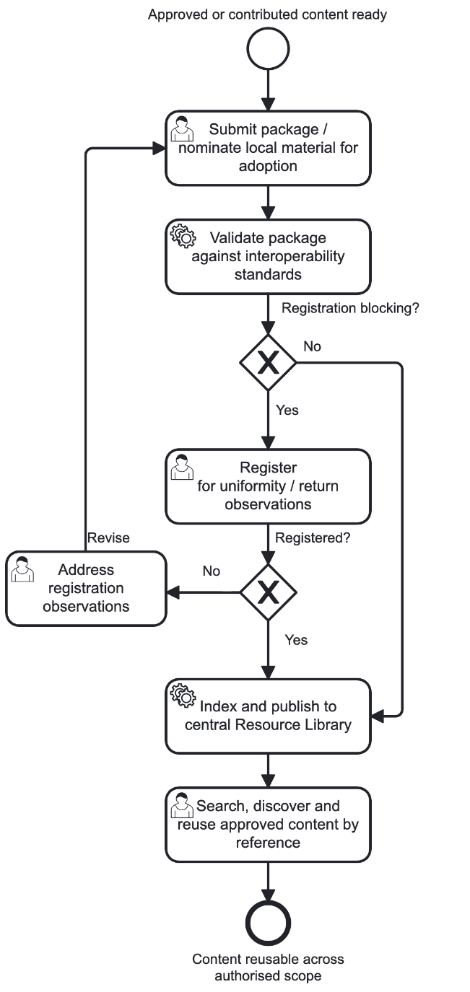
- •Registration for uniformity: Where the Module
Administrator has configured the stage as blocking, an approved item is routed to the National Content Standards Authority, which registers it for uniformity or returns it with observations; the stage is not an instructional approval and does not displace the Reviewing and Approving Authority's decision.
- •Indexing and reuse by reference: A registered item
is indexed against the taxonomies configured and published to the central library, where it is reused by reference, a correction to a core module or a digital twin takes effect wherever that item is used, rather than requiring re-authoring at every cluster.
- •Local material and its route to adoption: An Institute
may compose and use local material within its own scope; where it proves effective, the Institute nominates it for adoption, and it enters the ordinary review workflow before it can be published to the national library.
- •Industry ingestion on equal terms: An Anchor
Industry Partner contributes existing material as a package or a hosted tool associated with a trade; it is examined on identical terms to authored material, and its industry origin is retained in the record rather than concealed from a subsequent reviewer or auditor.
AI support and content compliance assist user journeyPDF p.11
- •The Phase 2 assistant supports an authorised content developer from within the authoring workspace. It is optional and does not alter the ordinary review route.
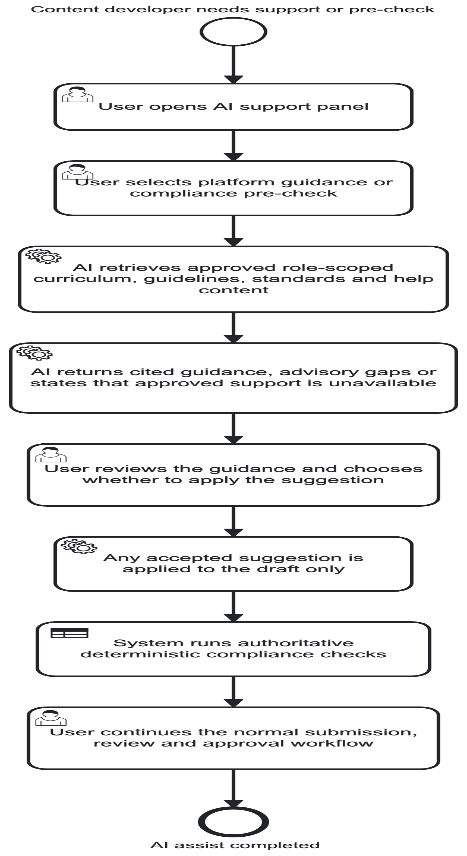
- •Entry and intent: Select platform guidance or an advisory content pre-check.
- •Grounded retrieval: Retrieve only approved help, curriculum, guideline and standards content relevant to the current user and project.
- •Guardrails: Apply role scope, prompt/output controls and provider isolation; prevent direct write, approval, publication or exemption actions.
- •Guidance: Return concise steps with the source used. Unsupported questions are stated as such and routed to human support.
- •Compliance pre-check: Highlight likely gaps in mapping, metadata, rights, accessibility, structure or package readiness; deterministic rules remain authoritative.
- •Human control and audit: Require user confirmation before applying a suggestion and retain the source, model/rule version and user action where relevant.
Consolidated feature list and implementation phasing:
The tables below bring together the principal capabilities proposed for the Digital TLM module and indicate the sequence in which they may be taken up. Phase 1 establishes the core authoring, review, conformance, library and integration capabilities required for controlled operation of the module. Phase 2 builds on this foundation through immersive content, AI-assisted authoring and support, connected-device integration and deeper usage insights. The phasing is indicative and may be refined during detailed design based on programme priorities, dependency readiness and implementation experience.
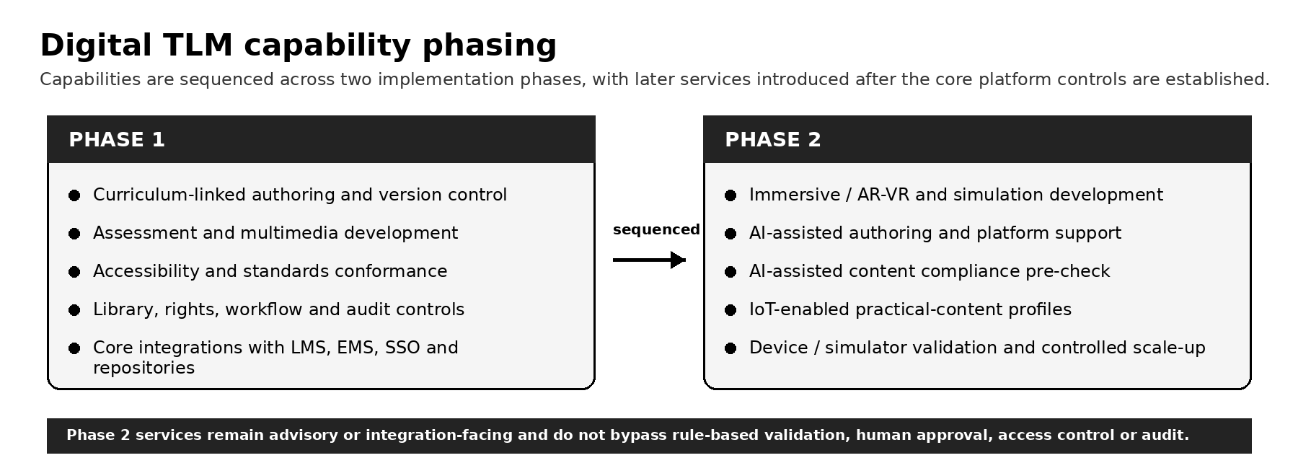
Illustration: Digital TLM capability phasing
Phase 1
| Feature | Description | Indicative implementation / standards |
| Curriculum-linked content setup | Create content only against an approved trade and qualification. The relevant NOS, NSQF level and prescribed course structure are brought into the authoring workspace so that content starts from the approved framework. | Curriculum master data; controlled taxonomy and verb bank; role-based access. |
| Collaborative authoring and version control | Allow multiple authors to develop text, images, audio, video and packaged learning material in the same workflow. Every material change is retained with its author and version history. | Web authoring workspace; version repository; content storage; workflow service. |
| Assessment content development | Create and manage objective, descriptive, practical and viva assessments, including question banks and rubrics. Each item is linked to the relevant competency, difficulty level and assessment mode. | QTI 3.0 where applicable; assessment item bank; rubric and blueprint rules. |
| Multimedia and multi- language support | Prepare approved content for delivery across different media and Indian languages. Transcripts, subtitles and translated versions remain linked to the approved source so that updates can be tracked. | Media processing services; approved language services; accessibility metadata. |
| Accessibility and standards checks | Check content against the prescribed accessibility, metadata, curriculum and packaging requirements before it is submitted for approval. The result of each check is retained for review and audit. | GIGW 3.0; WCAG 2.1 AA; configurable rule engine; conformance reports. |
| Review, approval and publication workflow | Route authored and partner-contributed content through the defined review and approval process. The system prevents self-approval and releases material only after the required approvals are complete. | Role-based workflow; notifications; audit trail; release controls. |
| Feature | Description | Indicative implementation / standards |
| Resource library and reuse | Maintain a central library of approved learning material, searchable by trade, competency, format and language. Common content can be reused without creating duplicate copies, while withdrawn versions remain available for audit. | Search and metadata catalogue; content and version store. |
| Integration with LMS, EMS and source systems | Use approved curriculum, identity and institution data from the relevant source systems and send approved content and assessment material to the LMS and EMS. Each exchange retains its source and interface reference. | API gateway; OpenAPI interfaces; SCORM, cmi5, xAPI and LTI where applicable. |
| Monitoring and audit | Keep a complete record of authoring, review, approval, publication and integration activity. Administrators can view pending actions, failed transactions and other operational exceptions. | Central logging; monitoring; audit store; operational dashboards. |
Phase 2
| Feature | Description | Indicative implementation / standards |
| Immersive / AR-VR and simulation content | Develop AR/VR and simulation content for selected practical skills where immersive training is useful. Content should be designed for the available device types, include the required safety information and provide a non-immersive alternative where needed. | OpenXR where applicable; glTF 2.0 source assets; LTI launch; xAPI/cmi5 telemetry. |
| AI-assisted content authoring | Help authors draft, structure and improve learning material using approved curriculum, guidelines and published content. AI suggestions remain editable drafts and follow the same review and approval process as other content. | Provider-neutral AI gateway; RAG over approved sources; prompt and model version logging. |
| Platform support chatbot | Help users navigate the platform, understand process steps and resolve common queries. The chatbot responds from approved help and policy content and routes unresolved queries to the normal support channel. | RAG-based assistant; role-based retrieval; source citation; guardrails and human support. |
| AI-assisted compliance pre-check | Flag likely gaps in curriculum mapping, metadata, accessibility, rights or packaging before formal submission. This is an advisory check only; the existing rules- based validation remains the final compliance gate. | RAG over approved rules and guidance; existing conformance engine remains authoritative. |
| Feature | Description | Indicative implementation / standards |
| IoT and device integration | Connect selected simulators and training devices so that relevant activity or telemetry can be linked to the competency being trained. Device profiles and data formats are validated before any learning event is passed downstream. | Versioned device profiles; approved HTTPS/MQTT adapter; schema validation; xAPI/cmi5 event mapping. |
| Advanced usage and quality insights | Use approved platform and content data to identify which material is being reused, where users need support and where content may require revision. Reporting remains within the scope already defined for the Digital TLM module. | Validated event and audit data; governed analytics. |
3. Functional System RequirementsPDF p.14
This section sets out the functional requirements of the module across eight pillars, following the sequence in which content is created, assessed, prepared, checked, published and exchanged with systems outside the module. The requirements retain the existing operating model while making three controls explicit: the approved curriculum and its version are consumed from the Curriculum Management System rather than recreated within Digital TLM; examination-bound assessment content is governed through integration with the NIMI Question Bank and the Exam Management System; and content compliance is evaluated as a formal, traceable gate before approval and publication. Each pillar describes the required capability, the conditions that must be met before the capability is accepted, the rules applied by the system, and the action to be taken where an exception occurs. The implementation sequence is reflected through Phase 1 and Phase 2 without changing the control requirements that apply to authoring, review, conformance and publication.
Pillar 1: Content authoringPDF p.14
The module shall permit a content development project to be raised only against a trade recorded as approved, reading the approved curriculum version, qualification, National Occupational Standards, NSQF level, credit structure, module structure and effective dates from the Curriculum Management System / Compliance and Accreditation Management module. Digital TLM shall not create or amend the formal curriculum; each authoring project is pinned to the curriculum version against which it was raised, and a later curriculum revision shall trigger a controlled review and remapping decision rather than silently changing the project. The module shall establish the modular structure prescribed for the trade, core modules held once and reused by reference, cluster-specific modules scoped to the owning cluster, and prevent a structural departure without recorded approval by the Instructional Design Authority. It shall provide composition of text, image, video, audio, document and packaged courseware; require a learning outcome, verb- banked and taxonomy-tagged, against every module, session and topic; support multiple authors with full attribution and version retention; and, as a Phase 2 capability, may provide AI-assisted drafting whose output is an unpublished draft requiring the author's revision and the ordinary review. Material contributed by an Anchor Industry Partner or an Institute shall be accepted as a package or a hosted tool, associated with a trade, and routed through the same review stages as authored material. Approved material is published to the Resource Library, released to the Learning Management System, and given a periodic review date; the Directorate General of Training is recorded as rights holder on every published item irrespective of the contributing party. Phase 2 AI-assisted authoring and guided support. Where enabled, all generative or conversational functions shall be invoked through a provider-agnostic wrapper or model gateway rather than directly from the authoring interface. Retrieval shall be limited to approved content, help material, curriculum context and standards within the authenticated user's role and project scope. The service shall return the source used for factual or rule-based guidance, apply prompt and output guardrails, and require the user to confirm any proposed change before it is written into a draft. It shall not approve, publish, register, grant an exemption, alter curriculum mapping or access material outside the user's authorised scope. Where the approved corpus does not
support the request, the service shall state that limitation and preserve the ordinary authoring and human-support route.
Acceptance Criteria
- •Material cannot be published without approval by an officer competent for the trade.
- •Every item traces to its qualification and National Occupational Standard.
- •Every version is retained and attributable.
- •Core module content exists once and is reused by reference.
- •A contributed package carries the identity of the contributing party.
Validation Rules
- •A project cannot be raised against an unapproved trade.
- •A learning outcome cannot use a verb outside the controlled bank.
- •Cluster-level authoring cannot alter core module content directly.
- •Submission is prevented where metadata, curriculum mapping or either conformance report is incomplete.
- •A response unsupported by the approved retrieval corpus is not presented as an authoritative rule.
- •The reviewing officer cannot be an author of, or employed by the contributor of, the item under review.
- •AI-generated or AI-retrieved output cannot change a controlled field or persist a content change without explicit user confirmation.
- •A response unsupported by the approved retrieval corpus is not presented as an authoritative rule.
Exception Management
| Exception | System Action |
| Qualification record unavailable AI authoring / support service unavailable Submission unresolved beyond service level Publication to LMS fails | Prevent new project creation; existing projects remain editable on the structure last read Suppress AI drafting and support functions; ordinary authoring, deterministic validation and human support continue unaffected. Escalate to the next authority; notify both parties Hold as approved but unreleased; retry; notify Administrator on repeated failure |
| Contributed package fails validation Curriculum version superseded or unavailable | Reject with the failure stated; admit nothing partial to the review queue Prevent new authoring against the affected version; retain the last validated mapping for audit; flag in-progress content for remapping or recorded continuation. |
Pillar 2: Assessment content developmentPDF p.15
The module shall provide composition of assessment items in the objective, descriptive, practical- task-with-rubric and viva-with-rubric formats, bulk import from a prescribed template, and the composition of an assessment blueprint for each module before items are authored against it. Every item shall be tagged to curriculum version, trade, chapter or module, competency, taxonomy domain and level, difficulty, assessment mode and language; an untagged item cannot
be submitted. For examination-bound content, the module shall integrate with the National Instructional Media Institute (NIMI) Question Bank rather than establish a competing formal examination bank. NIMI remains the authoritative owner of the approved question content and its vetting / translation status; Digital TLM shall consume the approved question reference and metadata and, where the agreed workflow permits Digital TLM-originated items to be proposed to NIMI, transmit them through the governed interface for NIMI review and approval. The interface shall retain the NIMI question identifier, version, trade and chapter coverage, competency mapping, language, vetting / approval status, effective date and embargo status. The module shall report bank coverage and composition against the blueprint and support learning and formative-assessment use of approved items subject to role and embargo controls. Formal examination-paper generation, randomisation and shift-level paper assembly remain functions of the Exam Management System / examination agency and are not performed in Digital TLM. The module shall provide authoring of a simulation-based rubric mapping a telemetry threshold to a competency, and permit a simulator proficiency score to be designated as a prerequisite to a physical workshop examination of the same competency. Approved learning-assessment content and governed NIMI references are released to the Learning Management System and Exam Management System through their defined interfaces.
Acceptance Criteria
- •No item releases without approval by an officer other than its author.
- •Every released item carries its competency, taxonomy level, difficulty and mode.
- •A bank reports coverage and blueprint composition.
- •A translated item is not drawn into a live examination without a recorded equivalence confirmation.
- •A simulator prerequisite is enforced before the corresponding physical examination is scheduled.
Validation Rules
- •An item cannot be tagged above the taxonomy level of the outcome it assesses.
- •An objective item cannot be tagged above the ceiling configured for that format.
- •Difficulty and taxonomy level are distinct attributes and neither substitutes for the other.
- •An item under examination embargo cannot be edited.
- •A simulation rubric threshold not mapped to a competency does not contribute to a score.
- •Exception Management
| Exception | System Action |
| Bulk import contains invalid items | Accept valid items; reject invalid ones with reasons stated; report as partial |
| Bank departs materially from its blueprint | Permit publication; state the deficiency; report to the reviewing authority |
| Exam Management System unavailable | Hold approved items for release; release on restoration |
| Simulator telemetry not received in time | Mark the session incomplete rather than scored; do not penalise the candidate |
| NIMI Question Bank unavailable or status cannot be verified | Do not expose or release the affected examination-bound items as current; retain the last verified reference for audit and retry the governed synchronisation. |
| NIMI schema / version mismatch | Reject the affected record or update as an integration exception; identify the failed field and admit no partial status change. |
Pillar 3: Multimedia and multi-language integrationPDF p.16
The module shall support incorporation of video, audio and animation, whether uploaded or referenced from an approved repository, and shall process media into delivery renditions while retaining the source. It shall produce a draft transcript and a draft translation of approved material, including the string tables externalised from immersive scenes, by automated means, present the
draft to the Language and Accessibility Editor for correction against the source and the trade glossary, and hold every language version against its source version so that a subsequent revision marks derived versions as requiring revision. A trade glossary and the regional-language equivalents of the taxonomy verb bank are maintained per language so that terminology and taxonomy level are applied consistently once settled.
Acceptance Criteria
- •No automated translation, transcript or subtitle publishes without recorded correction.
- •Every language version identifies its source version and currency.
- •Media is delivered in a rendition appropriate to the device and connectivity of the learner.
Validation Rules
- •Translation proceeds only from material already approved in its source language.
- •Referenced media must reside on the approved repository list, verified at publication and periodically thereafter.
- •A language version cannot publish in a language not prescribed for the trade and region without recorded approval.
Exception Management
| Exception | System Action |
| Translation or transcription service unavailable | Suppress the automated draft; manual authoring remains available; notify Administrator |
| Media processing fails | Hold unpublished; report to author; retain source rendition unaltered |
| Source version revised | Mark every derived language version as requiring revision; notify the editors concerned |
Pillar 4: Immersive and simulation content developmentPDF p.17
Phase 2 capability. The module shall provide composition of an immersive scenario specification, task, environment, hazards, tolerances, telemetry variables, competency mapping and scoring thresholds, and shall accept three-dimensional assets only in the portable formats and interoperability standards identified in Section 8, validated against the polygon and texture budget of each device tier and optimised into tier-specific renditions while the source is retained unaltered. Every immersive unit shall declare the device tiers on which it is deliverable and carry a non-immersive alternative capable of evidencing the same outcome; a unit deliverable on a single tier cannot publish. In-scene text shall be externalised as a string table subject to the language versioning mechanism at the multimedia pillar, and every unit shall declare its locomotion method, comfort rating, maximum session duration, seated-mode availability and supervision requirement. The module shall provide the accessibility provisions for immersive content defined under Pillar 5 and the reference register at Section 8, registration of reusable digital twins of workshop equipment, authoring of simulation-based rubrics shared with the assessment pillar, and composition of a launch configuration validated by handshake before publication. The module shall not host, render or store the executable software of an external simulator; it holds the specification, the assets, the rubric and the telemetry statistics returned.
Acceptance Criteria
- •Every immersive unit carries a rubric mapping each telemetry variable to a named competency, renditions for at least two tiers, and a non-immersive alternative.
- •Comfort and safety attributes are visible before selection.
- •No source asset is overwritten.
- •The module's content store demonstrably holds no executable simulator software.
Validation Rules
- •An asset is accepted only in a format in a portable format identified in the standards reference register at Section 8 and not in one dependent on a single rendering engine or headset manufacturer.
- •An immersive unit cannot publish without a non-immersive alternative and at least two tier renditions.
- •A hazardous scenario cannot approve without recorded hazards and safe-practice conditions.
- •A telemetry variable not mapped to a competency does not contribute to a score.
- •Passthrough imagery, room geometry, eye- and hand-tracking data are never transmitted to or retained by this module.
Exception Management
| Exception | System Action |
| Asset exceeds a tier's budget | Refuse the tier declaration; state the budget and the measured value |
| External simulator returns no telemetry in time | Record the session as incomplete; do not penalise the candidate; notify the institution |
| Launch handshake fails | Do not commence the session; report to the Trainer in actionable terms; escalate on repeated failure |
| Institute holds no matching device tier | Present the non-immersive alternative alone; report the deficiency in the estate report |
Pillar 5: AccessibilityPDF p.18
The module shall evaluate every item continuously against the accessibility rule set as it is composed, requiring alternative text on non-textual elements, an accessible label on every assessment item, captions or a transcript on every video and audio item, and, for immersive content, the provisions in the standards reference register at Section 8. A conformance report is produced for every item and presented to the Reviewing and Approving Authority as a condition of approval; an exemption from a mandatory rule is recorded with the granting officer, the ground and the period, and is never granted by the item's own author.
Acceptance Criteria
- •No item approves without a conformance report.
- •Every image carries alternative text and every assessment item an accessible label.
- •The conformance position of published material is available for report at any time.
Validation Rules
- •Submission is prevented where a mandatory rule is unsatisfied.
- •A conformance report is never edited, only superseded by a fresh evaluation.
- •A rule-set change applies prospectively and raises published material for remediation rather than withdrawing it automatically.
Exception Management
| Exception | System Action |
| Conformance evaluation service unavailable | Hold submission rather than permit unevaluated material; notify Administrator |
| Deficiency cannot be corrected | Seek and record an exemption; report it in the periodic conformance report |
| Published material falls out of conformance on a rule change | Raise for remediation with a stated period; withdraw only if unremediated at expiry |
Pillar 6: Course development guidelines and standards conformancePDF p.18
This pillar operationalises the course-development, content-compliance and interoperability standards defined in this DPR and the reference register at Section 8. The compliance rule set shall cover, at minimum, approved-curriculum and curriculum-version alignment; modular and credit structure; the three-domain taxonomy and verb bank; assessment-blueprint rules;
mandatory metadata; source and contributor provenance; rights / licensing and review date; language, transcript and caption requirements; accessibility; duplicate / deprecated-content status; and the interoperability standards register spanning SCORM, cmi5, xAPI, LTI Advantage, QTI 3.0 and the immersive-asset standards. Where a DGT, CSTARI, NIMI or other competent- authority content rule is configured as applicable to the trade or content type, its rule identifier, source, version and effective date shall form part of the same controlled rule set. The module shall evaluate material continuously against these rules and produce a consolidated Content Compliance Report that distinguishes mandatory failures from advisory findings, states the rule and evidence for each finding, and records the rule-set version used. A mandatory failure shall prevent submission or publication until corrected or covered by a permitted, time-bound exemption granted by the competent authority. Packaged output shall also be validated ag ainst the declared standard at ingestion, export and release to the Exam Management System. The module shall provide a configurable registration stage routing approved items to the National Content Standards Authority, and shall record exemptions on the same terms as under the accessibility pillar, granted by the Instructional Design Authority, never by the author, and never against a rule marked incapable of exemption. Phase 2 AI-assisted content compliance pre-check. The authoring workspace may provide an advisory pre-check that retrieves the applicable curriculum, NIMI / DGT content guidance, guideline and standards context and explains likely gaps before formal submission. The pre- check may identify stale curriculum mapping, incomplete competency or chapter mapping, missing metadata or rights evidence, accessibility concerns, language or transcript gaps, structural inconsistencies, duplicate / deprecated source material and package-readiness issues, but it shall not issue or modify the Content Compliance Report or the accessibility conformance report. Every advisory observation shall identify the source or rule used; low-confidence or unsupported observations shall be labelled as such and shall not block or clear submission. The deterministic rules defined in this pillar and Pillar 5 remain the only authoritative automated gate, and the existing human review and exemption authorities remain unchanged.
Acceptance Criteria
- •No item approves without a guideline conformance report.
- •Every learning outcome uses a verb-banked, level-tagged expression.
- •Every published item carries the complete metadata schema.
- •A package failing standards validation is rejected with the failure identified by standard and element.
- •Where registration is blocking, no item reaches the national library unregistered.
Validation Rules
- •A project cannot depart from the prescribed modular structure without recorded Instructional Design Authority approval.
- •An assessment item cannot be tagged above the taxonomy level of the outcome it assesses.
- •A metadata field with a controlled vocabulary cannot be entered free-form.
- •A package cannot enter the review queue on a standard or version not in the standards reference register at Section 8. An AI observation cannot override a deterministic failure, grant an exemption or mark a mandatory rule as satisfied.
- •Cited source and model/rule version are retained for an applied advisory suggestion.
Exception Management
| Exception | System Action |
| Guideline evaluation service unavailable | Hold submission rather than permit unevaluated material |
| Registration stage undecided beyond its service level | Escalate within the registering institution; notify both parties |
| Package fails standards validation | Reject with the failure identified by standard, element and line; retain nothing partial |
| Exception | System Action |
| Rule-set change affects a substantial body of published material | Apply with a stated remediation period; report the affected volume before the change takes effect |
| Applicable curriculum or content- rule source cannot be resolved | Hold formal submission for the affected rule set; state the unresolved source / version and notify the Administrator or rule owner. |
Pillar 7: Resource librariesPDF p.20
The module shall retain every approved item in a central library organised by trade, competency, taxonomy, format, language, device tier and conformance position, searchable by any of the foregoing. Reuse is by reference, so a correction to a core module, a digital twin, or any shared item takes effect wherever it is used. Institution-local collections remain visible to the owning institution alone until nominated for adoption, at which point they enter the ordinary review workflow. The module shall assemble approved courses into a gamified learning pathway with a portable, independently verifiable credential issued on completion of a stage, and retain withdrawn material in an archive discoverable to the Administrator and the auditor but not returned for reuse.
Acceptance Criteria
- •A stakeholder sees only material their role and entity authorise.
- •Reuse by reference reflects a source correction everywhere it is used.
- •Withdrawn material is not returned for reuse.
- •A pathway credential remains independently verifiable irrespective of subsequent changes to the module's own configuration.
Validation Rules
- •Only approved, and where configured registered, material enters the central library.
- •institution-local material is not discoverable outside its institution.
- •A pathway cannot include draft or unapproved material as a stage.
- •An item or taxonomy term in use is not deleted, only deprecated with its successor recorded.
Exception Management
| Exception | System Action |
| Item withdrawn while in use | Notify delivering institutions; cease delivery; state the reason |
| Search index unavailable | Retrieval by direct reference remains available; state the condition on the view |
| Duplicate material detected on submission | Report to the reviewing authority to adopt, merge or refuse |
Pillar 8: IntegrationPDF p.20
The module depends on systems of record outside it and is a producer of content to, and a consumer of structure from, each. It reads the approved curriculum, curriculum version, qualification, NOS / competency structure, NSQF level, credits, module structure, effective dates and supersession status from the Curriculum Management System / Compliance and Accreditation Management module; consumes approved question references and governance metadata from the NIMI Question Bank; reads identity from the Government Identity and Access Management framework; reads institution, trainer and immersive-estate particulars from the ITI Management System; releases approved learning material and formative assessment to the Learning Management System; and releases approved assessment references, including governed NIMI references where applicable, to the Exam Management System. It routes registration to the National Content Standards institution; draws draft transcription and translation
from the national language services platform; accepts contributed packages from Anchor Industry Partners and Institutes; and launches external simulators and immersive platforms through Learning Tools Interoperability, receiving telemetry through xAPI or cmi5 into the shared learning record store. The module shall not recreate the authoritative curriculum, NIMI question-bank approval workflow or examination-paper generation function. It shall not host, render or store the executable software of any external simulator or third-party tool; its role is limited to composing and governing Digital TLM content, exchanging approved references and packages, launching the session with the requesting stakeholder's identity and scope, and recording the content-side outcome.
| Integration | Integration Purpose | Data / Information Exchanged |
Compliance and Accreditation Management module
Read approved curriculum / qualification structure
Qualification, NOS, NSQF level and modular structure
Government Identity and Access Management framework
Authenticate and resolve stakeholder role and owning entity
Identity, role and authorization context
ITI Management System Read institution, trainer and
ITI, trainer, equipment / device- estate particulars
immersive-estate particulars
Release approved learning material and formative assessment
Learning Management System
Approved content, packages and assessment references
Exam Management System
Release approved formal- assessment items and banks
Assessment items, banks and related metadata
National Content Standards institution
Route approved content for registration / uniformity
Approved content package and registration status
National language services platform
Obtain draft transcription and translation services
Draft transcript, captions and translation output
Content packages, hosted-tool references and contributor identity
Anchor Industry Partners / Institutes
Accept contributed packages and hosted tools
Launch external experiences through LTI and receive telemetry
Launch configuration, learner / competency context and xAPI/cmi5 telemetry
External simulators / immersive platforms
Learner-attributed xAPI/cmi5 statements; this module reads aggregate statistics
Shared learning record store
Receive and retain learning telemetry outside this module
User role and project context; approved reference material; prompt template; response metadata; model and prompt version.
Provide a controlled route from the authoring workspace to approved AI services.
AI model gateway
Retrieve approved curriculum, guidelines, standards, help material and published content for authoring and user support.
Source reference; document metadata; retrieved content; citation details.
RAG knowledge and help service
Validate approved devices and simulator data before learning events are passed to the LMS or shared learning record store.
Device profile; telemetry format; sample payload; competency/event mapping; configuration version; source identifier.
IoT / simulator gateway
Phase 2 AI and IoT integration. AI services shall connect through a controlled model gateway that enforces identity, role scope, approved retrieval sources, prompt and output policy, logging and provider isolation; the model endpoint shall have no direct authority to write to publication, approval or conformance stores. IoT-enabled practical content shall be represented in the Digital TLM as a versioned device profile and telemetry schema linked to the competency or rubric it supports. Authors may define variables, thresholds and event mappings and validate sample payloads through a connector sandbox. A local or partner edge gateway may use HTTPS, MQTT or an approved industrial adapter as applicable, but only the approved profile, schema and launch configuration are released from this module. Runtime learner telemetry and learning events are handed to the LMS or Learning Record Store through the approved interface and are not retained here as a parallel learner record.
Acceptance Criteria
- •Each integration reads or releases only the information defined for it.
- •Curriculum, identity and institution information is read as validated within its source system and not re-entered here.
- •A session launched externally is traceable to the learner, the competency and the institution. . A Phase 2 AI or IoT connector is accepted only after role-scope, source, schema, retry and audit scenarios pass in the integration sandbox, and no such connector may create a parallel learner record in this module.
Validation Rules
- •An integration cannot widen its scope without recorded Administrator configuration.
- •Material releases to LMS or EMS only after recorded approval within this module.
- •Externally referenced media must reside on the approved repository list.
- •IoT payloads that do not match the approved device profile or telemetry schema are rejected before release, and duplicate or out-of-order sample events remain test evidence rather than content state.
Exception Management
| Exception | System Action |
| A source system is unavailable | Suppress the dependent function; continue on information last read; notify Administrator |
| Release to LMS or EMS fails | Hold as approved but unreleased; retry; escalate on repeated failure |
| External simulator returns no telemetry in time | Record the session as incomplete; notify the institution |
| AI service returns unsupported or uncited guidance | Suppress the authoritative interpretation, state the limitation and retain the ordinary authoring or human- support path. |
| IoT sample payload fails schema or device-profile validation | Reject the sample, identify the failed field or mapping and prevent release of the configuration until corrected. |
| NIMI Question Bank synchronisation fails | Hold examination-bound status or release changes; preserve the last verified reference, retry and escalate repeated failure. |
4. Solution ArchitecturePDF p.23
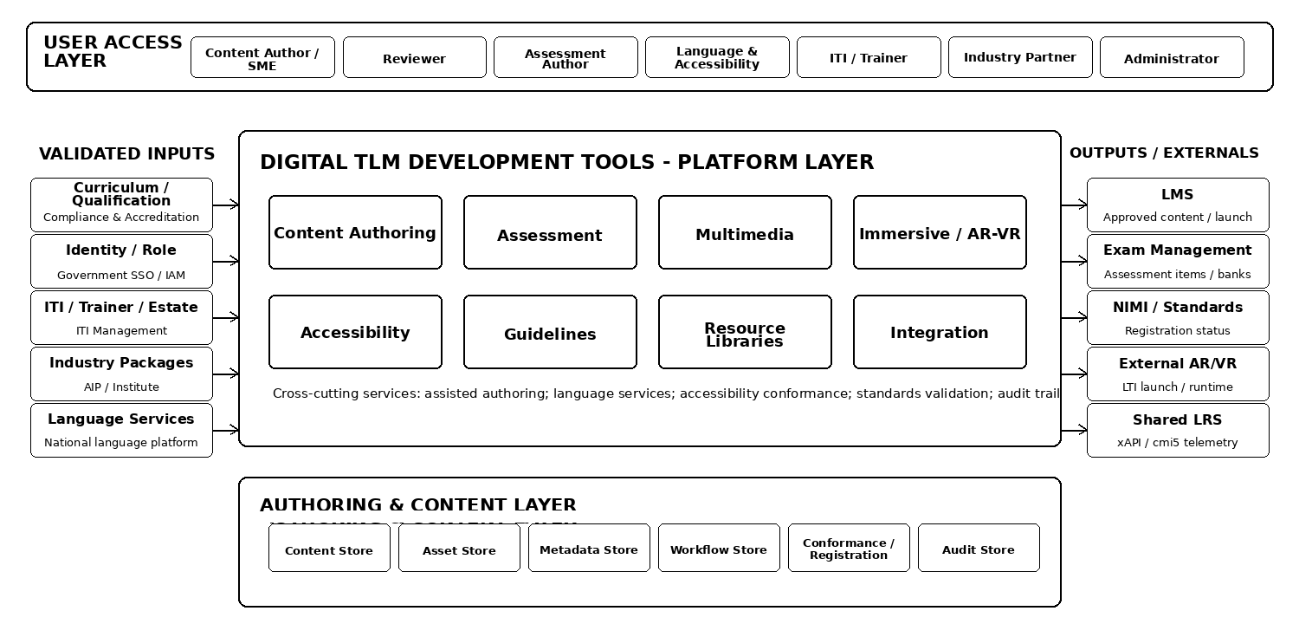
The module is organised into three layers:
- 1.Authoring and Content Layer
- 2.Platform Layer
- 3.User Access Layer
Authoring and content layerPDF p.23
This layer holds six bodies of information: the content store (material and media renditions, every version retained); the asset store (three-dimensional models and their optimised renditions, source never overwritten); the metadata store (curriculum mapping, taxonomies, language relationships, conformance positions); the workflow store (submissions, decisions, escalations); the conformance and registration store (write-once records of conformance reports, standards validation and registration decisions); and the audit store. Information reaching this layer from outside, qualification, identity, institution and estate data, is read as validated within its source system rather than re-entered here.
Platform layerPDF p.23
The Platform Layer hosts the eight pillars as its functional components, together with five cross- cutting services: assisted authoring, the language service, the accessibility conformance service, the guideline conformance service, and the standards validation service. None of these publishes material of its own, and where the accessibility or guideline conformance service is unavailable, submission is held rather than permitted on unevaluated material. Access control is enforced at the level of the query rather than the page, so a stakeholder's role and content-owning entity constrain the material returned, not merely the screens rendered. For external tools and simulators, the layer uses Learning Tools Interoperability and xAPI/cmi5 as its primary architecture, deliberately keeping the module out of the business of rendering third-party software. In Phase 2, the platform adds a controlled AI wrapper/model gateway, a retrieval service over an approved knowledge corpus and a policy/guardrail service for authoring support and compliance explanation. The integration boundary may also admit an IoT edge connector for design-time device profiles and sample telemetry validation. Neither extension is permitted to create an alternative publication route or learner system of record.
Immersive content pipeline and institute deliveryPDF p.23
Four concerns are kept separate by design. Production, building the scene, scripting interactions, compiling the application, occurs outside the module on an external AR/VR production toolchain governed through Pillar 4; the module holds no build artefact. Specification and governance, the scenario, rubric, telemetry mapping, string tables and tier declarations, are artefacts of this module, versioned and reviewed here, so that an asset produced once is reused across scenarios and delivery partners. Distribution occurs through the Learning Management System and an on- premises content cache at the Institute; the module releases the reference and the launch configuration, not the payload. Delivery and recording occur at the Institute: the session is launched with the requesting stakeholder's identity, the external system renders it, and telemetry is written to the shared learning record store, from which this module reads aggregate statistics alone.
User access layerPDF p.23
Every stakeholder authenticates through Single Sign-On, and the role and content-owning entity resolved at login govern both the functions rendered and the material returned within each pillar. No officer approves, registers or grants an exemption upon material of their own authorship or their own organisation's authorship, and this separation is enforced by the system rather than by administrative instruction.
5. Nonfunctional RequirementsPDF p.24
The module composes and retains material of record, and its nonfunctional requirements are framed around responsiveness in composition, integrity and retention of versions, security of unpublished material and embargoed assessment items, learner safety at the point immersive material is delivered, and auditability of every decision.
Performance requirementsPDF p.24
| Performance Parameter | Minimum Requirement |
| Editor and library response | Composition environment and library search return within 3 seconds for 90% of requests under normal load |
| Immersive asset ingestion and optimisation | An asset up to 200 MB validates within 60 seconds and renders every declared tier within 30 minutes |
| Standards validation of a package | A package up to 500 MB validates within 10 minutes, asynchronously, with the failure identified by standard and element |
| Session launch and telemetry | A launch handshake completes within 10 seconds; aggregate telemetry statistics are available within 24 hours |
| Concurrent usage | A minimum of 300 concurrent authoring users, scaling to 600 at peak, and 50 concurrent immersive authoring sessions scaling to 100 |
| Availability | A minimum of 99.5% monthly availability, excluding pre- notified planned maintenance |
Security requirementsPDF p.24
User authentication integrates with Government SSO; multi-factor authentication is mandatory for approving, registration and administrative roles. Role-based access control is enforced at the level of the query, and the module prevents an officer from approving, registering or exempting material of their own or their own organisation's authorship, without administrative override. Assessment items, correct responses and rubrics are accessible only to the author, the reviewer, the examiner and the Administrator, with every access logged. Passthrough imagery, room geometry, eye- and hand-tracking and other biometric data captured by a delivery device are never transmitted to, retained by or requested by this module; the telemetry profile accepted is limited to the variables the rubric declares. All traffic is protected by TLS 1.2 or higher, and material at rest is encrypted using AES-256. The comfort rating, maximum session duration, locomotion method and supervision requirement of every immersive unit are recorded and presented to the Institute before selection; the module is the record of the conditions content
assumes, not the guarantor of safety at the point of delivery. Phase 2 AI services shall be protected against prompt injection, retrieval of material outside the user's role and project scope, disclosure of secrets or personal data to a model endpoint, and direct writes from model output to controlled stores. Requests and responses that influence a content change shall be attributable to the user and model version. IoT and simulator connectors shall use authenticated endpoints, encrypted transport, signed or otherwise integrity-protected configuration where applicable, and strict schema validation before any device profile is accepted.
Availability, retention and disaster recoveryPDF p.25
The content, asset, metadata, workflow, conformance and audit stores are recoverable to the platform's prescribed recovery point and time objectives. Every version of every item, including scenario specifications, source assets, rubrics and conformance reports, is retained for the life of the qualification and the period thereafter prescribed by the programme's retention policy, and is not deleted upon withdrawal or the departure of its author. A source asset is retained irrespective of the continued engagement of the delivery partner that supplied it; the licence recorded against it must permit that retention, so the programme's asset library remains a durable public asset rather than a rental.
Audit logging requirementsPDF p.25
Every composition, submission, decision, registration, exemption, publication, withdrawal and denied access attempt is logged with stakeholder identity, role, entity, timestamp and the item concerned, in sufficient completeness to reconstruct an item's entire history. Logs are tamper- resistant and accessible only to authorised administrators and auditors. Where Phase 2 AI is enabled, the audit record shall additionally retain the assistant function invoked, model or rule version, approved source references retrieved and the user confirmation for any applied suggestion, without retaining unnecessary prompt content. IoT connector testing shall record device/profile identifier, schema version, source endpoint, validation outcome and release decision.
Compliance requirementsPDF p.25
Material produced within the module carries its alignment to the National Skills Qualifications Framework, the National Occupational Standards and the National Credit Framework, so that certification issued upon it is supportable. Authoring interfaces and delivered material conform to the Guidelines for Indian Government Websites 3.0, including WCAG 2.1 Level AA. Packaged material, assessment interchange, launch, telemetry, metadata and credential output conform to the interoperability standards identified in Section 8; where a conformance certification programme exists for a standard, the certification position of the implementation is recorded and maintained. AI-generated or AI-assisted output is advisory and is subject to the same rights, accessibility, guideline, approval and audit controls as manually authored material. A conversational or generative service cannot certify compliance. IoT-enabled practical-content configuration shall follow data-minimisation principles: the Digital TLM retains the design-time profile and mapping needed to govern the content, while learner-level runtime telemetry remains with the system designated to receive learning events.
6. Testing Strategy and Deployment ApproachPDF p.25
Testing strategyPDF p.25
Testing shall verify that every version of every item is retained, attributable and restorable, that no officer approves material of their own or their own organisation's authorship, and that a package contributed by an Anchor Industry Partner or Institute passes through the ordinary review without an accelerated path. Accessibility and guideline conformance testing shall confirm that submission is prevented where a mandatory rule is unsatisfied, that a conformance report is produced for every item, and that an exemption is recorded with officer, ground and period. Immersive content testing shall confirm that an asset outside the prescribed formats is rejected, that a unit without a non-immersive alternative or without renditions for at least two tiers cannot publish, and that a session for which telemetry is not received in time is recorded as incomplete rather than scored, tested on each device tier defined under Pillar 4, including degraded-uplink and offline-cache operation. Integration testing shall validate each interface named at the integration pillar, including its behaviour where the counterpart system is unavailable or returns incomplete data. User Acceptance Testing shall be conducted with a nominated representative of each stakeholder, including at least one item routed end to end through the registration stage
and one immersive scenario authored, optimised, translated, launched on a live device and scored against its rubric. Where Phase 2 AI is enabled, testing shall cover grounded retrieval and source citation, unsupported-request handling, prompt-injection resistance, role isolation, human confirmation, service unavailability and the prohibition on AI approval or publication. IoT testing shall cover authenticated connector registration, device-profile and schema validation, malformed and duplicate sample payloads, retry and offline recovery behaviour, and confirmation that this module does not persist runtime learner telemetry as an operational learner record.
Acceptance criteria for go-livePDF p.26
All content-integrity and workflow test cases pass, with no loss upon simulated failure and no approval by an author of their own material. Accessibility and guideline conformance are enforced at submission across every prescribed standard. Immersive asset ingestion, optimisation, tier declaration and alternative provision pass on every device tier defined under Pillar 4, including degraded and offline conditions. Performance parameters at Section 5 are met under normal and peak load. All critical and high-severity defects are resolved and retested, and User Acceptance Testing sign-off is obtained from a nominated representative of each stakeholder. Phase 2 production activation is gated separately: AI, immersive and IoT capabilities are enabled only after their additional security, safety, conformance and sandbox tests pass, so failure of an optional service does not prevent Phase 1 authoring and validation from operating.
Deployment approachPDF p.26
Deployment follows the platform's phased environment promotion, Development, Testing, UAT, Pre-Production, Production, with automated build, security and testing gates at each promotion. Releases affecting the content, asset, metadata, workflow, conformance or audit stores carry a migration plan and a verified rollback position; rollback is never effected by application redeployment alone. Deployment is phased by capability rather than delivered at once: capability already present in the deployed authoring environment (Annexure A) is brought under the workflow and guideline rule set first; practical and viva assessment authoring, language versioning, and the conformance and standards validation services follow; Phase 2 capabilities are activated only after the Phase 1 controls are proven, with immersive, AI and IoT services piloted on a defined number of clusters or authoring teams before wider scale-up.
Implementation roadmap The roadmap below translates the capability phasing into controlled implementation stages. It follows the same environment-promotion and gated-rollout principle used across the PM-SETU digital modules: each stage advances only when the required content controls, integrations, user support and performance have been demonstrated, and a Phase 2 service can be deferred without weakening the Phase 1 operating model.
| Stage | What will be done | Completion point |
| Phase 1 - Design and mobilisation | Confirm the detailed functional scope, user roles, content and metadata structure, workflow, priority interfaces, migration needs and non- functional requirements. | Solution design approved; data and interface requirements agreed; development and test environments ready. |
| Phase 1 - Build and integration | Build the core authoring, assessment, multilingual, compliance, library, workflow and audit capabilities and connect the priority systems. | Core build completed; priority integrations working; solution ready for system integration testing. |
| Phase 1 - Testing and UAT | Test the full content lifecycle, integrations, security, accessibility and performance. Conduct UAT with nominated users and close all critical and high-severity defects. | UAT sign-off completed; production readiness confirmed; support |
| Stage | What will be done | Completion point |
| and rollback arrangements agreed. | ||
| Phase 1 - Production rollout | Move the approved release into production and verify login, authoring, review, compliance, publication, release and audit flows. Stabilise the platform during the initial operating period. | Production acceptance completed; operating procedures and support ownership in place. |
| Phase 2 - Design and controlled build | Confirm the use cases and control boundaries for AI, immersive content and connected devices, and configure these capabilities first in non-production environments. | Phase 2 design approved; prototypes available for controlled testing. |
| Phase 2 - Pilot | Pilot selected capabilities with a defined set of users, trades and clusters. Review output quality, guardrails, accessibility, device performance, integrations and support needs. | Pilot completed; findings, issues and operating controls documented. |
| Phase 2 - Scale-up | Extend the capabilities that perform satisfactorily in the pilot and onboard additional content, devices and approved integrations through the established release process. | Scale-up approved; production controls and support arrangements updated. |
Implementation timing remains subject to the approved PM-SETU implementation plan, procurement sequencing and readiness of external systems. The roadmap therefore defines dependency and release order rather than an unsupported calendar commitment.
7. Process designs and mockupsPDF p.27
The processes below are the ones the module itself executes, corresponding to the five lifecycles introduced at Section 2. Where Section 2 described each lifecycle from the stakeholder's vantage, this section states the formal system process, what the module validates, where it holds state, and how it responds when a step fails.
Content authoring and review process design and mockupPDF p.27
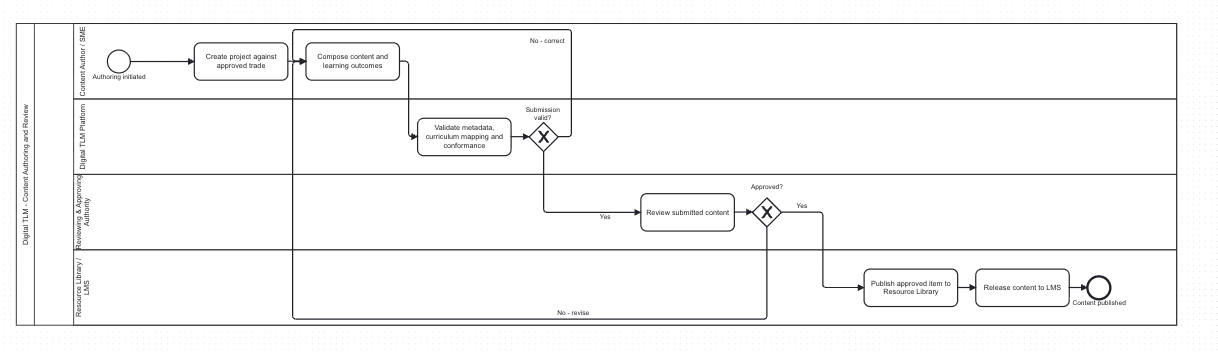
The process begins when a trade is notified for adoption and a project is raised against it; the module refuses the project where the trade is not recorded as approved. The modular structure is established from the curriculum record, core modules drawn by reference and cluster-specific modules scoped to the owning cluster. The author composes material and records learning outcomes; on submission, the module validates metadata, curriculum mapping and both conformance reports, refusing submission and identifying the deficiency where any is incomplete. The Reviewing and Approving Authority, never the item's author, examines the material with its conformance reports and decides; a decision withheld beyond the configured service level escalates automatically. On approval the item is published to the Resource Library, rights- attributed to the Directorate General of Training, and released to the Learning Management System. This process ensures that no item reaches a learner without a competent, independently recorded approval, and that the complete history of authorship and decision remains available for audit.
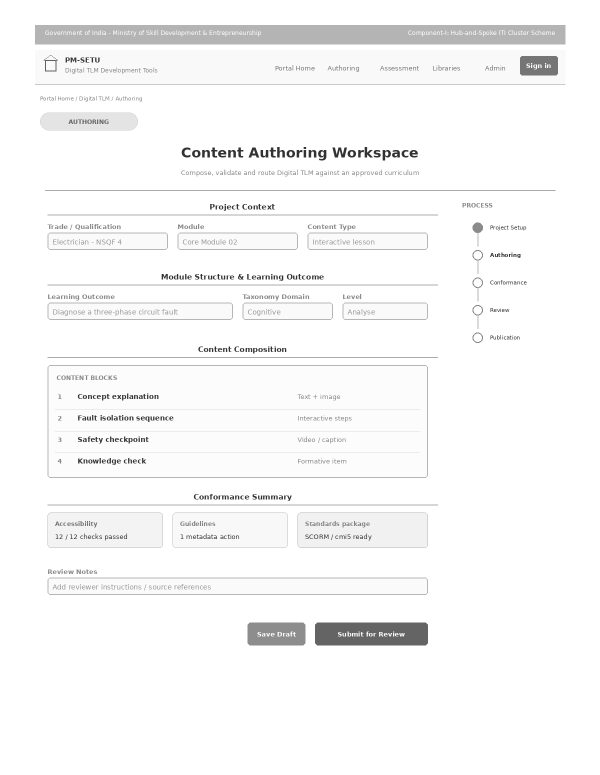
Phase 2 support overlay. The authoring workspace may expose a side-panel assistant for two narrowly defined tasks: guiding the content developer through the platform and providing an advisory content pre-check. The mockup below keeps the draft in the ordinary workspace, shows
the source behind a suggestion, separates advisory findings from the formal conformance status, and makes explicit that approval and publication remain outside the assistant.
Assessment development process design and mockupPDF p.30
The blueprint for a module is composed before any item is authored against it, stating the distribution of items and marks by taxonomy level, mode and competency. Items are composed and tagged; an untagged item, or one tagged above the taxonomy level of the outcome it assesses, is refused at validation. The module reports bank coverage and blueprint composition continuously as items are added. Review is always conducted by an officer distinct from the author; on approval, items release to the Exam Management System and the Learning Management System, remaining under this module's version control. Where a competency is simulation-assessed, a telemetry threshold is mapped to it and, where the interval configured for its return lapses, the session is recorded as incomplete rather than scored, a deliberate design choice so that a fault in the interface between this module and an external simulator is never converted into a fault attributed to the candidate.
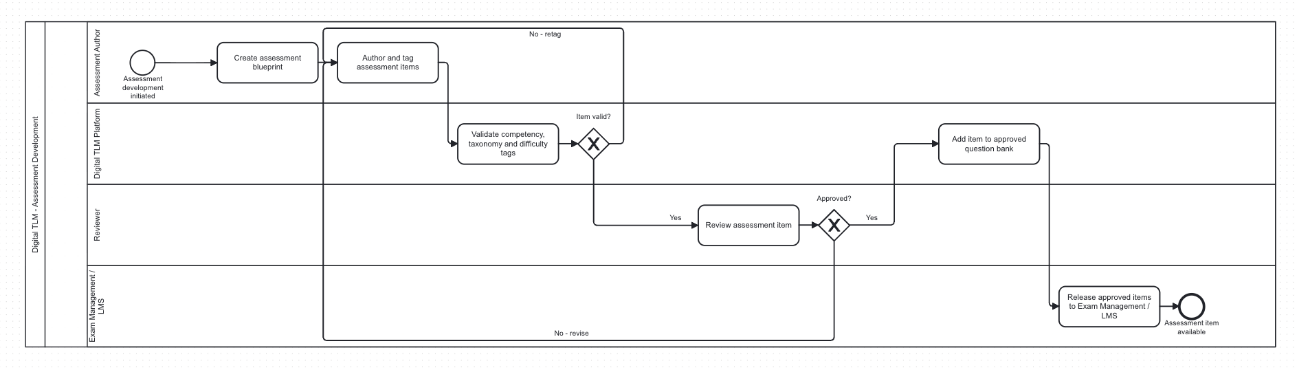
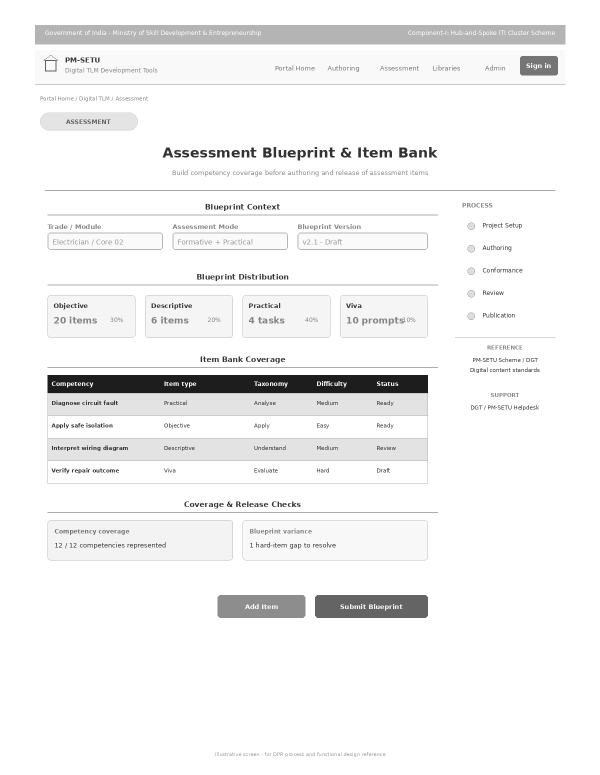
Language, accessibility and guideline conformance process design and mockupPDF p.32
Once an item is approved in its source language, the module produces a draft translation, transcript or caption set; the editor's correction against the source and the trade glossary is the version of record, never the machine draft. In parallel, the item is evaluated continuously against the accessibility rule set and the guideline rule set in the standards reference register at Section 8, structural form, taxonomy expression, metadata completeness and standards conformance. A mandatory deficiency in either rule set prevents submission; where a deficiency cannot be corrected by reason of the material's nature, the Instructional Design Authority adjudicates a time- limited, attributable exemption. Both conformance reports are presented to the Reviewing and Approving Authority as a condition of approval, and a subsequent rule-set change is applied prospectively, raising already-published material for remediation rather than withdrawing it. This process ensures that a course composed in one cluster carries the same taxonomic and structural form as one composed in another, and that every departure from either standard is deliberate and traceable rather than an omission.
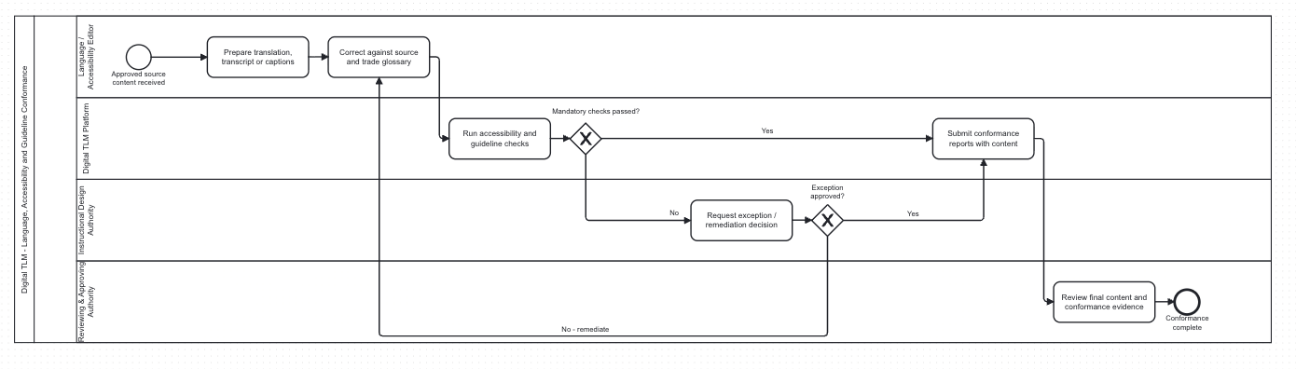
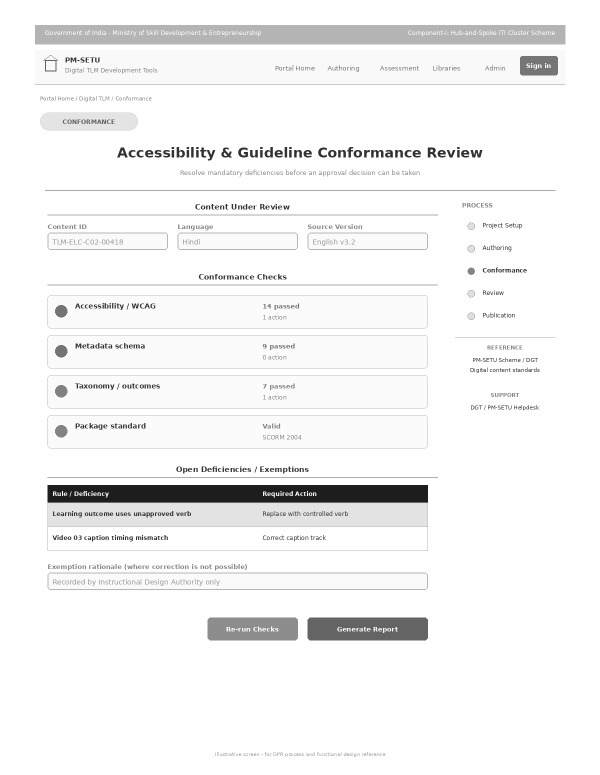
Immersive content production and delivery process design and mockupPDF p.34
The producer composes the scenario specification and uploads the assets it depends on; the module validates format and measures each asset against the polygon and texture budget of every declared device tier, refusing a tier declaration the asset cannot satisfy and stating the measured value against the budget. Once tiers, a non-immersive alternative, and comfort and safety attributes are declared, the unit enters the ordinary review, accessibility and guideline conformance included, and is published only on approval, with its launch configuration validated by handshake beforehand. At delivery, the module launches the session through Learning Tools Interoperability with the Trainer's identity and scope; the external system renders the scenario and returns telemetry through xAPI or cmi5. A session for which telemetry is not received within the configured interval is recorded as incomplete, the candidate is not penalised, and the Institute is notified so the equipment or connection can be checked. This process keeps the module the system of record for the outcome of immersive training without requiring it to become a rendering engine, so a change of delivery partner changes only the external endpoint, never this module's architecture.
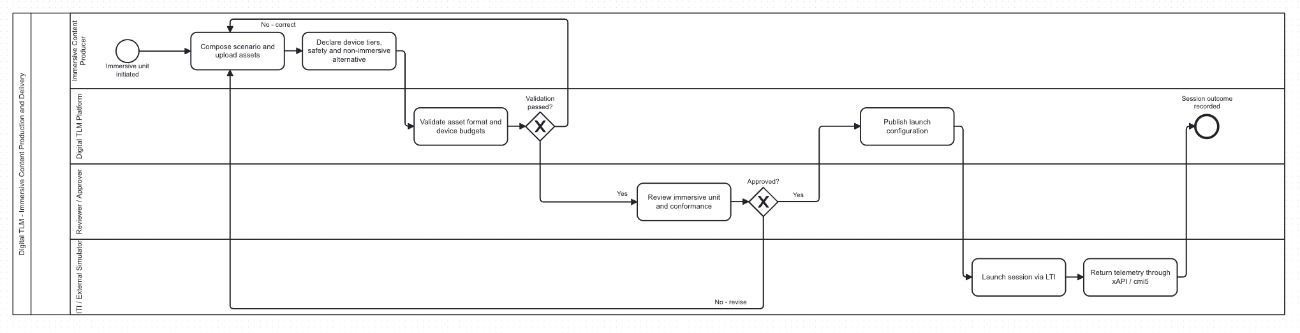
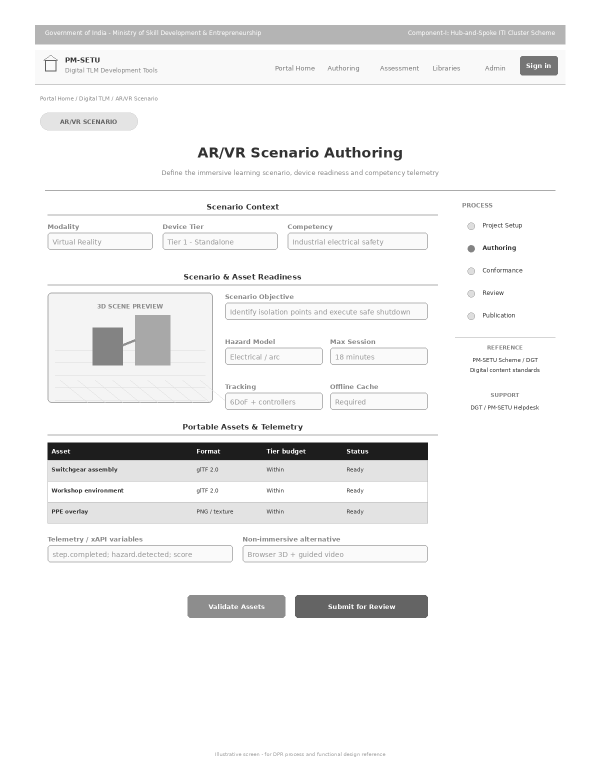
Registration, library reuse and industry ingestion process design and mockupPDF p.36
Approved content is validated against the interoperability standard it declares before it can proceed; a failure is reported by standard and element, and nothing partial is retained. Where the registration stage is configured as blocking, the item routes to the National Content Standards Authority, which registers it for uniformity or returns it with observations, a decision distinct from, and not a substitute for, the Reviewing and Approving Authority's approval. On registration, the item is indexed against the configured taxonomies and published to the central library, where it is discoverable and reusable by reference. An Institute may compose local material for its own use, or nominate effective local material for adoption, in which case it enters this same review and registration path. An Anchor Industry Partner's contributed package follows an identical path from the point of ingestion onward, its industry origin retained in the metadata record rather than concealed. This process ensures that the routing the scheme requires for national uniformity is evidenced in the system of record, that a correction to shared content takes effect wherever that content is used, and that material contributed from outside the module is never held to a lighter standard than material authored within it.
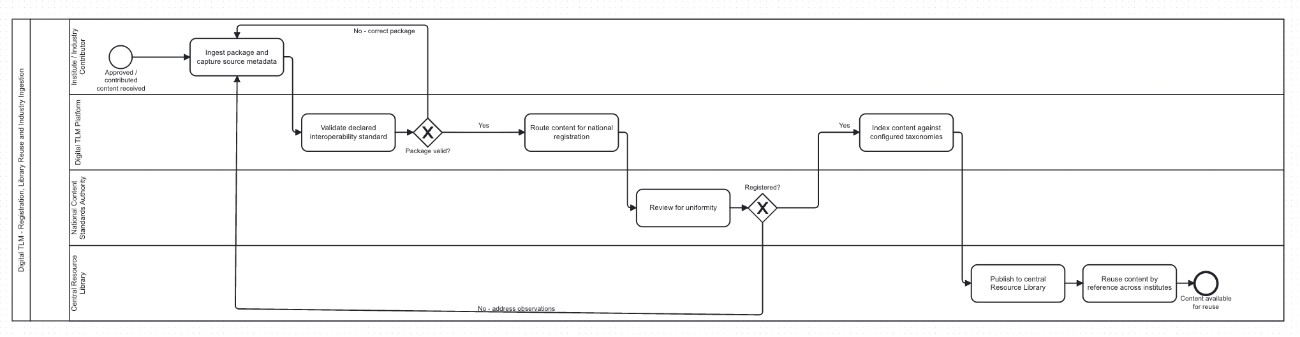
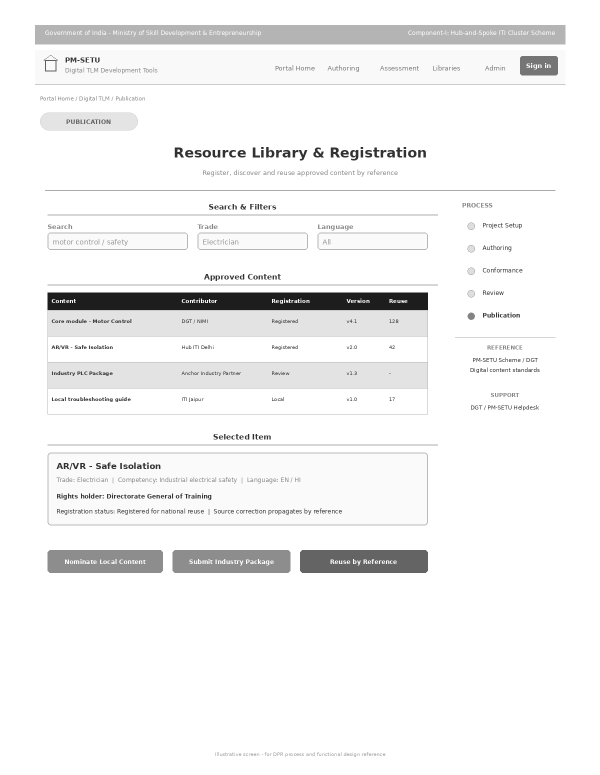
8. ReferencesPDF p.38
The following standards and public reference sources underpin the interoperability, accessibility and immersive-content requirements stated in this DPR. PM-SETU scheme and DGT curriculum / assessment source material remain the programme-specific basis for the functional requirements.
| Reference | Application to Digital TLM | Official source |
| PM-SETU Scheme / Component I programme framework | DGT / MSDE - programme- specific basis for the Hub-and- Spoke ITI model, curriculum/content governance and implementation requirements | Programme reference supplied for DPR preparation |
| Digital TLM current-state evidence | Skill India Digital Hub / Open edX UAT review - existing authoring position carried into Annexure A | Annexure A of this DPR |
| National Digital Education Architecture (NDEAR) | Ministry of Education - interoperability and federated digital architecture principles | https://www.education.gov.in/ne p-initiatives |
| Guidelines for Indian Government Websites and Apps (GIGW 3.0) | NIC / MeitY - government digital quality, accessibility, cybersecurity and lifecycle requirements | https://guidelines.india.gov.in/gi gw3/ |
| Web Content Accessibility Guidelines (WCAG) 2.1 | W3C - accessibility requirements for web content and interfaces | https://www.w3.org/TR/WCAG2 1/ |
| Learning Tools Interoperability (LTI / LTI Advantage) | 1EdTech - standards-based launch and integration of external learning tools | https://www.1edtech.org/standa rds/lti |
| Question & Test Interoperability (QTI) 3 | 1EdTech - exchange of assessment items, tests and associated metadata | https://www.1edtech.org/standa rds/qti/index |
| xAPI and cmi5 | Advanced Distributed Learning Initiative - learning activity statements, launch / packaging and LRS interoperability | https://www.adlnet.gov/guides/tl a/service-definitions/extra- resources.html |
| SCORM | Advanced Distributed Learning Initiative - interoperable packaging and LMS delivery of e-learning content | https://adlnet.gov/assets/upload s/SCORM_Users_Guide_for_IS Ds.pdf |
| OpenXR | Khronos Group - vendor-neutral API standard covering VR, AR and mixed-reality runtimes | https://registry.khronos.org/Ope nXR/ |
| glTF 2.0 | Khronos Group - interoperable runtime delivery format for three-dimensional assets | https://registry.khronos.org/glTF /specs/2.0/glTF-2.0.html |
Annexure A - Existing Platform PositionPDF p.39
This annexure records the authoring capability presently available on the Skill India Digital Hub, established by direct examination of the User Acceptance Testing environment. It is the evidence base for the functional requirements at Section 3: those requirements are framed as the difference between the capability recorded here and the capability required, not as a fresh build. Course authoring on the Hub hands off to a separate Open edX deployment; the Hub portal itself handles organisation particulars, enrolment and certificate configuration. The advanced module configuration of that Open edX deployment already includes two non-standard extensions, a bulk multiple-choice upload facility and a scheme assessment submission facility, establishing that extending the environment, rather than replacing it, is an accepted and proven practice.
| Capability required | Position in the deployed environment |
| Collaborative content authoring | Available: multiple authors via the course team function, with authoring and publication rights distinguished |
| Assisted content authoring | Not available: no such function in any menu or the advanced module list |
| Review and approval workflow | Available: drafted, submitted, approved, sent-back and deactivated states, with reviewer comments recorded |
| Multi-modal assessment | Partly available: objective formats and bulk upload exist; practical and viva formats do not |
| Difficulty and competency tagging | The mechanism exists (taxonomies tab, problem bank); no taxonomy is pre-configured |
| Multimedia and multi-language | Available: video, audio, PDF and SCORM packages; catalogue already carries thirteen languages |
| Auto-translation and subtitling | Not available at authoring: transcripts are uploaded manually per language |
| Accessibility | Available and certified to the Guidelines for Indian Government Websites and WCAG 2.1 AA |
| Resource libraries and reuse | Available: library and problem-bank components, created independently of any course and reused across courses |
| Structural, taxonomic and standards guideline enforcement | Not available: no modular structure, controlled outcome expression, blueprint or standards validation is enforced |
| Immersive content authoring | Not available: no facility for scenario composition, asset ingestion or tier declaration |
Two limits apply to the above: the examination was conducted under a Training Partner credential, so an administrator-only capability would not have been visible; and it was conducted in the User Acceptance Testing environment, with production configuration to be confirmed.