On this page: jump to a section
- Abbreviations
- 1. Overview
- Scope
- Key Assumptions
- 2. As-Is Grievance Management Landscaped
- 3. Business Requirements
- Sub-module 1: PM-SETU Project Management — user journey
- Sub-module 2: Grievance Management — user journeys
- 4. Functional System Requirements
- Pillar 1: Task & work management
- Pillar 2: Programme monitoring dashboards
- Pillar 3: Grievance intake & PM-SETU integration touchpoints
- Pillar 4: Grievance routing, workflow & escalation
- Pillar 5: Alert & SLA engine
- Pillar 6: Grievance analytics, dashboards & reports
- Pillar 7: Integration
- 5. Solution Architecture
- 6. Non-Functional Requirements
- Performance requirements
- Security requirements
- Disaster recovery requirements
- Backup and data retention requirements
- Audit logging and monitoring requirements
- Compliance requirements
- 7. Process Designs and Mockups
- PM-SETU Project Management — task assignment and tracking
- Trainee grievance redressal via SIDH — marks and profile category
- Trainer grievance redressal via SIDH
- CPGRAMS grievance routing and closure
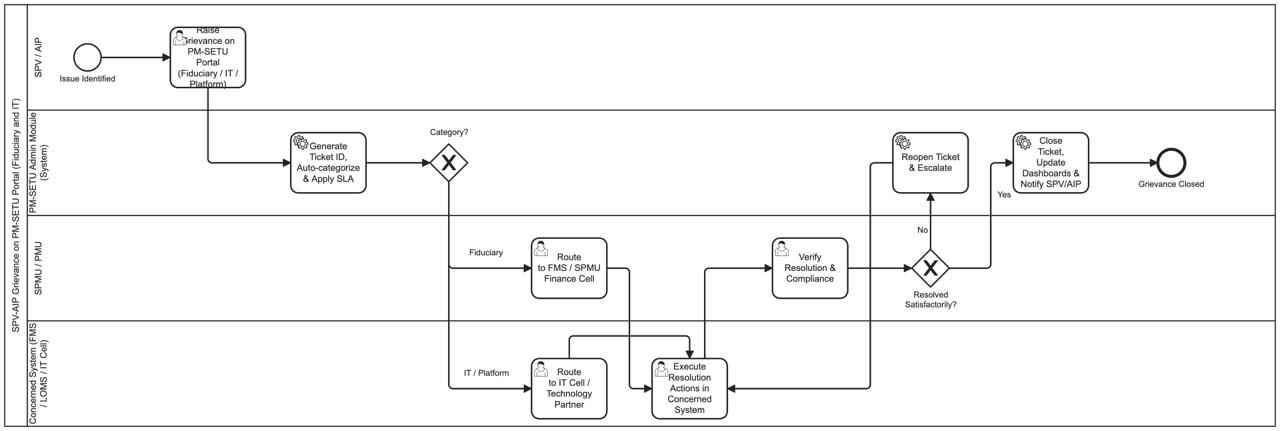
- SPV/AIP grievance on the PM-SETU portal — fiduciary and IT
- Illustrative screen mockups


Detailed Project Report for Admin Management System
AbbreviationsPDF p.3
The abbreviations used throughout this Detailed Project Report are listed below in alphabetical order.
| Abbreviation | Expansion |
| AIP | Anchor Industry Partner |
| API | Application Programming Interface |
| ATR | Action Taken Report |
| BPMN | Business Process Model and Notation |
| CPGRAMS | Centralized Public Grievance Redress and Monitoring System |
| DGT | Directorate General of Training |
| DMS | Document Management System |
| DPDP Act | Digital Personal Data Protection Act, 2023 |
| DPR | Detailed Project Report |
| DR | Disaster Recovery |
| FMS | Fiduciary Management System |
| GIGW | Guidelines for Indian Government Websites |
| IAM | Identity and Access Management |
| ISMS | Information Security Management System |
| ITI | Industrial Training Institute |
| KPI | Key Performance Indicator |
| LOMS | Learning and Operations Management System |
| MFA | Multi-Factor Authentication |
| MIS | Management Information System |
| MSDE | Ministry of Skill Development and Entrepreneurship |
| NCVT | National Council for Vocational Training |
| NFR | Non-Functional Requirement |
| PMU | Programme Management Unit |
| PM-SETU | Pradhan Mantri - Skilling and Employability Transformation of Utilization (Scheme) |
| RBAC | Role-Based Access Control |
| RDST | Regional Directorate (Regional / District / State Level) |
| RPO | Recovery Point Objective |
| RTO | Recovery Time Objective |
| SIDH | Skill India Digital Hub |
| SLA | Service Level Agreement |
| SPMU | State Programme Management Unit |
| SPV | Special Purpose Vehicle |
| SSO | Single Sign-On |
| TPS | Transactions Per Second |
| UAT | User Acceptance Testing |
| VAPT | Vulnerability Assessment and Penetration Testing |
| WCAG | Web Content Accessibility Guidelines |
1. OverviewPDF p.4
This section for the PM-SETU Admin Management System defines the business, functional, technical, governance, and implementation requirements for establishing a centralized digital administration platform across the PM-SETU ecosystem. The system is envisaged as a core programme administration and stakeholder support mechanism comprising two sub-modules: (i) PM-SETU Project Management, which will enable structured planning, assignment, tracking, and monitoring of all work being performed on the programme by SPMU, PMU, State, and partner teams; and (ii) Grievance Management, which will provide a unified, scheme-tagged grievance redressal capability by integrating with the existing grievance ecosystems of SIDH and CPGRAMS, and by providing native grievance filing on the PM-SETU portal for SPVs and AIPs.
The primary purpose of the Admin Management System is to establish end-to-end visibility across programme execution and stakeholder redressal. The Project Management sub-module will function as a simplified, PM-SETU-specific work management capability — comparable in concept to industry task- tracking tools, but purpose-built for programme workstreams — enabling authorities to create and assign tasks, monitor progress and effort, track milestones, and review completion against workplans. The Grievance Management sub-module will ensure that trainees, trainers, ITIs, and SPVs/AIPs have clearly defined, digitally traceable channels for raising and resolving grievances relating to the PM-SETU scheme, with existing portals reused wherever they operate today and PM-SETU-specific integration touchpoints (scheme-selection dropdowns and routing tags) introduced at those portals. Given the programme's multi- stakeholder implementation structure involving Central Government entities, State Governments, SPVs, AIPs, ITIs, trainees, trainers, and technology partners, the system is intended to create a single source of truth for programme execution status and grievance disposal.
ScopePDF p.4
The PM-SETU Admin Management System will provide a centralized digital platform covering the following scope across Centre, State, SPV, and institution levels:
- •Project management: Digital creation, assignment, prioritization, and tracking of programme tasks
across workstreams, with progress logging, effort capture, deliverable attachment, review workflows, and closure controls.
- •Programme monitoring: Milestone and workplan tracking linked to programme timelines, with
completion percentages, overdue identification, and role-based progress dashboards for SPMU, PMU, State, and Centre authorities.
- •Grievance integration touchpoints: PM-SETU scheme-selection dropdowns and routing tags on
SIDH (trainee and trainer grievances) and CPGRAMS (ministry-level grievances), such that grievances relating to PM-SETU are identifiable, traceable, and reportable end to end.
- •Native SPV/AIP grievance channel: Grievance filing on the PM-SETU portal for SPVs and AIPs
covering fiduciary management and IT/platform-related matters, with automated categorization, routing to the concerned system owners, SLA tracking, and closure workflows that flow to the other PM-SETU systems (FMS, LOMS) where required.
- •Grievance analytics: Consolidated grievance analytics: volumes, ageing, disposal rates, SLA
compliance, category-wise and geography-wise distribution with drill-down from national to State, ITI, and SPV levels.
- •Platform services: Configurable alerts, escalation workflows, role-based dashboards, audit trails,
reporting services, and integration with SIDH, CPGRAMS, FMS, identity and access management platforms, document repositories, and communication gateways.
The platform will support role-based access for Centre authorities (DGT/MSDE), State Governments, SPMU/PMU teams, SPVs, AIPs, ITIs, trainees, trainers, and nodal officers, ensuring secure and efficient collaboration across stakeholders.
Key AssumptionsPDF p.5
- •All participating SPMU/PMU teams, State Governments, SPVs, and AIPs will use the PM-SETU Admin
Management System as the single platform for programme task management, progress tracking, and PM-SETU-related grievance administration.
- •Existing grievance portals — SIDH and CPGRAMS — will continue to operate as the primary intake
channels for trainees, trainers, and ministry-level complainants respectively. These portals will provide the required APIs, configuration provisions (scheme-selection dropdowns), and data exchange mechanisms to enable PM-SETU tagging and status synchronization.
- •The current grievance escalation hierarchy (ITI approval, Nodal Officer, RDST, State, Centre) and the
CPGRAMS transfer mechanism will remain stable during implementation. Future policy or process changes will be addressed through configurable business rules and change management processes.
- •Grievances pertaining to pre-2014 examinations, which are presently handled manually, will remain
outside the digital intake scope in the initial phase; the system will however provide a register to record and track such cases once digitized by the concerned cell.
- •Participating institutions will have the necessary digital infrastructure, connectivity, and trained users
to support system adoption. Roles, approval authorities, delegation matrices, data ownership, and operational responsibilities will be defined and operationalized prior to deployment.
The table below presents the key stakeholders and the role of each stakeholder group in the admin management ecosystem.
| Stakeholder | Role in the Admin Management Ecosystem |
| Central Govt. / DGT / MSDE / SPMU / PMU | National programme administration, task assignment and monitoring, grievance oversight, escalation handling, and strategic decision- making |
| State Governments / RDST | State-level task execution, grievance review and forwarding within the escalation chain, and implementation monitoring |
| SPVs & AIPs | Programme execution, task updates, and filing of fiduciary and IT/platform grievances on the PM-SETU portal |
| ITIs | Verification and approval of trainee grievances, submission of institutional grievances, and task execution at institution level |
| Trainees | Filing of marks, profile, and examination grievances on SIDH with original documents |
| Trainers | Filing of marks/certification and profile grievances on SIDH |
| Nodal Officers | First-level review and forwarding of trainee grievances (one nodal officer per 4–5 ITIs); CPGRAMS transfer handling at DGT and division level |
| DGT Divisions / Cells | Resolution of grievances routed to the concerned cell (Trade Test, IT, Curriculum, and other cells) and preparation of Action Taken Reports |
| Technology & Integration Providers | Platform operations, integrations, identity, and communication services |
2. As-Is Grievance Management LandscapedPDF p.6
Grievance management at DGT is presently administered in a decentralized manner across divisions and cells, each supporting its individual grievance portal mechanism. The divisions and cells participating in grievance handling are: Trade Test Cell, Information Technology Cell, Curriculum Division Cell, Central Field Institution Cell, Budget Section, General Admin, Scheme Division (All Schemes), Affiliation Section, Coordination, Vigilance, Establishment, and Cash Section. There is no consolidated, scheme-tagged view of grievances across these channels, and no mechanism currently exists to identify PM-SETU-specific grievances or report on their disposal.
Trainee grievances — SIDH (LOMS)
Trainees file their grievances on the SIDH portal, which handles marks and profile grievances of the trainee. The grievance first goes to the Nodal Officer (one nodal officer for every 4–5 ITIs), then to the RDST (Regional / District / State level), then to the State, and then to the Centre, after which the resolution is updated on the SIDH portal. The trainee is required to submit original documents when filing the grievance, and the grievance must also be approved by the ITI before it progresses through the escalation chain.
For examinations, trainees can file complaints only within the designated examination window, covering grievances related to both practical and written examinations. Grievances pertaining to examinations conducted prior to 2014 are handled manually, and no digital portal is currently available for such cases.
Ministry-level grievances — CPGRAMS
A CPGRAMS portal is administered at the DGT level. All queries received at the ministry level are passed on to CPGRAMS, from where they are transferred to the nodal officer, who in turn transfers them to the nodal officers of the concerned internal departments, and thereafter to the respective sub-portals for resolution. Closure on CPGRAMS is effected through Action Taken Reports uploaded by the concerned division.
Trainer grievances — SIDH
Trainers also file their grievances on the SIDH portal. The trainer channel presently covers only marks/certification and profile-related complaints of trainers.
Key gaps in the as-is landscape
| Gap | Implication for PM-SETU |
| Fragmented channels | Twelve divisions/cells operate individual grievance mechanisms with no consolidated visibility, making programme-level oversight and reporting infeasible. |
| No scheme tagging | SIDH and CPGRAMS do not capture the scheme to which a grievance pertains; PM-SETU grievances cannot be identified, tracked, or reported separately. |
| Manual legacy handling | Pre-2014 examination grievances are processed manually with no digital record, traceability, or SLA discipline. |
| No channel for SPVs/AIPs | SPVs and AIPs — central actors in PM-SETU delivery — have no defined channel for fiduciary or IT/platform grievances. |
| No SLA and escalation discipline | Escalation through Nodal Officer, RDST, State, and Centre is sequential and untimed; delays are not automatically flagged or escalated. |
| No unified analytics | There is no consolidated dashboard of grievance volumes, ageing, disposal, or category-wise trends across channels. |
3. Business RequirementsPDF p.6
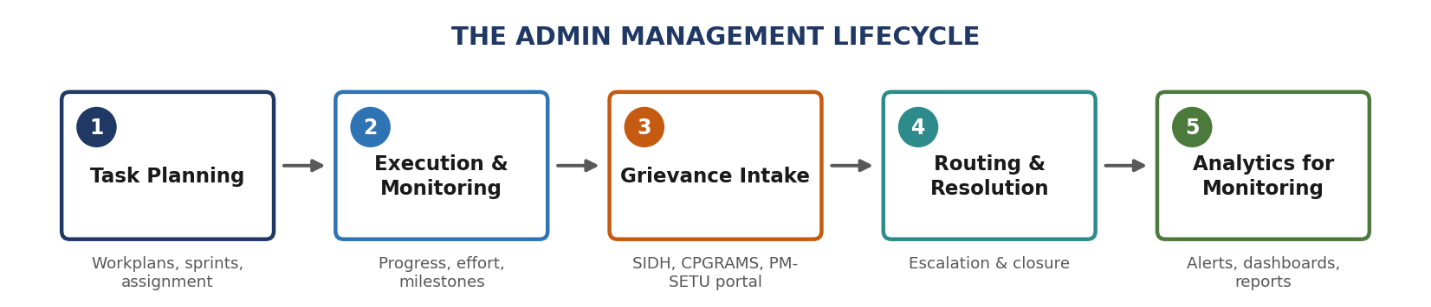
The PM-SETU Admin Management System digitizes and governs two core business processes of programme administration. The first is project management, under which SPMU/PMU and workstream leads plan workplans and sprints, create and assign tasks with priorities and due dates, monitor execution and effort, review deliverables, and close tasks with full traceability of programme progress. The second is grievance management, under which grievances raised by trainees and trainers (on SIDH), ministry-level complainants (on CPGRAMS), and SPVs/AIPs (natively on the PM-SETU portal) are tagged to the PM- SETU scheme, routed through the prescribed escalation hierarchies, tracked against SLAs, and closed with complete disposal records. Finally, analytics for monitoring converts task and grievance transactional data into alerts, dashboards, and reports that provide actionable insights for governance and decision-making.
These processes are inherently complex to administer. They span multiple stakeholders — Central Government entities, State Governments, RDST offices, nodal officers, ITIs, SPVs, AIPs, trainees, trainers,
DGT divisions and cells, and technology partners — each with distinct roles, approval authorities, and information needs. They also involve multi-channel grievance intake, mandatory ITI approval and original- document requirements for trainee grievances, examination-window constraints, CPGRAMS transfer chains, and division-wise resolution responsibilities. Managing this lifecycle through manual or fragmented systems would result in delayed task delivery, invisible programme slippage, untraceable grievances, and elevated stakeholder dissatisfaction. A dedicated, centralized Admin Management Module is therefore required to act as the single source of truth — enforcing approved workplans, automating routing and escalation, maintaining complete audit trails, and providing real-time visibility to all stakeholders.
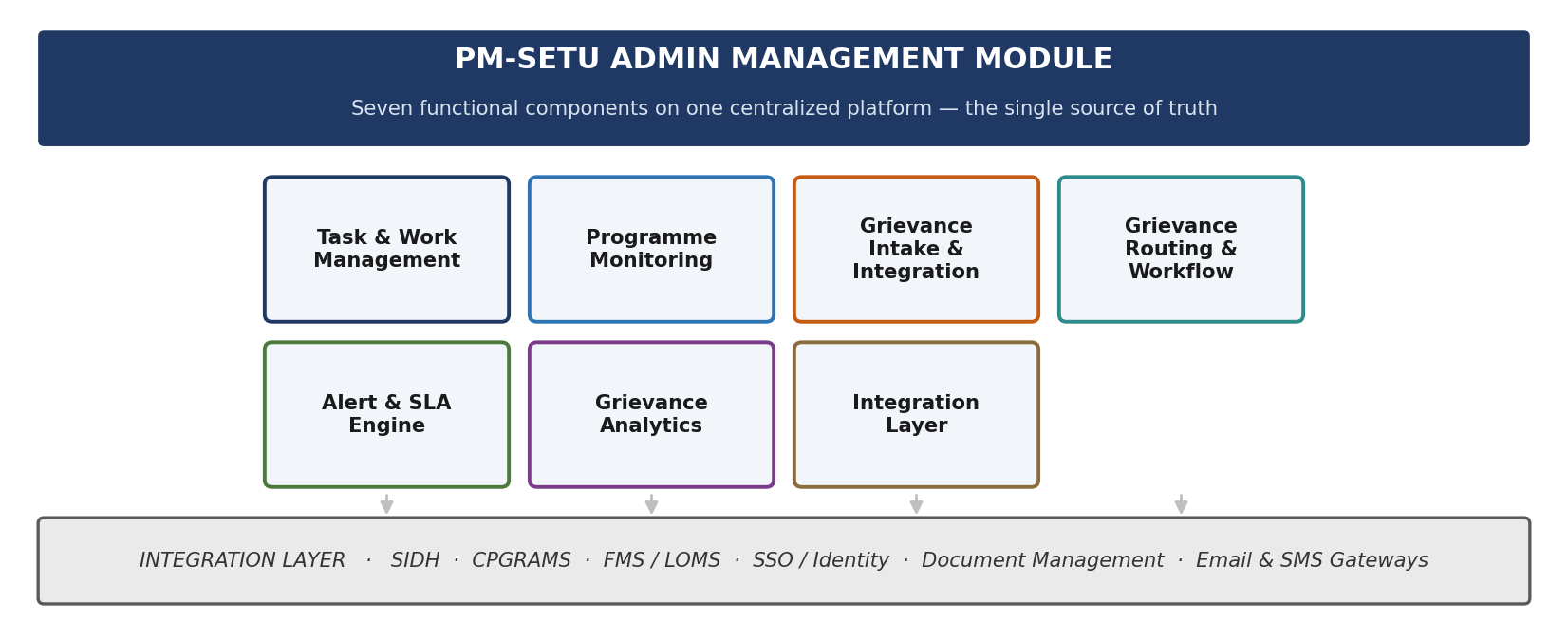
To address these requirements, the Admin Management Module is organized into two sub -modules delivered through seven functional pillars: a Task & Work Management component and Programme Monitoring Dashboards under the Project Management sub-module; and Grievance Intake & Integration Touchpoints, Grievance Routing & Workflow, an Alert & SLA Engine, and Grievance Analytics under the Grievance Management sub-module; connected by a common Integration Layer linking SIDH, CPGRAMS, FMS/LOMS, identity management, document repositories, and communication gateways.
Sub-module 1: PM-SETU Project Management — user journeyPDF p.8
- •Workplan setup: The SPMU/PMU defines
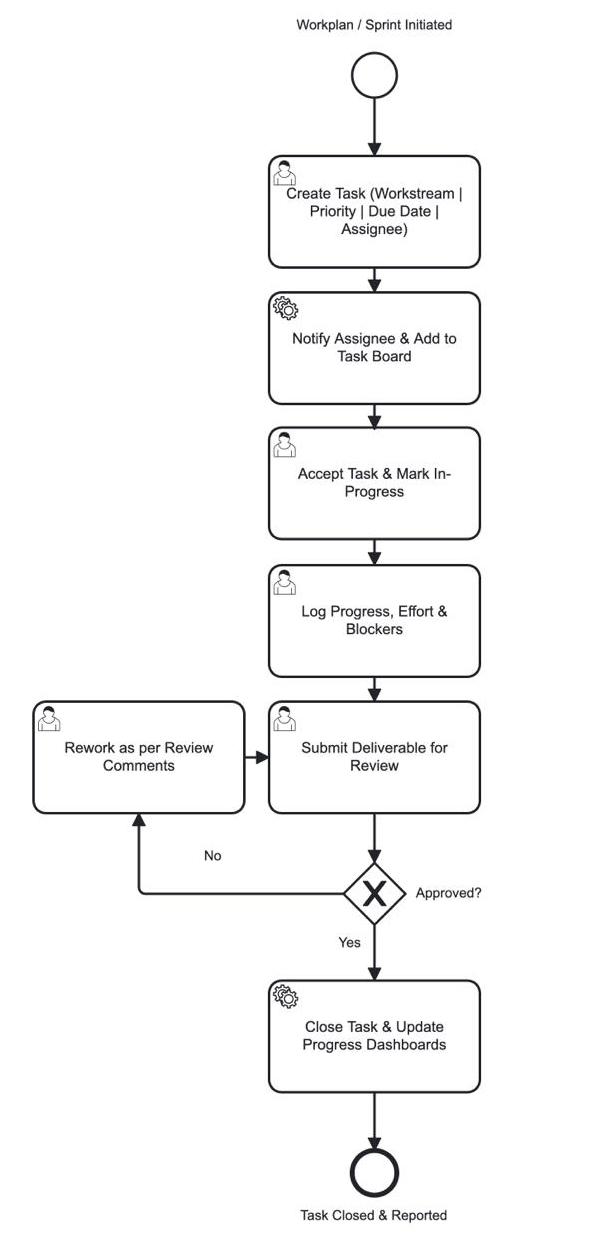
programme workstreams, workplans, and sprint/milestone calendars; the system auto- initializes task boards and reporting structures for each workstream.
- •Task creation and assignment:
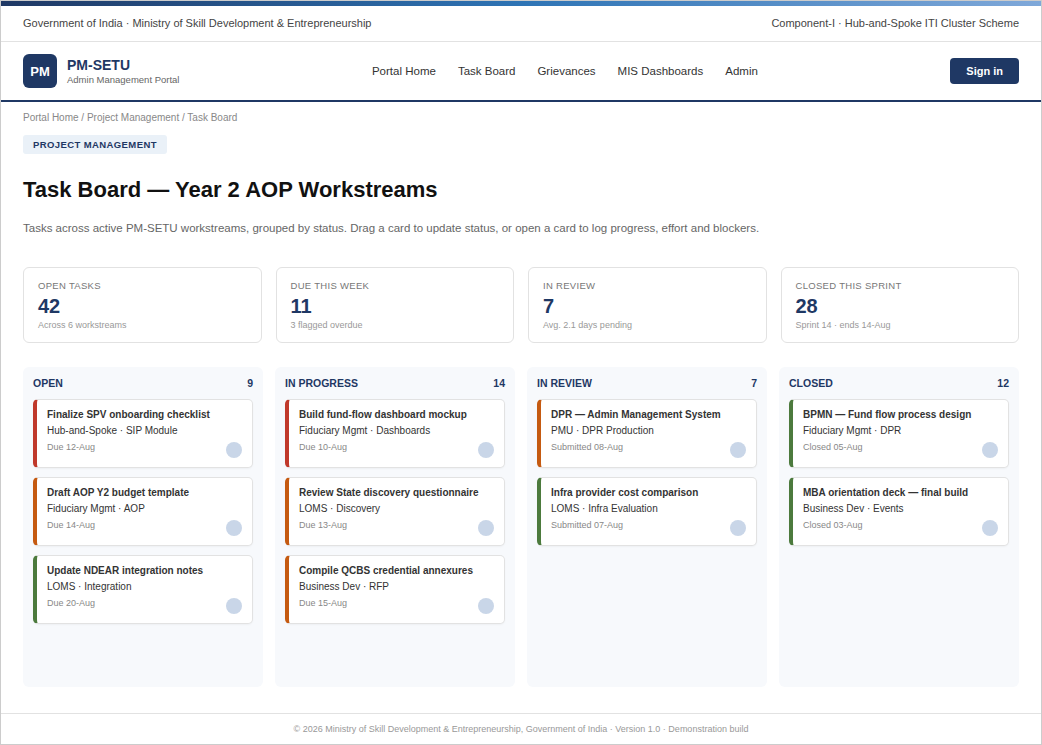
The workstream lead creates tasks specifying title, description, workstream, priority, due date, and assignee; the system notifies the assignee and places the task on the board.
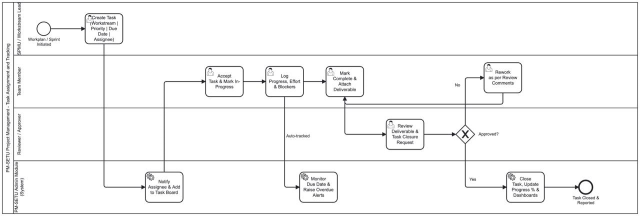
- •Execution and progress logging: The team
member accepts the task, marks it in-progress, and periodically logs progress, effort, and blockers; the system continuously monitors due dates and raises overdue alerts to the workstream lead.
- •Review and closure: On completion, the
member attaches the deliverable and submits the task for review; the reviewer/approver examines the deliverable and either approves closure or returns the task for rework with comments.
- •Reporting: On approval, the system closes the
task, recomputes workstream completion percentages, and refreshes progress dashboards; milestone status and delayed tasks are surfaced to SPMU, State, and Centre views.
Figure 3 — User journey: PM-SETU Project Management task workflow (see Annexure for the full Camunda BPMN process design).
Sub-module 2: Grievance Management — user journeysPDF p.8
The grievance management approach for PM-SETU is to reuse the existing grievance ecosystems and introduce PM-SETU integration touchpoints at each of them, while creating a native filing channel only where none exists today. On SIDH and CPGRAMS, a PM-SETU scheme-selection dropdown shall be introduced so that grievances relating to the scheme are tagged at intake and can be routed, tracked, and reported end to end. For SPVs and AIPs, grievance filing for fiduciary management and other IT-related matters shall be provided on the PM-SETU portal itself, with resolutions flowing to the other systems (FMS, LOMS) where required.
Trainee grievance journey (SIDH)
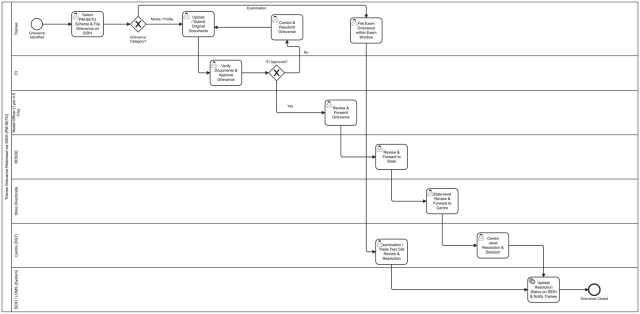
- •Filing with scheme tag: The
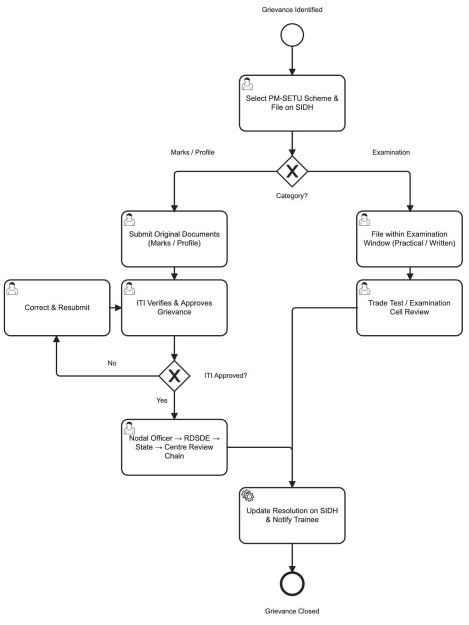
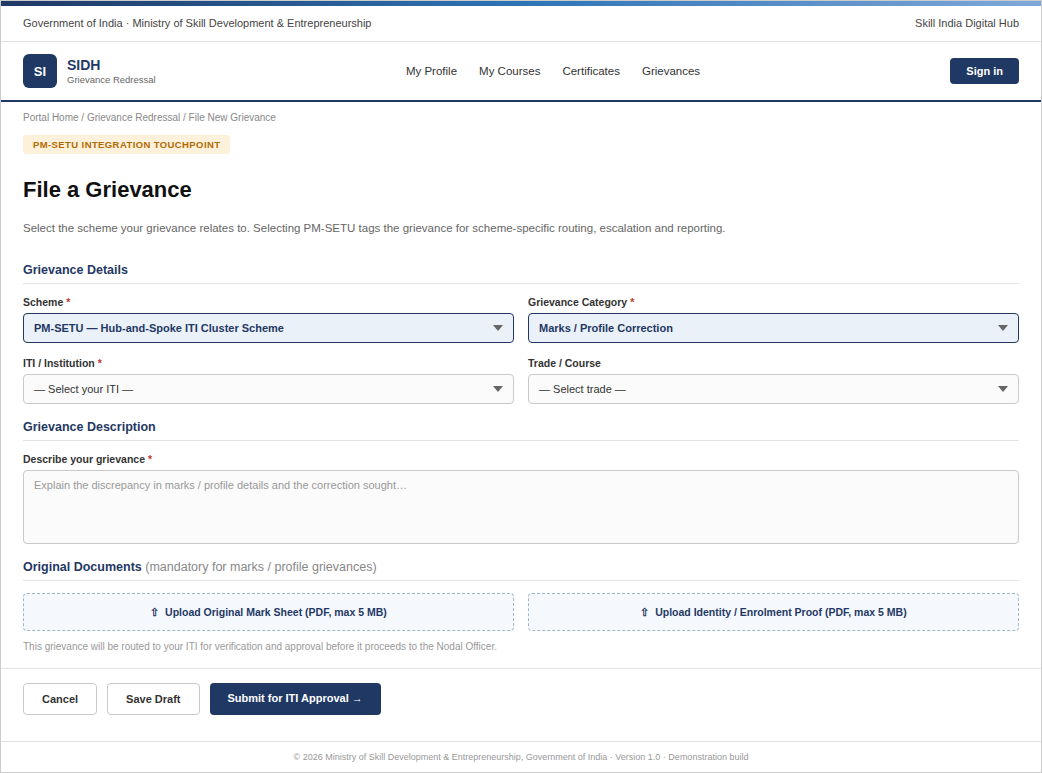
trainee logs into SIDH, selects the PM-SETU scheme from the scheme dropdown, and files a grievance under the marks/profile or examination category.
- •Documents and ITI approval: For
marks/profile grievances, the trainee submits the original documents as part of the filing; the grievance is then verified and approved by the ITI before progressing.
- •Escalation chain: The approved
grievance is routed to the Nodal Officer (one per 4–5 ITIs), then to the RDST, then to the State, and then to the Centre for resolution; each stage records remarks and timestamps.
- •Examination window:
Examination grievances (practical or written) can be filed only within the designated examination window and are routed to the Examination/Trade Test Cell for resolution; pre-2014 examination grievances remain manual and are recorded in a digitized register once processed by the concerned cell.
- •Closure and synchronization:
On resolution, the status is updated on the SIDH portal and the trainee is notified; the disposal record is synchronized to the PM- SETU grievance analytics store.
Figure 4 — User journey: Trainee grievance redressal via SIDH (marks/profile and examination categories).
Trainer grievance journey (SIDH)
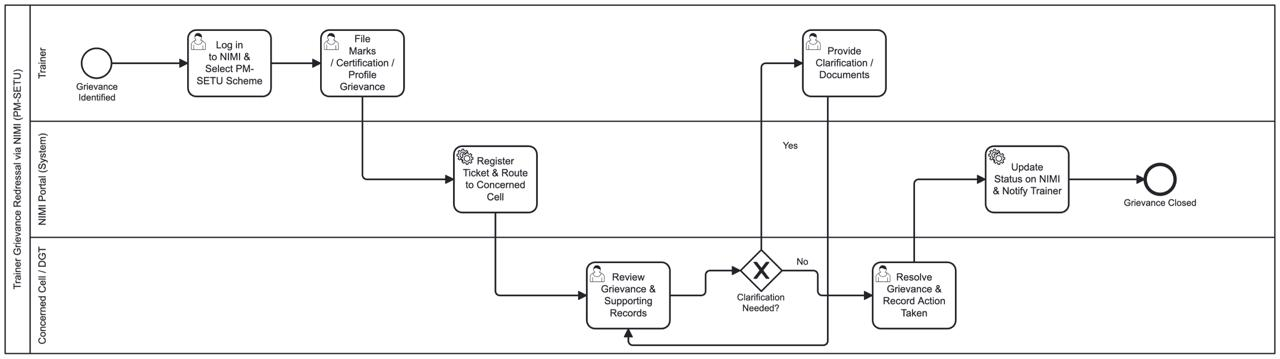
- •Filing with scheme tag: The trainer logs into
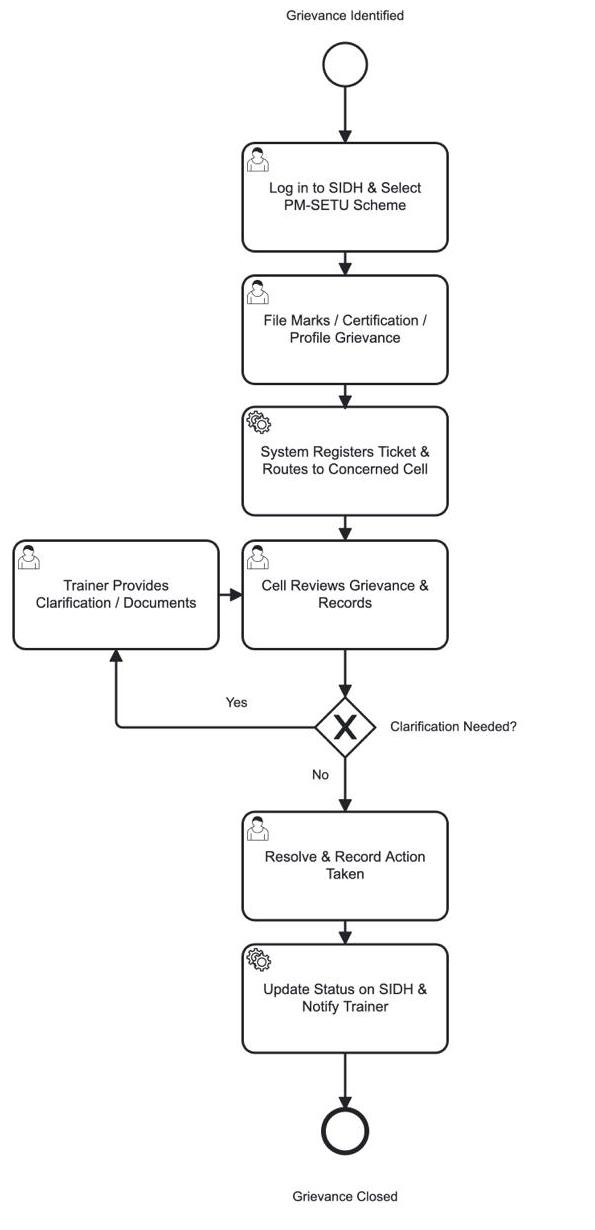
SIDH, selects the PM-SETU scheme from the scheme dropdown, and files a marks/certification or profile grievance.
- •Routing and clarification: SIDH registers the
ticket and routes it to the concerned cell; where clarification is needed, the trainer is asked to provide additional information or documents.
- •Resolution and closure: The concerned cell
resolves the grievance, records the action taken, updates the status on SIDH, and notifies the trainer; the disposal record is synchronized to the PM-SETU grievance analytics store.
Figure 5 — User journey: Trainer grievance redressal via SIDH.
Ministry-level grievance journey (CPGRAMS)
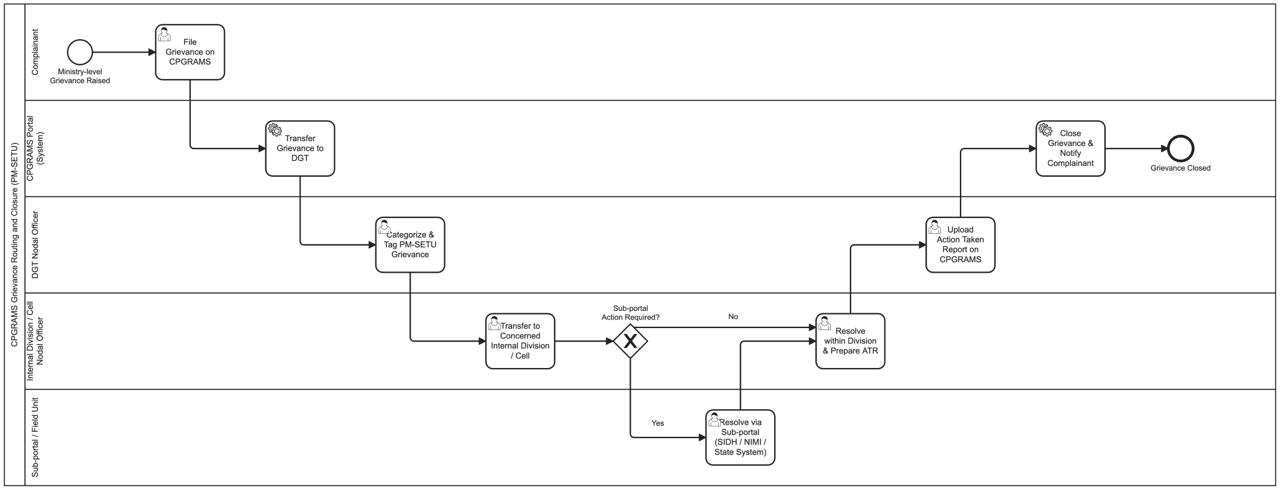
- •Intake and tagging:
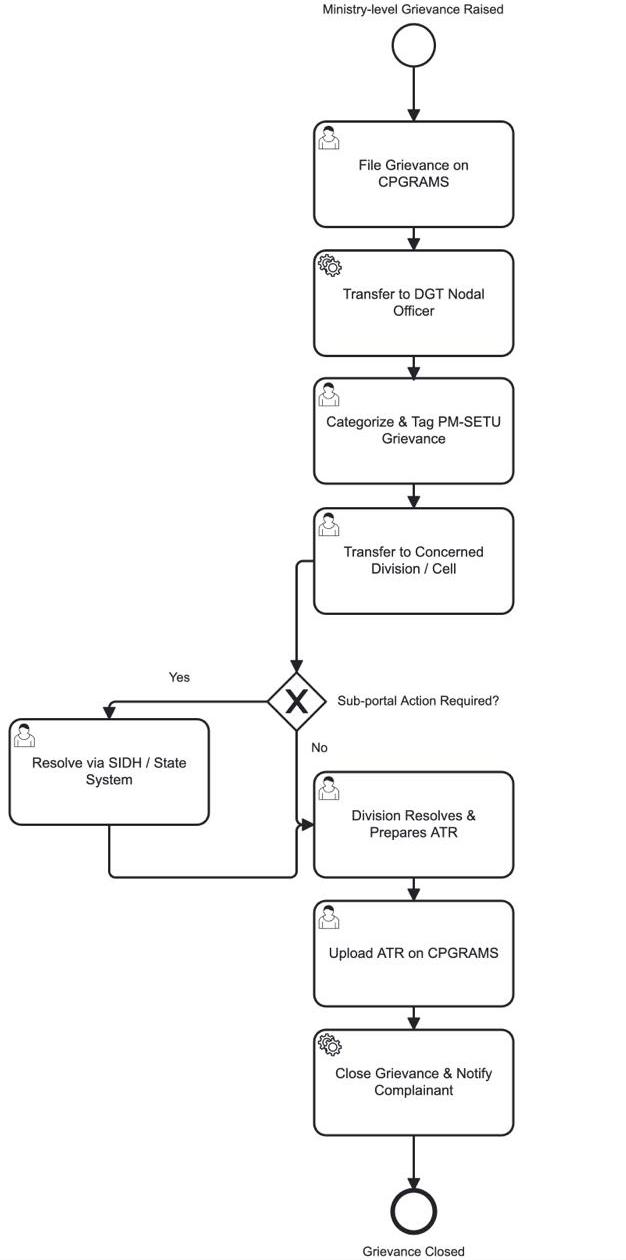
Grievances received at the ministry level are filed on CPGRAMS and transferred to DGT, where the DGT nodal officer categorizes the grievance and applies the PM- SETU tag where applicable.
- •Transfer chain: The grievance
is transferred to the nodal officer of the concerned internal division/cell; where sub-portal action is required, it is further transferred to the relevant sub- portal (SIDH or State system) for resolution.
- •ATR and closure:
The concerned division resolves the grievance, prepares the Action Taken Report, and uploads it on CPGRAMS, following which the grievance is closed and the complainant notified.
Figure 6 — User journey: Ministry-level grievance routing and closure via CPGRAMS.
SPV/AIP grievance journey (PM-SETU portal)
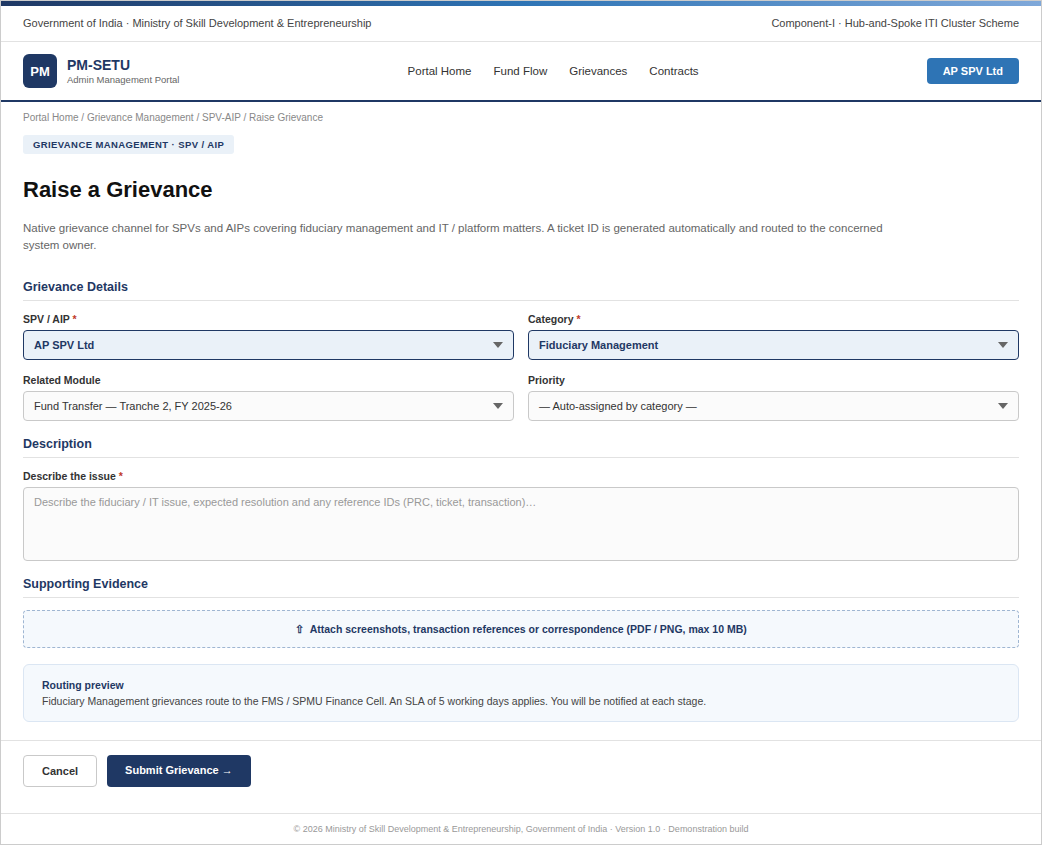
- •Native filing: The SPV/AIP
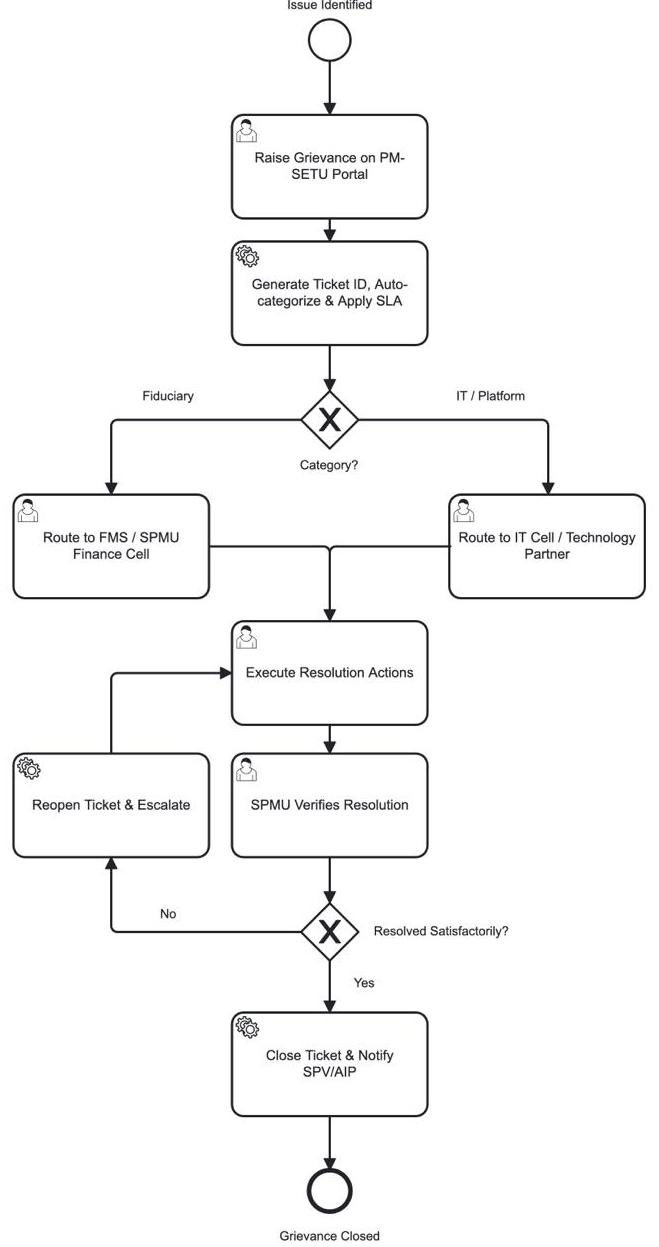
raises a grievance on the PM- SETU portal under the fiduciary management or IT/platform category; the system generates a ticket ID, auto-categorizes the grievance, and applies the applicable SLA.
- •Category-based routing:
Fiduciary grievances are routed to the FMS/SPMU finance cell; IT and platform grievances are routed to the IT Cell or the concerned technology partner. Resolution actions are executed in the concerned system and flow back to the ticket.
- •Verification and closure:
The SPMU verifies the resolution; unsatisfactory resolutions are reopened and escalated, while satisfactory resolutions result in ticket closure, dashboard updates, and notification to the SPV/AIP.
Figure 7 — User journey: SPV/AIP grievance filing on the PM-SETU portal (fiduciary and IT categories).
The table below outlines the access rights and functional permissions available to each stakeholder persona across the sub-modules.
| Persona | Project Mgmt. | Grievance Filing | Grievance Review / Routing | Analytics | Alerts |
| Centre / DGT / MSDE | Assign / Monitor | No | Resolve / Monitor | Full | Yes |
| State / RDST | Execute / Monitor | No | Review / Forward | State View | Yes |
| SPMU / PMU | Full | No | Verify / Escalate | Full | Yes |
| SPV / AIP | Task Updates | Yes (Fiduciary / IT on PM-SETU portal) | No | SPV View | Yes |
| ITI | Task Updates | Institutional | Approve Trainee Grievances | ITI View | Yes |
| Trainee | No | Yes (SIDH) | No | Own Grievances | Yes |
| Trainer | No | Yes (SIDH) | No | Own Grievances | Yes |
| Nodal Officer | No | No | Review / Forward | Assigned View | Yes |
| DGT Division / Cell | Task Updates | No | Resolve / ATR | Cell View | Yes |
The table below summarizes the core functional modules and capabilities of the PM-SETU Admin Management System.
| Module | Key Features |
| Task & Work Management | Workplan and sprint setup; task creation, assignment, and prioritization; progress and effort logging; deliverable attachment; review and closure workflow; overdue tracking |
| Programme Monitoring | Workstream completion percentages; milestone tracking; delayed-task identification; role-based progress dashboards for Centre, State, and SPMU |
| Grievance Intake & Integration | PM-SETU scheme dropdowns on SIDH and CPGRAMS; native SPV/AIP filing on the PM-SETU portal; document capture; examination-window enforcement |
| Grievance Routing & Workflow | ITI approval; Nodal Officer → RDST → State → Centre escalation; CPGRAMS transfer chain; category-based routing for SPV/AIP tickets; reopen and escalation handling |
| Alert & SLA Engine | Event-driven alerts; SLA and ageing monitoring; escalation management |
| Grievance Analytics & Reporting | National, State, ITI, SPV, and cell-wise dashboards; ageing and disposal reporting |
| Integration Layer | SIDH, CPGRAMS, FMS/LOMS integrations; DMS integration; SSO integration; email / SMS gateway integration |
4. Functional System RequirementsPDF p.14
Pillar 1: Task & work managementPDF p.14
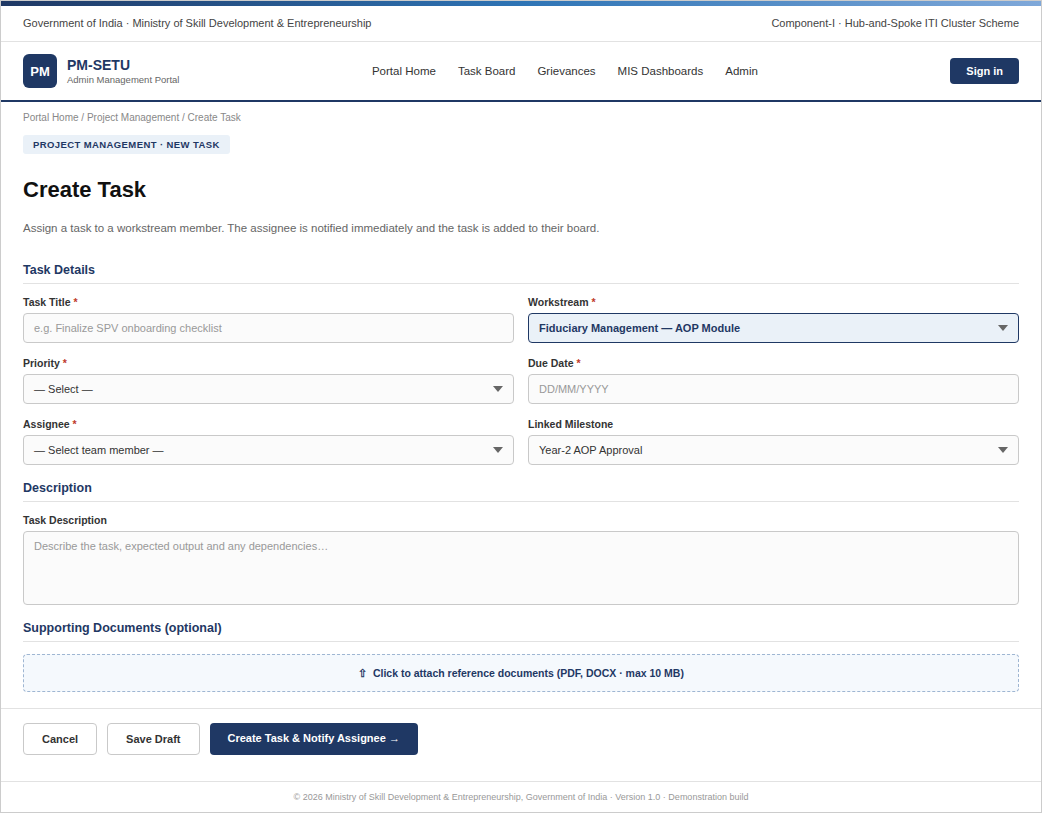
The system shall enable digital creation, assignment, and lifecycle management of programme tasks across PM-SETU workstreams. The platform shall capture task attributes including title, description, workstream, priority, due date, assignee, and linked milestone. The solution shall support task states (Open, In-Progress, Under Review, Rework, Closed), progress and effort logging, deliverable attachment, and review-based closure. The module shall maintain complete task history and prevent closure without reviewer approval.
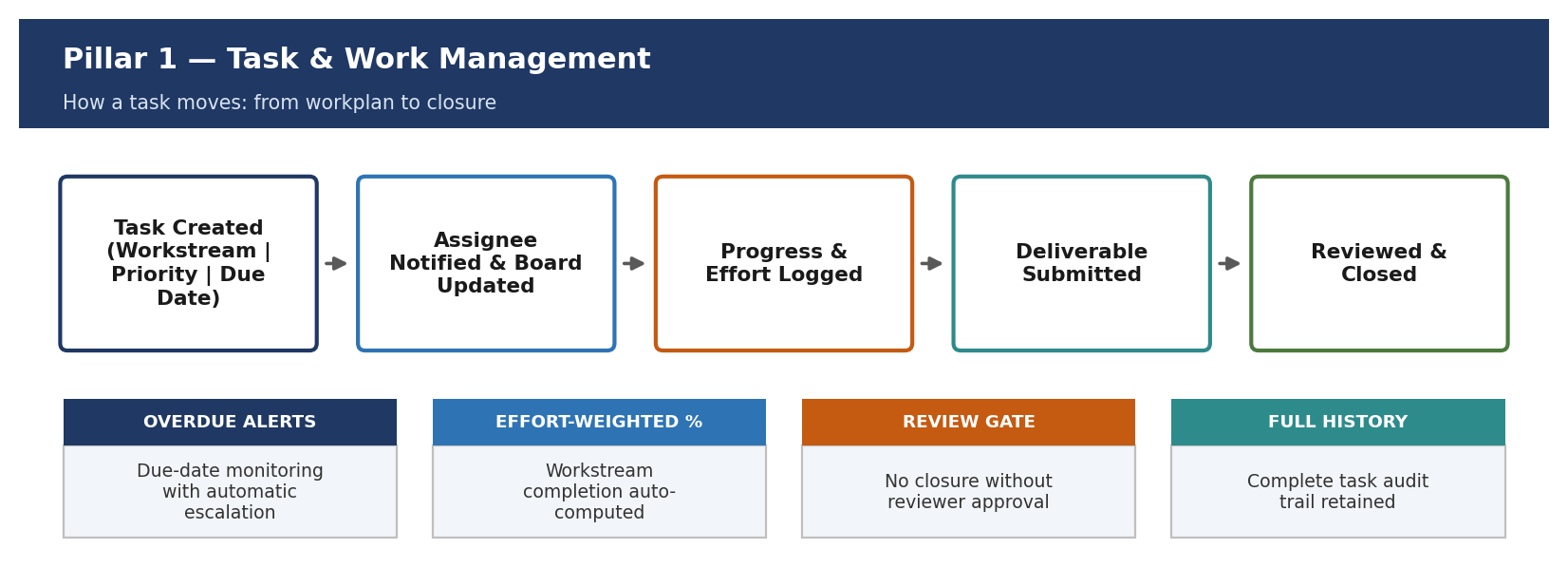
Functional Capabilities
Task Administration: Explicitly requires structured task capture and assignment with notification to assignees.
- •Create task with workstream, priority, due date, and assignee.
- •Notify assignee and add task to the workstream board.
- •Reassign, re-prioritize, and re-schedule tasks with audit trail.
- •Link tasks to milestones and workplan items.
Progress & Effort Tracking: Identifies progress percentage, effort, and blocker capture as system functions.
- •Log progress percentage and effort against each task.
- •Record blockers and dependencies.
- •Auto-compute workstream completion using effort-weighted task progress. Review & Closure: Requires reviewer approval before closure, with rework loops for returned tasks.
- •Submit completed task with deliverable attachment.
- •Approve closure or return for rework with comments.
- •Close task and update dashboards automatically.
Acceptance Criteria
- •Tasks can be created, assigned, and tracked digitally across all workstreams.
- •Assignees receive notifications within five minutes of assignment.
- •Workstream completion percentages are recomputed automatically on task updates.
- •Tasks cannot be closed without reviewer approval.
- •Complete task history is preserved and viewable.
Validation Rules
- •Task title, workstream, due date, and assignee are mandatory.
- •Due dates cannot precede the task creation date.
- •Progress percentage must be between 0 and 100.
- •Deliverable attachment is mandatory for closure submission.
- •Only designated reviewers may approve closure.
Exception Management
| Exception | System Action |
| Task overdue | Raise overdue alert to assignee and workstream lead; flag on dashboard. |
| Assignee unavailable / role revoked | Notify workstream lead and prompt reassignment. |
| Closure without deliverable | Prevent submission and display validation message. |
| Unauthorized task modification | Create audit log and deny transaction. |
Pillar 2: Programme monitoring dashboardsPDF p.15
The system should provide role-based programme monitoring dashboards covering workstream progress, milestone status, task ageing, and team workload. Dashboards shall support drill-down from national summaries to workstreams, teams, and individual tasks, and shall reconcile with underlying task records.
Functional Capabilities
- •National and workstream-level completion dashboards with milestone RAG status.
- •Overdue and at-risk task listings with ageing buckets.
- •Team workload and effort distribution views.
- •Scheduled and on-demand progress reports exportable in PDF and Excel formats.
Acceptance Criteria
- •Users access dashboards based on assigned roles.
- •Dashboards refresh automatically and support drill-down navigation.
- •Dashboard KPIs reconcile with source task data.
Validation Rules
- •Users shall view only authorized data.
- •Completion calculations must follow approved effort-weighted formulas.
- •Historical reports cannot be modified.
Exception Management
| Exception | System Action |
| Data synchronization failure | Notify administrator and display last successful refresh time. |
| Incomplete source data | Flag dashboard metrics as provisional. |
| Report generation failure | Generate support ticket and notify user. |
Pillar 3: Grievance intake & PM-SETU integration touchpointsPDF p.15
The system shall enable PM-SETU-tagged grievance intake across the existing portals and the PM-SETU portal. The platform shall introduce a PM-SETU scheme-selection dropdown on SIDH and CPGRAMS intake screens, capture grievance category and supporting documents, enforce examination-window rules for exam grievances, and provide native filing for SPVs/AIPs on the PM-SETU portal.
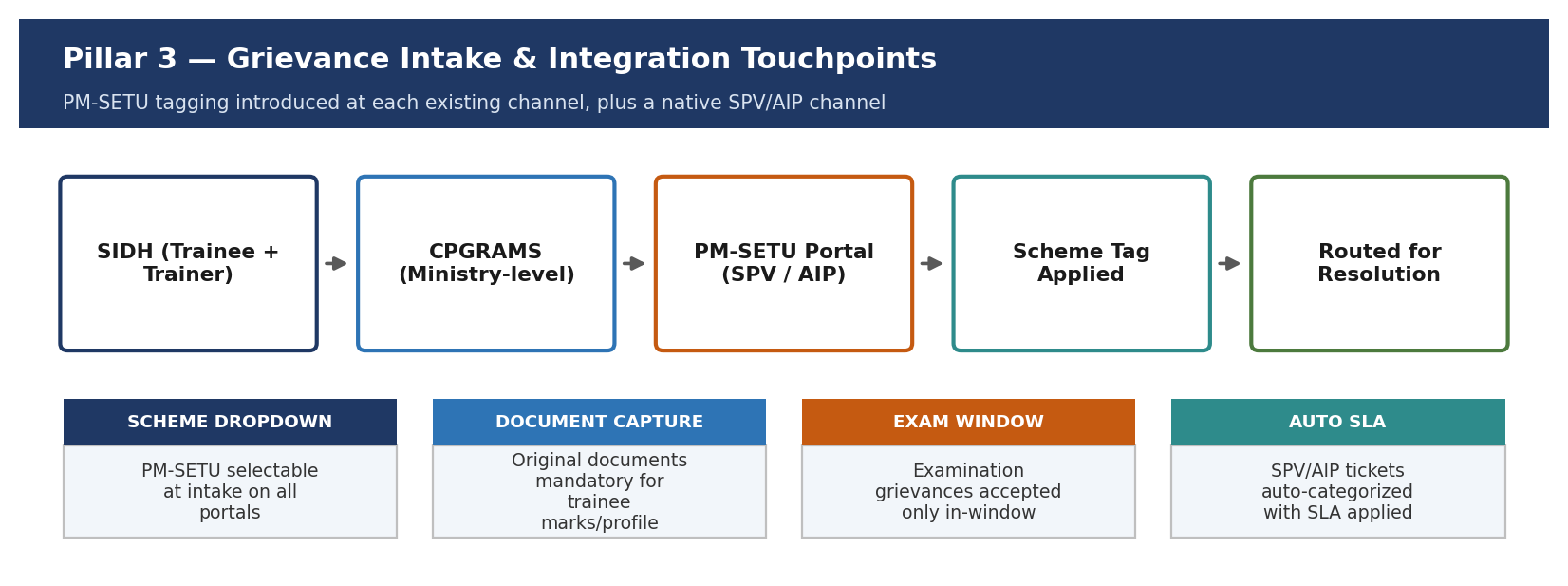
Functional Capabilities
Scheme Tagging: Requires PM-SETU selection at intake on all integrated portals so grievances are identifiable end to end.
- •Display PM-SETU in the scheme dropdown on SIDH and CPGRAMS.
- •Apply the PM-SETU tag to the grievance record and propagate it through routing. Trainee Intake (SIDH): Covers marks/profile and examination grievances with document and approval controls.
- •Capture grievance category (marks/profile or examination).
- •Capture original document submission for marks/profile grievances.
- •Enforce ITI approval before escalation.
- •Restrict examination grievances (practical/written) to the designated examination window.
- •Maintain a digitized register for pre-2014 examination grievances processed manually by the
concerned cell.
Trainer Intake (SIDH): Covers marks/certification and profile grievances of trainers.
- •Capture trainer grievance with category and supporting records. SPV/AIP Intake (PM-SETU Portal): Provides native filing for fiduciary management and IT/platform grievances.
- •Capture grievance under fiduciary or IT/platform category.
- •Generate ticket ID and apply SLA automatically.
- •Flow resolution actions to the concerned systems (FMS, LOMS) where required.
Acceptance Criteria
- •PM-SETU is selectable at intake on SIDH and CPGRAMS.
- •Trainee grievances cannot progress without ITI approval and required documents.
- •Examination grievances are accepted only within the examination window.
- •SPV/AIP tickets are generated with automatic categorization and SLA assignment.
Validation Rules
- •Scheme tag is mandatory for PM-SETU grievance reporting.
- •Original document reference is mandatory for marks/profile grievances.
- •Examination grievances outside the window shall be rejected with a message.
- •Grievance category is mandatory for SPV/AIP tickets.
Exception Management
| Exception | System Action |
| Documents missing | Prevent submission and display validation message. |
| Filing attempted outside examination window | Reject filing and display window dates. |
| ITI approval pending beyond SLA | Generate reminder to ITI and alert Nodal Officer. |
| Duplicate grievance detected | Generate duplicate warning and link records. |
Pillar 4: Grievance routing, workflow & escalationPDF p.17
The system shall route grievances through the prescribed hierarchies with complete traceability. For trainee grievances, the platform shall enforce the Nodal Officer → RDST → State → Centre chain following ITI approval, with SIDH status updates at closure. For ministry-level grievances, the platform shall support the CPGRAMS transfer chain from DGT nodal officer to division nodal officers and onward to sub-portals, with ATR-based closure. For SPV/AIP tickets, the platform shall route by category to the FMS/SPMU finance cell or the IT Cell/technology partner, support SPMU verification, and permit reopening of unsatisfactory resolutions.
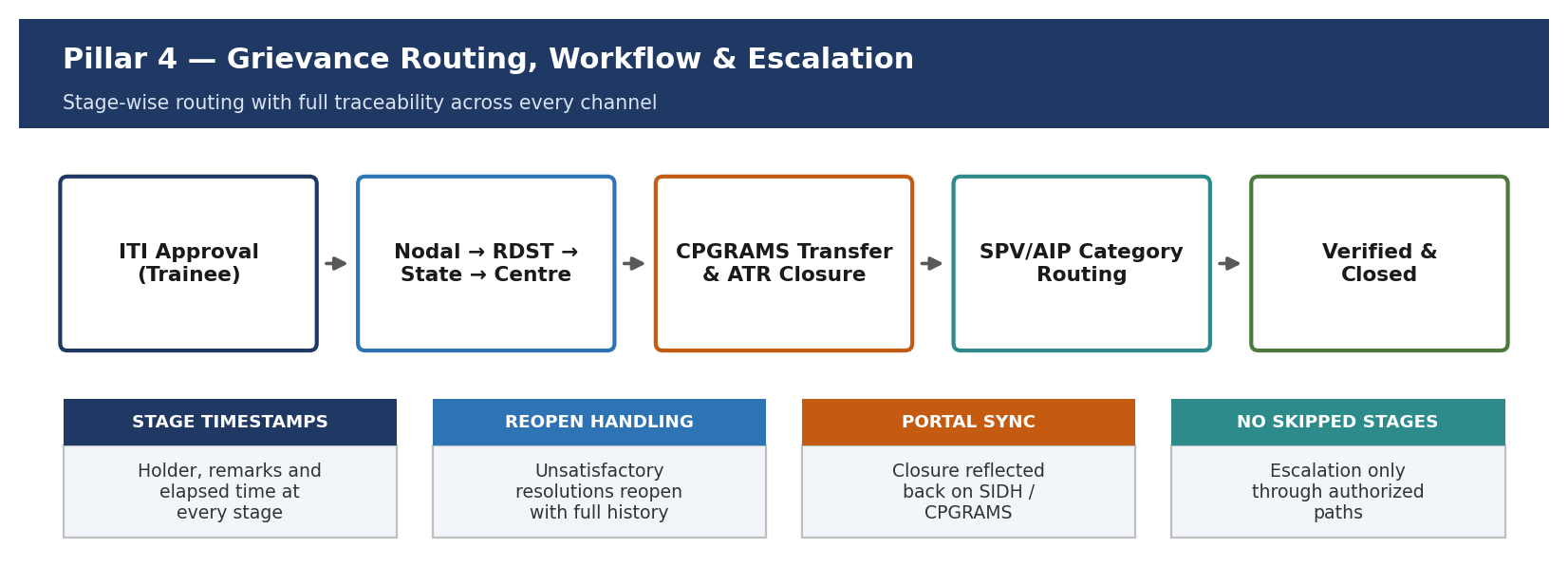
Functional Capabilities
- •Stage-wise routing with remarks, timestamps, and holder identification at every stage.
- •Forward, return, seek-clarification, and resolve actions at each stage.
- •CPGRAMS transfer tracking and ATR upload linkage.
- •Category-based auto-routing of SPV/AIP tickets with reopen and escalation handling.
- •Status synchronization back to the originating portal (SIDH / CPGRAMS) at closure.
Acceptance Criteria
- •Every grievance displays its current stage, holder, and elapsed time.
- •Stage transitions are recorded with user, timestamp, and remarks.
- •Closure updates are reflected on the originating portal.
- •Reopened tickets retain full history and are flagged for escalation.
Validation Rules
- •Stages cannot be skipped except through authorized escalation.
- •Closure requires a recorded resolution remark and, for CPGRAMS, an uploaded ATR.
- •Only the current stage holder may act on a grievance.
Exception Management
| Exception | System Action |
| Grievance pending beyond stage SLA | Escalate to next authority and flag on dashboards. |
| Sub-portal / integration unavailable | Log failure, notify administrator, attempt automated retry. |
| ATR not uploaded at closure (CPGRAMS) | Block closure and notify division nodal officer. |
| Resolution rejected at verification | Reopen ticket, escalate, and restart SLA tracking. |
Pillar 5: Alert & SLA enginePDF p.18
The alert engine shall continuously monitor task events, grievance ageing, SLA breaches, approval delays, and escalation triggers. Alerts shall be configurable, role-based, and capable of supporting escalation workflows.
Major Alert Types
| Trigger Event | System Action | Recipient |
| Task overdue | Overdue alert and dashboard flag | Assignee, Workstream Lead |
| Milestone at risk | RAG escalation on progress dashboards | SPMU, Centre |
| ITI approval pending beyond SLA | Reminder and escalation alert | ITI, Nodal Officer |
| Grievance pending at a stage beyond SLA | Escalation to next authority | Stage Holder, Next Authority |
| Examination window closing | Advance notification | Trainees, ITIs |
| CPGRAMS ATR overdue | SLA breach alert | Division Nodal Officer, DGT |
| SPV/AIP ticket unresolved beyond SLA | Escalation alert | SPMU, IT Cell / FMS Cell |
| Ticket reopened | Escalation and priority flag | SPMU, Concerned Cell |
Escalation and priority flag SPMU, Concerned Cell Beyond the task and grievance events described above, the Alert & SLA Engine shall additionally serve as the consolidated notification layer for fiduciary, analytical, and programme-delivery events raised elsewhere in the PM-SETU ecosystem. The Fiduciary Management System, the analytics and reporting services, and the PM-SETU Monitoring Platform shall each publish their alert events to the Admin Management Module through the Integration Layer, where the events shall be de-duplicated, tagged to the concerned SPV, State, ITI, or workstream, and routed to the applicable recipients through a single role-based notification channel. The source system shall remain the system of record for the underlying transaction; the Admin Management Module shall be the system of record for alert issuance, acknowledgement, escalation, and closure.
Alerts originating from the Fiduciary Management System
The system shall ingest and route the fiduciary alerts published by the FMS covering contribution compliance, utilization thresholds, budget deviation, audit outcomes, and fund-release readiness. Alerts that affect tranche processing shall carry the highest severity classification and shall be escalated automatically where the associated approval or verification step exceeds its SLA.
| Trigger Event | System Action | Recipient |
| State share not deposited | Red flag on the fund-flow dashboard and contribution shortfall alert | State, Centre |
| Industry (AIP) share not deposited | Red flag on dashboard and contribution compliance alert | SPV, State, Centre |
| 75% utilization threshold reached | Next-tranche unlock trigger and initiation of IMA verification | SPV, SPMU |
| Utilization below threshold at period close | Tranche hold notification and AOP re-planning advisory | SPV, SPMU |
| Utilization Certificate not submitted for the reporting period | Compliance reminder and dashboard exception | SPV, SPMU |
| CAPEX/OPEX reallocation within approved cap | Notification workflow to governance bodies within 14 days | State, Centre |
| AOP deviation beyond approved cap | Approval workflow initiated and system lock applied until sign-off | Centre |
| Major audit observation unresolved beyond timeline | Red/hold alert and fund-release hold recommendation | SPV, State, Centre |
| Adverse or disclaimed audit opinion issued | Fund-release hold flag and escalation to governance bodies | State, Centre |
| IMA verification report delayed beyond SLA | SLA breach alert and escalation | IMA, SPMU |
| Trigger Event | System Action | Recipient |
| Payment Release Certificate (PRC) delayed | Approval delay alert | SPMU, State |
| Banking integration failure or balance refresh not received | Technical failure alert with automated retry and administrator notification | SPMU, IT Cell |
Alerts originating from Analytics, Dashboards & Reports
The analytics engine shall convert consolidated task, grievance, fiduciary, and monitoring data into risk indicators, and shall raise alerts where configured thresholds, trend rules, or data-quality rules are breached. Analytical alerts shall be advisory in nature and shall not by themselves place a hold on any fund release or approval; where an analytical alert corresponds to a control breach, the corresponding transactional alert from the owning system shall govern.
| Trigger Event | System Action | Recipient |
| Delayed SPV identified against programme timeline | Risk indicator raised on national and State dashboards | SPMU, State, Centre |
| Utilization shortfall trend detected | Early-warning advisory with variance summary | SPV, SPMU |
| Contribution gap trend across a State | Aggregated shortfall alert with SPV- wise breakdown | State, Centre |
| AOP deviation trend across multiple SPVs | Portfolio deviation alert on the national dashboard | Centre |
| Grievance ageing beyond configured band | Ageing exception with stage-wise pendency breakdown | Stage Holder, SPMU |
| Grievance disposal rate below target | Performance alert on State and ITI scorecards | State, DGT |
| Grievance reopen rate above threshold | Quality-of-resolution alert for review | SPMU, Concerned Cell |
| Data synchronization failure from a source system | Administrator notification displaying last successful refresh time | IT Cell, SPMU |
| Incomplete or unreconciled source data | Dashboard metrics flagged as provisional | SPMU, IT Cell |
| Scheduled report generation failure | Support ticket generated and requesting user notified | IT Cell, Requesting User |
| Unauthorized access attempt on a restricted dashboard | Access denied, audit log entry created, and security alert raised | IT Cell, System Administrator |
Alerts originating from the PM-SETU Monitoring Platform
The PM-SETU Monitoring Platform shall publish programme-delivery and physical-progress events to the Alert & SLA Engine so that implementation risks surface alongside fiduciary and grievance exceptions within a single consolidated view. Monitoring alerts shall be linked to the affected milestone, KPI, or ITI record so that recipients can navigate directly to the underlying progress entry, and shall be reconciled against the approved implementation schedule and AOP targets.
| Trigger Event | System Action | Recipient |
| Milestone slippage against approved implementation schedule | Milestone-at-risk flag raised with request for revised completion date | SPV, SPMU, State |
| Infrastructure or civil works progress behind plan | Physical-progress exception on the monitoring dashboard | SPV, State |
| Equipment procurement or installation delayed | Delivery-delay alert linked to the affected milestone | SPV, SPMU |
| Trainer deployment or trainer-training shortfall | Capacity shortfall alert with ITI-wise breakdown | ITI, State |
| Trigger Event | System Action | Recipient |
| Enrolment below planned intake for the cycle | Intake shortfall alert | ITI, State, SPMU |
| KPI achievement below target at a review point | KPI shortfall alert with drill-down to the underlying indicator | SPV, SPMU, Centre |
| Placement or outcome-linked indicator below target | Outcome shortfall alert for governance review | SPV, State, Centre |
| Periodic progress report not submitted by the SPV | Non-submission reminder, with escalation on repeat default | SPV, SPMU |
| Adverse finding recorded during field or IMA inspection | Inspection exception routed to the SPV for response | SPV, SPMU |
| Hub-and-spoke cluster linkage not operational within timeline | Implementation risk flag on State and national dashboards | SPV, State, Centre |
Cross-platform alert governance
Every ingested alert shall retain the source system identifier, the originating event timestamp, and a navigable reference to the source record, so that recipients can act on the alert within the system that owns the transaction. Ingestion shall not alter or restart the SLA clocks maintained by source systems; the Admin Management Module shall track only the notification, acknowledgement, and escalation timelines associated with the alert itself. Where a source system is unavailable, the Integration Layer shall queue alert events and replay them on restoration, and shall raise an integration-health alert where the queued backlog exceeds the configured threshold.
Acceptance Criteria
The system will generate alerts within five minutes of identifying a trigger event. Users shall receive dashboard alerts, email notifications, and SMS notifications based on configured severity levels. Escalation rules shall automatically execute upon SLA breaches.
Validation Rules
Alert generation shall only occur against approved business rules. Duplicate alerts for the same unresolved issue shall be consolidated.
Exception Management
Failure of email or SMS delivery shall trigger retry attempts and escalation logging. Communication failures should not prevent alert visibility within dashboards.
Pillar 6: Grievance analytics, dashboards & reportsPDF p.20
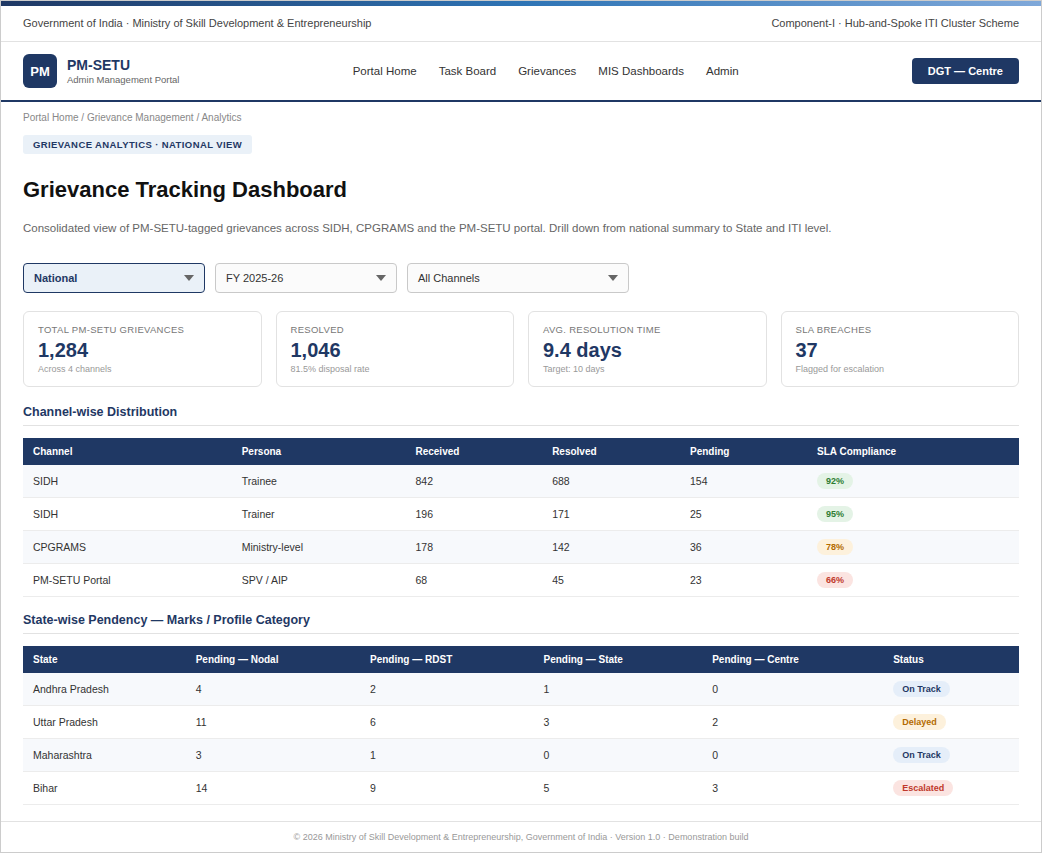
The analytics component shall provide stakeholder-specific views for grievance monitoring, disposal tracking, and decision support, consolidated across SIDH, CPGRAMS, and the PM-SETU portal for PM- SETU-tagged grievances.
| National Dashboard | State Dashboard | ITI / SPV Dashboard | Cell / Division Dashboard |
| Total PM-SETU grievances by channel. Category-wise distribution. Disposal rate and average resolution time. SLA compliance and ageing. State-wise comparison. Escalation and reopen trends. | State grievance volumes. Pending by stage (Nodal / RDST / State). ITI-wise pendency. Delayed cases and red flags. Examination-window filings. | Own grievances and status. Pending approvals (ITI). SPV/AIP ticket status. Resolution history. | Assigned grievance queue. ATR pendency. Category trends. Clarification requests outstanding. |
Acceptance Criteria
- •Users access dashboards based on assigned roles.
- •Dashboards refresh automatically and support drill-down navigation.
- •Reports can be exported in PDF and Excel formats.
- •Dashboard KPIs reconcile with source grievance records.
Validation Rules
- •Users shall view only authorized data.
- •Disposal and ageing calculations must follow approved formulas.
- •Dashboard data must originate from validated source systems.
- •Historical reports cannot be modified.
Exception Management
| Exception | System Action |
| Data synchronization failure | Notify administrator and display last successful refresh time. |
| Incomplete source data | Flag dashboard metrics as provisional. |
| Unauthorized access attempt | Deny access and create audit log. |
| Report generation failure | Generate support ticket and notify user. |
Pillar 7: IntegrationPDF p.21
The Admin Management Module will operate as a central platform within the PM-SETU ecosystem and will require integration with multiple internal and external systems to support task management, grievance intake and routing, stakeholder workflows, and programme reporting. These integrations will enable seamless exchange of task, grievance, and disposal data, reduce manual intervention, improve data accuracy, and facilitate real-time decision-making across national, state, and implementation levels. The integration architecture will support secure, API-driven data exchange with the SIDH and CPGRAMS portals, the PM-SETU FMS and LOMS platforms, government identity platforms, document repositories, and enterprise support services.
5. Solution ArchitecturePDF p.21
The PM-SETU Admin Management System shall act as a unified digital administration platform to manage programme execution visibility and grievance disposal. The system architecture should enable real-time or near real-time visibility of task progress and grievance status across channels, enforce routing and SLA rules, trigger escalations, and provide role-based dashboards. The architecture is organized into three layers:
- •Data Layer
- •Platform Layer — PM-SETU LOMS / Admin Management Platform
- •User Access Layer
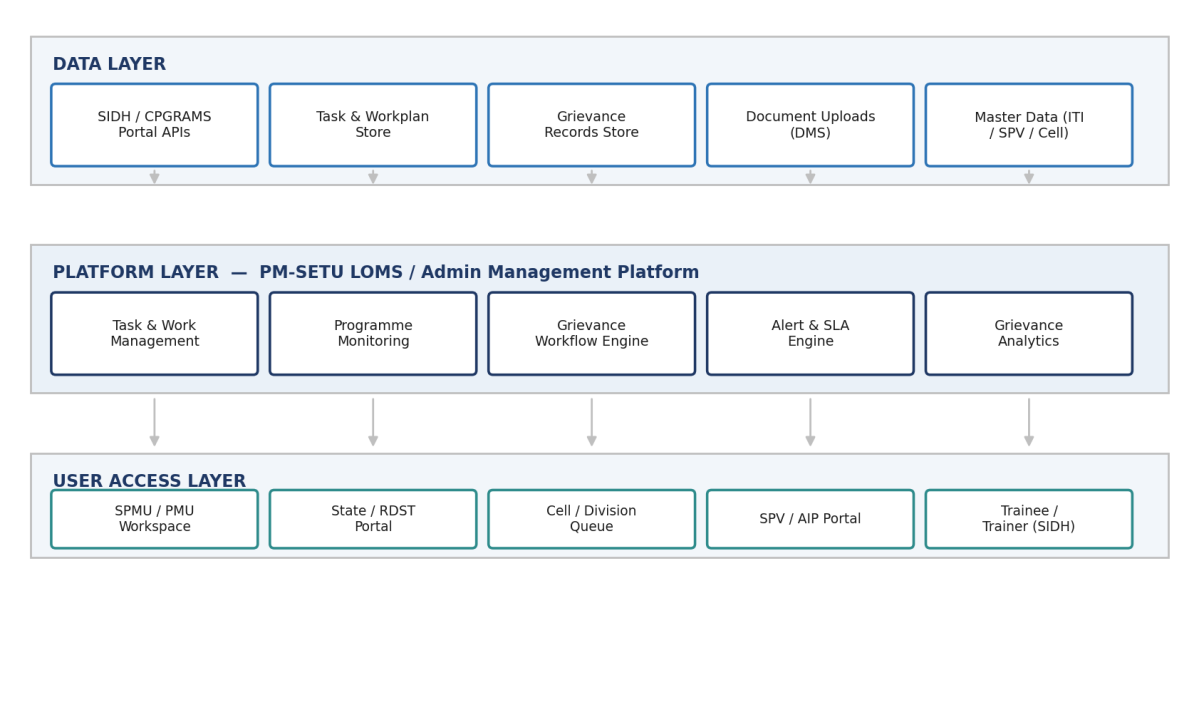
| Integration | Integration Purpose | Data / Information Exchanged |
| SIDH (LOMS) | Trainee and trainer grievance intake with PM-SETU tagging and closure synchronization | Grievance records, scheme tags, documents metadata, stage status, disposal updates |
| CPGRAMS | Ministry-level grievance transfer and ATR-based closure | Grievance transfers, PM-SETU tags, ATR references, closure status |
| FMS / LOMS Platforms | Resolution flow for SPV/AIP fiduciary and platform grievances | Ticket references, resolution actions, status updates |
| Document Management System (DMS) | Storage and retrieval of supporting documents | Grievance documents, deliverables, ATRs, resolution evidence |
| Email Gateway | System notifications and workflow communication | Assignment notices, alerts, reminders, escalation notifications |
| SMS Gateway | Critical alerts and stakeholder communication | SLA breach alerts, closure notifications, examination-window reminders |
| Government Identity & Access Management (SSO) | Centralized authentication and user management | Login credentials, access roles, authentication tokens |
Data layer
The Data Layer shall serve as the foundation of the admin platform. It will collect, store, validate, reconcile, and standardize data from multiple internal and external sources. This layer is critical because PM-SETU grievances originate across three intake channels and programme tasks span multiple workstreams, States, and partner teams.
| Portal APIs | Task & Workplan Store | Grievance Records | Document Uploads | Master Data |
| The system should integrate with SIDH and CPGRAMS APIs to receive PM- | Workplans, sprints, tasks, effort logs, deliverables metadata, and | Unified PM-SETU grievance store consolidating channel, category, stage, holder, | Trainees, ITIs, cells, and SPVs shall upload original documents, | Stakeholder registries — ITIs, nodal officer mapping (1 per 4– 5 ITIs), |
| SETU-tagged grievances, stage transitions, and closure updates. | milestone linkages maintained as the programme execution baseline. | timestamps, SLA state, and disposal outcome. | evidence, deliverables, and ATRs through DMS-backed storage. | RDST/State hierarchy, cells, SPVs/AIPs — supporting routing rules. |
Platform layer
The Platform Layer is the core application layer where business rules, workflows, validations, dashboards, alerts, approvals, and administration controls will operate. The admin framework identifies the PM-SETU LOMS as the platform layer comprising the Task & Work Management component, Programme Monitoring Dashboards, Grievance Intake & Routing Workflow, Alert & SLA Engine, and Grievance Analytics.
| Task & Work Management | Programme Monitoring | Grievance Workflow | Alert & SLA Engine | Grievance Analytics |
| Central work management component providing task creation, assignment, progress logging, review, and closure across workstreams. | Effort-weighted completion computation, milestone RAG, and delayed-task surfacing for Centre, State, and SPMU views. | Routing and escalation engine enforcing the ITI → Nodal → RDST → State → Centre chain, the CPGRAMS transfer chain, and SPV/AIP category routing. | Business-rule- driven alerts, ageing computation, SLA tracking, and automatic escalation on breaches. | Channel- consolidated grievance analytics, disposal and ageing reporting, and export services. |
User access layer
The User Access Layer shall provide secure, role-based access to different stakeholders through tailored portals and dashboards. The framework defines user access for the SPMU/PMU workspace, State/RDST view, Cell/Division queues, SPV/AIP portal, ITI view, and trainee/trainer touchpoints on their existing portals. This layer must balance transparency with operational autonomy: maximum transparency at the summary level, with resolution responsibility retained by the concerned cell or authority rather than central micromanagement.
| SPMU / PMU | State / RDST | Cell / Division | SPV / AIP |
| Create and assign tasks. Monitor workstream progress. Verify SPV/AIP resolutions. Escalate SLA breaches. Generate programme reports. | Execute assigned tasks. Review and forward trainee grievances. Monitor ITI-wise pendency. Track delayed cases. View State dashboards. | Work assigned grievance queues. Resolve and record actions. Upload ATRs (CPGRAMS). Respond to clarifications. View cell dashboards. | Update task progress. Raise fiduciary / IT grievances. Track ticket status. Receive alerts. View SPV dashboards. |
6. Non-Functional RequirementsPDF p.23
The PM-SETU Admin Management System will serve as the central digital platform for managing programme execution and grievance redressal across multiple States, ITIs, SPVs, divisions, and programme management entities. Given its administrative significance and citizen-facing character, the platform must satisfy stringent non-functional requirements relating to performance, availability, security, resilience, auditability, and regulatory compliance.
Performance requirementsPDF p.23
The platform shall provide responsive and reliable user experience across all stakeholder groups including Centre, State Governments, SPMU/PMU teams, SPVs, AIPs, ITIs, trainees, trainers, and divisions. The system shall support concurrent access from all participating entities without degradation in performance, and shall maintain performance consistency during peak periods such as examination windows, admission cycles, and programme review periods. The table below contains the ideal response times of the platform.
| Performance Parameter | Minimum Requirement |
| Online screen response time | Dashboards, task boards, grievance queues, and workflow pages shall load within 3 seconds for 90% of requests under normal load, and within 5 seconds under peak load. |
| Transactional operations | Save, submit, forward, approve, and workflow transition actions shall complete within 2 seconds for 95% of transactions. |
| API and integration response | Synchronous API calls (SIDH, CPGRAMS, IAM) shall respond within 500 milliseconds at the 95th percentile. |
| Concurrent usage | The platform shall support a minimum of 1,000 concurrent users across all stakeholder groups, with the ability to scale to 3,000 concurrent users during peak periods (examination windows, programme reviews) with no more than 20% response-time degradation. |
| Transaction throughput | The system shall sustain a minimum of 100 TPS, scalable to 300 TPS during peak processing periods. |
| Grievance synchronization | Grievance records and stage transitions received through portal integrations shall be reflected on the platform within 15 minutes of receipt, with end-of-day reconciliation completed by 08:00 hours on T+1. |
| Alerts and notifications | System-generated alerts (SLA breaches, overdue tasks, escalation triggers) shall be dispatched within 5 minutes of the triggering event. |
| Report generation | Standard operational reports shall be generated within 10 seconds; complex consolidated national-level reports within 60 seconds; large scheduled reports shall execute asynchronously and complete within 15 minutes without impacting online transaction processing. |
| Bulk data processing | Bulk uploads of up to 10,000 records (master data, legacy grievance registers, task imports) shall be validated and processed within 5 minutes. |
| System availability | The platform shall provide a minimum of 99.5% monthly availability (approximately 3.6 hours of permissible unplanned downtime per month), excluding pre-notified planned maintenance windows scheduled outside business hours. |
| Scalability headroom | The architecture shall support at least 20% year-on-year growth in users, ITIs, SPVs, grievance volumes, and data storage over a 5-year horizon through horizontal scaling, without architectural redesign. |
| Recovery objectives | Critical administration functions shall meet an RTO of 4 hours and an RPO of 30 minutes, as further detailed under Disaster Recovery Requirements. |
Security requirementsPDF p.24
The platform shall implement a comprehensive security framework to protect grievance, personal, task, and administrative data. User authentication shall be integrated with Government Identity and Access Management or approved Single Sign-On mechanisms to provide centralized and secure user access management. RBAC shall be enforced across all application modules to ensure users can access only information and functionality relevant to their designated responsibilities. The system shall maintain strict segregation of duties between trainees, trainers, ITIs, nodal officers, State authorities, cells, SPVs/AIPs, and Centre-level authorities. Sensitive information, including grievance records, personal data, uploaded documents, and user credentials, shall be protected through encryption at rest and encryption in transit. The table below describes the security standards and frameworks required for the admin management module.
| Security Framework / Standard | Application to the Platform |
| ISO/IEC 27001:2022 | The platform and its hosting operations shall implement an ISMS certified to ISO/IEC 27001:2022, with the Statement of Applicability covering all grievance and personal data processing environments. |
| CERT-In Directions and Guidelines (2022) | Cyber security incidents shall be reported to CERT-In within 6 hours of detection; security and system logs shall be retained for a minimum of |
| 180 days within India; ICT system clocks shall be synchronized with NIC/NPL NTP servers. | |
| IT Act, 2000 and DPDP Act, 2023 | The platform shall comply with the Information Technology Act, 2000 (including reasonable security practices) and the Digital Personal Data Protection Act, 2023, covering lawful processing, purpose limitation, data minimization, and breach notification obligations for personal data of trainees, trainers, and users. |
| MeitY empanelled cloud / GI Cloud (MeghRaj) | The solution shall be hosted on a MeitY-empanelled cloud service provider or NIC infrastructure, with all data, including backups and DR copies, residing within Indian territory. |
| Security audit and certification | A CERT-In empanelled agency shall conduct VAPT prior to go-live, after every major release, and at least half-yearly thereafter; a security audit clearance / safe-to-host certification shall be obtained before production deployment. |
| OWASP ASVS / Top 10 and secure SDLC | Application development shall follow secure coding practices aligned to OWASP ASVS Level 2 and OWASP Top 10 mitigation, with static (SAST) and dynamic (DAST) security testing integrated into the CI/CD pipeline. |
| Encryption standards | All data in transit shall be protected using TLS 1.2 or higher (TLS 1.3 preferred); data at rest, including databases, documents, and backups, shall be encrypted using AES-256; cryptographic keys shall be managed through a dedicated KMS/HSM with defined rotation policies. |
| Identity, access, and authentication | User authentication shall integrate with Government SSO (e.g., NIC Parichay) or an approved identity provider; MFA shall be mandatory for administrative, resolution-authority, and escalation roles; RBAC with segregation of duties shall be enforced, supported by quarterly user access reviews. |
| Security monitoring (SIEM/SOC) | All security events shall be aggregated into a SIEM with 24x7 SOC monitoring, defined incident response runbooks, and tamper-evident (WORM) log storage aligned to audit logging requirements. |
| GIGW 3.0 and e- Governance standards | Web interfaces shall conform to GIGW 3.0, including accessibility (WCAG 2.1 AA) and quality requirements applicable to government digital platforms — particularly material given the citizen-facing character of grievance intake. |
Disaster recovery requirementsPDF p.25
The PM-SETU Admin Management System shall be designed for high availability and business continuity. A disaster recovery environment shall be maintained at a geographically separate location to ensure continuity of critical administration operations in the event of infrastructure failure, cyber incidents, natural disasters, or other disruptive events. The DR environment shall maintain synchronized copies of application data, configuration information, master data, documents, grievance records, task records, and transaction history. Recovery procedures shall be documented, periodically tested, and governed through defined operational protocols. Critical functions including grievance intake synchronization, routing workflows, task management, and reporting shall be restored within agreed recovery time objectives. The platform shall support failover procedures and controlled restoration processes to minimize operational disruption and prevent loss of grievance or programme information.
Backup and data retention requirementsPDF p.25
The platform shall implement automated backup mechanisms covering application databases, uploaded documents, grievance records, ATRs, task records, master data, configuration settings, and system logs. Backups shall be performed at scheduled intervals and stored securely in accordance with government data protection guidelines. The solution shall maintain multiple backup copies to support operational recovery, disaster recovery, and regulatory compliance requirements. Backup files shall be encrypted and protected against unauthorized access or alteration. Periodic backup restoration testing shall be conducted to validate recoverability and data integrity. The system shall preserve historical grievance, disposal, task, and workflow information for the duration prescribed under applicable government record retention policies and programme governance requirements. Archived data shall remain searchable and auditable throughout the retention period.
Audit logging and monitoring requirementsPDF p.26
Given the citizen-facing and administrative nature of the programme, comprehensive audit logging shall be a mandatory platform capability. The system shall capture all user authentication events, record creation activities, data modifications, approvals, stage transitions, routing decisions, report generation requests, integration transactions, exception handling actions, and administrative changes. All logs shall include user identification, timestamp, action performed, affected entity, previous value, updated value, and source of transaction where applicable. Audit logs shall be tamper-resistant and accessible only to authorized administrators and auditors. The platform shall support centralized log monitoring, exception detection, activity tracing, and forensic investigation capabilities. Log retention periods shall align with programme audit requirements and statutory governance obligations.
Compliance requirementsPDF p.26
The platform shall adhere to the administrative governance principles and operational controls defined under the PM-SETU programme. The solution shall support compliance with Government of India digital governance standards, approved cybersecurity guidelines, data protection requirements, and applicable grievance redressal guidelines including CPGRAMS disposal norms. The system shall maintain immutable audit trails for all routing decisions, stage transitions, and disposal outcomes to support internal audits, external audits, and independent verification activities. All workflows related to task management, grievance intake, routing, escalation, and closure shall be digitally recorded and retained to ensure accountability, transparency, and regulatory adherence across the PM-SETU ecosystem. The solution shall provide evidence-based reporting capabilities to support governance reviews by Centre, State Governments, and programme oversight bodies.
7. Process Designs and MockupsPDF p.27
This section presents the detailed swimlane process designs for each user journey described in Section 3, together with illustrative screen mockups of the PM-SETU Admin Management portal. The process designs are modelled in BPMN 2.0 and are provided as editable files compatible with Camunda Modeler (see Annexure); the diagrams below are rendered directly from those files. The mockups illustrate the primary screens referenced in the functional requirements and are intended to guide UI/UX development.
PM-SETU Project Management — task assignment and trackingPDF p.27
This process diagram illustrates the end-to-end task lifecycle across the SPMU/Workstream Lead, Team Member, Reviewer/Approver, and the PM-SETU Admin Module. A task is created against a workstream with a due date and assignee; the assignee logs progress and effort until the deliverable is submitted for review; on approval the task is closed and dashboards are refreshed, while a rejected review routes back for rework.
Trainee grievance redressal via SIDH — marks and profile categoryPDF p.27
This process diagram illustrates the escalation chain for trainee marks and profile grievances filed on SIDH. Following ITI verification and approval, the grievance moves sequentially through the Nodal Officer, RDST, State Directorate, and Centre before the resolution is recorded back on SIDH. Grievances returned by the ITI are corrected and resubmitted by the trainee. Examination-window grievances follow a separate, shorter path illustrated in the user journey at Figure 4.
Trainer grievance redressal via SIDHPDF p.28
This process diagram illustrates the trainer grievance process on SIDH. The trainer files a marks/certification or profile grievance, which is registered and routed to the concerned cell; the cell may seek clarification from the trainer before resolving the grievance and updating the status on SIDH.
CPGRAMS grievance routing and closurePDF p.28
This process diagram illustrates the ministry-level grievance transfer chain. A grievance filed on CPGRAMS is transferred to the DGT Nodal Officer, categorized and tagged to PM-SETU, and transferred to the concerned internal division or cell. Where sub-portal action is required, the grievance is additionally resolved via SIDH or the relevant State system before the division prepares and uploads the Action Taken Report and closes the grievance.
SPV/AIP grievance on the PM-SETU portal — fiduciary and ITPDF p.29
This process diagram illustrates the native SPV/AIP grievance channel. A grievance raised on the PM- SETU portal is auto-categorized and assigned an SLA, then routed to the FMS/SPMU Finance Cell (fiduciary category) or the IT Cell/technology partner (IT/platform category). Following execution of resolution actions, the SPMU verifies the outcome; unsatisfactory resolutions are reopened and escalated, while satisfactory resolutions close the ticket and notify the SPV/AIP.
Illustrative screen mockupsPDF p.30
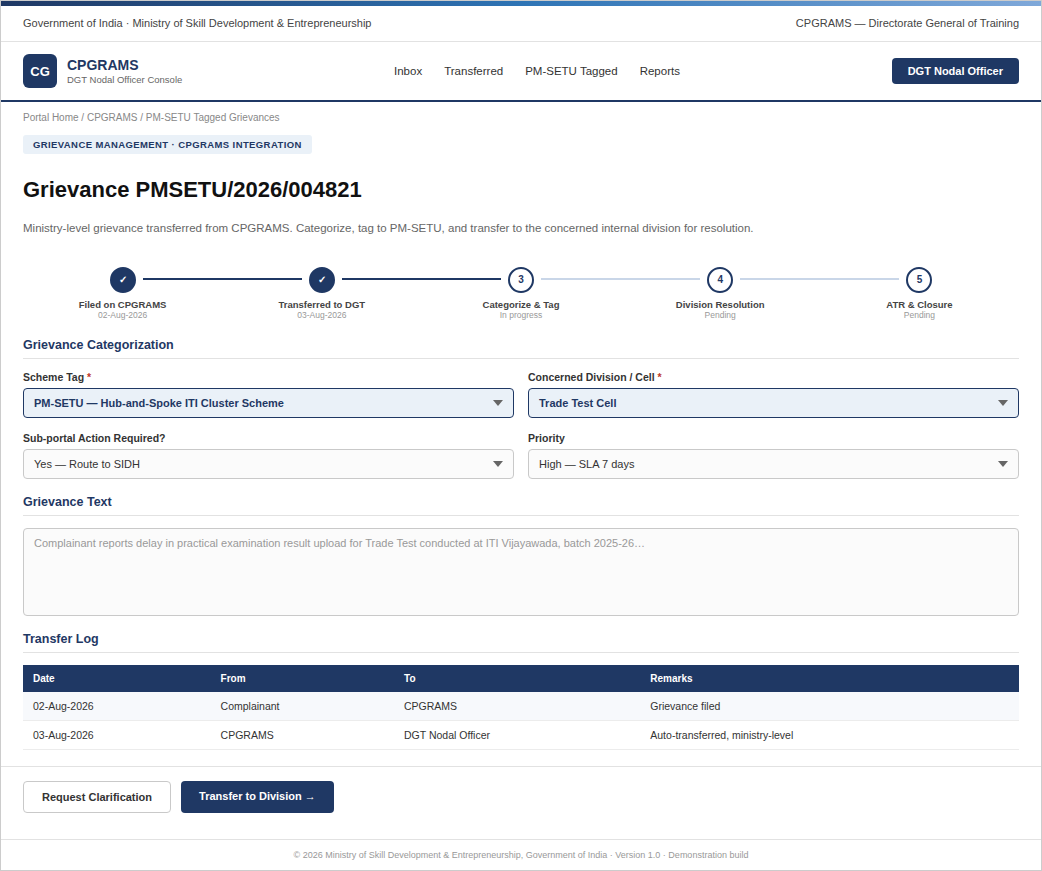
The mockups below illustrate the primary screens of the PM-SETU Admin Management portal referenced in the functional requirements: the project management task board and task creation form, the SIDH grievance filing touchpoint carrying the PM-SETU scheme dropdown, the native SPV/AIP grievance filing screen, the consolidated grievance tracking dashboard, and the CPGRAMS DGT Nodal Officer console.
Task Board (Kanban view)
Task Creation form
SIDH — Grievance filing with PM-SETU scheme dropdown
PM-SETU Portal — SPV/AIP grievance filing
Grievance Tracking Dashboard (National view)
CPGRAMS — DGT Nodal Officer console