On this page — jump to a section
- Abbreviations
- 1. Overview
- Scope
- System Boundaries and Adjacent DPRs
- Design Principles
- Key Assumptions
- Stakeholders
- 2. Business Requirements and User Journeys
- 2.1 Current SIDH Context Used as the Starting Point
- 2.2 Learner / Trainee Journey
- Illustrative user journey - Learner / Trainee Journey.
- 2.3 Trainer Journey
- Illustrative user journey - Trainer Journey.
- 2.4 ITI Administrator Journey
- Illustrative user journey - ITI Administrator Journey.
- 2.5 SPV / AIP Journey
- Illustrative user journey - SPV / AIP Journey.
- 2.6 Industry Partner with Existing LOMS
- Illustrative user journey - Industry Partner with Existing LOMS.
- 2.7 Content-Only / Knowledge Partner Journey
- Illustrative user journey - Content-Only / Knowledge Partner Journey.
- 2.8 Three Industry / Content Integration Pathways
- 3. Functional System Requirements
- Pillar 1: Curriculum, Course & Qualification Management
- Pillar 2: Digital TLM, Content & Resource Library
- Pillar 3: Learning Delivery & Learner Lifecycle
- Pillar 4: Trainer & ITI Operations
- Pillar 5: Assessment, Examination, Certification & Skill Passport
- Pillar 6: Industry, OJT, Apprenticeship, Placement & Alumni
- Pillar 7: Federation, Integration & Data Contracts
- Pillar 8: Identity, Accessibility, Communications & Support
- Pillar 9: Compliance, Accreditation, Governance & Master Data
- Pillar 10: Monitoring, KPI Events & Analytics Handoff
- 3.11 Capability Disposition against the LOMS Master List
- 4. Solution Architecture
- 4.1 User Access & Experience Layer
- 4.2 LOMS Domain Platform Layer
- 4.3 Federation & Integration Layer
- 4.4 Data Layer and System-of-Record Principles
- 5. Non-Functional Requirements
- 6. Testing Strategy and Deployment Approach
- 7. Process Designs and Mockups
- 7.1.1 Industry-owned LOMS integration
- 7.1.2 Content-only partner ingestion
- 7.1.3 Curriculum Composer and approval
- 7.1.4 Trainer content authoring and publish
- 7.1.5 Learner course lifecycle
- 7.1.6 OJT / apprenticeship / placement
- 7.1.7 KPI event pipeline
- 7.2.1 PM-SETU project-management task workflow
- 7.2.2 Trainee grievance via SIDH - marks/profile
- 7.2.3 Trainee examination grievance via SIDH
- 7.2.4 Trainer grievance via SIDH
- 7.2.5 CPGRAMS grievance routing
- 7.2.6 SPV/AIP grievance via PM-SETU portal
- 7.2.7 SPV formation / SIP / AOP lifecycle
- 7.2.8 Fund flow / tranche release eligibility
- 7.2.9 Audit / IMA verification supporting release
- 7.2.10 Budget / AOP reallocation monitoring
- 7.2.11 Audit observation mitigation
- 7.2.12 Contract / MDB compliance
- 7.2.13 Analytics role/entity access
- 7.3 Illustrative Screen Mockups
- 7.3.1 Learner PM-SETU home
- 7.3.2 Trainer teaching cockpit
- 7.3.3 Industry Integration Console
- 7.3.4 Curriculum Composer
- 7.3.5 Cluster KPI Command Centre
- 7.3.6 Content Partner Submission
- 8. KPI and Analytics Alignment
- 8.1 Funding-Linked Data Conditions Relevant to LOMS
- 9. Implementation Roadmap and Governance
- Governance Forums
- 10. Official Portals and Reference Links
- 11. Repository Structure and Reference Basis
- Reference Basis
- Appendix A - LOMS Functional Module Inventory
- Appendix B - Illustrative KPI Event Dictionary

Detailed Project Report for Learning and Operations Management System (LOMS)
| Section | Page |
| Abbreviations | 3 |
| 1. Overview | 5 |
| 2. Business Requirements and User Journeys | 7 |
| 3. Functional System Requirements | 10 |
| 4. Solution Architecture | 13 |
| 5. Non-Functional Requirements | 16 |
| 6. Testing Strategy and Deployment Approach | 16 |
| 7. Process Designs and Mockups | 17 |
| 8. KPI and Analytics Alignment | 40 |
| 9. Implementation Roadmap and Governance | 42 |
| 10. Official Portals and Reference Links | 43 |
| 11. Repository Structure and Reference Basis | 44 |
| Appendix A - LOMS Functional Module Inventory | 44 |
| Appendix B - Illustrative KPI Event Dictionary | 46 |
Abbreviations
| Abbreviation | Expansion |
| ABC | Academic Bank of Credits |
| AIP | Anchor Industry Partner |
| API | Application Programming Interface |
| BPMN | Business Process Model and Notation |
| CITS | Craft Instructor Training Scheme |
| CPGRAMS | Centralized Public Grievance Redress and Monitoring System |
| CSTARI | Central Staff Training and Research Institute |
| CTS | Craftsmen Training Scheme |
| DGT | Directorate General of Training |
| DMS | Document Management System |
| DPDP Act | Digital Personal Data Protection Act, 2023 |
| FMS | Fiduciary Management System |
| IAM | Identity and Access Management |
| IMA | Independent Monitoring Agency |
| ITI | Industrial Training Institute |
| KPI | Key Performance Indicator |
| LOMS | Learning and Operations Management System |
| MDB | Multilateral Development Bank |
| MSDE | Ministry of Skill Development and Entrepreneurship |
| NAPS | National Apprenticeship Promotion Scheme |
| NCVET | National Council for Vocational Education and Training |
| NCS | National Career Service |
| NIMI | National Instructional Media Institute |
| NPMU | National Project Monitoring Unit |
| NSQF | National Skills Qualifications Framework |
| OJT | On-the-Job Training |
| PM-SETU | Pradhan Mantri Skilling and Employability Transformation through Upgraded ITIs |
| PMU | Programme Management Unit |
| QP-NOS | Qualification Pack - National Occupational Standards |
| RBAC | Role-Based Access Control |
| RDST | Regional Directorate (Regional / District / State level - terminology used in Admin DPR) |
| SIP | Strategic Investment Plan |
| SIDH | Skill India Digital Hub |
| Abbreviation | Expansion |
| SLA | Service Level Agreement |
| SPMU | State Programme Management Unit |
| SPV | Special Purpose Vehicle |
| SSO | Single Sign-On |
| ToT | Training of Trainers |
| UAT | User Acceptance Testing |
| UC | Utilization Certificate |
| WCAG | Web Content Accessibility Guidelines |
1. Overview
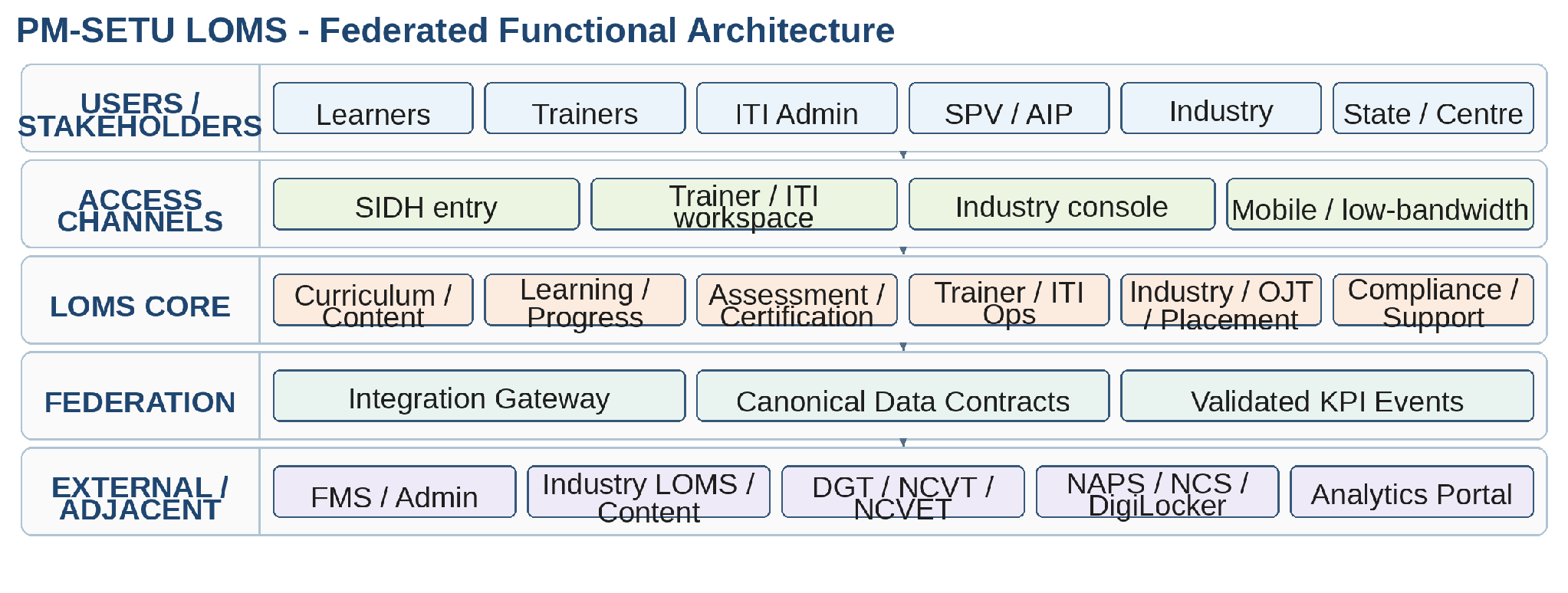
This Detailed Project Report defines the business, functional, logical-architecture, integration, governance, non-functional, testing and process requirements for the PM-SETU Learning and Operations Management System (LOMS). The proposed LOMS is conceived as the operational digital backbone for teaching-learning, curriculum and content management, learner and trainer lifecycle management, industry/OJT/apprenticeship interfaces, assessment/certification support and structured data exchange across Hub-and-Spoke ITI clusters.
The platform is intentionally designed as a federated ecosystem rather than a mandatory monolithic LMS. Industry partners may operate their own learning systems; content-only partners may contribute approved resources; ITIs may continue to offer nationally recognized programmes; and PM-SETU-specific curriculum, special modules and OJT can be orchestrated through a common registry, governance framework and data contract. The central LOMS is therefore responsible for consistent identity, curriculum/version control, operational records, interoperability, data quality and validated learning events while respecting the systems of record owned by participating stakeholders.
Terminology note The Component I Guidelines use the term “Learning Outcome Management System” in places, while the Admin DPR and project master list use “Learning and Operations Management System”. This DPR uses “Learning and Operations Management System (LOMS)” for the broader platform while preserving the outcome-management intent of the scheme.
Scope
- ●Curriculum and course registry, modular course composition, versioning, NSQF/QP-NOS mapping and governance.
- ●Digital teaching-learning material (TLM) authoring, partner content ingestion, review/approval, multilingual and accessible delivery, resource reuse and version control.
- ●Learner lifecycle, batches, sessions, progress, attendance, interventions, assessments, credentials and learner-facing PM-SETU programme context.
- ●Trainer and ITI operational workflows including course assignment, delivery plans, practical tracking, ToT/capacity records and institutional data needed for PM-SETU monitoring.
- ●Industry linkages, curriculum co-design, guest experts, OJT, apprenticeship, placement and employer-feedback records.
- ●Federated integration with industry-owned LOMS, content providers, SIDH, DGT/NCVT ecosystem systems, CSTARI/NIMI/NCVET governance touchpoints, NAPS/NCS, DigiLocker/ABC and common identity/notification services.
- ●Publication of validated operational events and KPI-ready data to the PM-SETU Analytics Portal; integration to FMS and Admin Management without duplicating their systems of record.
- ●Role-based access, auditability, accessibility, multilingual support, privacy, security and mobile/low-connectivity support.
System Boundaries and Adjacent DPRs
| System | Boundary / Relationship |
| LOMS (this DPR) | Primary operational system for curriculum/content, learning delivery, learner/trainer/ITI records, assessments support, industry/OJT/placement records, and learning-data integration. |
| Fiduciary Management System | System of record for SIP/AOP fiduciary planning, funds, utilization, audits, contracts/MDB compliance and tranche readiness. LOMS consumes/produces only required references or operational evidence. |
| Admin Management System | System of record for programme task/work management and PM-SETU grievance orchestration. SIDH/CPGRAMS remain intake channels where specified. |
| Analytics Portal | Presentation/analytics layer. It reads validated data from LOMS and FMS/Admin source systems, evaluates thresholds and renders |
| System | Boundary / Relationship stakeholder-scoped dashboards; it is not the primary transaction-entry system. |
| SIDH | Existing national learner/training-partner digital hub and a key learner-facing access/integration channel. Current SIDH features are not treated as proof that proposed LOMS features already exist. |
Design Principles
- ●One PM-SETU ecosystem, multiple learning systems: central orchestration with federated systems of record.
- ●Build once, validate once, reuse appropriately: approved curriculum/content assets can be versioned and reused subject to governance and rights.
- ●Programme layer, not a duplicate portal: PM-SETU context should be visible within the learner/trainer journey rather than forcing unnecessary portal switching.
- ●Data contracts before dashboards: common identifiers, definitions, validation and freshness are prerequisites for reliable cluster/State/national analytics.
- ●Curriculum governance by design: trainer enrichment is separated from formal curriculum change; formal changes route through applicable CSTARI/DGT/NIMI/NCVET processes.
- ●Open integration and portability: APIs/connectors are first-class product capabilities; implementation standards such as SCORM/xAPI/LTI may be evaluated, but are not assumed as scheme mandates.
- ●Accessibility and multilingual delivery as foundational requirements, not add-ons.
Key Assumptions
- ●Participating ITIs/SPVs will have defined roles, master identifiers and data ownership arrangements before production onboarding.
- ●Industry partners may fall into multiple integration patterns: full LOMS integration, content-only contribution, or operational collaboration without a separate learning system.
- ●SIDH and other national portals will expose the approved integration mechanisms required for identity, learner discovery, credential and opportunity journeys.
- ●Curriculum and qualification approval responsibilities remain with the authorities defined by prevailing PM-SETU/DGT/NCVET policy; LOMS digitizes and evidences the workflow but does not replace statutory authority.
- ●FMS, Admin Management and Analytics will remain distinct products/source systems as described in their DPRs, with controlled API/data exchange.
- ●Final physical deployment topology, cloud provider, database technologies, API gateway product, event technology and detailed API schemas will be finalized during solution design and are not asserted in this DPR.
Stakeholders
| Stakeholder | Role in LOMS ecosystem |
| Learner / Trainee | Discover and participate in PM-SETU programmes; consume learning; complete assessments/OJT; view credentials and opportunities. |
| Trainer / Faculty | Plan and deliver sessions, use/create approved content, record attendance/progress/practical outcomes, intervene for at-risk learners, coordinate industry exposure and maintain ToT records. |
| ITI Administrator / Principal | Configure institutional delivery, batches, timetable, learners, trainers and institutional evidence; validate data quality and operational readiness. |
| SPV / AIP | Operate cluster, shape special modules, coordinate content/trainers/industry, monitor delivery and outcomes, and provide cluster-level operational evidence. |
| Industry Partner with LOMS | Maintain own system of record while exchanging standardized master data and learning/KPI events through the Integration Gateway. |
| Content / Knowledge Partner | Provide content/resources with metadata, rights and versions for review and approved reuse. |
| Employer / OJT / Apprenticeship Partner | Provide OJT/apprenticeship/placement opportunities, mentor/evaluate learners and return outcome/feedback records. |
| State / SPMU / Centre / DGT | Policy, oversight, approvals where applicable, programme monitoring and data-governance responsibilities. |
| CSTARI / NIMI / NCVET | Curriculum/content standardization and approval-related roles as defined by prevailing policy. |
| Technology / Integration Provider | Operate platform, connectors, security, observability, data quality and support services. |
2. Business Requirements and User Journeys
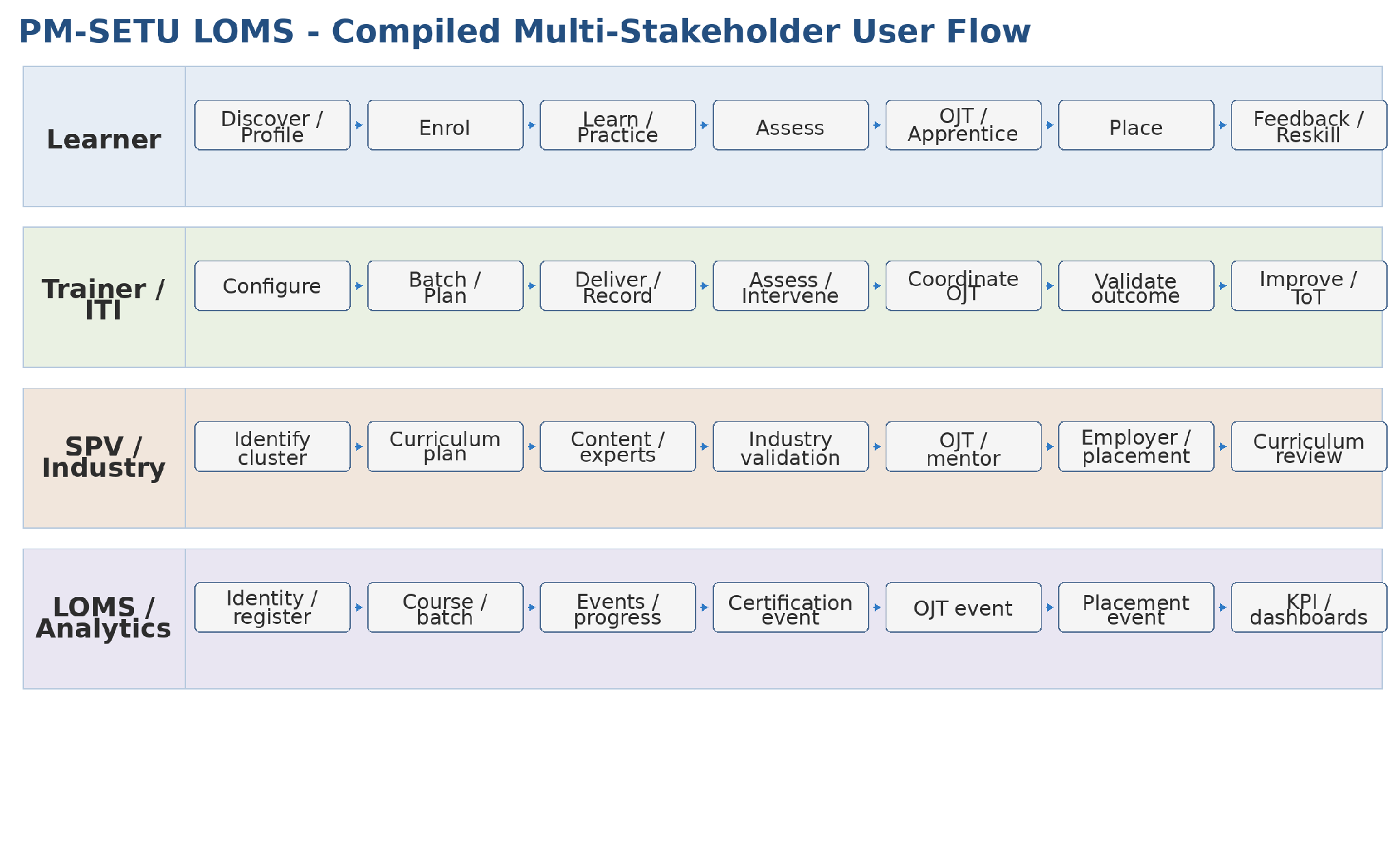
The LOMS business model is built around a single learner outcome lifecycle with multiple contributing actors. SIDH can continue to provide national discovery and learner-profile entry points; LOMS manages the PM-SETU learning journey and its operational records; industry and content partners contribute through governed integration; and validated data is consumed by the Analytics Portal for role-based monitoring.
2.1 Current SIDH Context Used as the Starting Point
The current-state walkthrough supplied for this project documents two authenticated personas in SIDH: Learner / Participant and Training Provider. The learner experience is broad and discovery-led; the Training Provider experience focuses on training operations, courses, certificates, reports, events and PMKVY administration. The future LOMS design reuses this ecosystem context without assuming that every proposed LOMS module is already present in SIDH.
| Current capability | Observed As-Is | LOMS implication |
| Learner identity & access | Phone + PIN; Aadhaar/eKYC/profile; QR; languages and accessibility controls. | Reuse/align identity and profile; expose PM-SETU programme journey rather than duplicate profile data. |
| Learning discovery | Skill courses, centres, live sessions, TCS iON assessments, recommendations and personalised journey. | Use SIDH as discovery/front door; LOMS manages approved PM-SETU learning plan, delivery and outcomes. |
| Opportunity discovery | Internships, jobs, apprenticeships, Skill India Map and sector pages. | Feed PM-SETU OJT/apprenticeship/placement records and matching opportunities through governed integration. |
| Training Provider operations | Training/course overview, course statuses, enrolment, certificate configuration, reports, placement and events. | Preserve useful operational patterns; add cluster/ITI/trainer and PM-SETU-specific delivery controls. |
| Programme links | PM-SETU, PMKVY, SOAR, IndiaSkills and external ecosystem destinations. | Move from scheme-link navigation to an integrated PM-SETU programme layer in the user journey. |
2.2 Learner / Trainee Journey
The learner should experience PM-SETU as a coherent programme journey: profile and discovery, enrolment, approved learning plan, learning/practical delivery, assessment, credentials, OJT/apprenticeship and employment outcomes. The learner record should identify the ITI, cluster, industry partner, course version and progress while preserving national identity/credential integrations.
Illustrative user journey - Learner / Trainee Journey.
2.3 Trainer Journey
The trainer workspace should organize the job-to-be-done rather than expose the full module master list. A trainer sees assigned courses and batches, approved curriculum, a teaching plan, content library, assessment tools, learner progress/intervention views, industry/OJT coordination and feedback/ToT. Trainers may create supplementary content, but formal curriculum change follows the appropriate approval route.
Illustrative user journey - Trainer Journey.
2.4 ITI Administrator Journey
ITI administrators configure institutional delivery and validate operational data. The institution is responsible for courses/batches, trainer assignment, routine academic records, infrastructure/readiness data where in scope, industry/OJT records and data-quality exceptions before higher-level reporting.

Illustrative user journey - ITI Administrator Journey.
2.5 SPV / AIP Journey
The SPV/AIP uses LOMS to operationalize the approved SIP academic strategy: cluster setup, curriculum enhancement, content/trainer plan, course delivery, industry linkages, OJT/apprenticeships, placement, employer feedback and KPI evidence. The platform should respect SPV autonomy while providing standardized programme data.

Illustrative user journey - SPV / AIP Journey.
2.6 Industry Partner with Existing LOMS
An industry-owned LOMS may remain the source system for its operational learning records. The PM-SETU Integration Gateway maps that system to canonical identifiers and data contracts, validates synchronization and publishes standardized events to the central ecosystem. The partner is not required to re-enter the same data in a second LMS.

Illustrative user journey - Industry Partner with Existing LOMS.
2.7 Content-Only / Knowledge Partner Journey
A partner that does not operate a LOMS can still contribute content. The platform supports metadata/rights capture, curriculum/competency tagging, academic review, versioned publishing and trainer selection. Completion and usage data returns to the learner record where technically supported.

Illustrative user journey - Content-Only / Knowledge Partner Journey.
2.8 Three Industry / Content Integration Pathways
| Pathway | When used | LOMS treatment |
| A. Connected LOMS | Industry partner already operates its own LOMS/LMS. | System-to-system connector; canonical data contract; source ownership retained; sync health and reconciliation; KPI events. |
| B. Content Partner | Partner has content/tools but no learner-lifecycle system for PM-SETU. | Content registry; metadata/rights; curriculum mapping; approval; secure launch/package/API; usage/completion return where available. |
| C. ITI / National Programme | ITI delivers existing Ministry/DGT/NCVET-recognized courses and PM-SETU enhancements. | Unified Curriculum Registry combines national core with approved industry specialisation, OJT and enrichment; formal approval boundaries remain intact. |
3. Functional System Requirements
The 150-feature LOMS master list has been normalized into ten functional pillars for the purpose of this DPR. The normalization reduces duplication, separates core LOMS functions from adjacent PM-SETU systems, and organizes features around end-to-end user outcomes.
Pillar 1: Curriculum, Course & Qualification Management
- ●Central course/qualification catalogue with trade, occupation, NSQF/QP-NOS, credit and certification mappings.
- ●Course creation, modular composition, prerequisites, version control and effective-date/batch controls.
- ●Curriculum Composer supporting national core, industry special modules, OJT, partner resources, assessment and enrichment.
- ●Approval routing and status tracking for formal curriculum changes/new courses consistent with applicable CSTARI/DGT/NIMI/NCVET processes.
- ●Course reuse across clusters/ITIs subject to ownership, approval, version and applicability rules.
- ●National/cluster/local scope metadata and audit history for every curriculum version.
Pillar 2: Digital TLM, Content & Resource Library
- ●Multi-author content creation and upload with structured metadata, competency tags, language, accessibility and versioning.
- ●Content review/sign-off workflow before publishing; rights/licensing/expiry and partner ownership metadata.
- ●Multimedia and multilingual resources, subtitles/translation, low-bandwidth variants and downloadable/offline access where permitted.
- ●Central reusable resource library with search, tagging, reuse and retirement/version controls.
- ●Partner content ingestion via package, secure link or API; illustrative interoperability standards may be evaluated during solution design.
- ●Question-bank and assessment-content authoring support with difficulty/competency tags.
Pillar 3: Learning Delivery & Learner Lifecycle
- ●Batch/cohort management, session/lesson planning, timetable linkage and content sequencing.
- ●Blended theory/practical delivery, learning progress, module completion, attendance and practical/skill evidence.
- ●Learner lifecycle from enrolment/admission context to certification/OJT/placement with PM-SETU programme and cluster identifiers.
- ●Learner recommendations, skill-gap and at-risk intervention support; predictive flags must be advisory and visually distinguished from recorded outcomes.
- ●Offline/downloadable access and mobile-responsive experiences for low-connectivity conditions.
- ●Learner dashboard showing next actions, progress, credentials, opportunities and support.
Pillar 4: Trainer & ITI Operations
- ●Trainer profile/assignment, qualifications, trainer utilization, vacancy context and ToT/upskilling records.
- ●Trainer teaching workspace for plans, content, assessments, learner progress/interventions and industry/OJT coordination.
- ●ITI-level course/batch/timetable/attendance/SIS operational records required for PM-SETU delivery.
- ●Institutional readiness and selected infrastructure/asset references required for course delivery, while detailed infrastructure project management may remain in adjacent systems.
- ●Guest faculty / industry expert assignment and session records.
- ●Data-quality queue for missing/late institutional records before analytics publication.
Pillar 5: Assessment, Examination, Certification & Skill Passport
- ●Formative/summative and practical/skill-based assessment support with standardized rubrics.
- ●Question bank, exam scheduling interfaces, result processing and security controls as allocated between LOMS and DGT examination systems.
- ●Integration with DGT/NCVT examination systems rather than duplicating authoritative exam records where a national system of record exists.
- ●Credential/badge/micro-credential issuance or mapping subject to awarding-body rules; certificate verification and DigiLocker/ABC integration where approved.
- ●Learner skill passport combining approved qualifications, module completion, practical competencies, OJT/apprenticeship and selected outcome records.
- ●Assessment/certification events published to the analytics pipeline after validation.
Pillar 6: Industry, OJT, Apprenticeship, Placement & Alumni
- ●Industry partner registry, ITI-level MoUs/engagements, curriculum co-design and expert sessions.
- ●OJT allocation, evidence, mentor evaluation and completion tracking; the Guidelines specify industry mentor and external examiner roles for final OJT evaluation in the cited model.
- ●NAPS/Apprenticeship portal integration where applicable; employer self-service and opportunity records.
- ●Internship/placement drives, job roles, candidate matching/status, employer, salary and placement evidence.
- ●Employer feedback, graduate/alumni outcome tracking, mentorship and second-chance/reskilling pathways.
- ●Placement and apprenticeship outcome events for scheme KPIs and tracer analysis.
Pillar 7: Federation, Integration & Data Contracts
- ●Industry Integration Gateway with API/connector registration, authentication, mapping, validation, throttling and monitoring.
- ●Canonical identifiers and data contracts for learner, trainer, ITI, cluster, course, version, batch, assessment, credential, OJT/apprenticeship and placement objects.
- ●Configurable synchronization frequency; source freshness and last-successful-refresh visibility.
- ●Data-quality rules, duplicate/missing-ID reconciliation, quarantine/retry and audit trail.
- ●Open API framework for SIDH, DGT/NCVT systems, NAPS/NCS, DigiLocker/ABC and other approved systems.
- ●Event publication to Analytics; controlled references to FMS/Admin; no silent duplication of source-system transactions.
Pillar 8: Identity, Accessibility, Communications & Support
- ●RBAC and multi-stakeholder access for Centre/State/SPV/ITI/trainer/learner/industry roles; role/entity scoping.
- ●SSO/government identity integration for official users and learner eKYC/identity integration as approved.
- ●Session security, activity logging, password/security policy where local credentials exist.
- ●WCAG-aligned accessibility, screen-reader compatibility, font/contrast controls and keyboard/mobile usability.
- ●Multilingual UI/content and regional-language notifications; BHASHINI may be an integration option subject to architecture approval.
- ●SMS/email/push/WhatsApp or approved multi-channel notification services; technical helpdesk/ticketing integration.
Pillar 9: Compliance, Accreditation, Governance & Master Data
- ●NCVET affiliation/renewal status, NSQF/QP-NOS mappings, recognition/license calendars and compliance checklist tracking.
- ●Curriculum/content approval evidence, ownership, rights, review date and change history.
- ●Master data for State, cluster, Hub/Spoke, ITI, trade, course, role, industry partner and programme year.
- ●Board/SPV governance references and license/MDO links where needed, while contract/fiduciary records remain in FMS/contract systems.
- ●DPDP/consent and data-minimization controls for learner/staff data; traceable access and change logs.
- ●Data lineage and source-system attribution for records consumed by Analytics.
Pillar 10: Monitoring, KPI Events & Analytics Handoff
- ●Operational event model covering enrolment, attendance, module completion, assessment, certification, OJT, apprenticeship, placement, trainer upskilling and other approved events.
- ●Cluster/ITI operational monitoring to detect missing data, late submissions and below-threshold conditions before national reporting.
- ●Validated KPI-ready data published to the Analytics Portal; Analytics remains the role-scoped presentation/threshold layer.
- ●Source lineage, data currency, provisional-data flags and reconciliation status carried with outputs.
- ●Evidence links to course versions, assessment records, OJT/placement records and institutional data where role permissions allow.
- ●Export/report capabilities within operational scope; programme dashboards and cross-system analytics remain aligned with the Analytics DPR.
3.11 Capability Disposition against the LOMS Master List
| Master-list domain | Disposition | LOMS DPR treatment |
| LMS / Learning Management | Core LOMS | Retain and organize around learner/trainer journeys. |
| Digital TLM Development | Core LOMS | Retain; integrate curriculum governance, partner ingestion and resource reuse. |
| ITI Management | Core / Integrated | Academic/learner/trainer operations core; payroll/ERP-like items may integrate with State/ITI ERP where available. |
| Exam Management | Core / Integrated | LOMS supports assessment workflow; authoritative DGT/NCVT exam/results remain integrated where applicable. |
| Industry / Alumni | Core LOMS | High relevance to PM-SETU industry-led model, OJT, apprenticeship and placement. |
| Financial Management | Adjacent - FMS | Do not recreate fiduciary functions; integrate required learner fee/stipend references and programme evidence. |
| PM-SETU Monitoring | Adjacent / Shared | Operational source data originates in LOMS; programme project-management functions |
| Master-list domain | Disposition | LOMS DPR treatment belong to Admin; dashboards consolidate in Analytics. |
| Analytics & Dashboard | Adjacent - Analytics Portal | LOMS publishes validated records/events; Analytics renders cross-system views and alerts. |
| Administrator Management | Adjacent - Admin / Common | Task/grievance system belongs to Admin DPR; identity/master admin shared where needed. |
| Infrastructure & Asset | Integrated / Adjacent | Course-readiness/equipment references may be used; full civil/asset maintenance domain should avoid duplication. |
| IT Infrastructure / Security / DR | Common Platform NFR | Required as platform-level services, not a user-facing business module. |
| User Access & Identity | Common Core Service | Core cross-cutting requirement. |
| Compliance & Accreditation | Core / Integrated | Strong relevance for qualification/curriculum and institution compliance. |
| SPV & Concession Contract | Adjacent - FMS/Contract | LOMS consumes governance/milestone references only; do not duplicate contract repository/penalties. |
| Communications / Mobile | Common Core Service | Retain as cross-cutting experience/service. |
| Support / Scheme Convergence | Core / Integrated | Helpdesk/career support and scheme identifiers relevant; cross-scheme data depends on approved integrations. |
4. Solution Architecture
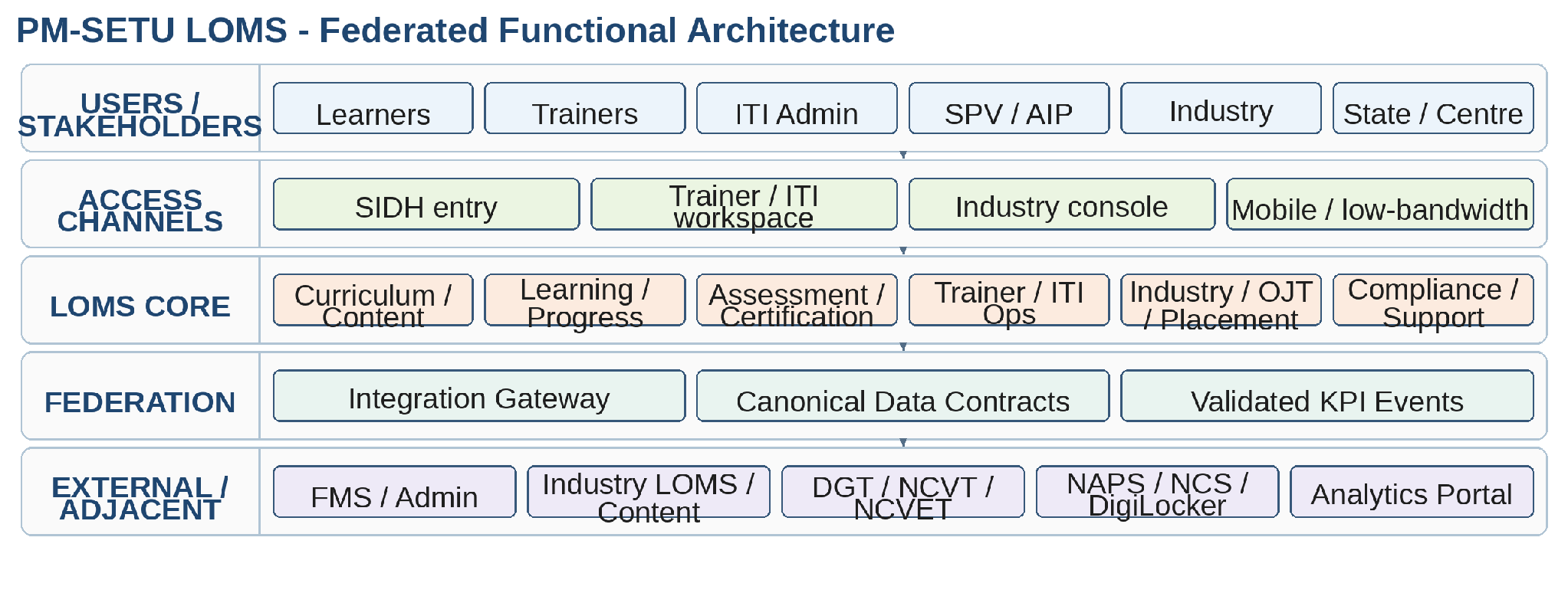
The architecture below is a logical and functional architecture. It defines the responsibilities and exchange boundaries required by the DPR; it does not prescribe a specific cloud provider, database, programming language, event broker or API-management product.
4.1 User Access & Experience Layer
- ●Learner-facing access is aligned with SIDH/approved learner identity channels, with PM-SETU programme context surfaced in the journey.
- ●Trainers, ITIs, SPVs/AIPs and industry partners receive role-specific workspaces rather than a single feature-heavy navigation.
- ●Official stakeholders use approved government IAM/SSO where available; learner identity can use eKYC-backed credentials as defined by the ecosystem.
- ●Mobile, accessibility and low-connectivity needs are supported as cross-cutting experience requirements.
4.2 LOMS Domain Platform Layer
- ●Curriculum & Course Registry; Digital TLM & Content Library; Learning/Batches/Progress; Assessment/Certification; Trainer & ITI Operations; Industry/OJT/Apprenticeship/Placement; Compliance/Accreditation; Notifications/Support.
- ●Every major object is versioned and linked to canonical master identifiers.
- ●Workflow state, permissions, evidence and audit history are held by the originating operational domain.
4.3 Federation & Integration Layer
- ●Integration Gateway manages partner registration, authentication, data contracts, mapping, validation, synchronization, retries and monitoring.
- ●Canonical data contracts separate the PM-SETU semantic model from each industry partner’s internal schema.
- ●Validated operational events are published for analytics and monitoring; data-quality exceptions remain traceable to the source owner.
- ●External systems retain ownership where they are authoritative; LOMS should not copy data merely to create a second source of truth.
4.4 Data Layer and System-of-Record Principles
| Data object | Primary source / authority | Principle |
| Course / curriculum version | LOMS Curriculum Registry (subject to statutory approval source/evidence) | Industry LOMS may reference local equivalent; approved PM-SETU course ID is canonical for programme reporting. |
| Learning activity / batch progress | LOMS or connected industry LOMS, depending delivery model | Source identifier and timestamp preserved. |
| Data object | Primary source / authority | Principle |
| Formal exam/result | DGT/NCVT system where authoritative; LOMS may support workflow/display | Avoid conflicting marks/result records. |
| Credential | Awarding-body / approved credential service; mapped in LOMS | DigiLocker/ABC integration where applicable. |
| OJT/apprenticeship | LOMS/industry system + NAPS where applicable | Cross-reference opportunity and completion evidence. |
| Placement | LOMS Industry/Alumni domain or approved partner system | Employer, role, salary/outcome evidence with privacy controls. |
| Fiduciary | FMS | LOMS holds references/evidence only where required. |
| Tasks/grievances | Admin Management / SIDH / CPGRAMS according to channel | LOMS receives status/reference only if relevant. |
| Cross-system analytics | Analytics Portal presentation store / source systems | Analytics consumes validated source records; not first-entry point. |
5. Non-Functional Requirements
The following requirements are intended as DPR-level platform requirements. Final numeric performance thresholds should be finalized during detailed solution design and load modelling; where the adjacent DPRs define common platform expectations, the LOMS should align to the programme-wide standard unless a LOMS-specific use case requires a stricter target.
| Area | Requirement |
| Performance & scalability | Responsive learner/trainer interactions; asynchronous handling for bulk/event processing; horizontal scalability for growth in ITIs, clusters, users, content, events and integrations; capacity planning for admission/exam/result peaks. |
| Availability & DR | High availability for core learning operations, defined RTO/RPO, geographically separate DR as applicable, tested restoration and controlled failover. |
| Security | Government IAM/SSO integration where applicable; RBAC; least privilege; segregation of duties; encryption in transit/at rest; secure APIs; VAPT before go-live; secrets/key management. |
| Privacy & consent | DPDP Act 2023 alignment, purpose limitation, data minimization, consent/notice where required, retention/deletion policy and restricted handling of sensitive learner/staff records. |
| Auditability | Tamper-resistant logs for authentication, data changes, approvals, publishing, integration events, exports, administrative changes and denied access attempts. |
| Accessibility | WCAG-aligned web/mobile experience, keyboard navigation, screen-reader support, contrast/font controls, captions/transcripts and accessible content-authoring checks. |
| Multilingual | Regional-language UI/content metadata, language preferences, translation/subtitle workflows and notification localization; preserve source and translated versions. |
| Offline / low bandwidth | Downloadable learning resources and offline-first sync for permitted workflows; conflict resolution and data freshness visibility on reconnect. |
| Interoperability | Versioned APIs/data contracts, source identifiers, schema governance, API monitoring and backward-compatible change management; standards may be used where they demonstrably improve portability. |
| Observability & support | Application/integration monitoring, source freshness, failed-event queue, alerting, support ticket linkage and operational dashboards. |
6. Testing Strategy and Deployment Approach
| Test / Deployment Area | Coverage |
| Functional testing | Course/curriculum/content/batch/assessment/credent ial/OJT/placement workflows; permissions and validation rules. |
| Test / Deployment Area | Coverage |
| Integration contract testing | Partner APIs, schema versions, required/optional fields, duplicate IDs, replay/idempotency, timeouts, retries and error responses. |
| Reconciliation testing | Counts/statuses at source must reconcile with cluster/State/national aggregates; last-refresh time and provisional status shown on failures. |
| Access-control testing | Role + entity scope, cross-ITI/cluster/State negative tests, denied-access logging and learner self-record isolation. |
| Content interoperability testing | Partner content launch/package behavior, completion/assessment return and version/rights handling; if SCORM/xAPI/LTI are adopted, test conformance to the selected profile/version. |
| Accessibility & device testing | WCAG checks, screen reader/keyboard, mobile devices, low bandwidth/offline sync and multilingual rendering. |
| Performance/load testing | Peak admissions, mass attendance/session posting, result publication, bulk sync and partner event spikes. |
| Security testing | VAPT by appropriate empanelled/authorized agency, API security, session management, encryption, logging and privacy controls. |
| UAT | Representative learner, trainer, ITI, SPV/AIP, State/Centre and industry/content partner users; sign-off by business owners. |
| Deployment | Phased Development -> Test -> UAT -> Pre-Production -> Production; controlled release gates, rollback plan and post-deployment source/connectivity validation. |
7. Process Designs and Mockups
This section presents normalized process designs derived from the supplied BPMN working files, the PM-SETU Guidelines and the adjacent DPRs, together with LOMS-native process designs required by the proposed operating model. Duplicate working diagrams have been consolidated, and identified inconsistencies have been corrected in the illustrations used here.
Process normalization Key corrections include: State/SPMU appointment of IMA; IMA verification terminology; RDST terminology; 75% utilization treated as a trigger/necessary condition rather than automatic release; no unsupported generic three-day SIP auto-approval; and full Analytics role/entity scoping including ITI/Student and MDB restrictions.
7.1.1 Industry-owned LOMS integration
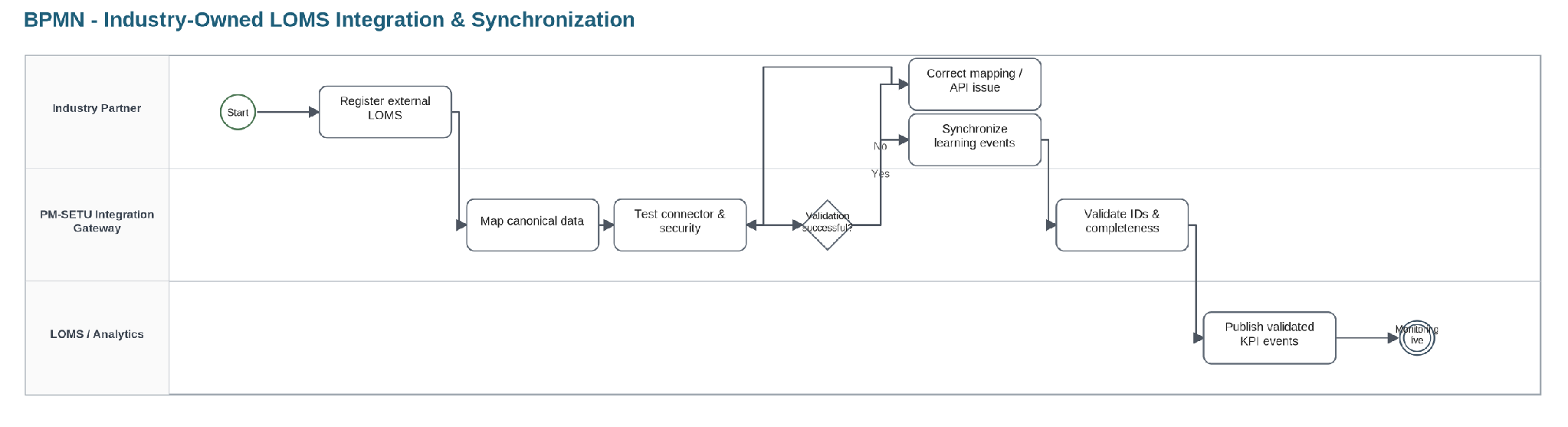
Registers the external learning system, maps it to the PM-SETU canonical data contract, validates synchronization and publishes only validated learning/KPI events.
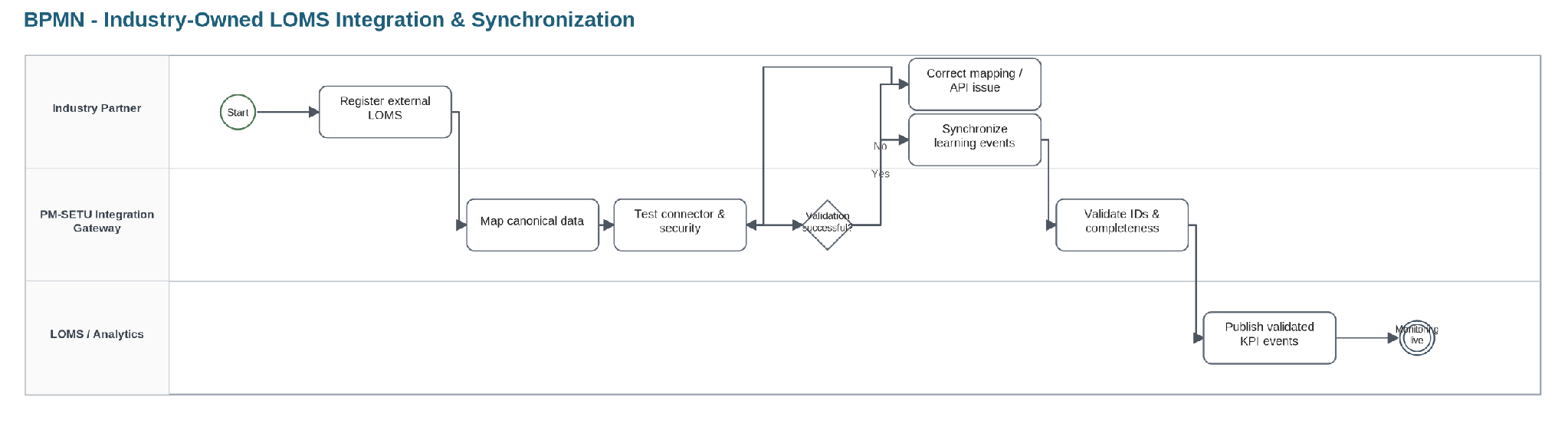
Process design - Industry-owned LOMS integration.
7.1.2 Content-only partner ingestion
Allows a partner without a learner-lifecycle platform to submit governed content, metadata and rights for academic review, versioned publication and trainer selection.
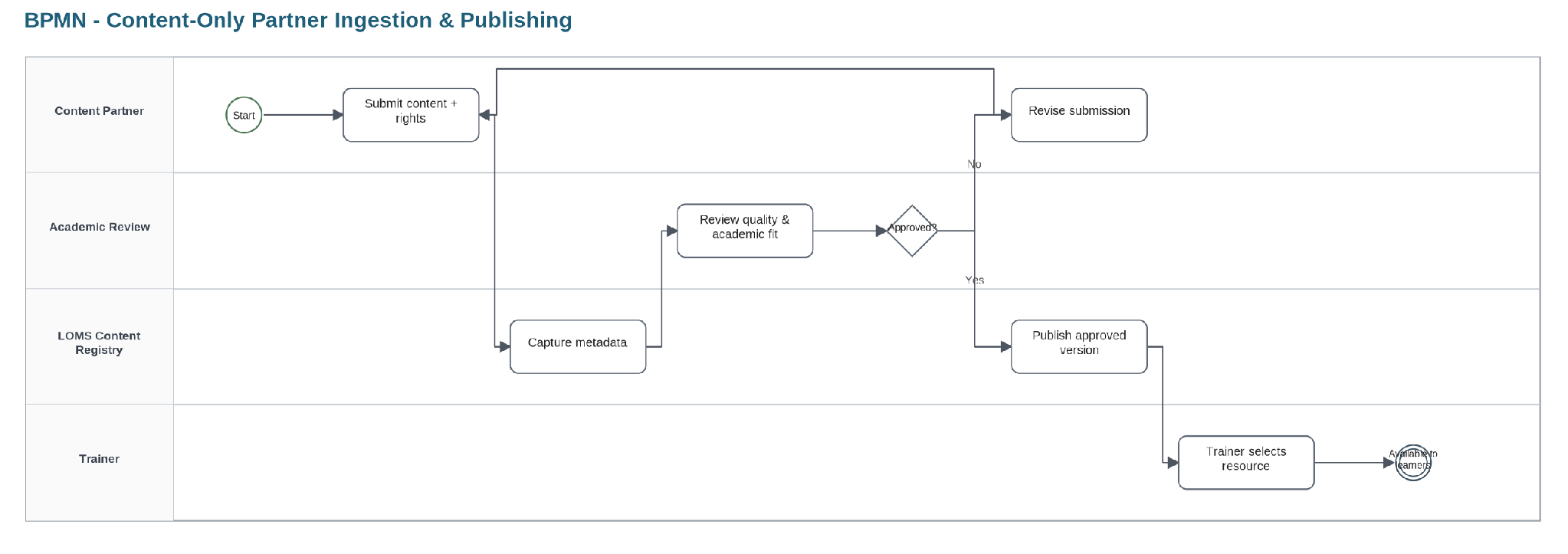
Process design - Content-only partner ingestion.
7.1.3 Curriculum Composer and approval
Combines national core, approved industry specialization, OJT and partner resources while routing formal curriculum changes through the applicable DGT/CSTARI/NIMI/NCVET governance path.
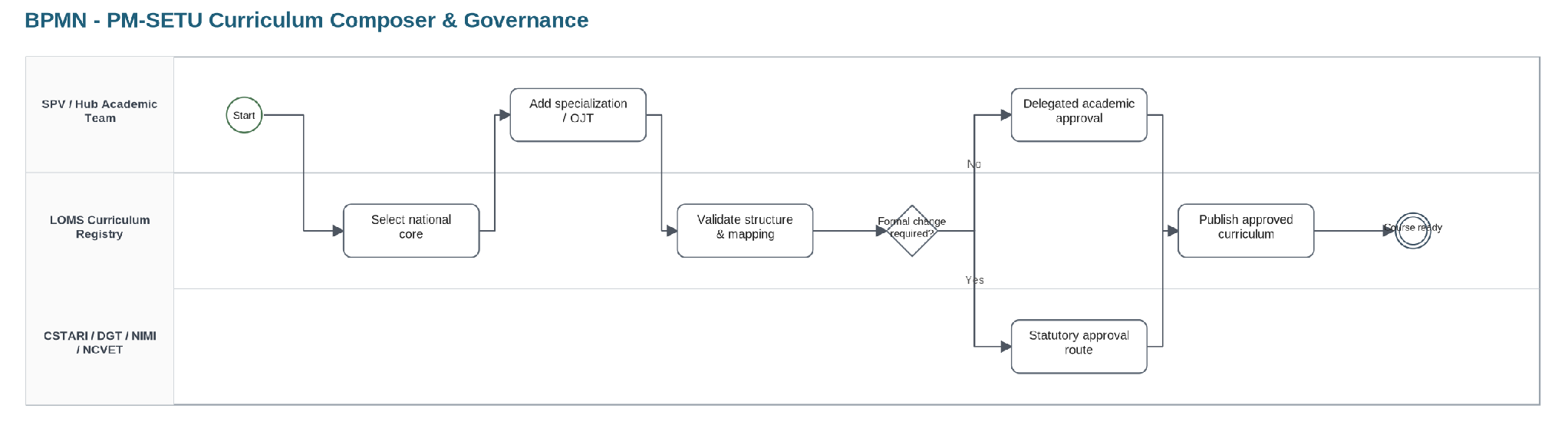
Process design - Curriculum Composer and approval.
7.1.4 Trainer content authoring and publish
Lets trainers enrich delivery with supplementary material while preserving formal curriculum controls, review, accessibility checks and version history.
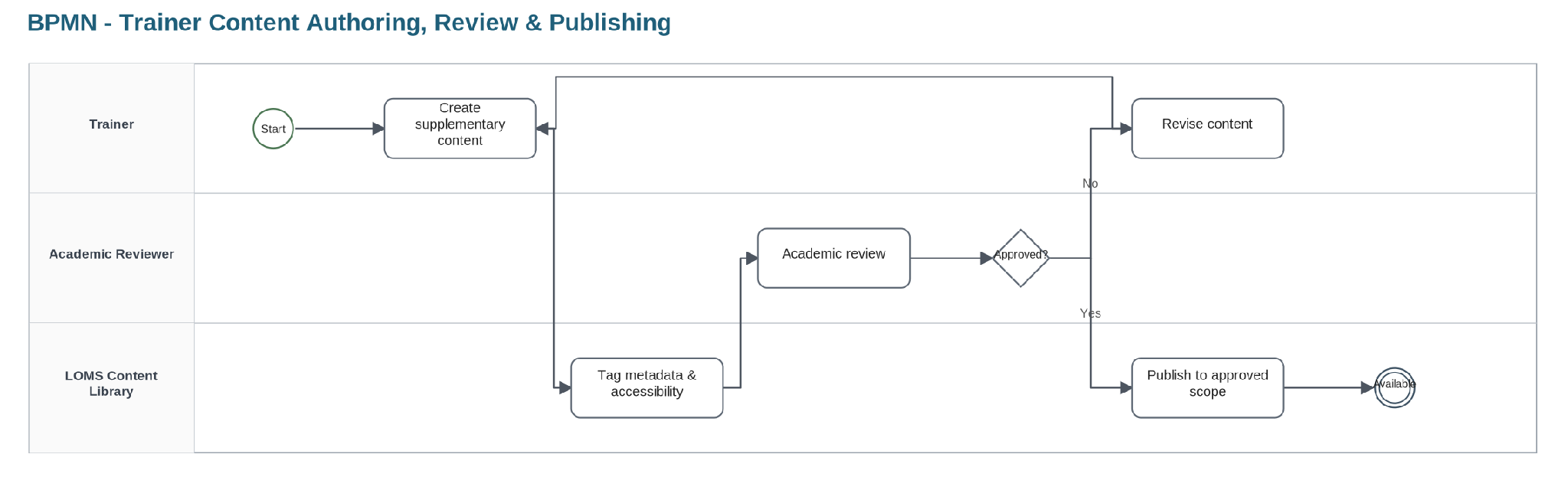
Process design - Trainer content authoring and publish.
7.1.5 Learner course lifecycle
Connects programme context, enrollment, learning delivery, progress/intervention, assessment, credential/OJT and opportunity outcomes into one learner lifecycle.
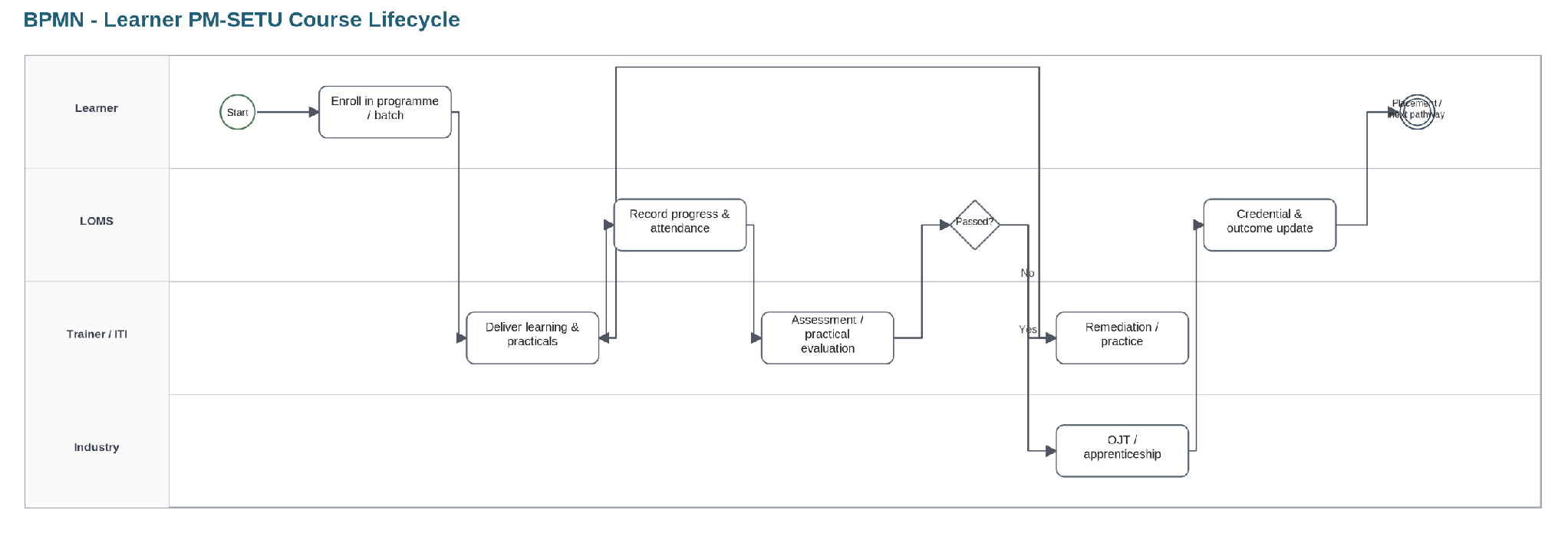
Process design - Learner course lifecycle.
7.1.6 OJT / apprenticeship / placement
Captures industry opportunity allocation, OJT/apprenticeship evidence, mentor/examiner outcomes where applicable, and validated placement records.
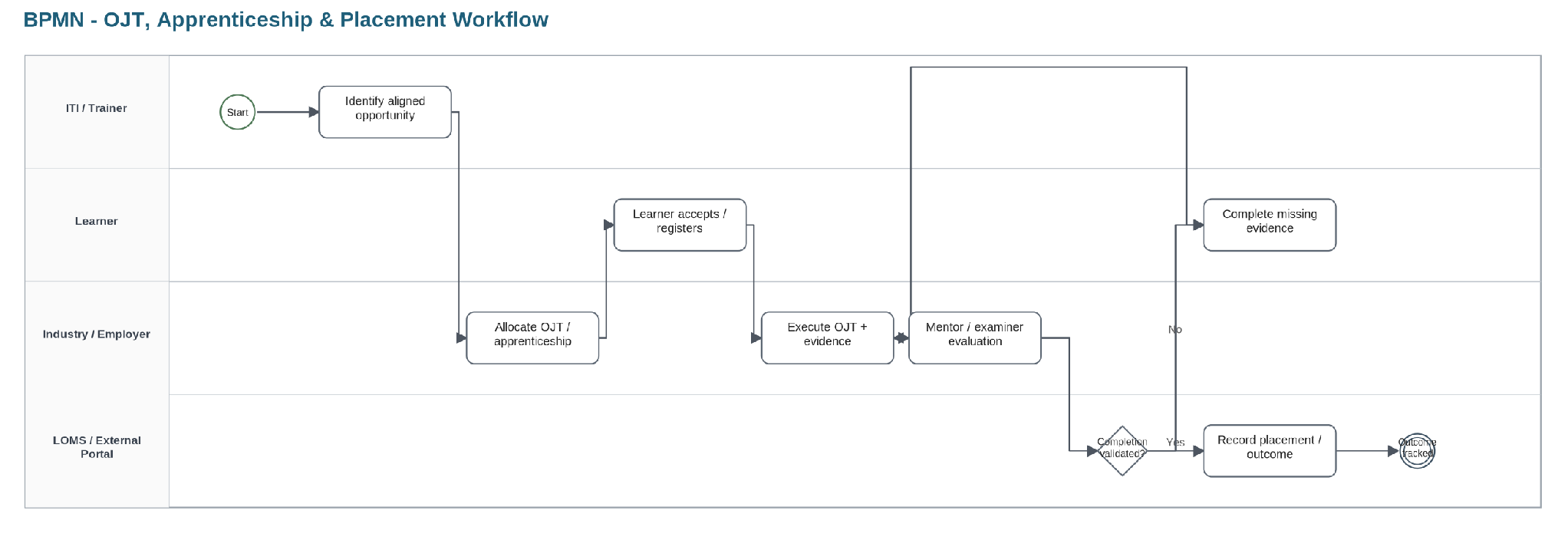
Process design - OJT / apprenticeship / placement.
7.1.7 KPI event pipeline
Transforms governed operational records into standardized, traceable KPI-ready events for the PM-SETU Analytics Portal without making Analytics the source system.
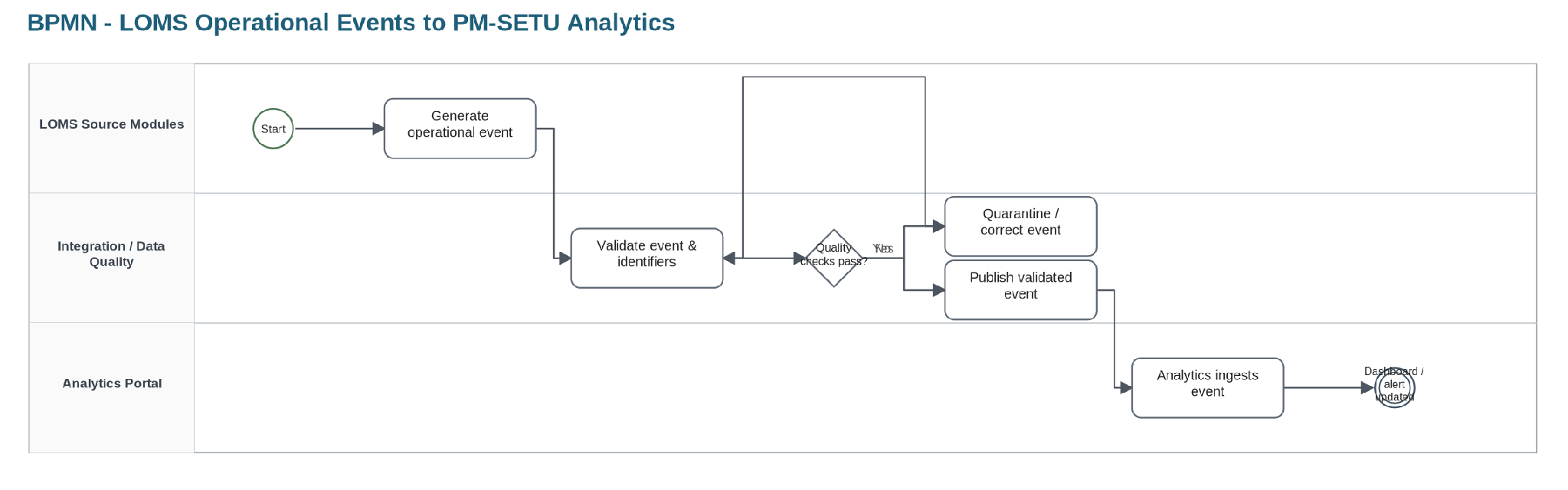
Process design - KPI event pipeline.
7.2.1 PM-SETU project-management task workflow
Adjacent Admin Management process: workplan/task creation, assignment, execution, overdue monitoring, review/rework and closure.
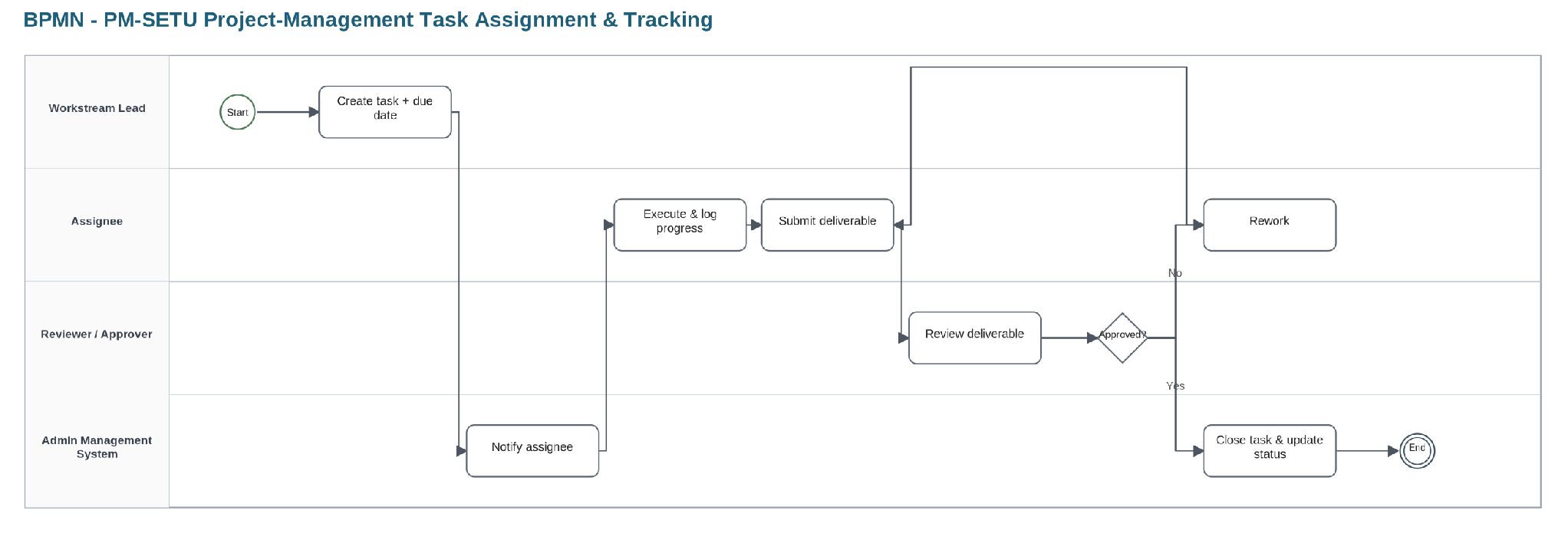
Integrated PM-SETU process interface - PM-SETU project-management task workflow.
7.2.2 Trainee grievance via SIDH - marks/profile
Adjacent Admin/SIDH process: document-backed grievance, ITI approval, Nodal Officer, RDST, State and Centre routing, followed by status synchronization.
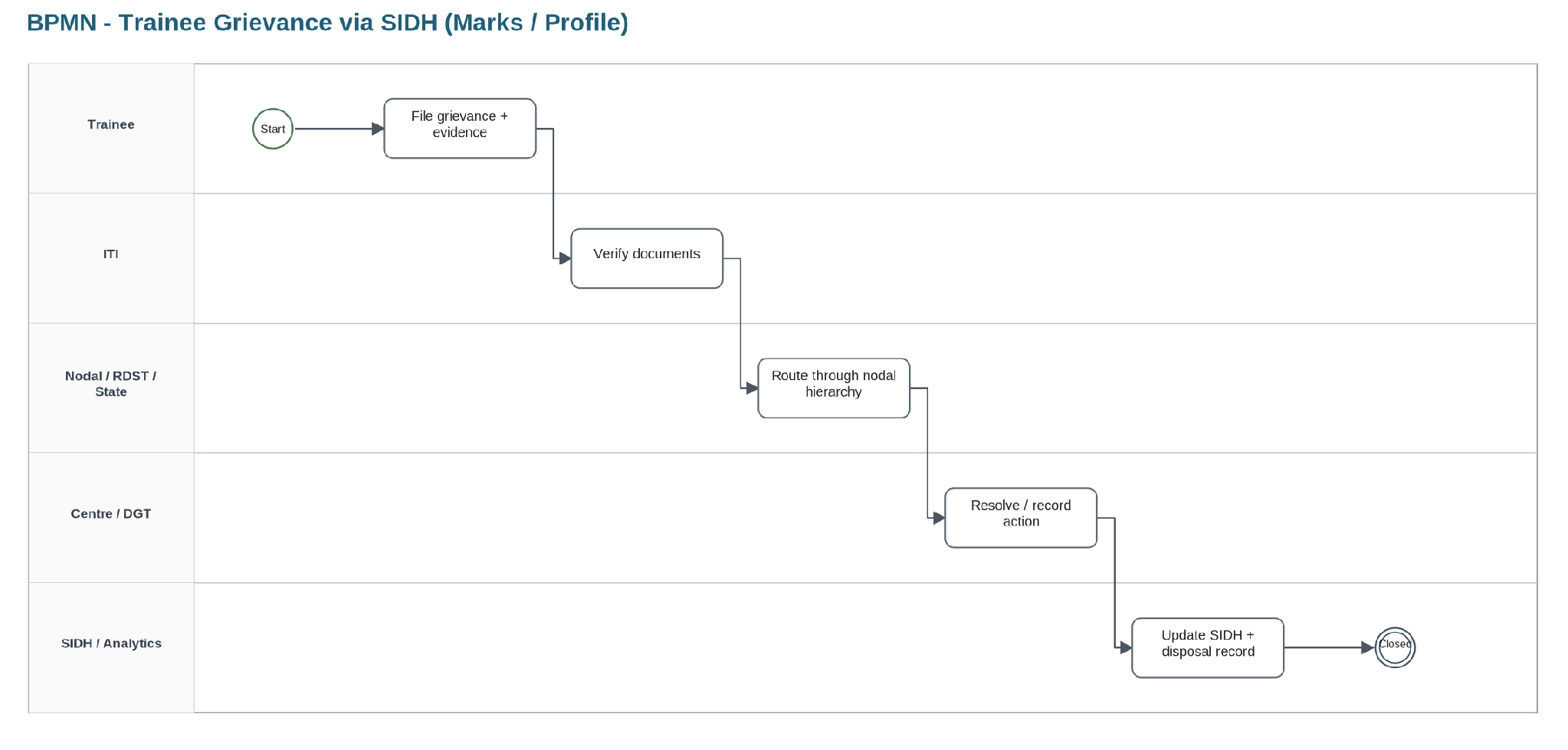
Integrated PM-SETU process interface - Trainee grievance via SIDH - marks/profile.
7.2.3 Trainee examination grievance via SIDH
Adjacent Admin/SIDH process: examination-window validation, relevant examination/Trade Test routing and legacy handling where applicable.
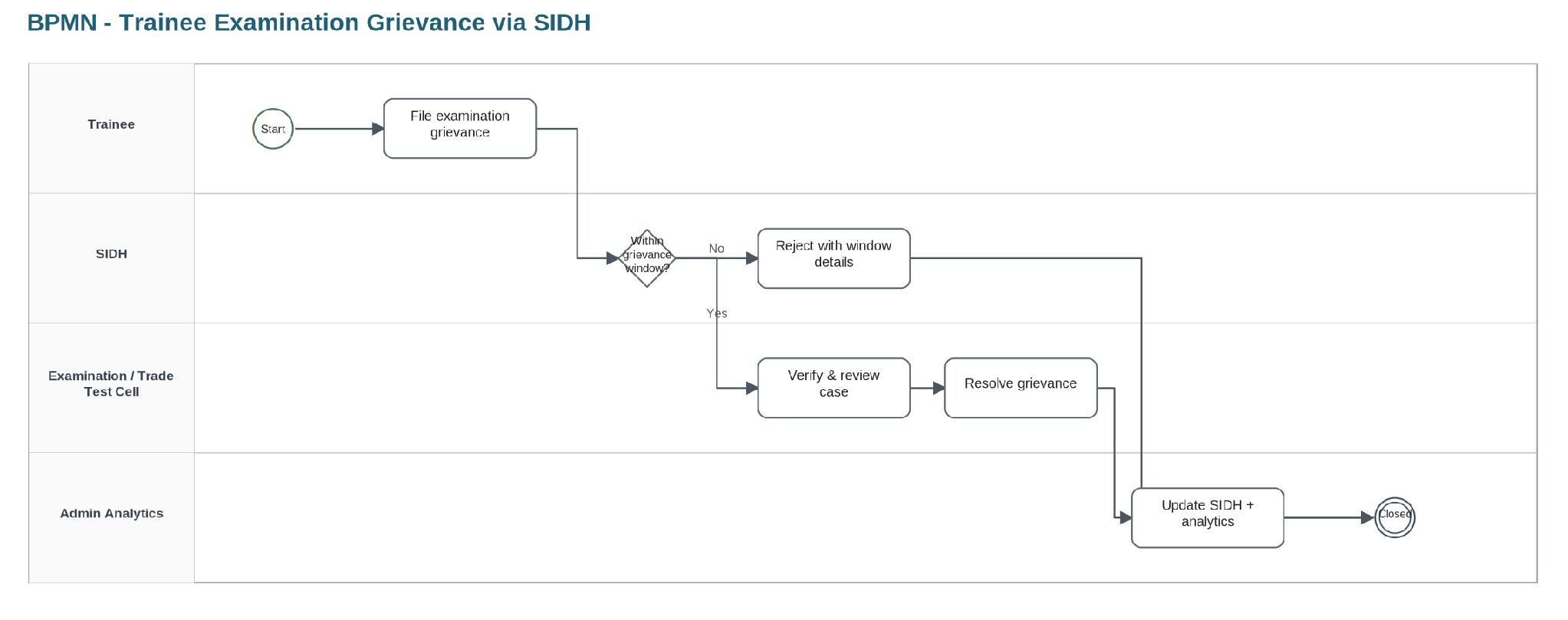
Integrated PM-SETU process interface - Trainee examination grievance via SIDH.
7.2.4 Trainer grievance via SIDH
Adjacent Admin/SIDH process: PM-SETU-tagged marks/certification or profile grievance, concerned-cell resolution and programme analytics synchronization.
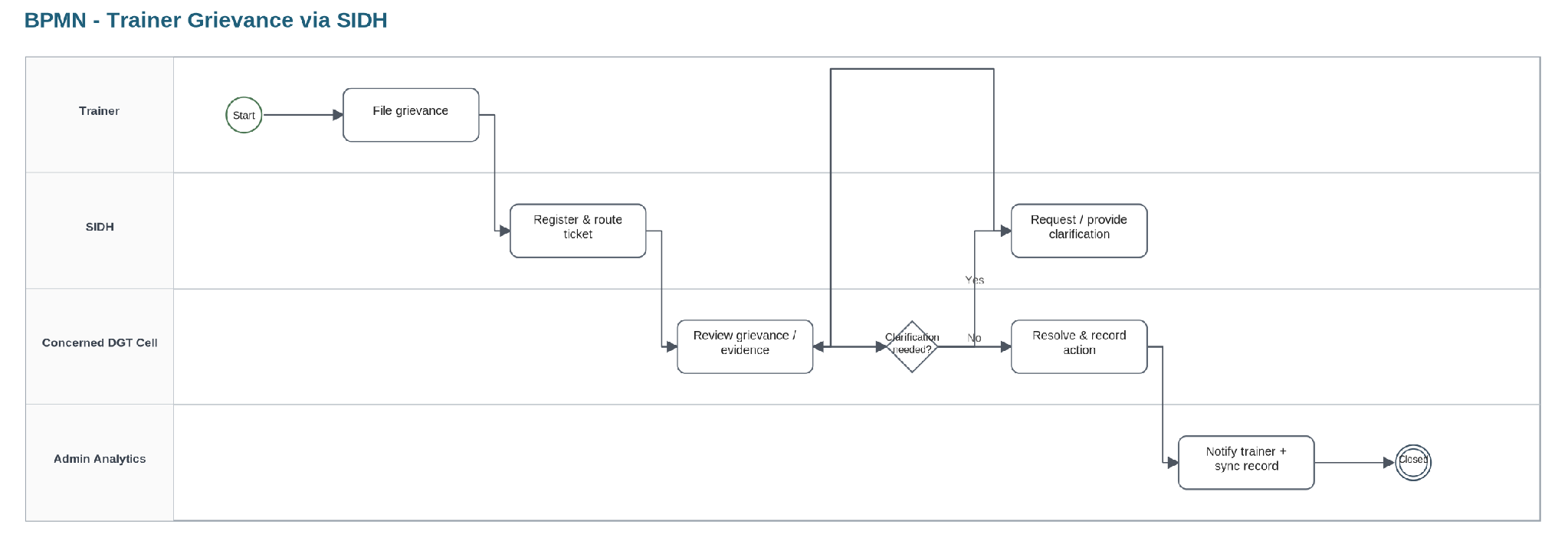
Integrated PM-SETU process interface - Trainer grievance via SIDH.
7.2.5 CPGRAMS grievance routing
Adjacent Admin/CPGRAMS process: DGT nodal routing to the concerned division or sub-portal and Action Taken Report based closure.
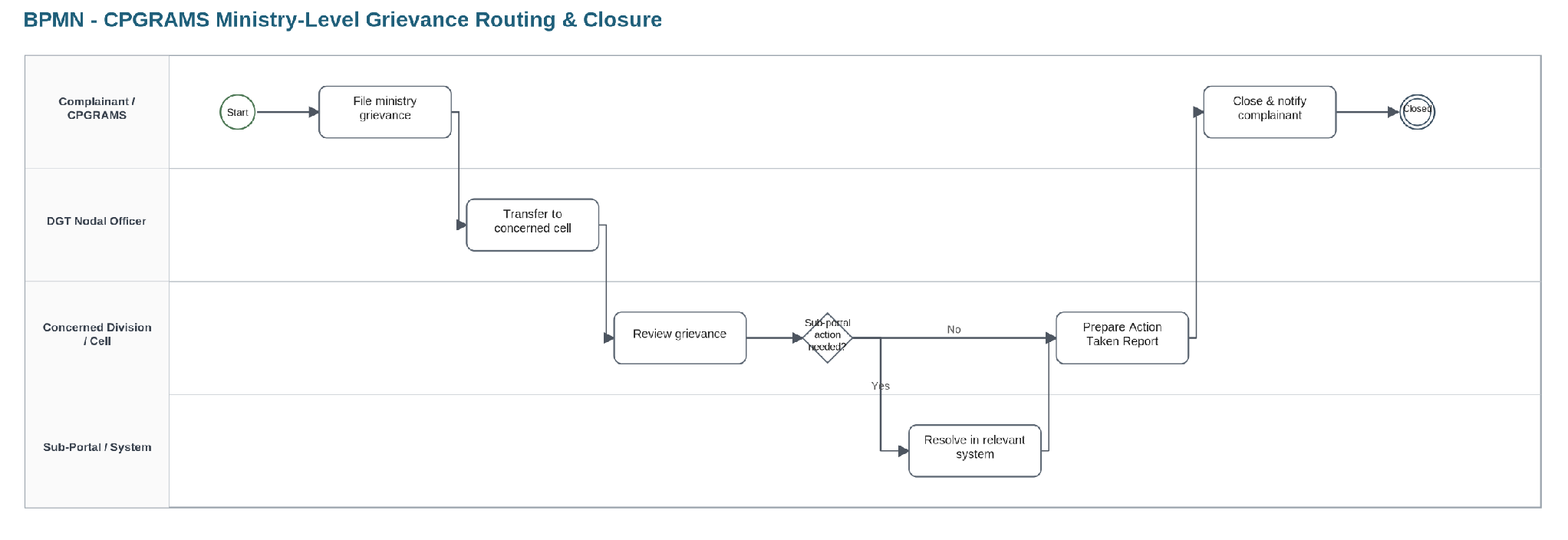
Integrated PM-SETU process interface - CPGRAMS grievance routing.
7.2.6 SPV/AIP grievance via PM-SETU portal
Adjacent Admin process: native fiduciary or IT/platform ticket, automated SLA/category routing, system-owner action, SPMU verification and closure/reopen.
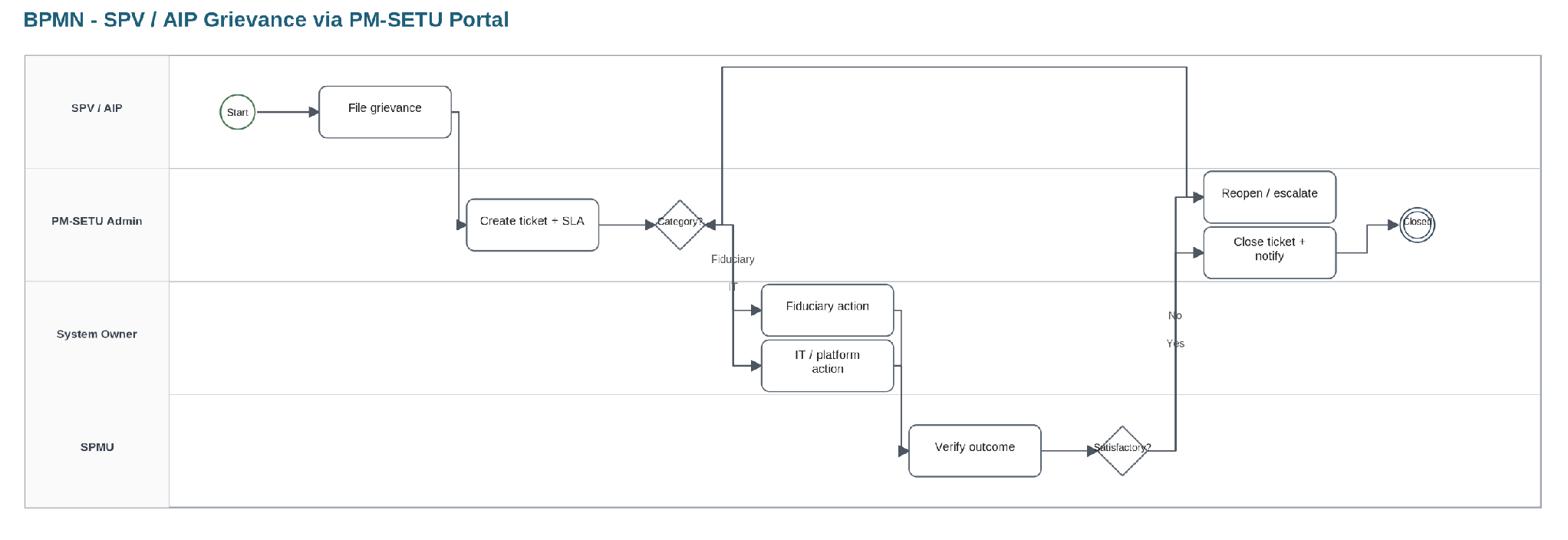
Integrated PM-SETU process interface - SPV/AIP grievance via PM-SETU portal.
7.2.7 SPV formation / SIP / AOP lifecycle
Adjacent FMS/governance process: SPV setup, SIP baseline and annual planning; approval is kept separate from tranche-release eligibility.
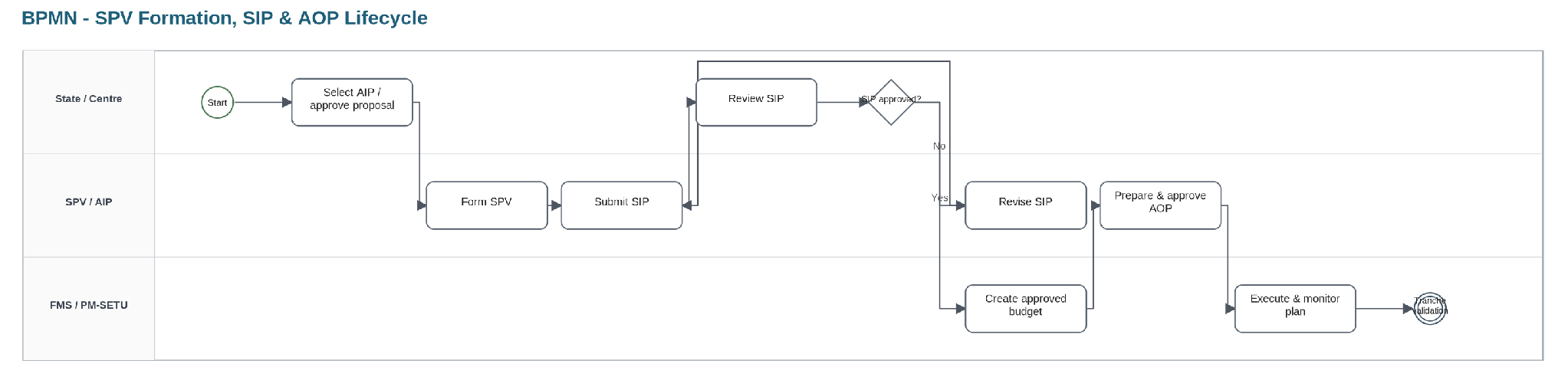
Integrated PM-SETU process interface - SPV formation / SIP / AOP lifecycle.
7.2.8 Fund flow / tranche release eligibility
Adjacent FMS process: contributions, utilization, IMA/KPI/audit controls and release eligibility; 75% utilization is a necessary trigger/condition, not automatic release.
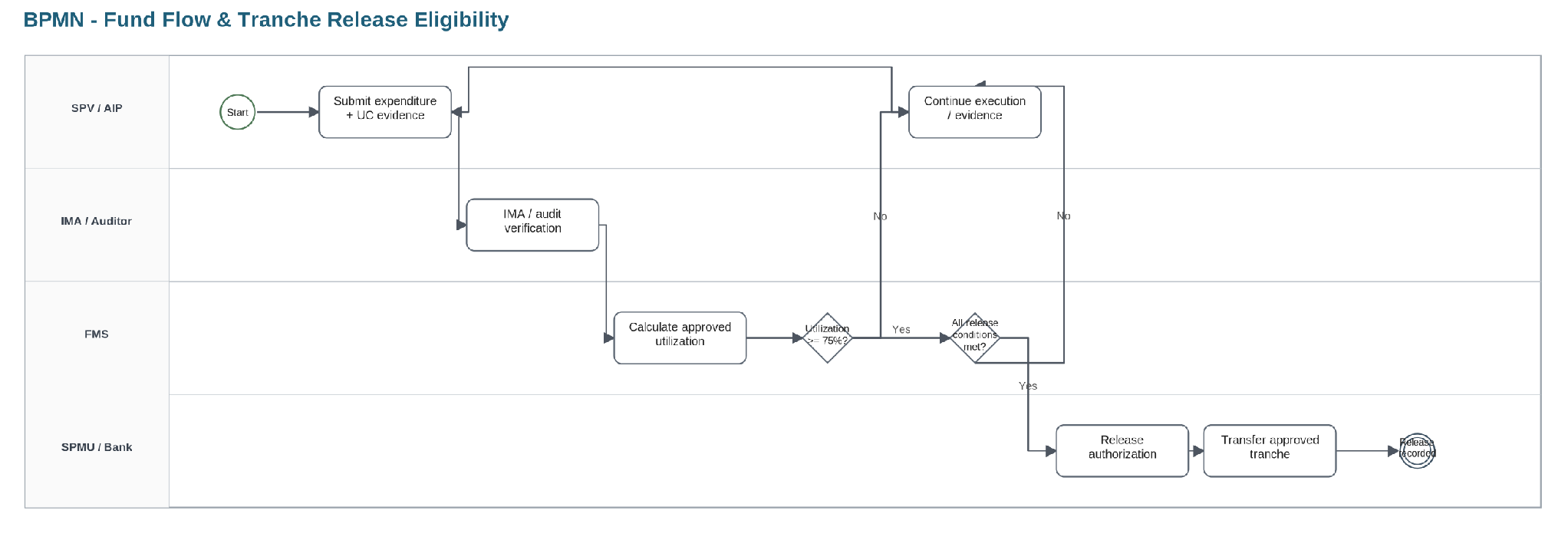
Integrated PM-SETU process interface - Fund flow / tranche release eligibility.
7.2.9 Audit / IMA verification supporting release
Adjacent FMS assurance process: internal/external audit evidence plus independently appointed IMA verification support the release decision.
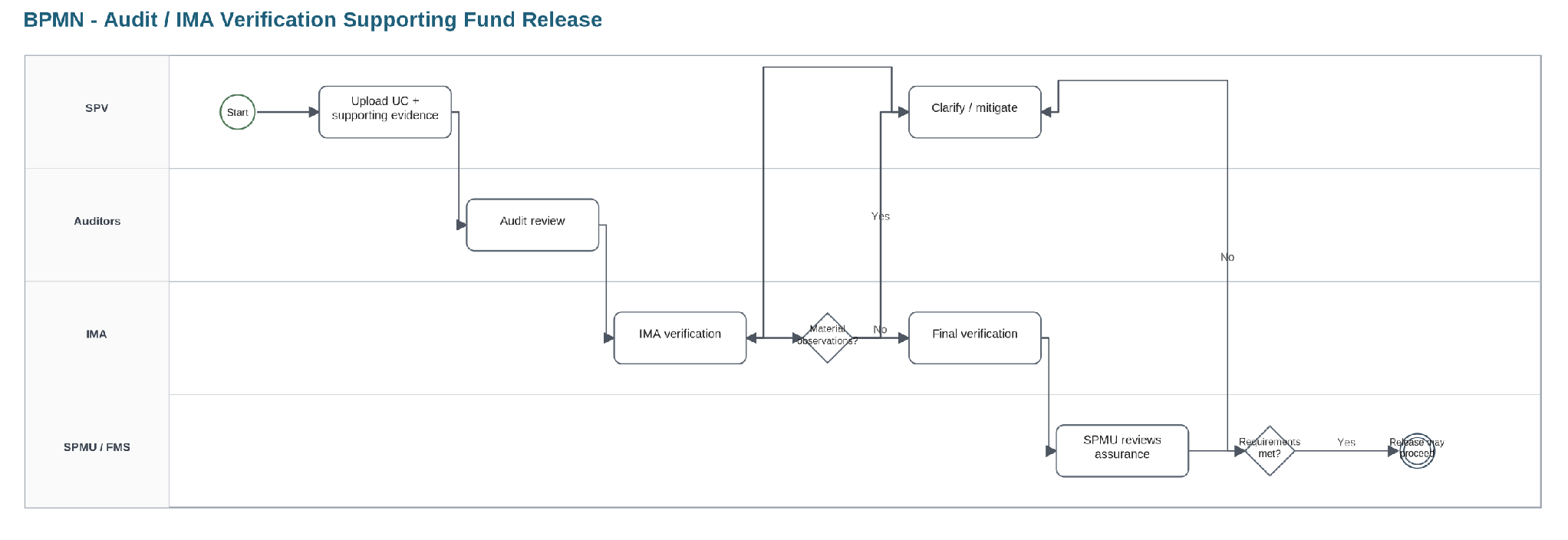
Integrated PM-SETU process interface - Audit / IMA verification supporting release.
7.2.10 Budget / AOP reallocation monitoring
Adjacent FMS process: compare actuals with approved AOP, maintain a continuing monitoring loop and route material deviations through the required approval path.
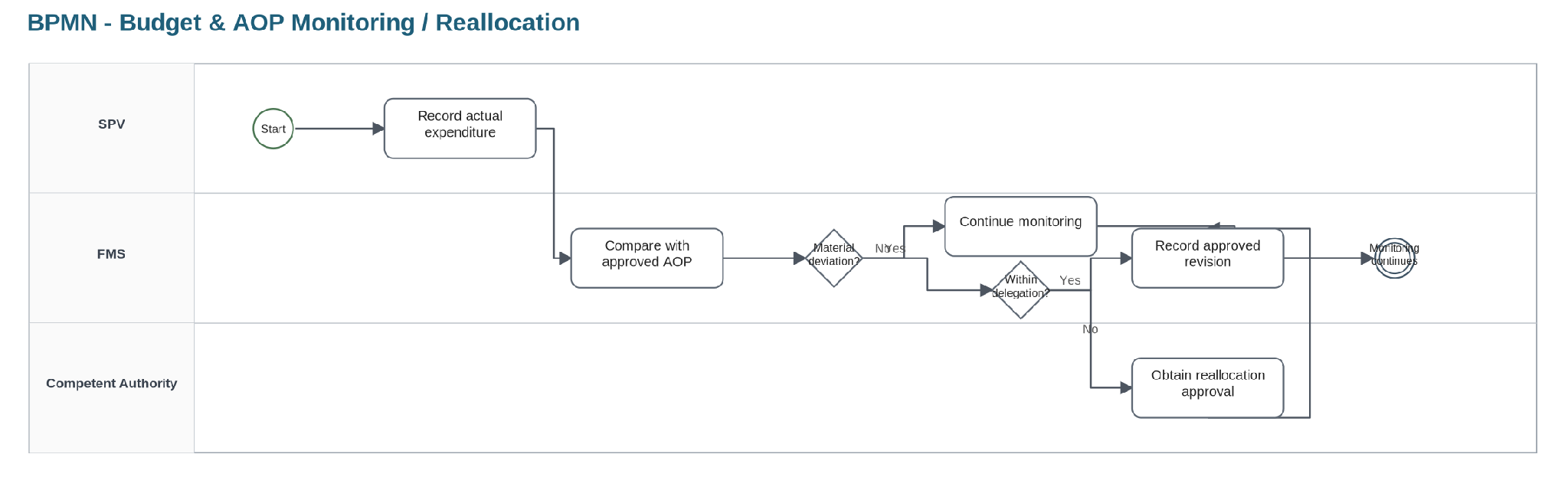
Integrated PM-SETU process interface - Budget / AOP reallocation monitoring.
7.2.11 Audit observation mitigation
Adjacent FMS process: classify observations, assign mitigation, monitor timelines, escalate material unresolved issues and record closure.
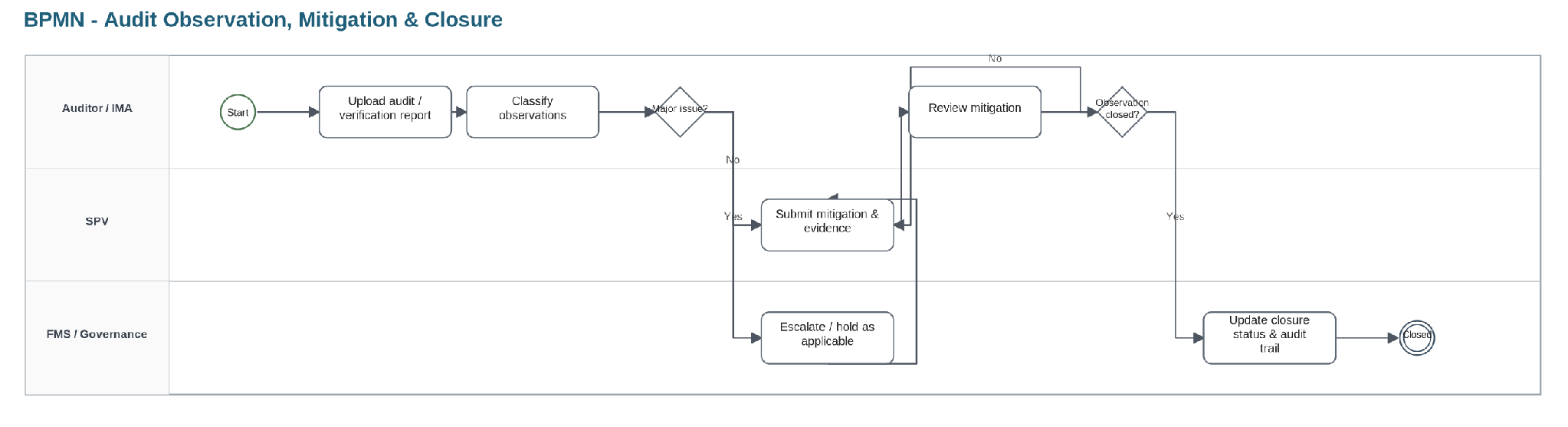
Integrated PM-SETU process interface - Audit observation mitigation.
7.2.12 Contract / MDB compliance
Adjacent FMS process: SPV contract registration, MDB debarment screening, policy-based warning/blocking and auditor-oriented compliance visibility.
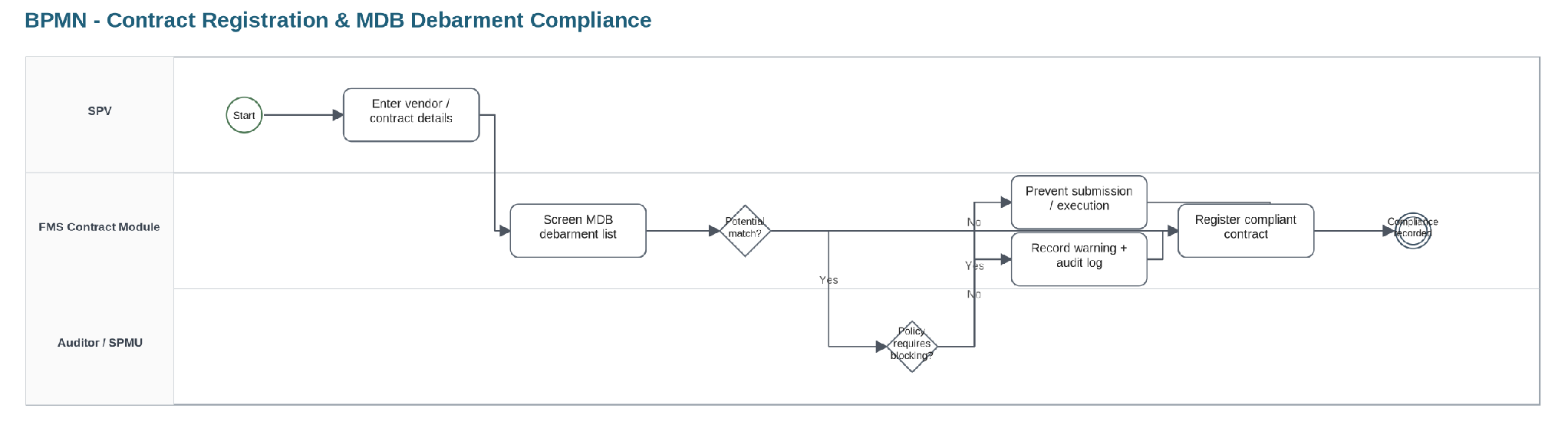
Integrated PM-SETU process interface - Contract / MDB compliance.
7.2.13 Analytics role/entity access
Adjacent Analytics process: authenticate, resolve role and entity, apply query-level scope and render only the permitted pillars; MDB access remains summary/review-oriented.
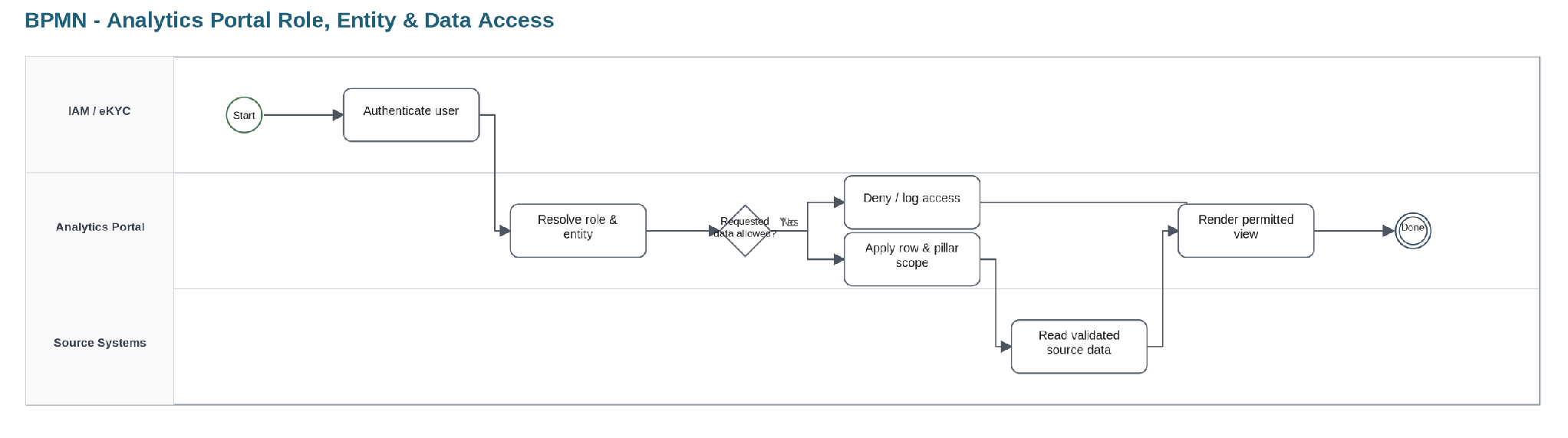
Integrated PM-SETU process interface - Analytics role/entity access.
7.3 Illustrative Screen Mockups
The following mockups illustrate information architecture and workflow intent only. Names, percentages, counts and records shown are illustrative and must not be interpreted as actual or projected PM-SETU programme results.
7.3.1 Learner PM-SETU home
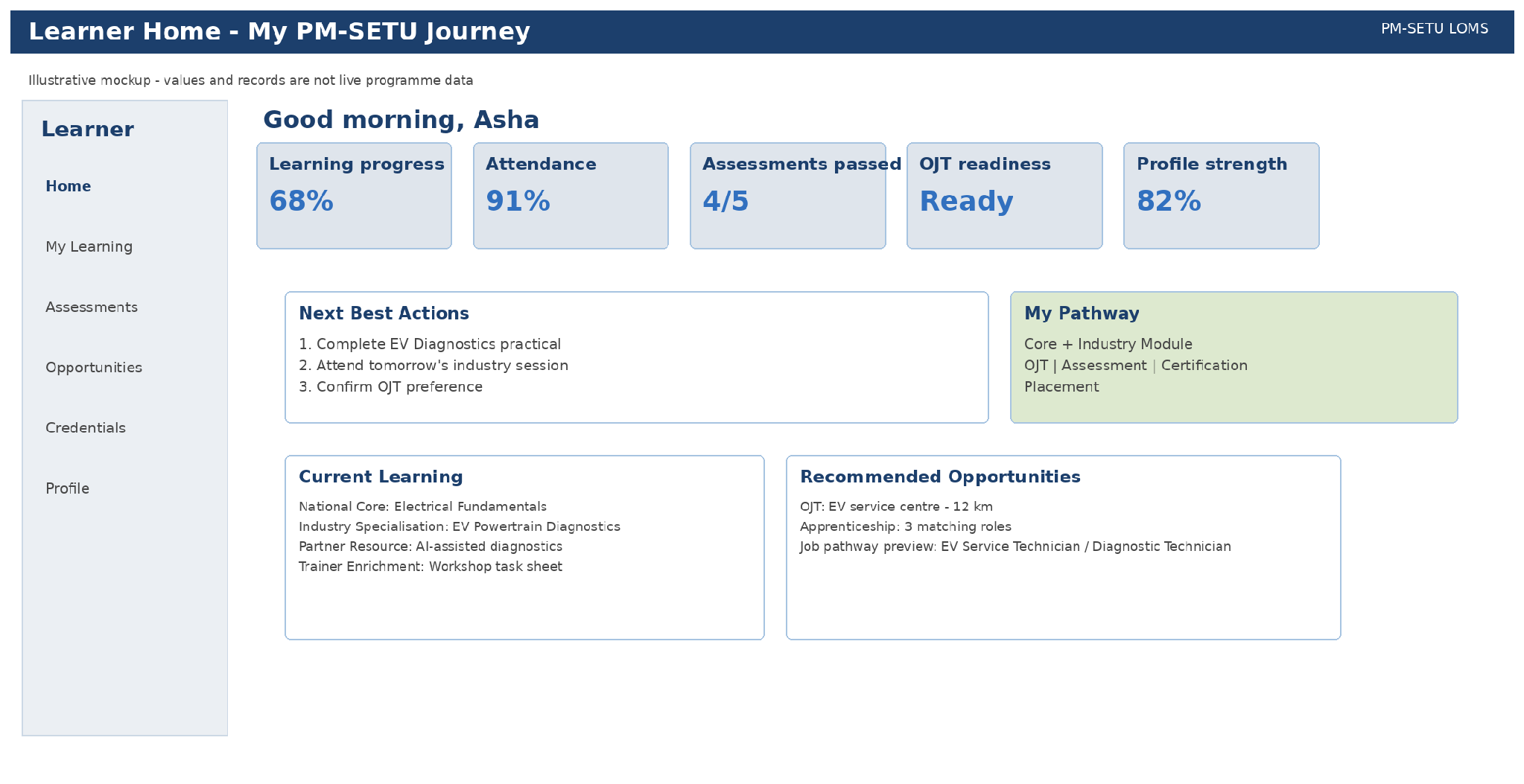
Illustrative mockup - Learner PM-SETU home.
7.3.2 Trainer teaching cockpit
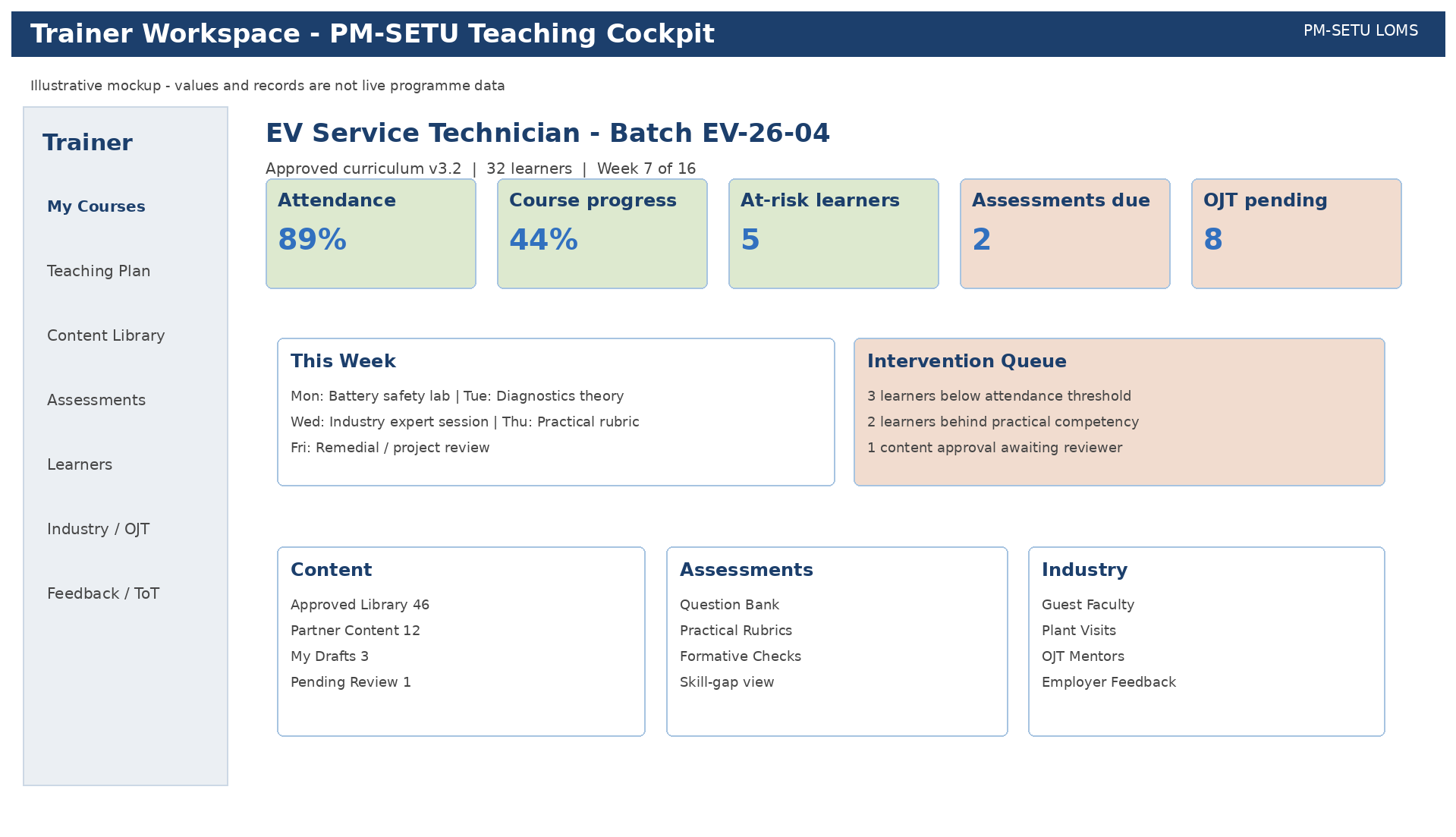
Illustrative mockup - Trainer teaching cockpit.
7.3.3 Industry Integration Console
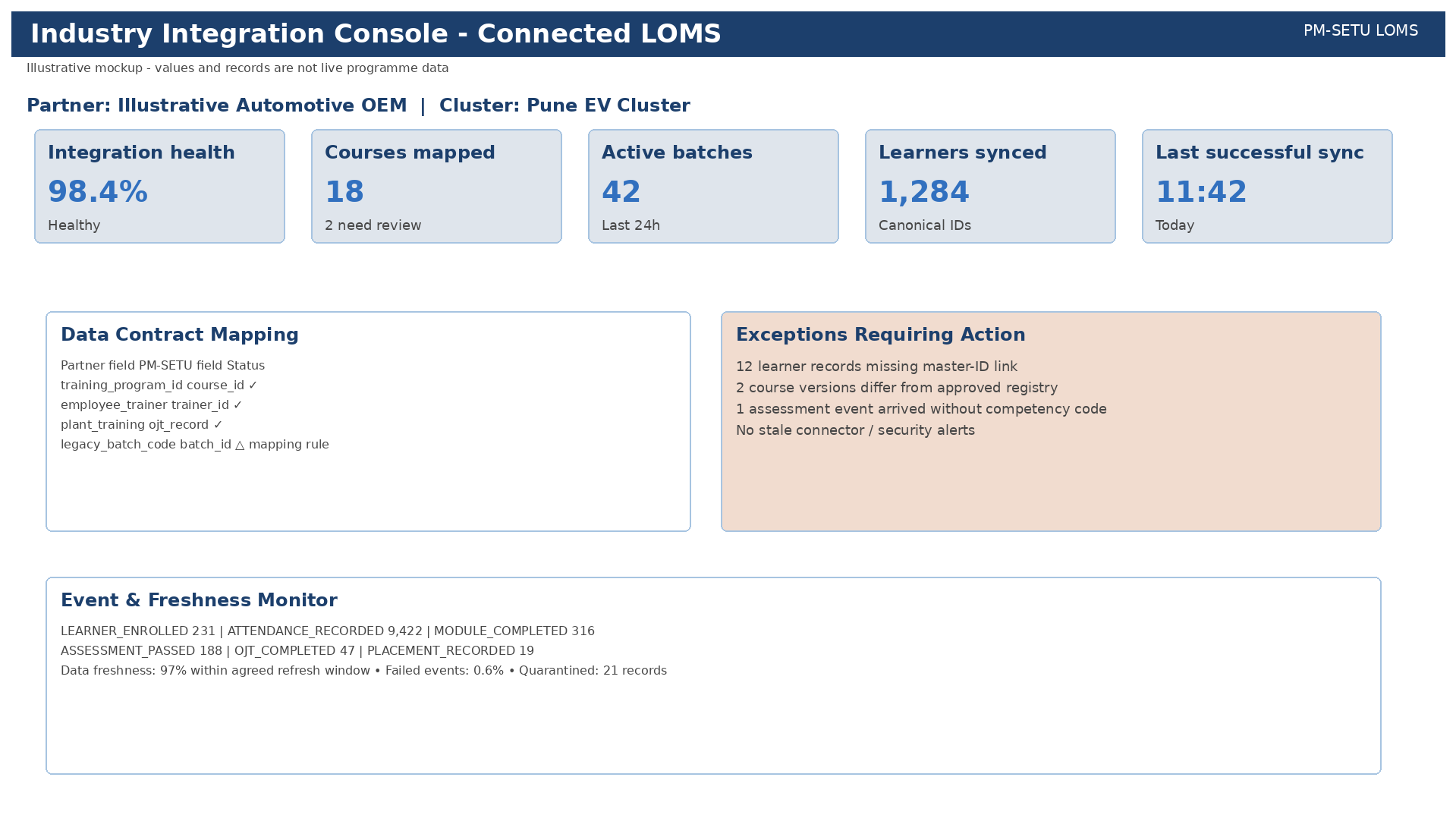
Illustrative mockup - Industry Integration Console.
7.3.4 Curriculum Composer
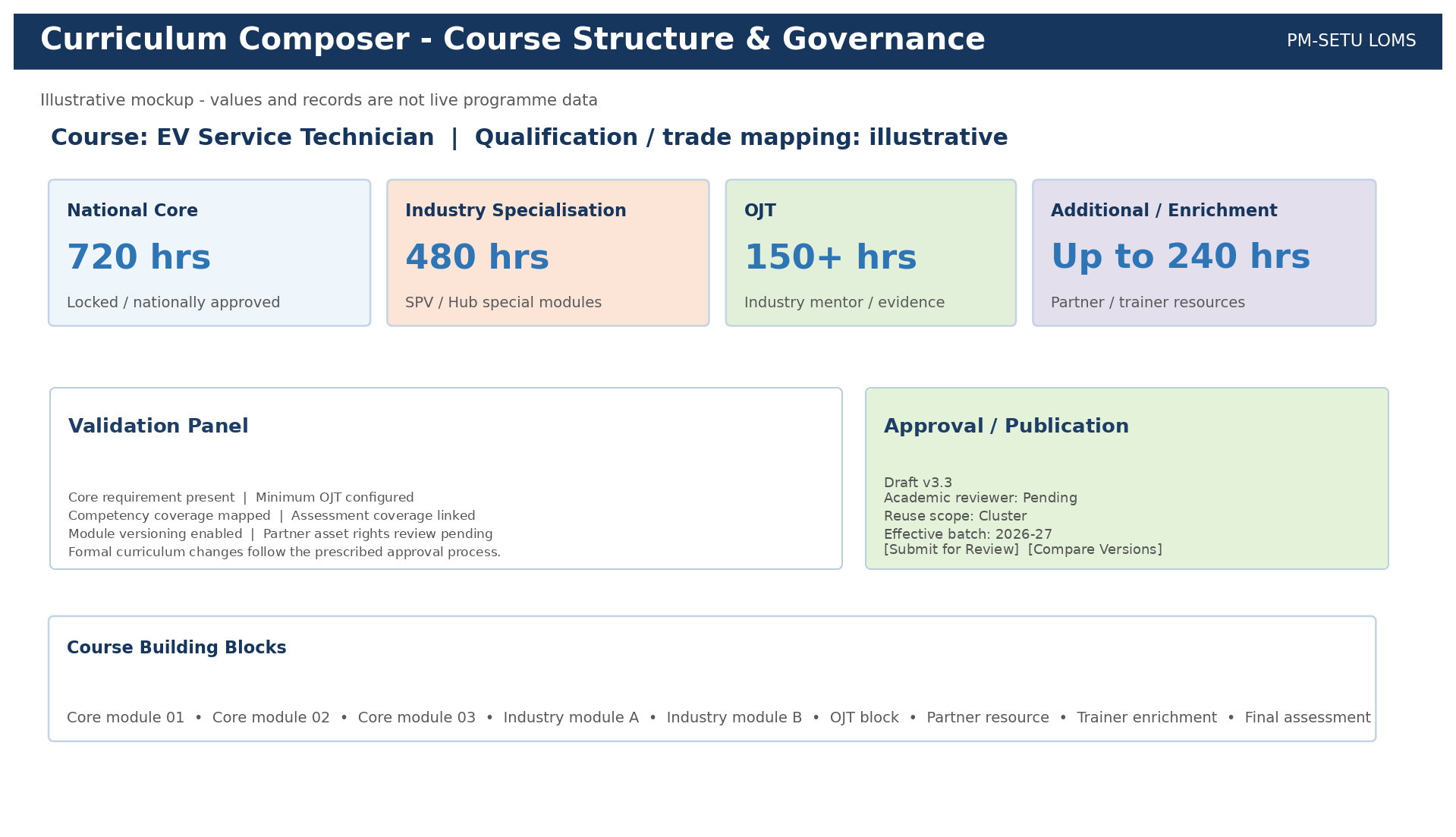
Illustrative mockup - Curriculum Composer.
7.3.5 Cluster KPI Command Centre
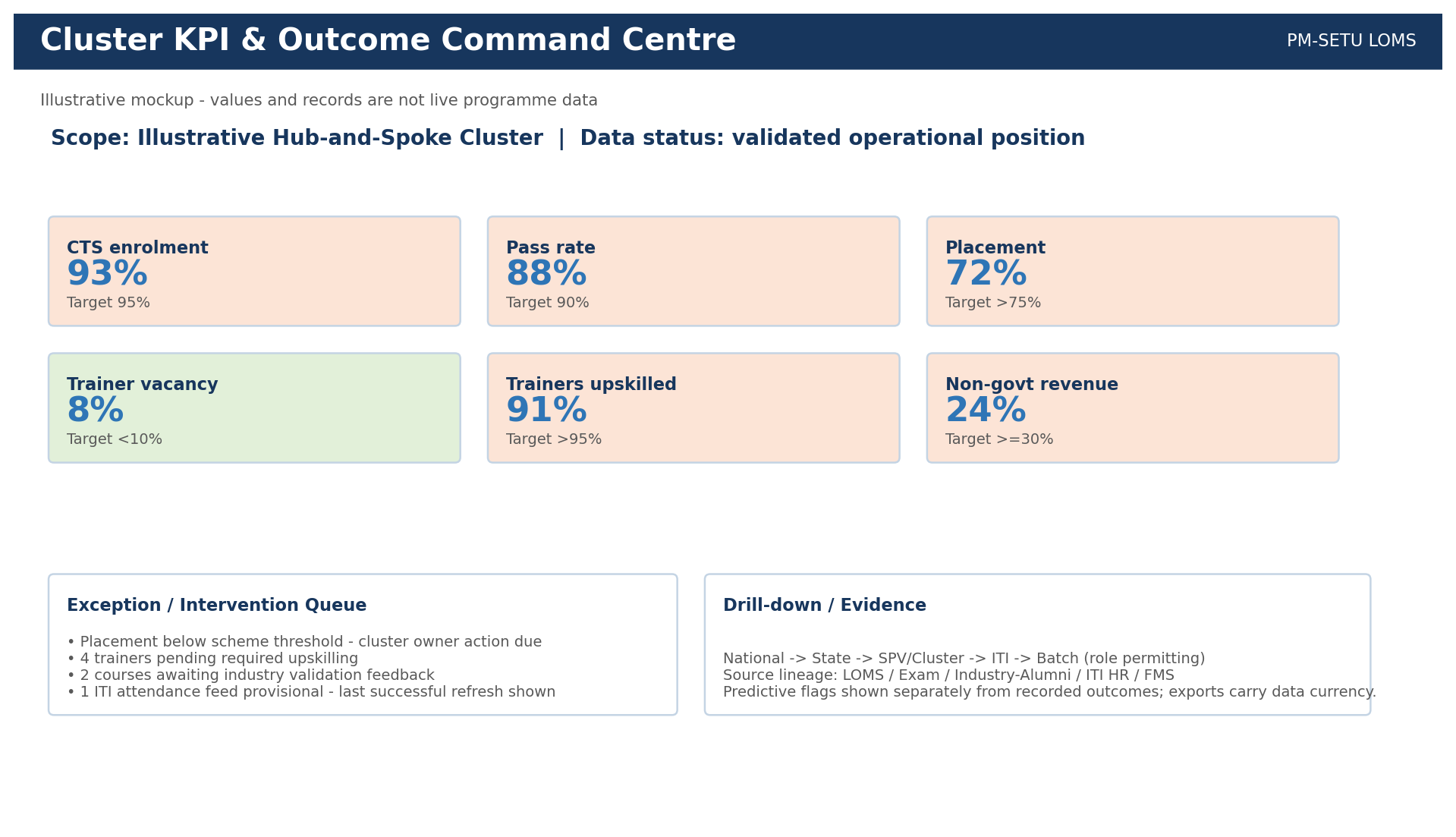
Illustrative mockup - Cluster KPI Command Centre.
7.3.6 Content Partner Submission
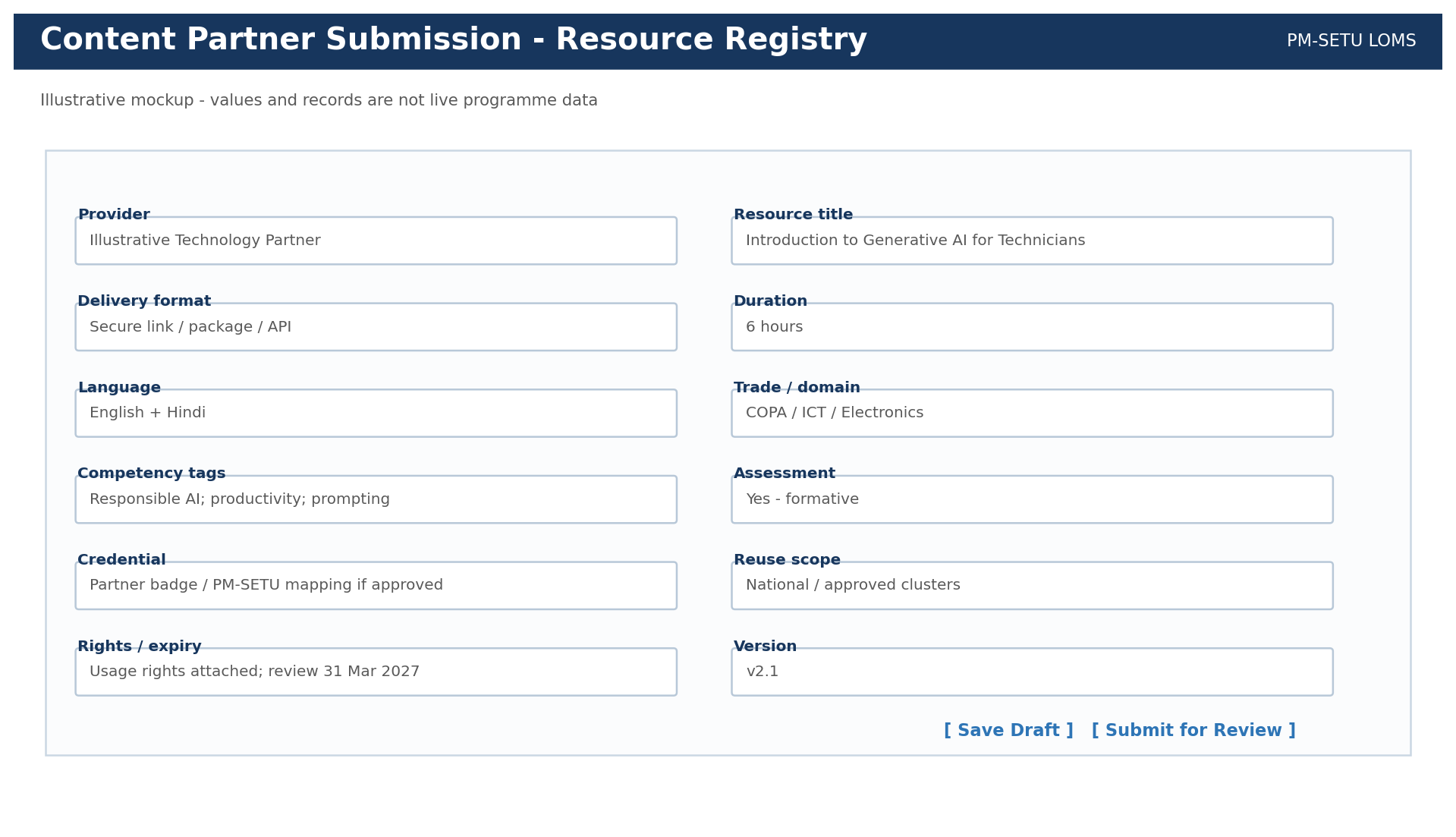
Illustrative mockup - Content Partner Submission.
8. KPI and Analytics Alignment
The LOMS design must make scheme KPIs computable from governed operational data rather than relying on manual dashboard entry. The formal Component I KPI framework is therefore translated below into source domains and minimum event/evidence requirements. Thresholds shown are sourced from the Component I Guidelines unless marked illustrative.
| KPI | Target / Threshold | Primary source | Required event / evidence |
| Industry-led SPV adoption | 100% of approved clusters | Admin / master data | CLUSTER_SPV_ACTIVE / governance master |
| CTS enrolment | 95% | LOMS / SIS | LEARNER_ENROLLED; sanctioned/available intake |
| Pass percentage | 90% | Exam Management / DGT result source | ASSESSMENT_RESULT / authoritative exam result |
| Short-term course output | 50% growth over baseline | Curriculum + LOMS | COURSE_ACTIVE; COMPLETION records; baseline |
| CTS placement rate | >75% | Industry / Alumni | PLACEMENT_RECORD ED; eligible graduate denominator |
| Average salary of placed trainees | 50% increment over baseline | Industry / Alumni | PLACEMENT_RECORD ED incl. validated wage + baseline |
| Women/PwD/SC/ST/rural /tribal enrolment | 50% increment over baseline | SIS / profile | Learner demographics + enrolment; privacy-controlled |
| Female trainee placement | >75% | Industry / Alumni + SIS | Placement + gender mapping |
| Courses upgraded | 10 per Hub; 8 per Spoke | Curriculum Registry | COURSE_VERSION_AP PROVED / upgrade classification |
| New CTS courses | 4 per Hub; 2 per Spoke | Curriculum Registry | COURSE_APPROVED / new CTS classification |
| New short-term courses | 10 per Hub-and-Spoke cluster | Curriculum Registry | COURSE_APPROVED / short-term classification |
| Trainer vacancy | Below 10% | ITI / trainer master | Sanctioned vs filled positions |
| Trainers upskilled | >95% | Trainer / ToT records | TRAINER_UPSKILLED / credential evidence |
| ITIs upgraded | 1,000 | PM-SETU Monitoring / master | ITI milestone status / readiness evidence |
| Trainers trained | 50,000 across ITIs and NSTIs | Trainer / ToT + programme reporting | TRAINER_TRAINING_C OMPLETED |
| Revenue from non-government sources | >=30% | FMS | FMS financial records - not calculated inside LOMS |
| Annual consolidated cluster reporting | 100% of onboarded clusters | Analytics / Admin | Report/evidence completion status |
8.1 Funding-Linked Data Conditions Relevant to LOMS
LOMS supplies operational/KPI evidence but does not authorize fiduciary releases. The FMS and competent authorities evaluate the applicable release conditions. For Component I, the Guidelines specify that Years 2-5 annual funding is split into two tranches: the first annual tranche is associated with at least 75% prior utilization, an approved current-year AOP and at least 80% achievement of previous-year KPI targets; the second annual
tranche includes at least 50% current-year KPI achievement at mid-year, full current-year Industry and State contributions, and required reporting/observation closure. These conditions must remain represented as data inputs/references to FMS, not simplified into “75% = release”.
9. Implementation Roadmap and Governance
| Phase | Focus |
| Phase 0 - Foundations | Canonical master IDs; role/entity model; curriculum governance; data-contract governance; source-system inventory; accessibility baseline. |
| Phase 1 - Core LOMS | Curriculum/course registry; batches/learning/progress; trainer/ITI workspace; content registry; assessment/practical records; SIDH integration; first KPI events. |
| Phase 2 - Federation & Industry | Industry Integration Console; connected-LOMS connectors; content partner ingestion; OJT/apprenticeship; employer/placement; reusable national content workflow. |
| Phase 3 - Scale & Intelligence | Cluster/State scale-out; data-quality automation; advanced interventions; personalized/adaptive features; deeper employer analytics; offline-first enhancements. |
| Phase 4 - Optimization | Predictive models subject to governance, benchmarking, continuous curriculum feedback, cross-scheme convergence and ecosystem expansion. |
Governance Forums
| Forum | Participants | Decisions |
| Curriculum & Academic Governance | DGT/CSTARI/NIMI/NCVET + SPV/Hub/industry as applicable | Course versions, formal changes, qualification mapping, national reuse. |
| Data Contract & Integration Governance | DGT/technology team + source-system owners | Schemas, identifiers, API versions, freshness, validation and change control. |
| Content Governance | Academic reviewers + content owners | Quality, rights, accessibility, language, version/expiry and reuse scope. |
| Data Quality / M&E | ITI/SPV data owners + programme monitoring | Completeness, reconciliation, source lineage, provisional status and KPI evidence. |
| Security & Privacy | Platform security/privacy authorities | RBAC, consent, access reviews, logs, VAPT, retention and incident response. |
10. Official Portals and Reference Links
The links below are included as operational/reference touchpoints. Availability and integration interfaces must be confirmed with each owning agency during detailed design. External standards are illustrative options only unless adopted through the approved technical architecture.
| Portal / Standard | Link | Relevance |
Scheme information, State/ITI information, RFP/resources and updates.
https://pm-setu.skillindiadigital.gov. in/
PM-SETU Official Portal
| Skill India Digital Hub (SIDH) | https://www.skillindiadigital.gov.in/ | Learner/training ecosystem and national digital skilling touchpoint. |
DGT policies, ITI/training/examination ecosystem.
DGT
https://dgt.gov.in/en
| DGT Skill India Digital | https://dgt.skillindiadigital.gov.in/ | DGT digital ecosystem entry point. |
Curriculum/research/training institution under DGT; relevant to course standardization workflows.
CSTARI Kolkata
https://www.cstaricalcutta.gov.in/
| NIMI | https://nimi.gov.in/ | Instructional media/content ecosystem and DGT-linked learning resources. |
Regulatory/qualification/NSQF and awarding/assessment ecosystem.
NCVET
https://ncvet.gov.in/
| Apprenticeship India | https://www.apprenticeshipindia.go v.in/ | Apprenticeship portal / NAPS ecosystem. |
Employment/job matching ecosystem.
National Career Service
https://www.ncs.gov.in/
| CPGRAMS | https://pgportal.gov.in/ | Ministry-level public grievance channel. |
Digital document/credential access and verification.
DigiLocker
https://www.digilocker.gov.in/
| Academic Bank of Credits | https://www.abc.gov.in/ | Academic credit ecosystem. |
Government language-technology ecosystem; potential multilingual integration option.
BHASHINI
https://bhashini.gov.in/
| 1EdTech LTI | https://www.1edtech.org/standards /lti | Illustrative learning-tool interoperability standard; not a PM-SETU mandate. |
Illustrative reusable e-learning content standard/resource family; not a PM-SETU mandate.
ADL SCORM Resources
https://adlnet.gov/
11. Repository Structure and Reference Basis
The DPR repository follows the working convention used for the PM-SETU digital DPR artefacts: a single report at repository root and three asset folders for User Journeys, BPMN Diagrams and Mockups. The document embeds the normalized illustrations while the folders retain reusable image/source artefacts for future iteration.
| Repository item | Purpose |
| LOMS_Platform_DPR_Final.docx / .pdf | Master DPR deliverables. |
| 01_User_Journeys | Compiled and stakeholder-specific user journey diagrams. |
| 02_BPMN_Diagrams | Normalized/corrected process-design PNGs plus supplied source BPMN files retained for traceability. |
| 03_Mockups | Illustrative LOMS screen mockups used in the DPR. |
Reference Basis
- ●PM-SETU Guidelines - Component I - ITIs (September 2025).
- ●PM-SETU Guidelines - Component II - NSTIs (September 2025).
- ●Model RFP for selection of Anchor Industry Partner.
- ●Model Strategic Investment Plan for Industries (illustrative).
- ●PM-SETU Brochure / presentation and FAQs.
- ●Detailed Project Report for Fiduciary Management System (July 2026).
- ●Detailed Project Report for Analytics Portal (August 2026).
- ●Detailed Project Report for Admin Management System (August 2026).
- ●User-provided SIDH authenticated Learner/Participant and Training Provider walkthrough.
- ●User-provided LOMS Module & Feature Master List screenshots (approximately 150 features / 16 parent modules).
- ●User-provided BPMN working files for FMS, audit, project-management and grievance processes.
- ●Approved product-direction inputs from the project working session: federated LOMS, content-partner pathway, Curriculum Composer, trainer workspace, KPI event pipeline and cluster-to-national integration model.
Source hierarchy For policy and programme rules, formal PM-SETU Guidelines prevail over illustrative model documents. Illustrative SIP/RFP figures, mockup values and example company names are not treated as actual programme results. Where final APIs, workflow authorities or technical standards remain unconfirmed, this DPR labels them as assumptions or implementation options.
Appendix A - LOMS Functional Module Inventory
| # | Parent Module | Summary / DPR Disposition |
| 1 | LMS / Learning Management | Course, content delivery, assessments, personalization, progress, credentials, digital identity, lifecycle. |
| 2 | Digital TLM Development | Authoring, review, assessments, multimedia/language, accessibility, resource library. |
| 3 | ITI Management | Trainer HR/utilization/ToT, infrastructure readiness, partnerships, admission/SIS/fees/attendance/tim etable/hostel. |
| 4 | Exam Management | Scheduling, question bank, proctoring, grading, results, review/security, reports, DGT workflow, marksheet/verification. |
| 5 | Industry / Alumni | Curriculum co-design, guest faculty/hiring, partner integration, internships/placements, NAPS, events, alumni. |
| # | Parent Module | Summary / DPR Disposition |
| 6 | Financial Management | Budget/accounting/fund-social safeguard/DBT/scholarship/payme nt - primarily aligned to FMS/adjacent financial systems. |
| 7 | PM-SETU Monitoring | Planning, audit tracking, proposals, project/resource/risk/budget/KPI/e mployment/MDO - shared with Admin/Analytics. |
| 8 | Analytics & Dashboard | Performance, operational/financial/exam/predicti ve analytics, dashboards, surveys, GIS - primarily Analytics Portal. |
| 9 | Administrator Management | Project/admin, audit, industry partnerships, placement, staff/performance/repository/grieva nce - primarily Admin/common. |
| 10 | Infrastructure & Assets | Civil works, vendors, equipment, assets, maintenance, safety, utilities, facilities. |
| 11 | IT Infra / Security / DR | Hosting, scaling, backup/DR, privacy/encryption, cybersecurity, SIDH/NCS/open APIs. |
| 12 | User Access & Identity | RBAC, access levels, SSO, government ID/eKYC, session/security policy. |
| 13 | Compliance & Accreditation | NCVET status, NSQF/QP-NOS mapping, renewal alerts, compliance checklists. |
| 14 | SPV / Concession Contract | License milestones, penalties, repository, renewal/termination, Board reporting - primarily FMS/contract domain. |
| 15 | Communication / Mobile | Alerts, WhatsApp/multichannel, rule triggers, regional language, mobile/offline-first. |
| 16 | Support / Convergence | Helpdesk, counselling/career mapping, cross-scheme and State Skill Mission convergence. |
Appendix B - Illustrative KPI Event Dictionary
| Event | Trigger | Minimum illustrative payload |
| LEARNER_ENROLLED | Learner joins an approved course/batch | learner_id, course_id, batch_id, ITI/cluster, timestamp, programme |
| ATTENDANCE_RECORDED | Attendance is validated for a session/day | learner_id, session_id, status, source, timestamp |
| MODULE_COMPLETED | Approved curriculum module completed | learner_id, module_version_id, completion date, evidence/source |
| Event | Trigger | Minimum illustrative payload |
| ASSESSMENT_PASSED | Assessment outcome validated | learner_id, assessment_id, competency, score/status, authority/source |
| CERTIFICATE_ISSUED | Credential/award is issued or mapped | learner_id, credential_id, qualification/NSQF mapping, issuer |
| OJT_STARTED / OJT_COMPLETED | On-the-job training lifecycle | learner_id, employer, start/end, hours, mentor/evaluator, evidence |
| APPRENTICESHIP_STARTED | Apprenticeship registered | learner_id, employer, role, NAPS/partner reference |
| PLACEMENT_RECORDED | Employment outcome validated | learner_id, employer, role, date, salary band/value subject to policy, evidence |
| TRAINER_UPSKILLED | Trainer completes approved ToT/upskilling | trainer_id, programme, credential, completion date |
| COURSE_VERSION_APPROVED | New/upgraded course version becomes effective | course_id, version, approval category, scope, effective date |